Bright Data Review 2026
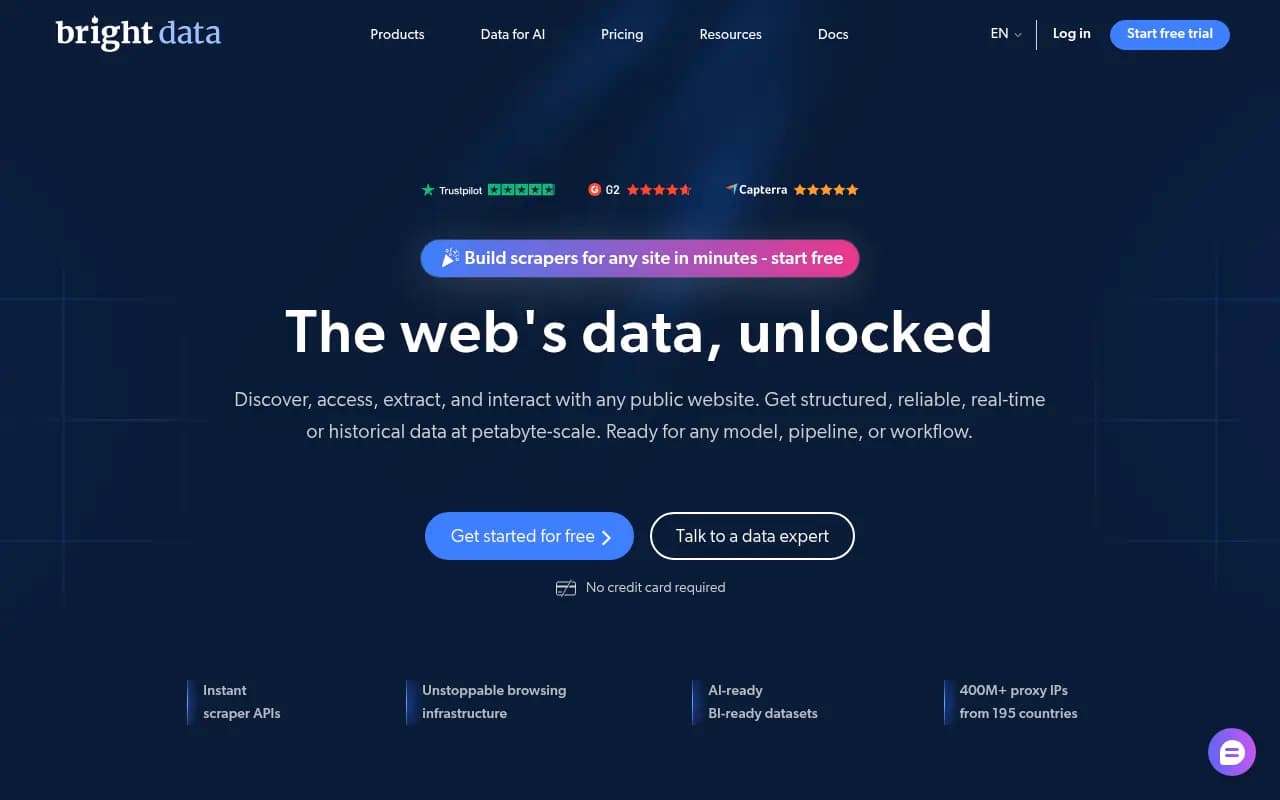
Bright Data is web data infrastructure for developers, data teams and AI builders. It combines a 400M+ IP proxy network, Web Unlocker, SERP and Scraper APIs, a Scraping Browser and ready-made datasets, with a free scraper tier to start.
Key takeaways
- Bright Data is one of the broadest web data platforms available: proxies, unblocking, scraper APIs, remote browsers, a Crawl API and pre-collected datasets all sit under one account.
- Its residential network (400M+ IPs across 195 countries) and compliance process (KYC, opt-in peers) are the main reasons enterprises pick it over cheaper rivals.
- It is premium priced. Minimum commitments on some products and manual onboarding for residential access can rule out hobbyists and small side projects.
- Third-party testing is mixed: strong global success rates, but slower latency than many competitors, and some hard targets such as Instagram lag behind.
- Best for data teams, AI startups and enterprises that need reliable, compliant collection at volume. Poor fit for casual one-off scraping on a tight budget.
Bright Data started life as Luminati, a proxy network, and has since turned into a full web data stack. The homepage now pitches it as "web data infrastructure for humans and agents," and claims 50,000+ customers. The logo wall includes Deloitte, Moody's, Pfizer, Nokia, McDonald's and the United Nations. Whether every one of those is a heavy user is unknowable from outside, but the enterprise footprint is real.
The pitch is simple. You need data from public websites. Sites block you, change their layouts and localize their content. Bright Data sells every layer of the solution: the IPs you route through, the unblocking logic, the browsers, the parsers that return structured JSON, and finally the pre-scraped datasets if you would rather skip scraping entirely. You pick the level of DIY that suits your team.
The audience has shifted in the last two years. Pricing-page testimonials are all from July 2026 and come mostly from AI startup founders, which tells you where the company is aiming: agents and models that need live web access. Traditional use cases like price monitoring, SERP tracking, ad verification and brand protection are still front and center.
Key features
Proxy infrastructure. This is the foundation. The residential network claims 400M+ IPs from real user devices, with country, state, city and zip code targeting, and carrier and ASN targeting on top. Datacenter proxies cover high-speed bulk jobs. ISP proxies (1,300,000+ IPs advertised) give you residential-grade identity with datacenter stability. Bright Data claims 99.99% uptime and a 99.95% success rate, though note the SLA language is softer than the marketing (more on that below). SOCKS5 is supported next to HTTP and HTTPS, and there is an integrated Proxy Manager plus management APIs.
Web Unlocker (Unlocker API). You send a request, and Bright Data handles CAPTCHAs, fingerprinting, retries and header rotation. You pay for successful requests only. In practice this is the product most teams reach for first, because it removes the proxy-tuning work that eats engineering weeks.
SERP API. Multi-engine search results on demand, parsed into structured output. It supports the SERP tracking use case directly, which is why SEO tooling vendors and rank-tracking products often build on it. You choose location and device, and results come back as JSON or raw HTML.
Browser API (Scraping Browser). Remote browsers compatible with Puppeteer, Playwright and Selenium, with stealth and unblocking built in. This is the answer for JavaScript-heavy sites and logged-in flows. You keep your own automation code and swap the browser endpoint. It scales to very large session counts, and one customer story describes growth from hundreds to hundreds of thousands of concurrent sessions.
Web Scraper APIs and Scraper Studio. Pre-built endpoints for popular domains return structured fields. The library includes entries like LinkedIn people profiles (675.9M records listed) and TikTok Shop products with prices and discounts. Billing is per successfully delivered record, with no charge for failed deliveries. AI Scraper Studio goes the other direction: describe a target site and it builds a scraper and data pipeline for you. Compare that with Apify, where you pick actors from a marketplace and often tweak code. Bright Data's parsers are closed-source, so when a site changes you wait on Bright Data to fix it rather than patching it yourself.
Crawl API and Web Archive. The Crawl API turns whole websites into AI-friendly output (clean markdown and structured data), which suits RAG pipelines. The Web Archive is a petabyte-scale historical collection, useful for model training and back-testing.
Dataset Marketplace and Data Feeds. If you do not want to scrape at all, you can buy structured, pre-collected data: 5B+ records across 800+ domains, refreshed regularly, with automated quality validation and delivery by API, webhook or cloud storage. This is a different business model from most proxy vendors, and it lets Bright Data serve analysts who never touch a proxy.
MCP server and AI agent tooling. Bright Data ships an MCP server so agents in Claude, LangGraph or Google ADK can search and scrape with unblocking handled for them. There is also a plugin for Claude Code on GitHub. Plenty of tutorial content exists, which helps if your team is new to MCP.
Compliance and trust. Peers in the residential network opt in personally. Customers go through a Know Your Customer process, and there is an Acceptable Use Policy and a compliance team. The company cites GDPR, CCPA and SEC adherence. For regulated buyers in finance, pharma or government, this paperwork is often the deciding factor.
Who is it for
The core buyer is a data or engineering team that treats web data as production infrastructure. Think of an e-commerce analytics company monitoring prices across 200 retailers, a fintech feeding alternative data into trading models, or an AI startup whose agents need real-time browsing at high concurrency. Teams with a dedicated data engineer or two get the most out of the full stack, because they can mix Unlocker, Browser API and datasets according to the target.
It also suits larger organizations with compliance requirements. Ad verification firms, brand protection teams and travel aggregators have used proxy networks for years, and Bright Data's KYC process makes procurement and legal reviews easier. SEO software vendors building on SERP data are another natural fit.
Who should skip it? Hobbyists and students scraping a few hundred pages. Residential access reportedly requires a registered company and a manual KYC check, and some products carry minimum monthly spend, so the friction is real. Freelancers on a tight budget will find cheaper proxy resellers. And if you need to patch parsers yourself the moment a site changes, the closed-source scraper APIs will frustrate you.
Integrations and ecosystem
Compatibility is wide. Proxies work with any HTTP client, scraping framework or tool that accepts a proxy endpoint, and the Browser API works with Puppeteer, Playwright and Selenium. On the AI side, the MCP server connects to Claude, LangGraph and Google ADK workflows, and the Claude Code plugin lives at github.com/brightdata/skills. Documentation sits at docs.brightdata.com and covers each scraper endpoint, including social platforms like X.
Delivery options for datasets and scraper output include API, webhook and cloud storage targets. The Proxy Manager gives you a local routing layer with rules, and management APIs let you automate zones and usage. I did not verify the full list of native cloud storage or no-code connectors, so check the integrations page for your specific warehouse before committing.
There is also a free education-style layer: a Web Data Masterclass, YouTube build walkthroughs and an in-site assistant named Sophie that recommends products. And a pro bono arm, the Bright Initiative, works with academic institutions and NGOs.
Pricing and value
The pricing hub has no dollar figures and says plans are designed for enterprise needs. Each product has its own pricing page, covering proxy networks, Web Scraper API, Scraper Studio, Scraping Browser, SERP API, Web Unlocker, Datasets and Bright Insights.
What I could confirm:
- Web Scraper API: a free tier of 5,000 records per month at $0, with steps at 50K, 500K and 1M records and a custom Enterprise tier. You pay only for successful deliveries. A promotion of 60% off for three months was showing.
- Residential proxies: pay-as-you-go exists, with a third-party review quoting roughly $8/GB after the promotional period. Verify that on the official page. Geo-targeting down to zip code is advertised as free.
- Minimum commitments: the proxy FAQ describes a monthly minimum with a $500 example, and it is unclear which plans it covers.
Pay-as-you-go is available for proxies, Web Unlocker, self-service scraper IDEs and the SERP API, and a no-credit-card start is offered. Compared with budget proxy sellers, Bright Data costs noticeably more per GB. Compared with building your own unblocking and parsing, the total cost often comes out lower, because engineering time is the expensive part. For a team running millions of requests, that math works. For small jobs, it does not.
Strengths and limitations
What it does well
- Largest residential pool with granular targeting (country, city, ZIP, carrier, ASN).
- A full range of access levels, from raw proxies to finished datasets.
- Compliance posture that holds up in enterprise procurement.
- Pay-for-success billing on scraper APIs and Unlocker, which keeps costs predictable.
- Good AI-agent tooling, including the MCP server and Crawl API.
Where it falls short
- Marketing versus SLA gaps. A third-party review notes the site advertises 24/7 live support and 99.99% uptime, while the SLA references business hours and best-effort 99.9%. Read the contract.
- Performance is not best in class. Proxyway measured a 98.96% global success rate in March 2024, with Amazon at 96.75% but Instagram at 72.50%. ProxyPerf's October 2026 month-to-date numbers placed residential proxies 5th of 13 on reliability (98.3%) and 13th of 13 on latency (3.0 s). If you run low-latency workloads, test first.
- Support and account friction. Trustpilot reviews are mostly positive, but complaints include production API calls blocked without notice, a refused deposit refund and long support threads. A Reddit thread mentions a canceled onboarding call and awkward 2FA. These are anecdotes, but the pattern is worth a trial run.
- Closed-source parsers. You depend on Bright Data to fix breakages, which is an Apify competitor's complaint, so weigh it accordingly.
- Mobile proxies are reportedly no longer listed publicly.
Bottom line
Bright Data is the safe, expensive choice for web data at scale. If your company needs reliable collection, a compliance story you can hand to legal, and the option to buy data instead of building scrapers, it earns its price. Run a proof of concept against your actual targets and measure latency and success rates yourself, since third-party benchmarks disagree.
Best use case: a funded data or AI team that needs compliant, high-volume access to geo-specific public web data without maintaining its own unblocking stack.
Frequently asked questions
What is Bright Data?
Does Bright Data have a free plan?
How much do Bright Data proxies cost?
Who is Bright Data best for?
Is Bright Data good for AI agents?
What are Bright Data's main drawbacks?
Similar and alternative tools to Bright Data