PromptPerfect Review 2026
Automates the optimization of AI prompts to improve output quality and consistency. Starts at $19/month with tools for refining and testing prompt variations.
Summary
- Best for: Content creators, marketers, and developers who regularly work with AI models and want better outputs without manually tweaking prompts for hours
- Standout feature: Auto-tune mode that iteratively refines prompts across multiple models (GPT-4, Claude, Midjourney, Stable Diffusion) and shows side-by-side comparisons in Arena mode
- Key limitation: Daily request limits on free and Pro tiers can feel restrictive for heavy users -- you'll hit the 500-request cap quickly if you're optimizing prompts all day
- Pricing sweet spot: Pro plan at $19.99/month is reasonable for freelancers and small teams, but the jump to $99.99/month for API access is steep
- Unique angle: Reverse-engineering feature that extracts prompts from existing images -- useful for replicating styles or learning from examples
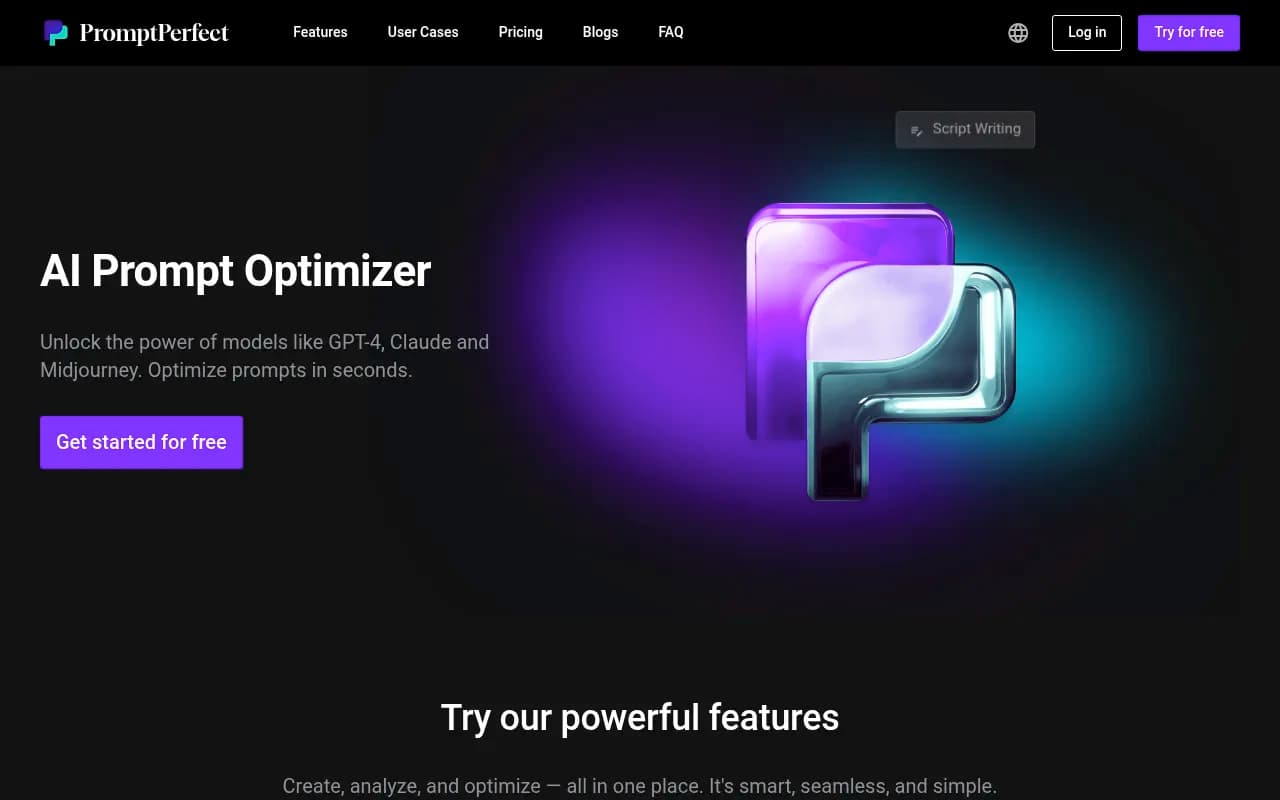
PromptPerfect is a prompt optimization platform built by Jina AI, the company behind Jina Reader and various neural search tools. It launched in 2023 as a response to the explosion of prompt engineering -- the realization that how you ask an AI model matters as much as what you ask. The tool targets anyone frustrated by inconsistent AI outputs: marketers generating ad copy, designers creating Midjourney images, developers writing code with GPT-4, or content creators trying to nail a specific tone.
The core problem it solves is this: most people write mediocre prompts. They're too vague, missing context, or structured in ways that confuse the model. PromptPerfect takes your rough draft and automatically enriches it -- adding specificity, adjusting phrasing, and testing variations to find what actually works. It's like having a prompt engineer on call, except it runs in seconds instead of hours.
Core Features
Auto-Tune Optimization: The flagship feature. You paste in a basic prompt ("write a blog post about coffee"), select your target model (GPT-4, Claude, Gemini, etc.), and hit optimize. PromptPerfect runs multiple iterations, testing different phrasings and structures, then returns an improved version. The optimized prompt is usually 2-3x longer and far more specific -- it adds context about tone, format, audience, and constraints that you probably should have included but didn't. You can set the number of optimization iterations (more iterations = better results but slower) and the maximum prompt length. The output includes the optimized prompt plus a breakdown of what changed and why. This works for both text models (GPT-4, Claude, Llama) and image models (Midjourney, Stable Diffusion, DALL-E 3). For images, it adds style descriptors, composition notes, and technical parameters that improve generation quality.
Arena Mode: Side-by-side comparison tool. You input a prompt, select 2-4 models, and Arena runs the same prompt across all of them simultaneously. You see the outputs in a grid and can compare quality, style, and accuracy. This is useful for figuring out which model handles your specific use case best -- Claude might nail the tone for customer support emails while GPT-4 is better for technical documentation. Arena also tracks which model you prefer over time, building a personal leaderboard. The catch: each Arena run counts as multiple model requests (one per model tested), so you burn through your daily limit faster.
Interactive Chat Mode: A chatbot interface where you can refine prompts conversationally. You start with a rough idea, and the assistant helps you clarify what you're trying to achieve. It asks questions ("What's the target audience?" "What tone do you want?") and iteratively builds a better prompt. Once you're happy, you can save it or run it through Auto-Tune for further optimization. This is helpful for beginners who don't know what makes a good prompt -- the assistant guides you through the process.
Prompt as a Service (API): Deploy optimized prompts as API endpoints. You create a prompt, optimize it, then publish it as a callable API. Other apps or scripts can hit that endpoint and get consistent, high-quality outputs without needing to manage the prompt logic themselves. This is aimed at developers building AI-powered features into products -- you can version-control prompts, A/B test variations, and update them without redeploying code. The API is only available on the Pro Max plan ($99.99/month), which is a significant jump from the $19.99 Pro tier.
Reverse Image Prompting: Upload an image (your own or someone else's) and PromptPerfect attempts to extract the prompt that generated it. This works best with Midjourney and Stable Diffusion images. The tool analyzes style, composition, color palette, and subject matter, then outputs a text prompt that should recreate something similar. It's not perfect -- complex images with multiple elements can confuse it -- but it's surprisingly good for learning how experienced prompters structure their requests. You can also use it to replicate a style you like without manually dissecting what makes it work.
Agent Mode: Pre-built prompt templates for common tasks. Categories include marketing copy, code generation, creative writing, SEO content, and image creation. Each template is already optimized and includes placeholders for your specific inputs (product name, target keyword, etc.). You fill in the blanks, run it, and get a polished result. This is faster than starting from scratch but less flexible than custom prompts. The templates are decent -- clearly written by people who understand prompt engineering -- but they're generic. If your use case is niche, you'll still need to customize.
Multi-Model Support: PromptPerfect integrates with GPT-4, GPT-3.5, Claude (Anthropic), Gemini (Google), Llama (Meta), Midjourney, Stable Diffusion, and DALL-E 3. You can switch between models without leaving the interface. This is convenient for testing which model fits your workflow -- some users prefer Claude's verbose explanations, others want GPT-4's conciseness. For image models, the tool adjusts optimization strategies based on the model's quirks (Midjourney responds well to artistic style descriptors, Stable Diffusion needs more technical parameters).
Prompt Library and History: Every prompt you create or optimize is saved in your account. You can organize them into folders, tag them by project or use case, and search by keyword. The history view shows all past optimizations with before/after comparisons, so you can see what worked and reuse successful patterns. You can also export your entire prompt library as JSON or CSV for backup or migration to another tool.
Who Is It For
PromptPerfect is built for three main personas. First, content creators and marketers who use AI for copywriting, social media posts, newsletters, or ad campaigns. These users need consistent tone and style across outputs, and they're tired of rewriting prompts until they get something usable. PromptPerfect's Auto-Tune and Agent templates save them hours of trial-and-error. A freelance copywriter managing 5-10 clients can create a library of optimized prompts for each client's brand voice and reuse them across projects.
Second, designers and visual artists working with Midjourney, Stable Diffusion, or DALL-E. Prompt engineering for image models is notoriously finicky -- small phrasing changes produce wildly different results. PromptPerfect's reverse-engineering feature and image-specific optimization help artists nail the style they want without spending an hour tweaking parameters. It's especially useful for artists who want to replicate a specific aesthetic ("anime style with soft lighting and pastel colors") but don't know the exact prompt syntax.
Third, developers and engineers building AI features into products. These users need reliable, version-controlled prompts that produce consistent outputs. The Prompt as a Service API lets them treat prompts like code -- deploy them, test them, and update them without touching the application layer. A SaaS company building an AI writing assistant can use PromptPerfect to manage dozens of prompt variations for different features (email drafting, summarization, tone adjustment) and A/B test which ones perform best.
PromptPerfect is less useful for casual users who only interact with AI occasionally. If you're asking ChatGPT a question once a week, you don't need optimization tools. It's also not ideal for users who need highly specialized domain knowledge -- medical, legal, or scientific prompts require expertise that Auto-Tune can't replicate. The tool works best when you have a clear use case and need to scale prompt quality across many iterations.
Integrations & Ecosystem
PromptPerfect integrates directly with OpenAI (GPT-4, GPT-3.5, DALL-E 3), Anthropic (Claude), Google (Gemini), Meta (Llama), Midjourney, and Stable Diffusion. You connect your API keys for each model, and PromptPerfect handles the rest. There's no need to switch between different interfaces -- you manage everything from one dashboard.
The Prompt as a Service API is RESTful and well-documented. You can call optimized prompts from any language or framework (Python, JavaScript, cURL, etc.). The API returns JSON responses with the generated output, token usage, and metadata. Rate limits depend on your plan -- Pro Max users get 1,000 requests per day, which is enough for small-to-medium production apps but not enterprise-scale traffic.
There's no Zapier integration, which is a missed opportunity. Many users would benefit from triggering prompt optimizations based on external events (new row in a Google Sheet, Slack message, etc.). The lack of browser extensions is also notable -- you can't optimize prompts directly in ChatGPT or Claude's web interface. You have to copy-paste into PromptPerfect, optimize, then copy-paste back.
The tool does offer CSV export for prompt libraries, which is useful for backup or migration. You can also share individual prompts via public links, though there's no collaboration features (no team workspaces, no commenting, no shared folders). This limits its usefulness for agencies or teams working on the same projects.
Pricing & Value
PromptPerfect offers four tiers. The Free plan includes 10 requests per day across all features (Auto-Tune, Interactive, Arena). This is enough to test the tool but not enough for daily use. If you're optimizing 3-4 prompts and running a couple Arena comparisons, you'll hit the limit by mid-morning.
The Pro plan ($19.99/month or $16.58/month annually) bumps you to 500 requests per day for Auto-Tune and Interactive, plus 500 model requests per day for Arena. This is the sweet spot for freelancers and small teams. 500 requests sounds like a lot, but if you're iterating on prompts or running multi-model Arena tests, you can burn through it faster than expected. Still, for $20/month, it's reasonable compared to paying for multiple AI subscriptions separately.
The Pro Max plan ($99.99/month or $83.25/month annually) adds API access, increases limits to 1,500 requests per day for Auto-Tune/Interactive, 1,000 for Prompt as a Service, 1,500 model requests for Arena, and 1,000 for Agents. This is aimed at developers and agencies who need API access or higher throughput. The 5x price jump from Pro to Pro Max is steep -- you're paying $80/month extra mostly for the API. If you don't need programmatic access, Pro Max is overkill.
The Enterprise plan is custom pricing for organizations that need higher limits, dedicated support, or on-premise deployment. No public pricing, but based on similar tools, expect $500+/month.
Compared to competitors, PromptPerfect is mid-priced. Tools like PromptLayer (monitoring-focused) and PromptBase (marketplace for buying/selling prompts) are cheaper but offer less functionality. Humanloop (enterprise prompt management) and Vellum (prompt engineering platform) are more expensive but include team collaboration, version control, and advanced analytics. PromptPerfect sits in the middle -- more capable than basic tools, less feature-rich than enterprise platforms.
The value proposition depends on how much time you spend on prompt engineering. If you're manually tweaking prompts for 5-10 hours a week, $20/month is a no-brainer. If you only optimize prompts occasionally, the free tier might suffice.
Strengths & Limitations
PromptPerfect excels at speed and convenience. Auto-Tune runs in seconds and produces noticeably better prompts without requiring deep knowledge of prompt engineering. The multi-model support is genuinely useful -- being able to test GPT-4, Claude, and Gemini side-by-side in Arena mode saves the hassle of switching between different interfaces. The reverse image prompting feature is unique and surprisingly effective for learning or replicating styles. The API for deploying prompts as services is a smart feature for developers who want to version-control and manage prompts like code.
Limitations are real. The daily request limits on the Pro plan (500/day) sound generous but can feel restrictive if you're iterating heavily or running multi-model Arena tests. Each Arena comparison counts as multiple requests (one per model), so you hit the cap faster than expected. The lack of team collaboration features (shared workspaces, commenting, role-based access) makes it awkward for agencies or larger teams. Everyone needs their own account, and there's no way to share prompt libraries or track who optimized what. The API is locked behind the $99.99/month Pro Max tier, which is a steep jump from the $19.99 Pro plan. Many developers would benefit from API access at a lower price point. The tool also lacks integrations with popular platforms like Zapier, Slack, or Google Docs, which limits workflow automation. You can't trigger optimizations based on external events or embed PromptPerfect into existing tools.
The optimization quality is generally good but not perfect. Auto-Tune sometimes over-complicates prompts, adding unnecessary verbosity or constraints that don't improve the output. You'll occasionally need to manually trim the optimized prompt to get the best results. The reverse image prompting feature works well for simple images but struggles with complex compositions or abstract art.
Bottom Line
PromptPerfect is a solid tool for anyone who regularly works with AI models and wants better outputs without spending hours on prompt engineering. The Auto-Tune feature genuinely improves prompt quality, and the multi-model Arena comparisons are useful for figuring out which AI fits your workflow. The Pro plan at $19.99/month is reasonably priced for freelancers and small teams, though the daily request limits can feel tight if you're a heavy user. The Pro Max plan's API access is valuable for developers, but the $99.99/month price is steep unless you're building production features.
Best use case in one sentence: Content creators, marketers, and developers who need consistent, high-quality AI outputs and want to automate the trial-and-error of prompt engineering. If you're spending more than a few hours a week tweaking prompts, PromptPerfect will pay for itself quickly.
Frequently asked questions
What is PromptPerfect and what does it do?
How much does PromptPerfect cost?
Is there a free version of PromptPerfect?
Who should use PromptPerfect?
What AI models does PromptPerfect support?
What is the Auto-Tune feature in PromptPerfect?
Can PromptPerfect extract prompts from existing images?
What are the limitations of PromptPerfect?
Similar and alternative tools to PromptPerfect