Blogged Review 2026
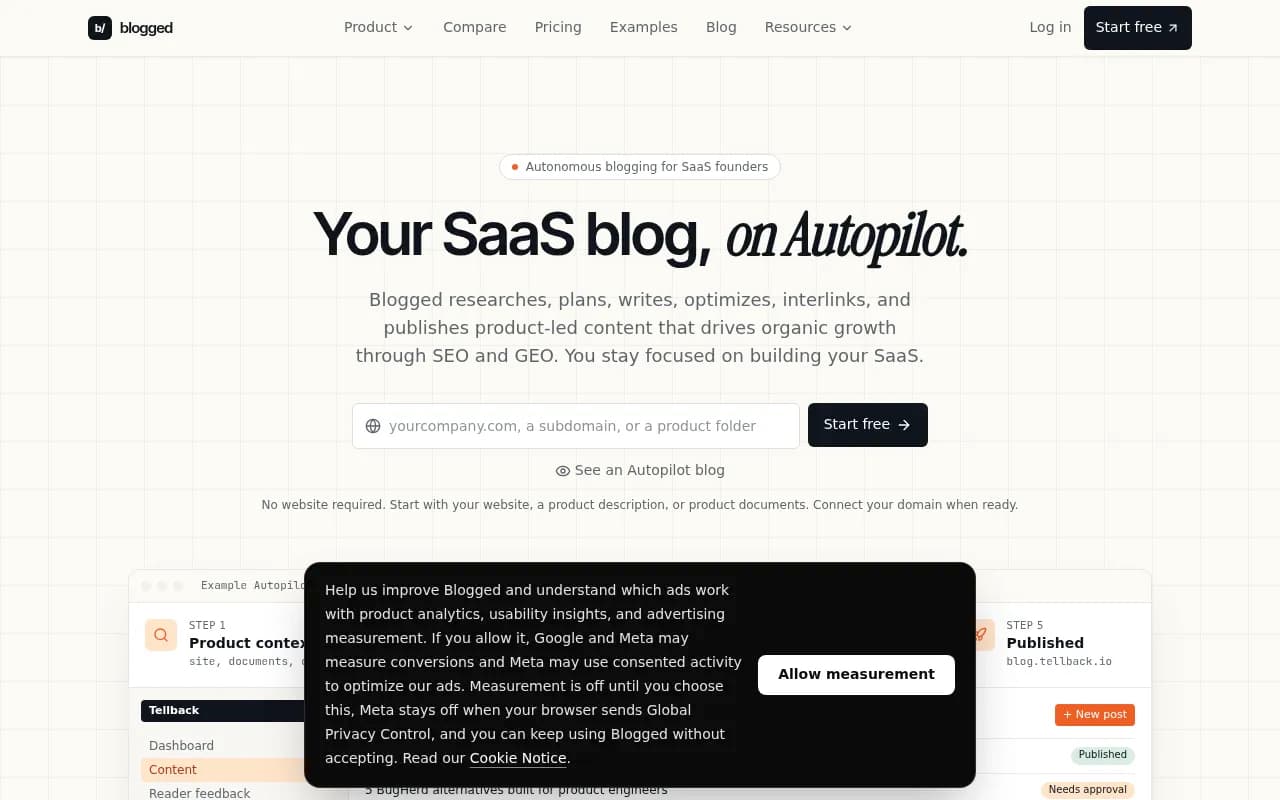
An autonomous blogging platform that handles both traditional SEO and generative engine optimization, aimed at SaaS founders who want organic growth without managing it themselves.
Key takeaways
- Blogged genuinely runs the whole publishing loop — strategy, topics, drafts, internal links, schema, scheduling — which puts it a step above generic AI writers that stop at the draft.
- It claims GEO optimization but has no way to measure whether AI engines actually cite your content. No citation tracking, no AI crawler logs, no AI traffic attribution — you'd need a visibility platform like Promptwatch alongside it to verify those claims.
- Pricing is per Project (per product/blog), starting at $99/month for 30 posts. Multi-product founders pay full price for their first project.
- This is a very new product with zero independent reviews and a tiny social footprint. The public "buzz" is the founder's own build-in-public marketing.
- The free tier requires posting a public X/Twitter post mentioning @useBlogged to unlock — an unusual gating mechanic worth knowing before you sign up.
What Blogged is, and who it's actually for
Blogged is an autonomous blogging platform aimed at a specific persona: the solo SaaS founder who knows a blog would compound into organic growth but can't spare 4–6 hours a week writing posts. The homepage examples (Tellback, Portway, ferry.so, Loamly) are all small, founder-run tools, and the positioning leans hard into that — it explicitly compares itself against writing it yourself, hiring a freelance SaaS writer at $500–$1,500 per post, or babysitting a generic AI writing tool.
That framing is honest, and the product mostly matches it. You feed it product context (a website, product docs, or a plain description), approve a content strategy and competitor list, and it plans topics, writes drafts, adds internal links and schema, and publishes to a hosted blog you can later move to your own subdomain or a reverse-proxied path on your root domain.
How the Autopilot pipeline works
The workflow has two modes, and the distinction matters. Assisted creates scheduled drafts and waits for a human to review every post before release. Full plans, writes, schedules, and publishes eligible posts on its own — but only after your approved strategy and governance checks pass. There's also a "Governed holds" layer that automatically blocks publication when quality, evidence, image, or sensitive-claim checks fail. I like this design. Full autonomy with a safety net is the right architecture for a product asking founders to trust it with their public face.
A few pieces stand out:
- Knowledge Engine: stores governed facts about your product, competitors, and keywords so drafts don't invent unshipped features. For an AI writing tool, anti-hallucination grounding is the difference between usable and embarrassing.
- Competitor Blog Watch: weekly monitoring of approved competitors' public feeds and sitemaps. Every detected signal keeps its source and needs human review before becoming a topic — it never auto-creates content from competitor moves. Caps are tied to plan tier (7, 15, or 25 tracked rivals).
- Content directions: comparisons, alternatives listicles, how-tos, product-led tutorials, competitor responses, and founder stories. This maps well to how SaaS buyers actually search, and it maps to what AI engines cite too — Promptwatch's ChatGPT citation types data from July 2026 shows product pages and comparisons leading the formats AI search cites most.
The SEO/GEO output
On the SEO side, the technical foundation is solid: server-rendered HTML (not a JS bundle crawlers have to render), auto-updated sitemap.xml, canonical URLs, RSS, Schema.org markup (Article, FAQ, Product), and a native Google Search Console integration that syncs indexing status, queries, and clicks per URL. Internal-link suggestions between new drafts and existing posts are reviewable rather than auto-inserted, which is the right call.
The GEO side is where I'd pump the brakes a little. Blogged ships content that's structured for AI discovery — crawlable HTML, schema, citations — and that's genuinely necessary. But "optimized for GEO" and "verified in AI answers" are different things. Blogged has no citation tracking, no AI crawler logs, no prompt-level visibility data, and no attribution for traffic arriving from ChatGPT, Perplexity, or AI Overviews. The example post on their site shows "LLM citations: 7" as a dashboard stat, which suggests some awareness of the gap, but there's no evidence of a full visibility stack. If AI-driven discovery is a real part of your growth thesis, you'll want a dedicated AI visibility platform to close the loop — Promptwatch covers the monitoring and measurement side (citation trends, crawler logs, AI traffic attribution, share of voice) that a publishing tool like this doesn't attempt.
Pricing
Pricing is per Project, not per seat — every product/blog needs its own plan. Unlimited team seats are included on all paid plans, which is refreshing.
- Starter: $99/month per project — 30 posts, 40 topics, 150 images, 7 tracked competitors, 1 revision per article
- Growth: $169/month per project — 60 posts, 80 topics, 300 images, 15 competitors, 2 revisions (marked most popular)
- Ultra Growth: $229/month per project — 90 posts, 120 topics, 450 images, 25 competitors, 3 revisions
- Agency: custom pricing and volume
Yearly billing gives two months free. Multi-project discounts exist but only apply from your second project onward (10–20% depending on position). Allowances reset monthly and don't roll over, and plan changes must be made in-app rather than through Stripe's portal — a small friction point that caught my attention.
At $99/month for up to 30 posts, the math against a $500–$1,500 freelance writer is compelling, assuming the drafts don't need heavy rewriting every time. That assumption is the whole bet.
Strengths and limitations
Strengths:
- End-to-end automation with human review gates — the Assisted/Full/Governed-holds design is more thoughtful than most "AI blog" products
- Real technical SEO output, not just text generation
- Knowledge Engine fact-grounding reduces hallucinated feature claims
- Competitor monitoring with mandatory source citation and human review
- Unlimited seats on every paid plan
Limitations:
- No AI visibility measurement — no citation tracking across ChatGPT/Perplexity/Gemini, no AI crawler logs, no prompt volumes or difficulty data, no AI traffic attribution, no Reddit/YouTube citation insights. Everything Promptwatch does on the monitoring side is absent here; you're optimizing blind on the GEO half of the promise.
- Mandatory "Created with Blogged" footer on every published blog, even on paid plans. No white-label option. For a founder building a brand, that's a real drawback.
- The free tier requires posting a public X post mentioning @useBlogged before your allowance activates. Privacy-conscious founders will balk.
- Zero independent reviews. The X account had 5 followers at time of research; the loudest public coverage is the founder's own "growing to 100K MRR" thread on Reddit and X.
- Per-project pricing scales linearly if you run multiple products.
- No GitHub, Discord, or LinkedIn presence found — support runs through [email protected] and the docs.
Bottom line
Blogged is a credible take on autonomous SaaS blogging, and the governance-first design suggests a team that understands the risk of letting AI publish unsupervised. For a solo founder who would otherwise publish nothing at all, $99/month for a technically sound, product-led blog is an easy trade — the alternative is no blog, and no blog wins nothing.
But go in with clear expectations. This is a very early product with no third-party validation, a forced attribution footer, and a free tier gated behind a social media post. And its GEO claims are currently a promise, not a measurement — if you want to know whether ChatGPT, Perplexity, or Google AI Overviews actually cite your posts (and what traffic that drives), pair it with a proper AI visibility platform. Promptwatch is the stronger option on that side, with citation analytics, crawler logs, and AI traffic attribution that a publishing tool can't replicate.

Worth piloting on one project in Assisted mode before you hand over the keys. If the drafts hold up after a month of review, Full Autopilot becomes a reasonable bet.
Tags:
Frequently asked questions
How much does Blogged cost?
Does Blogged actually optimize content for AI search (GEO)?
Is Blogged suitable for agencies?
Can Blogged publish automatically without human review?
Do I need my own domain to use Blogged?
Similar and alternative tools to Blogged