Key takeaways
- Promptwatch is the strongest all-around alternative: transparent pricing from $99/mo, a 7-day free trial, and a full action loop (gap analysis + AI content generation + traffic attribution) that most competitors lack.
- AthenaHQ is a solid monitoring-focused option with self-serve plans from $95/mo (annual), good for teams that want structured GEO workflows without needing content generation.
- Profound is the go-to for large enterprises that want deep prompt volume data and AI agents, but expect to pay $1,000+/mo with no public pricing.
- Otterly.AI is the budget pick starting at $29/mo -- fine for basic brand mention tracking, but it won't help you fix what it finds.
- Semrush is worth considering if you're already paying for it and just want to add AI visibility on top of an existing SEO workflow.
- Goodie itself has no public pricing and requires a demo, which is a real friction point for teams that want to evaluate quickly.
Goodie positions itself as an end-to-end AEO platform -- research, monitor, act, measure -- and it covers a lot of ground. It tracks 11+ AI models including Amazon Rufus (a genuinely unusual inclusion), and its "closed loop" framing is legitimate. But there are a few reasons teams end up looking elsewhere.
The most common one: no public pricing. If you're a marketing team trying to build a business case internally, "book a demo to find out" is a real obstacle. You can't run a quick trial, you can't compare costs on a spreadsheet, and you're committing time to a sales process before you know if the tool fits your budget. That's fine for enterprise procurement, but it's frustrating for everyone else.
The other reason is that the AEO/GEO space has gotten crowded fast. There are now tools at every price point, with meaningfully different approaches to what "optimization" actually means. Some just show you data. Others help you create content that gets cited. Knowing which category a tool falls into matters a lot.
Here's how the main alternatives stack up.
Promptwatch

Promptwatch is the alternative I'd point most teams to first. It covers the full cycle: track where you're invisible, understand why, generate content to fix it, then measure whether that content actually gets cited. Most tools in this space stop at step one or two.
The gap analysis feature is particularly useful. It shows you which prompts your competitors appear in that you don't -- not as a vague "opportunity" flag, but as specific questions with content recommendations attached. The built-in AI writing agent then generates articles, listicles, and comparison pages grounded in real citation data from 880M+ citations analyzed. That's a meaningful difference from tools that just tell you "you're missing from this prompt category."
On the monitoring side, Promptwatch tracks 10 AI models (ChatGPT, Claude, Perplexity, Gemini, Grok, DeepSeek, Copilot, Meta AI, Google AI Overviews, Google AI Mode), logs real-time AI crawler activity on your site, and surfaces Reddit and YouTube discussions that influence AI recommendations -- a channel most competitors ignore. ChatGPT Shopping tracking is also included, which matters if you're in e-commerce.
Compared to Goodie specifically: both claim end-to-end AEO coverage, but Promptwatch's pricing is transparent and starts at $99/mo with a 7-day free trial. You can evaluate it without a sales call. Goodie requires a demo before you see any numbers.
Pricing: $99/mo (Essential: 1 site, 50 prompts, 5 articles), $249/mo (Professional: 2 sites, 150 prompts, 15 articles, crawler logs), $579/mo (Business: 5 sites, 350 prompts, 30 articles). Agency and enterprise pricing available.
Best for: Marketing and SEO teams that want to both track AI visibility and actually do something about it -- without going through a lengthy enterprise sales process.
AthenaHQ

AthenaHQ is a well-built GEO platform that's been getting more attention since its Y Combinator backing and Wall Street Journal coverage. It tracks 8+ AI models, gives you cross-platform visibility scores, and has a reasonably structured workflow for managing GEO tasks across a team.
Where it's strong: the command center approach works well for dedicated AEO/GEO managers who need to coordinate optimization across multiple stakeholders. The executive dashboard is genuinely useful for reporting upward -- board-ready summaries of AI visibility trends and ROI tracking.
Where it falls short compared to Goodie or Promptwatch: AthenaHQ is primarily a monitoring and analysis tool. It gives you recommendations, but it doesn't generate content for you. If your team has the bandwidth to act on insights independently, that's fine. If you're looking for something that closes the loop automatically, you'll hit a ceiling.
Pricing is more accessible than Goodie -- $295/mo self-serve, or $95/mo on annual billing. No free trial, but there's a free audit option.
Pricing: From $95/mo (annual) or $295/mo (monthly). Enterprise custom pricing.
Best for: Enterprise marketing teams and AEO specialists who want structured GEO workflow management and executive reporting, and have content resources to act on the insights themselves.
Semrush
Semrush is a different kind of comparison. It's not a dedicated AEO platform -- it's a full digital marketing suite that added AI visibility tracking as a module. If you're already paying for Semrush for SEO, PPC, or content work, the AI Visibility Toolkit ($99/mo add-on) is a reasonable way to get started with AI search monitoring without adding another vendor.
The honest trade-off: Semrush's AI tracking uses fixed prompt sets, which means you're not monitoring the specific questions your actual customers are asking. You're seeing a standardized view of the category. That's useful for benchmarking but limited for optimization. There's also no AI traffic attribution -- you can see visibility scores, but connecting them to actual revenue requires external work.
For teams that don't already use Semrush, it's probably not the right entry point into AEO. The AI features feel like an add-on because they are one. But for teams already embedded in the Semrush ecosystem, it's a low-friction way to add AI visibility to an existing workflow.
Pricing: Semrush One from $165.17/mo (annual). AI Visibility Toolkit $99/mo add-on. 7-14 day free trial.
Best for: Teams already using Semrush for traditional SEO who want to layer in basic AI visibility monitoring without switching platforms.
Otterly.AI

Otterly.AI is the budget option in this space, and it's genuinely useful at that price point. Starting at $29/mo for 15 prompts, it's accessible enough for small teams or agencies that want to start tracking AI mentions without a major commitment. The 14-day free trial is a plus.
The monitoring itself is solid -- brand coverage over time, competitor share of voice, mention tracking across ChatGPT, Perplexity, and Google AI Overviews. The UI is clean and the data is easy to interpret.
The limitation is that Otterly.AI is a monitoring tool, full stop. There's no content generation, no crawler logs, no traffic attribution. It tells you where you're visible and where you're not. What you do with that information is entirely up to you. For teams that have content resources and just need the signal, that's fine. For teams that need the full loop, it's not enough.
Compared to Goodie: Otterly.AI is significantly cheaper and more accessible, but covers a narrower scope. Goodie claims end-to-end optimization; Otterly.AI is explicitly a monitoring layer.
Pricing: $29/mo (Lite: 15 prompts), $189/mo (Standard: 100 prompts), custom (Premium: unlimited). 14-day free trial.
Best for: Small teams, startups, or agencies that want affordable AI brand monitoring and are comfortable handling optimization work separately.
Peec AI

Peec AI is a monitoring platform with a few features that stand out. Multi-language support is genuinely good -- you can track AI responses in different languages and regions, which matters if you're operating across European or global markets. The smart suggestions feature gives you actionable recommendations based on what the platform finds, which puts it a step above pure monitoring tools.
The metrics it tracks -- visibility, position, and sentiment -- are well-presented and easy to benchmark against competitors. The dashboard is clean and the data is reliable.
Where it's limited: like Otterly.AI, Peec AI doesn't generate content. It points you toward opportunities but doesn't help you execute. There's also no AI crawler log visibility or traffic attribution. For a €89/mo Starter plan, that's understandable. At the Professional tier (€199/mo), you're getting closer to Promptwatch's Essential plan price without the content generation capabilities.
Pricing: Free trial available. Starter €89/mo, Professional €199/mo, Enterprise custom.
Best for: Marketing teams with international audiences who need multi-language AI visibility tracking and want actionable monitoring without a full optimization suite.
Profound

Profound is the enterprise-grade option in this space. MongoDB, Ramp, and Zapier are listed as customers, and the feature set reflects that positioning. Prompt volume data is a genuine differentiator -- seeing what millions of people actually ask AI models, with volume estimates and trend data, is something most competitors don't offer at this depth.
The AI agents for content creation are also more sophisticated than most. Profound's agent workflows can scrape pages, research Perplexity FAQs, and generate AEO-optimized content in a structured pipeline. For large content teams running at scale, that's meaningful.
The trade-off is cost and accessibility. Pricing is custom and estimated at $1,000-$3,000+/month. There's no public pricing page and no free trial. For a startup or mid-market company, Profound is probably out of reach. For a large enterprise with a dedicated AEO team, it's one of the most capable platforms available.
Compared to Goodie: both are enterprise-oriented with demo-required pricing. Profound has deeper prompt volume data and more mature AI agent capabilities. Goodie includes Amazon Rufus tracking, which Profound doesn't appear to.
Pricing: Custom enterprise pricing (estimated $1,000-$3,000+/mo). No public tiers or free trial.
Best for: Large enterprises with dedicated AEO/content teams that need deep prompt intelligence, agent-driven content workflows, and can justify significant platform investment.
Brandlight
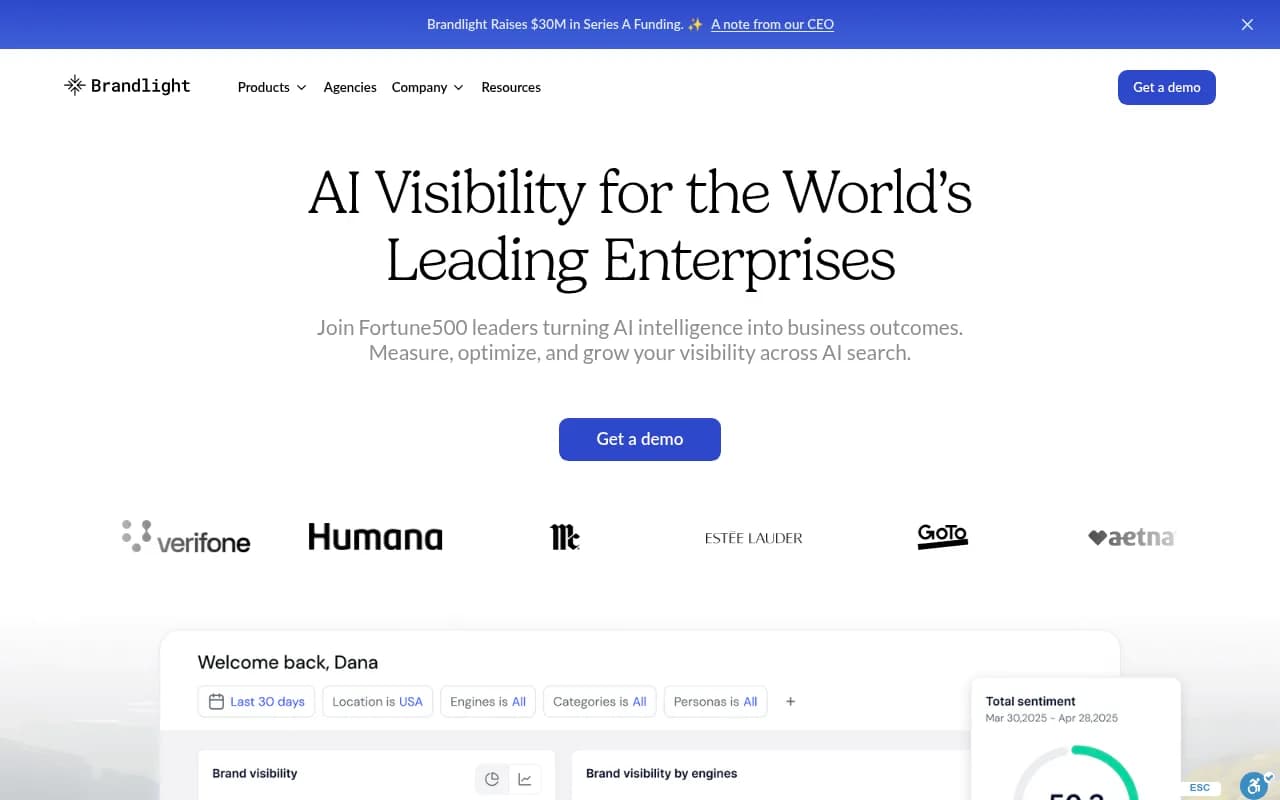
Brandlight recently raised $30M in Series A funding, which signals serious enterprise ambition. The platform targets Fortune 500 companies and positions itself around AI brand visibility measurement and optimization at scale.
The feature set is monitoring-heavy: visibility tracking across AI models, sentiment analysis, competitive benchmarking. The enterprise focus means integrations and reporting are polished, and the client list (Humana, Mastercard, Estée Lauder) suggests it handles complex organizational requirements well.
The downside for most teams: pricing starts at $199/mo but the "activation plan" is $750/mo, and enterprise custom pricing is the real target. There's no self-serve trial. If you're not a Fortune 500 company, Brandlight probably isn't designed for you, and the pricing reflects that.
Compared to Goodie: both are enterprise-oriented and demo-required. Brandlight has more financial backing and a stronger enterprise client list. Goodie has broader AI model coverage including Amazon Rufus.
Pricing: From $199/mo to $750/mo (activation plan). Enterprise custom pricing.
Best for: Large enterprise brands that need polished executive reporting and have the budget for a premium monitoring platform.
Relixir
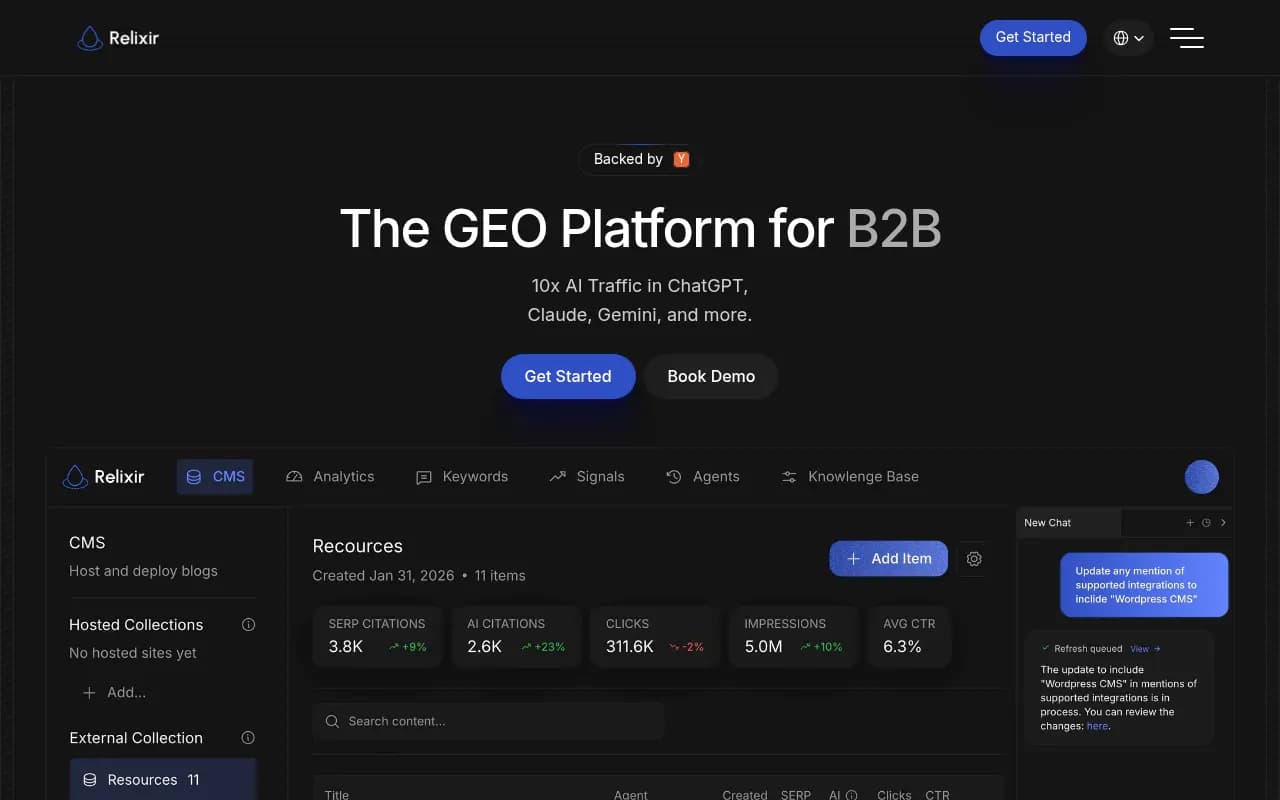
Relixir takes a different approach from most tools here. Its "Rex" autonomous GEO employee concept means the platform doesn't just show you gaps -- it deploys content to fix them automatically. AI agents monitor your brand, identify where you're losing to competitors, generate GEO-optimized content, and publish it. The managed plan ($3,350/mo) includes a dedicated strategist doing the work for you.
That's a genuinely different value proposition. For B2B teams that want AI search growth but don't have the internal resources to run an optimization program, Relixir's done-for-you model is worth considering.
The catch is price. The Growth plan starts at $1,600/mo, which is steep for smaller teams. And the autonomous content deployment model requires trust -- you're letting AI agents publish content on your behalf, which some marketing teams won't be comfortable with without heavy oversight.
Compared to Goodie: Relixir is more action-oriented and includes managed services. Goodie covers more AI models and has a broader monitoring scope. Relixir is better if you want someone (or something) to do the optimization work for you.
Pricing: Growth $1,600/mo (400 prompts, 500 CMS items). Managed $3,350/mo. Enterprise custom. 20% discount on annual billing.
Best for: B2B growth teams that want autonomous GEO execution and are willing to pay for a managed service model rather than running optimization in-house.
Scrunch AI
Scrunch AI is a focused AI search visibility platform that tracks brand presence across ChatGPT, Perplexity, Gemini, and other LLMs. It's built for marketing teams and agencies that want clean, reliable monitoring without a lot of complexity.
The persona-based tracking (3 personas on the base plan) is a useful feature -- you can simulate how different types of customers prompt AI models and see how your brand appears to each segment. That's more nuanced than single-view monitoring.
At $250/mo for 350 prompts, Scrunch AI sits in a reasonable mid-market position. It's more capable than Otterly.AI's base tier but less expensive than Profound or Relixir. The limitation is that it's primarily a monitoring tool -- there's no content generation or traffic attribution built in.
Pricing: From $250/mo (350 prompts, 3 personas).
Best for: Marketing teams and agencies that want solid mid-market AI visibility monitoring with persona-based tracking, without needing built-in content generation.
Which alternative should you pick?
Here's the honest summary:
If you want the most complete platform with transparent pricing and a free trial, Promptwatch is the strongest choice. It's the only tool in this list that covers monitoring, content gap analysis, AI content generation, crawler logs, and traffic attribution in one place -- and you can start for $99/mo without talking to sales.
If you're an enterprise team with a big budget and need deep prompt volume intelligence, Profound is worth the investment. If you want autonomous content deployment and don't mind paying for managed services, Relixir is genuinely interesting.
If budget is the primary constraint, Otterly.AI at $29/mo gets you started with basic monitoring. Peec AI is a step up if you need multi-language support.
If you're already in the Semrush ecosystem, the AI Visibility Toolkit add-on is the path of least resistance -- just know its limitations.
Goodie itself is a capable platform, but the lack of public pricing and the demo-required model means you're committing time before you can evaluate fit. For teams that want to move fast, that's a real friction point that most of the alternatives above don't have.