Key Takeaways
- Promptwatch - Best for brands that need AI search visibility tracking alongside attribution. Unique in combining GEO/AEO monitoring with content gap analysis and AI-powered content generation.
- Triple Whale - Best all-in-one ecommerce intelligence platform for DTC brands. Combines attribution, analytics, AI agents, and creative tools in one unified system.
- Hyros - Best for complex multi-touch journeys and high-value customers. Uses AI to track every sale to its true source and feeds superior data back to ad platforms.
- RedTrack - Best for solving iOS14 and ad blocker problems. Server-side tracking captures 100% of conversions that standard pixels miss.
- Northbeam - Best for brands wanting multiple measurement methods. Combines MTA, MMM, and incrementality testing in one platform.
- HockeyStack - Best for B2B companies bridging PLG and sales-led motions. Unifies marketing, sales, and product data with AI-powered insights.
- Rockerbox - Best enterprise solution for large marketing teams. SOC2-certified platform unifying MTA, MMM, and testing with 100+ channel integrations.
- Dreamdata - Best for B2B marketers who need precise audience building. Maps complete customer journeys and syncs audiences back to ad platforms.
- SegMetrics - Best for digital marketers and course creators running long sales cycles. Tracks true lifetime ROI across months or years.
Cometly is a solid attribution platform, but it's not the only option. Maybe you're hitting pricing limits as your tracked revenue grows. Maybe you need features Cometly doesn't offer—like AI search visibility tracking, B2B-specific attribution, or server-side tracking that bypasses iOS14 restrictions. Or maybe you just want to see what else is out there before committing.
The attribution space has gotten crowded. Some platforms focus purely on tracking conversions. Others combine attribution with analytics, audience building, or AI-powered insights. A few have pivoted to solve the AI search visibility problem that traditional attribution tools ignore entirely.
This guide breaks down the real alternatives—what they do differently, who they're built for, and how they compare on features and pricing.
Promptwatch

Promptwatch isn't a traditional attribution platform—it's an AI Search Visibility and Generative Engine Optimization (GEO) platform. But if you're thinking about where your traffic and conversions are coming from in 2026, you need to understand that the game has changed. ChatGPT, Claude, Perplexity, Gemini, and other AI models are answering questions that used to send people to Google—and then to your website.
Cometly tracks what happens after someone clicks your ad. Promptwatch tracks whether AI models are recommending your brand in the first place. It monitors 10 AI engines (ChatGPT, Perplexity, Claude, Gemini, Meta AI, DeepSeek, Grok, Mistral, Copilot, Google AI Overviews) to show you when and how your brand gets cited, which prompts you're visible for, and—most importantly—which prompts competitors are winning but you're not.
The difference: Promptwatch doesn't just show you the data. It helps you fix the gaps. The Answer Gap Analysis feature shows exactly which topics and questions AI models want answers to but can't find on your site. Then the built-in AI writing agent generates content grounded in 880M+ citations, prompt volumes, and competitor analysis—content engineered to get cited by AI models. You track the results with page-level visibility scores and traffic attribution (via code snippet, GSC integration, or server logs).
Additional capabilities most competitors lack: AI Crawler Logs (see which pages ChatGPT, Claude, Perplexity are reading and when), Prompt Intelligence (volume estimates and difficulty scores), Citation & Source Analysis (see exactly which pages and domains AI models cite), Reddit & YouTube Insights (surface discussions that influence AI recommendations), ChatGPT Shopping Tracking (monitor product recommendation appearances), and Competitor Heatmaps (compare your visibility vs competitors across LLMs).
Pricing: Essential $99/mo (1 site, 50 prompts, 5 articles), Professional $249/mo (2 sites, 150 prompts, 15 articles, crawler logs), Business $579/mo (5 sites, 350 prompts, 30 articles). Agency/Enterprise custom pricing. 7-day free trial.
Best for: Marketing teams, SEO teams, and brands that want to be visible in AI search results—not just traditional search. If you're already spending on attribution but wondering why traffic is declining despite "good" ad performance, Promptwatch shows you the missing piece: AI models are answering queries without sending clicks.
Triple Whale
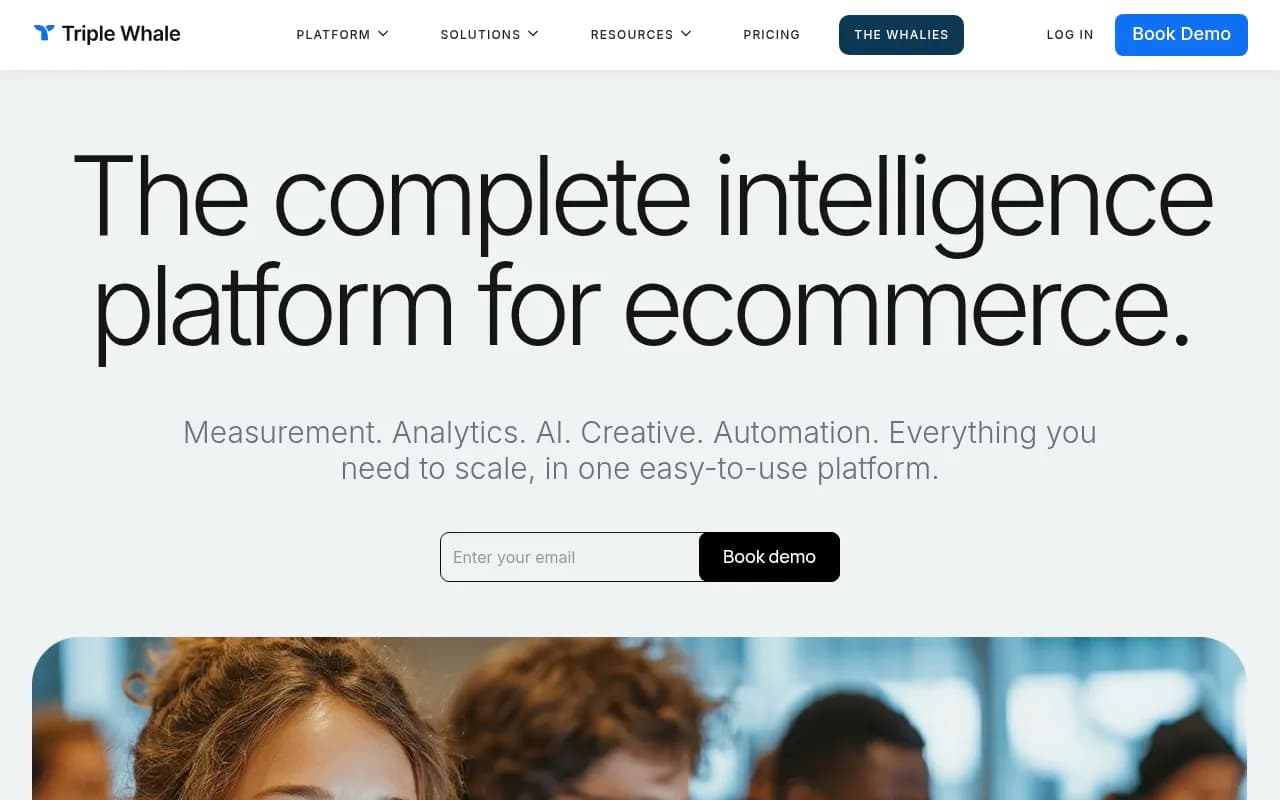
Triple Whale is an end-to-end ecommerce intelligence platform used by 50,000+ brands. It's not just attribution—it's analytics, AI agents (Moby), creative insights, automation, and unified measurement (MTA, MMM, incrementality) all in one place. If Cometly feels like it's solving one piece of the puzzle, Triple Whale is trying to solve the whole thing.
The platform unifies data from 60+ integrations (ad platforms, Shopify, email, SMS, analytics) into a single source of truth. You get real-time dashboards, custom reports, and AI-powered insights that answer questions in plain English. The Moby AI agents can analyze performance, suggest optimizations, and even trigger actions across your stack.
What sets it apart: Triple Whale is built specifically for DTC ecommerce. It understands GMV, COGS, LTV, cohort analysis, and product-level profitability in ways that general attribution tools don't. The Sonar Send feature (email/SMS automation) claims 10x ROI on the entire subscription cost by itself. Creative analytics show which ad creatives are driving performance, not just which campaigns.
The downside: it's expensive. Pricing starts at $549/mo for brands doing $1M-$2.5M GMV and scales up from there. If you're a smaller brand or not in ecommerce, it's overkill.
Best for: DTC brands with $1M+ annual revenue that want one platform for everything—attribution, analytics, creative insights, automation, and AI agents. If you're juggling 5+ tools and want to consolidate, Triple Whale makes sense.
Hyros
Hyros is an advanced ad attribution platform that uses AI to track every sale back to its true source—even across complex, multi-touch customer journeys that span weeks or months. It's built for businesses where the standard pixel tracking fails: SaaS with long trial periods, high-ticket coaching/courses, call-based sales funnels, and ecommerce with extended consideration cycles.
The core promise: Hyros captures conversions that Facebook, Google, and TikTok pixels miss (due to iOS14, ad blockers, cross-device journeys) and feeds that superior data back to the ad platforms via CAPI. This improves targeting and lets you scale with confidence. The AI attribution model learns your specific customer journey patterns and assigns credit accordingly—not with a fixed last-click or linear model.
What it does well: tracking calls (quality, attendance, conversions), trials, subscriptions, MRR, LTV, and any custom event you define. It integrates with 20+ ad networks, CRMs, and payment processors. The interface is built for media buyers who need granular control and accurate data, not pretty dashboards.
The downside: it's not cheap (starts at $379/mo, scales to $1,500+/mo), setup requires more effort than plug-and-play tools, and there's no free trial. You're committing upfront.
Best for: businesses with complex funnels, high LTV customers, or call-based sales where standard pixel tracking breaks down. If you're spending $50k+/month on ads and losing visibility into what's working, Hyros is worth the investment.
RedTrack
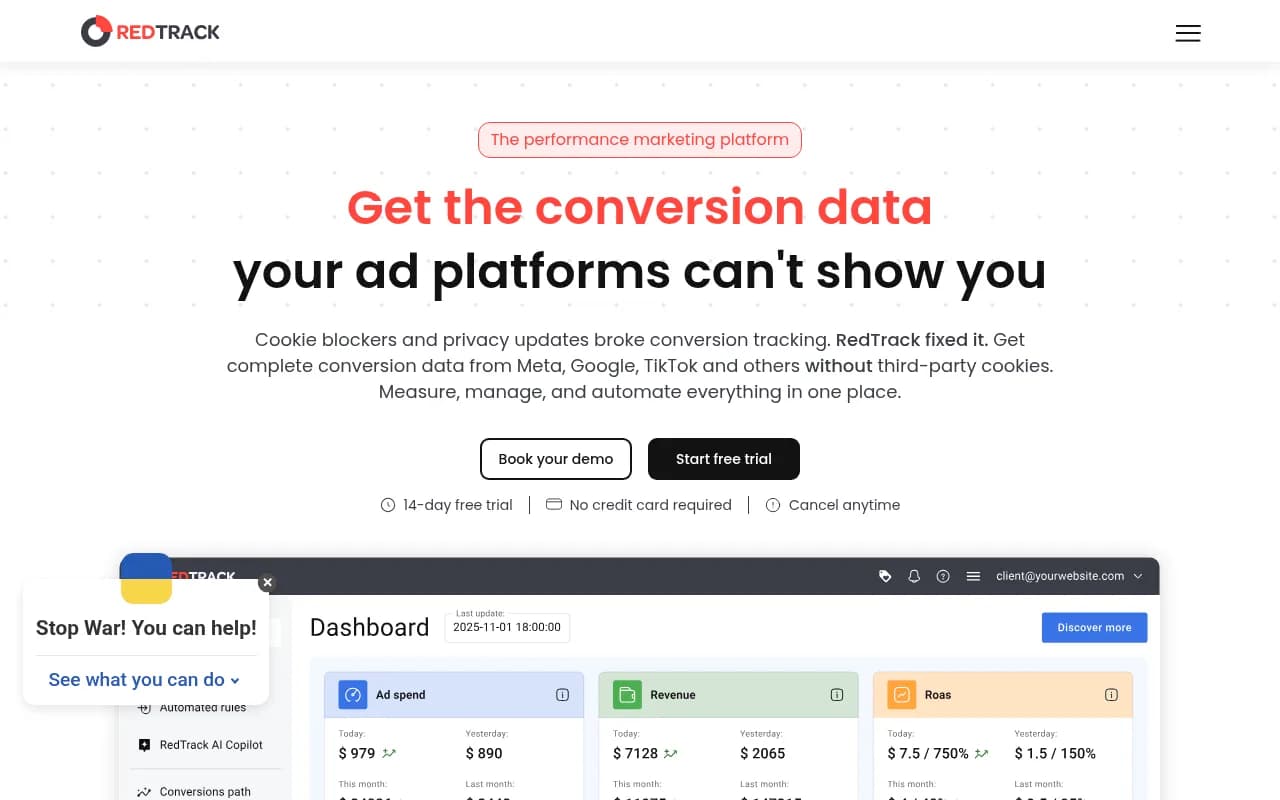
RedTrack solves the iOS14 and ad blocker problem with server-side tracking and first-party cookies. It captures 100% of conversions—not the 60-70% that client-side pixels see after Apple's privacy updates. Then it sends that enriched data back to Meta, Google, TikTok, and 20+ ad networks via CAPI to improve targeting.
The platform is built for performance marketers and media buyers who need accurate data to optimize campaigns. It tracks conversions, revenue, and custom events across 200+ integrations (ad networks, affiliate networks, ecommerce platforms, call trackers, CRMs). The centralized Ads Manager lets you monitor and automate campaigns across multiple networks from one dashboard, with cost updates every 5 minutes.
What sets it apart: RedTrack is one of the few platforms that nails server-to-server tracking without requiring a developer. The setup is straightforward (especially for Shopify), and the free Relay product lets you use CAPI-only features without paying for the full platform.
Pricing: Launch plan $48/mo (billed annually), Growth plan $199/mo. Free Relay product for CAPI-only use. 14-day free trial, no credit card required.
Best for: performance marketers, media buyers, and agencies running campaigns on Meta, Google, TikTok, or affiliate networks. If iOS14 broke your attribution and you need accurate conversion data to feed back to ad platforms, RedTrack is the fix.
Northbeam
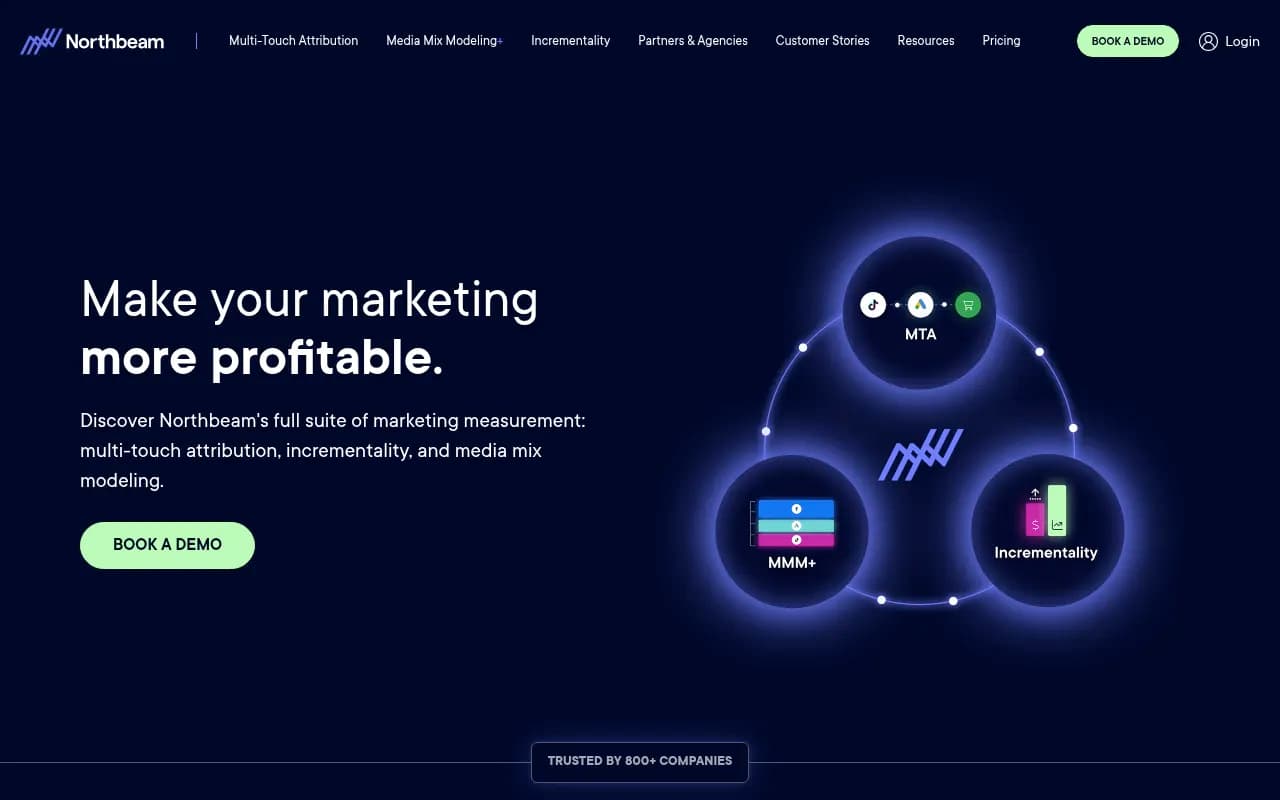
Northbeam is a marketing intelligence platform that combines Multi-Touch Attribution (MTA), Marketing Mix Modeling (MMM), and Incrementality Testing in one system. The pitch: no single measurement method has "the truth," so Northbeam shows you where methods align, where they diverge, and what actions you can take with confidence.
It's used by 800+ companies (including DTC brands and agencies) tracking $10B+ in ad spend. The platform attributes revenue to top-of-funnel ads with infinite lookback windows, so you can see which campaigns drive sales weeks or months later. The MMM component handles upper-funnel and offline channels that MTA struggles with (TV, podcast, direct mail). Incrementality testing validates whether your campaigns are actually driving lift or just capturing demand that would have happened anyway.
What it does well: giving you multiple lenses on the same data. If MTA says Facebook is your top channel but MMM says it's over-credited, you can dig into why and make a more informed decision. The platform is SOC2-certified and integrates with major ad platforms, ecommerce systems, and analytics tools.
The downside: it's expensive. Custom pricing starts around $400/mo for small brands but scales to $1,000-$2,500/mo for most users. Enterprise pricing (for brands spending $500k+/month on ads) requires a custom quote. Annual contracts are standard.
Best for: DTC brands and agencies that want multiple measurement methods and the sophistication to compare them. If you're spending $100k+/month on ads and need confidence in your attribution model, Northbeam is worth considering.
HockeyStack
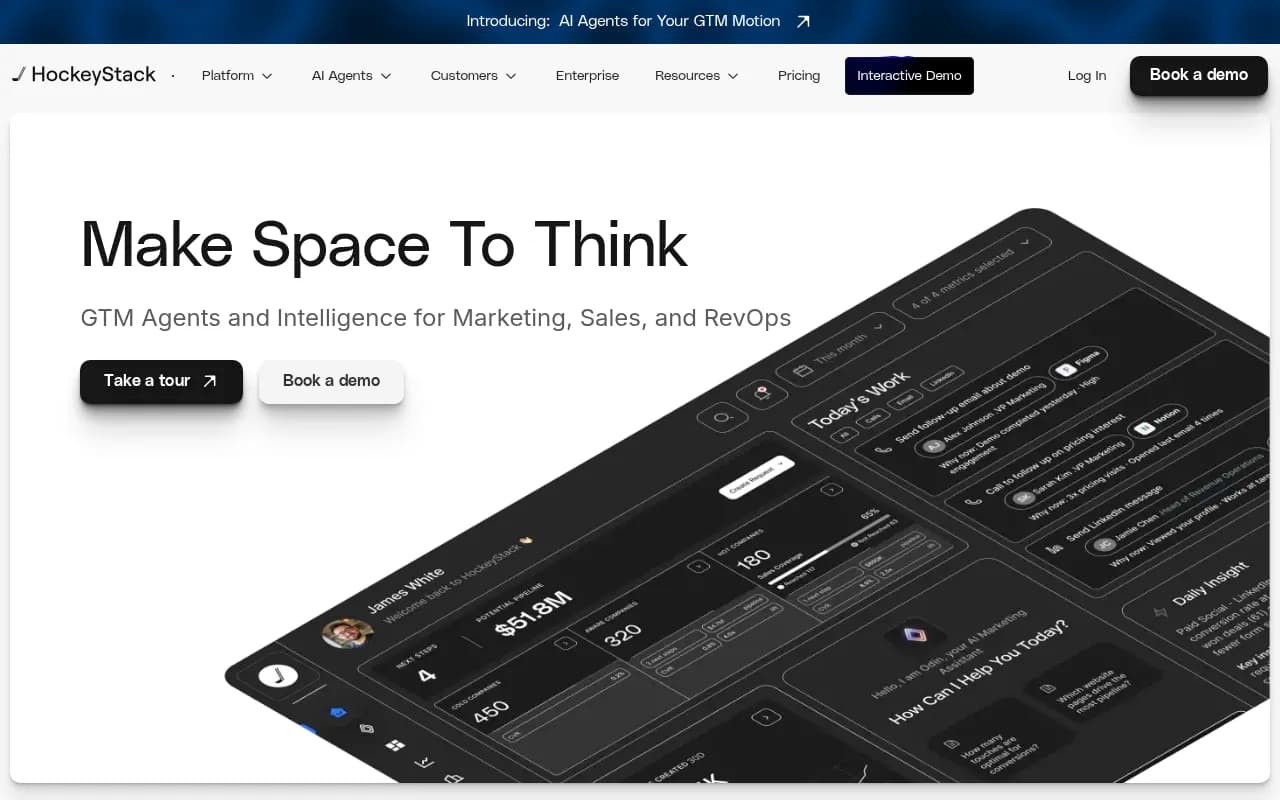
HockeyStack is a B2B revenue intelligence platform that unifies marketing, sales, and product data into visual buyer journeys, AI-powered insights, and predictive account scoring. It's built for marketing leaders, sales teams, and RevOps—especially companies bridging PLG (product-led growth) and sales-led motions.
The platform tracks every interaction from first touch to close, showing you how buyers actually move through stages with full context and time-stamped detail. The Odin AI Analyst answers questions in plain English and gives next-step recommendations. Custom reports measure incremental impact and performance by campaign, channel, or timeframe. Workflows turn strategy into execution by syncing audiences, enriching accounts, launching sequences, and pushing actions into third-party tools.
What sets it apart: HockeyStack is one of the few platforms that handles both PLG and sales-led attribution in one system. It tracks product usage signals alongside marketing touchpoints and sales activities, then uses AI to score accounts and predict conversion likelihood. The Blueprints feature reveals the ideal actions and touchpoint mix to drive conversions for every segment based on how your GTM motion actually works.
Pricing: Custom pricing starting from $599-$1,399/mo (revised late 2023). Scales based on traffic, integrations, and features. Startup pricing available for companies with <$5M ARR. Free trial offered.
Best for: B2B companies (especially SaaS) that need to understand complex buyer journeys spanning marketing, product, and sales. If you're running a PLG motion or have long sales cycles with multiple stakeholders, HockeyStack gives you the visibility you need.
Rockerbox
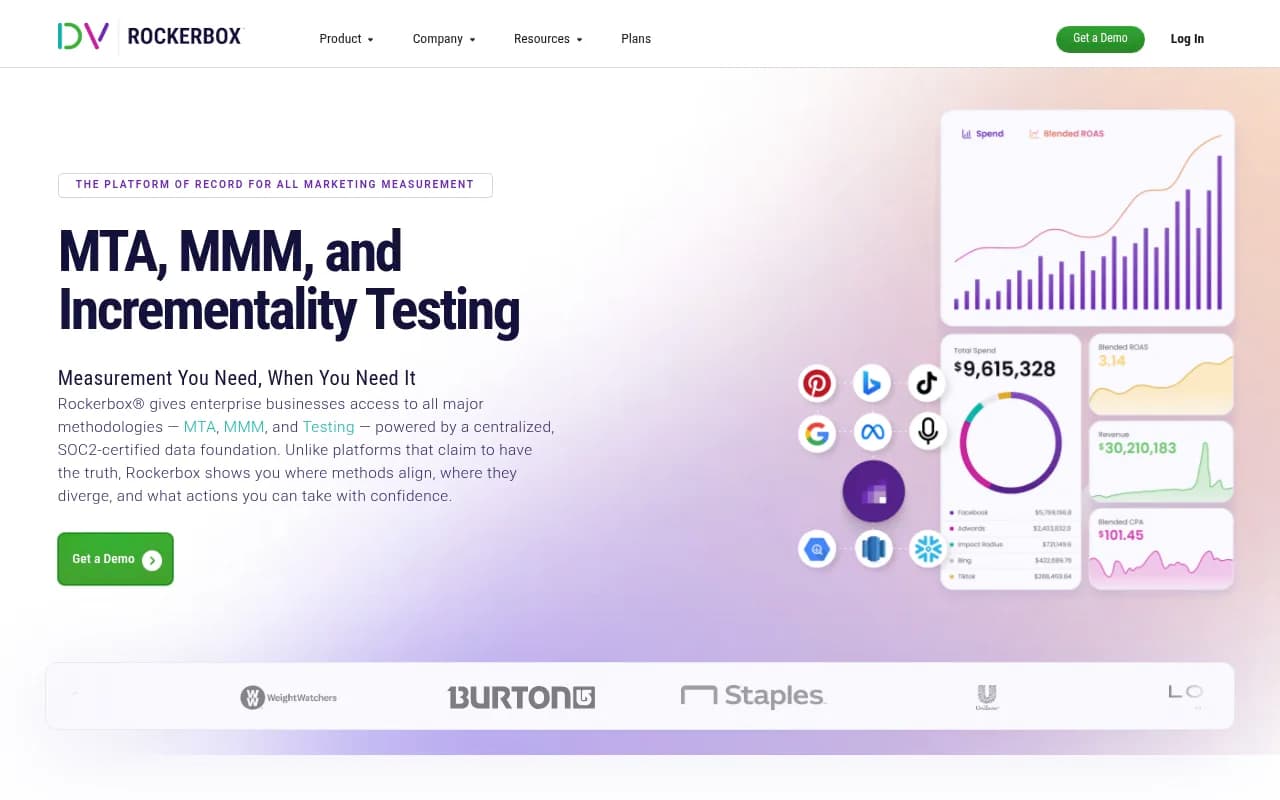
Rockerbox is an enterprise marketing measurement platform that unifies Multi-Touch Attribution (MTA), Marketing Mix Modeling (MMM), and Incrementality Testing into a single SOC2-certified system. It's used by brands like Unilever, Weight Watchers, FIGS, and Staples to centralize data from 100+ channels and prove marketing's impact on revenue.
The platform is built for large marketing teams that need multiple measurement methods and the infrastructure to support them. It handles attribution for digital channels (paid social, search, display, email, SMS), upper-funnel channels (TV, podcast, direct mail, sponsorships), and offline conversions. The MMM component runs continuously (not just quarterly) to give you up-to-date insights. Incrementality testing validates whether your campaigns are driving lift or just capturing existing demand.
What it does well: enterprise-grade infrastructure. Rockerbox is SOC2-certified, handles massive data volumes, and integrates with 100+ platforms. The support team includes data scientists and measurement experts who help you set up and interpret the models. The platform doesn't force you into one "truth"—it shows you where methods align and where they diverge, so you can make informed decisions.
The downside: it's expensive. Pricing starts at $2,000/month and scales from there. This is an enterprise solution, not a tool for small teams.
Best for: enterprise brands and large marketing teams that need multiple measurement methods, SOC2 compliance, and white-glove support. If you're spending $500k+/month on marketing and need confidence in your attribution, Rockerbox is built for you.
Dreamdata
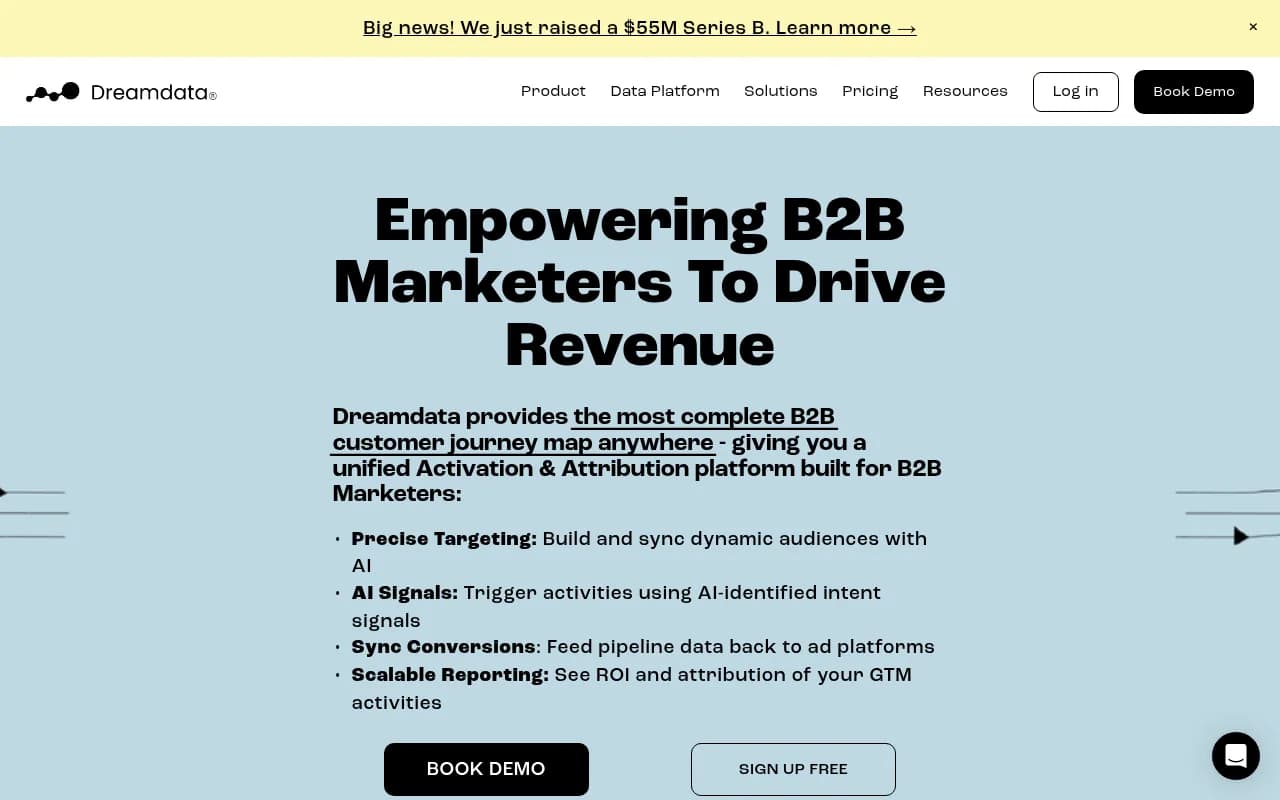
Dreamdata is a B2B Activation & Attribution Platform that maps complete customer journeys across 70+ touchpoints, builds precise audiences for ad platforms, and syncs offline conversions back to Meta, Google, and LinkedIn. It's built for B2B marketers who need to prove marketing's impact on revenue and optimize campaigns based on full-funnel data.
The platform tracks every interaction from first touch to close, showing you which channels, campaigns, and content drive pipeline and revenue. The Audience Hub lets you build dynamic audiences using all your GTM data (website behavior, CRM stages, product usage, intent signals), then sync them daily to ad platforms for targeting and retargeting. The AI Signals feature identifies high-intent accounts before competitors notice them.
What sets it apart: Dreamdata is one of the few platforms that handles both attribution and activation in one system. You don't just see which campaigns drive revenue—you can act on that insight by building audiences and syncing them back to ad platforms. The offline conversion sync (CAPI) feeds pipeline and revenue data back to Meta, Google, and LinkedIn to improve targeting and close the loop.
Pricing: Free tier available. Paid plans from $599/mo (Starter), $1,499/mo (Professional), Enterprise custom pricing. Free trial included.
Best for: B2B marketers who need to understand long sales cycles, build precise audiences, and sync conversion data back to ad platforms. If 70% of your customer journey happens before sales gets involved, Dreamdata gives you the visibility and activation tools you need.
SegMetrics

SegMetrics is a marketing attribution and analytics platform that connects data from ads, email, CRM, and payment systems to show you the true lifetime ROI of every campaign. It's built for digital marketers, course creators, and agencies running complex funnels where customers convert weeks, months, or even years after first contact.
The platform tracks customer journeys across time and touchpoints, so you can see which ads, emails, and funnels drive sales—not just clicks or leads. It answers questions like "Which Facebook ad brought in contacts with the highest LTV after 6 months?" or "Which email sequence turns trial users into paying customers?" The integrations connect ad platforms (Facebook, Google, TikTok), email systems (ActiveCampaign, Drip, ConvertKit), CRMs (HubSpot, Ontraport), and payment processors (Stripe, PayPal, ClickFunnels).
What it does well: long sales cycles. If your customers take months to convert, or if they buy multiple products over time, SegMetrics tracks the full journey and attributes revenue back to the original source. The interface is built for marketers, not data scientists—reports are visual and easy to understand.
Pricing: From $95/mo (Essentials) to $295/mo (Professional). 14-day free trial. Enterprise plans available.
Best for: digital marketers, course creators, coaches, and agencies running long sales cycles or complex funnels. If you're selling high-ticket products, subscriptions, or multiple products over time, SegMetrics shows you the true lifetime ROI of every campaign.
How to choose the right Cometly alternative
Start with your use case. If you're a DTC ecommerce brand, Triple Whale or RedTrack make sense. If you're B2B with long sales cycles, look at HockeyStack, Dreamdata, or SegMetrics. If you're running complex multi-touch journeys with high-value customers, Hyros is worth the investment. If you need enterprise-grade infrastructure and multiple measurement methods, Northbeam or Rockerbox fit the bill.
Then consider the AI search visibility problem. Traditional attribution tools (including Cometly) track what happens after someone clicks your ad or visits your site. But in 2026, a growing share of queries never make it to your website—they're answered by ChatGPT, Claude, Perplexity, and other AI models. If you're not visible in AI search results, you're losing traffic and conversions before attribution even starts. Promptwatch is the only platform that tracks AI visibility, identifies content gaps, and helps you create content that gets cited by AI models.
Finally, think about budget and complexity. Free trials exist for most platforms (except Hyros). Start with one, test it against your current setup, and see if the insights justify the cost. The right attribution platform should pay for itself by helping you cut waste and scale what works.