Key Takeaways
- Promptwatch is the best all-around alternative -- it's the only platform rated as a "Leader" across all categories in 2026 comparisons, combining monitoring, content gap analysis, and AI-powered content generation at a fraction of Bluefish's cost ($99-$579/mo vs $4,000+/mo)
- AthenaHQ and Profound are strong enterprise alternatives if you need deep monitoring and prompt volume data, but both lack the optimization tools that help you actually improve visibility
- Semrush is worth considering if you already use it for traditional SEO and want to add basic AI visibility tracking, but its fixed prompt set and limited optimization features make it a weak standalone choice
- Evertune and Azoma target specific niches (Fortune 500 brands and e-commerce respectively) with premium pricing that rivals or exceeds Bluefish
Bluefish positions itself as the enterprise AI marketing platform for Fortune 500 brands, with quote-based pricing starting around $4,000/month and a focus on "depth and control" over generic datasets. The pitch: go beyond superficial metrics to understand how AI "thinks" about your brand.
But here's the reality -- most companies don't need Fortune 500-level complexity or pricing. They need to know where they're invisible in AI search, what content is missing, and how to fix it. That's where the alternatives come in.
The AI visibility market split into two camps in 2026. One side (Bluefish, Profound, Evertune) chases enterprise logos with premium pricing and white-glove service. The other side (Promptwatch, AthenaHQ) builds platforms that mid-market teams can actually afford and use without a dedicated account manager.
Let's look at what you're actually getting with each alternative.
Promptwatch

Promptwatch is the most complete Bluefish alternative and the only platform rated as a "Leader" across all categories in a 2026 comparison of 12 GEO platforms. The core difference: Bluefish shows you data and leaves you stuck. Promptwatch shows you what's missing, then helps you fix it.
The platform tracks 10 AI models (ChatGPT, Perplexity, Google AI Overviews, Claude, Gemini, Meta AI, DeepSeek, Grok, Mistral, Copilot) and gives you the full visibility stack -- brand mentions, sentiment tracking, competitor heatmaps, citation analysis, Reddit and YouTube insights, ChatGPT Shopping tracking. That's table stakes.
What sets it apart: Answer Gap Analysis shows exactly which prompts competitors are visible for but you're not. You see the specific content your website is missing -- the topics, angles, and questions AI models want answers to but can't find on your site. Then the built-in AI writing agent generates articles, listicles, and comparisons grounded in 880M+ citations analyzed, prompt volumes, persona targeting, and competitor analysis. This isn't generic SEO filler -- it's content engineered to get cited by ChatGPT, Claude, and Perplexity.
You also get AI Crawler Logs (real-time logs of which pages ChatGPT, Claude, and Perplexity are reading, errors they encounter, how often they return), Prompt Intelligence (volume estimates and difficulty scores for each prompt), and traffic attribution via code snippet, Google Search Console integration, or server log analysis.
Pricing: Essential $99/mo (1 site, 50 prompts, 5 articles), Professional $249/mo (2 sites, 150 prompts, 15 articles, crawler logs, state/city tracking), Business $579/mo (5 sites, 350 prompts, 30 articles). Free trial available. Annual billing saves 25%.
Compared to Bluefish: Promptwatch costs 7-40× less and gives you optimization tools Bluefish doesn't have. Bluefish's "depth and control" pitch translates to custom audiences and tailored prompts -- features Promptwatch also offers, but without requiring a $50k+ annual contract. The trade-off: Bluefish includes white-glove service and passes enterprise infosec reviews more easily. If you're a Fortune 500 brand with a dedicated AI visibility team and budget to match, Bluefish's hand-holding might be worth it. If you're a normal company that wants results without the enterprise tax, Promptwatch is the obvious choice.
Best for: Mid-market and enterprise teams that want the full optimization loop (find gaps, create content, track results) without enterprise pricing. Marketing teams, SEO teams, digital agencies, and any brand that wants to be visible in AI search results.
AthenaHQ

AthenaHQ is a comprehensive GEO platform used by ZoomInfo, Coinbase, and SoFi. It tracks 8+ AI models and gives you the monitoring basics -- brand mentions, sentiment, competitor benchmarking, citation analysis. The interface is clean and the data is solid.
The problem: it's monitoring-focused. You get visibility into where you stand, but limited help on what to do about it. No content gap analysis. No AI writing agent. No crawler logs to see how AI models are actually discovering your content. You're looking at dashboards that tell you you're losing, but not how to win.
Pricing starts at $295/mo self-serve or $95/mo annual. No free trial. Enterprise custom pricing available.
Compared to Bluefish: AthenaHQ costs less (roughly $1,000-$3,000/mo for enterprise vs Bluefish's $4,000+/mo starting point) but offers similar monitoring depth. Both platforms stop at showing you the data. Neither helps you create the content that will actually improve your visibility. The difference: Bluefish's enterprise focus means better support and easier infosec approval. AthenaHQ's lower price point makes it more accessible to mid-market teams.
Best for: Teams that already have a content engine and just need monitoring and competitive intelligence. If you're confident in your ability to translate insights into action, AthenaHQ gives you the data without the premium.
Semrush
Semrush added AI visibility tracking as an add-on to its traditional SEO platform. The AI Visibility Toolkit ($99/mo on top of Semrush One starting at $165.17/mo) tracks brand mentions across ChatGPT, Perplexity, Google AI Overviews, Gemini, and a few others.
The appeal: if you're already paying for Semrush, adding AI visibility is a no-brainer. The data integrates with your existing SEO workflows and you don't need to learn a new platform.
The limitations: Semrush uses a fixed prompt set. You can't customize queries or track the specific prompts your customers are actually using. No crawler logs. No content generation. No traffic attribution. It's a dashboard that shows you where you stand, but doesn't help you improve.
Compared to Bluefish: Semrush costs less ($264-$365/mo total vs $4,000+/mo) but offers a fraction of the depth. Bluefish's custom audiences, tailored prompts, and "deep expertise" are real differentiators if you're willing to pay for them. Semrush's fixed prompts and limited optimization features make it a weak standalone choice. It works as a supplement to traditional SEO, not as a primary GEO platform.
Best for: Existing Semrush users who want basic AI visibility tracking without adding another tool to their stack. Not recommended as a standalone GEO platform.
Profound

Profound is an enterprise Answer Engine Optimization platform used by MongoDB, Ramp, and Zapier. It combines visibility tracking, prompt volume data, AI crawler analytics, and automated content creation.
The monitoring side is strong -- you get deep visibility into how your brand appears across ChatGPT, Perplexity, Claude, Gemini, and other LLMs, plus prompt volume estimates and difficulty scores. The AI crawler analytics show which pages AI models are reading and how often.
The content creation side (called "Agents") lets you build templates for listicles, how-tos, and comparisons, then generate articles at scale. The pitch: create AI-optimized content in minutes, not weeks.
Pricing: Custom enterprise pricing estimated at $1,000-$3,000+/month. No public tiers or free trial.
Compared to Bluefish: Profound and Bluefish are direct competitors at similar price points. Both target enterprise teams with deep pockets. The difference: Profound includes content generation tools (Agents) that Bluefish doesn't have. Bluefish counters with "depth and control" -- custom audiences, tailored prompts, and white-glove service. If you need content creation at scale, Profound is the better enterprise choice. If you want maximum customization and hand-holding, Bluefish wins.
Best for: Enterprise teams that need both monitoring and content generation at scale. The high price point ($1,000-$3,000+/mo) makes it a tough sell for mid-market companies.
Brandlight
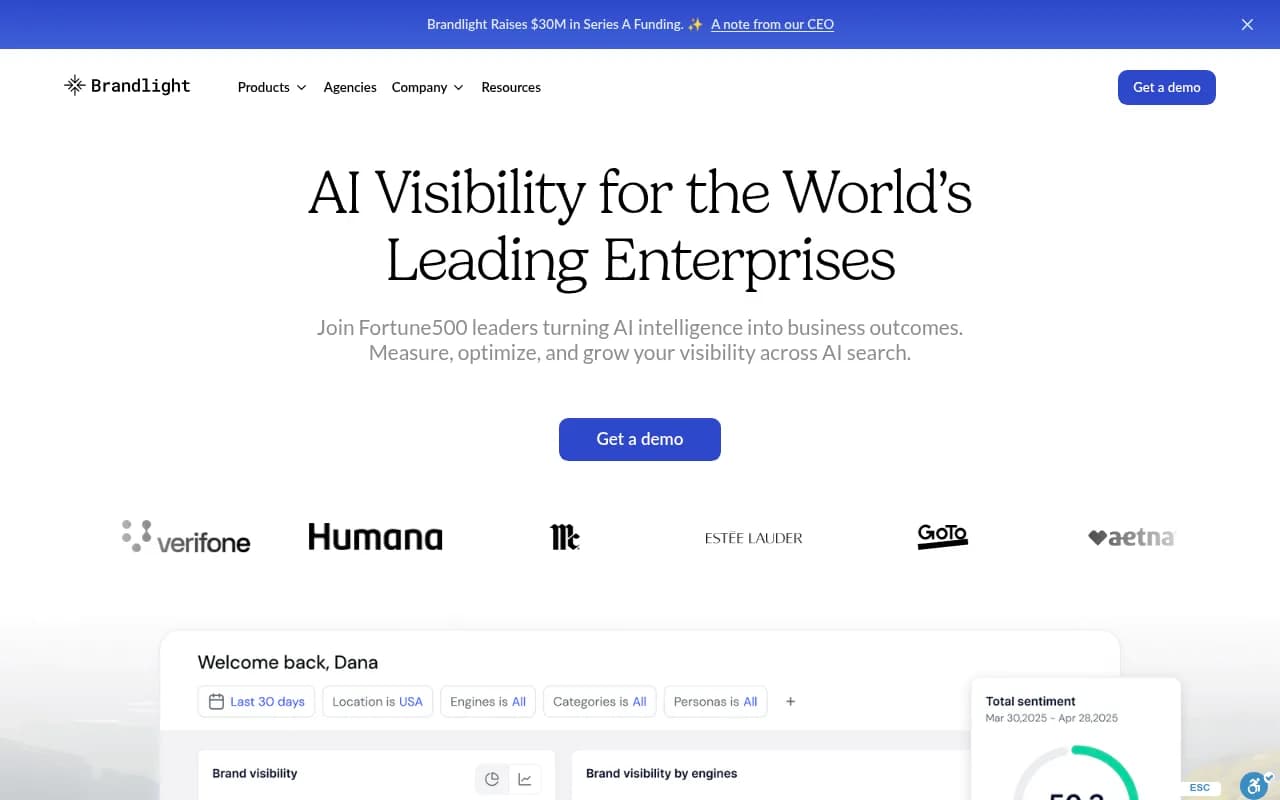
Brandlight raised $30M in Series A funding and positions itself as an AI visibility platform for enterprises. It tracks brand presence across AI search engines and provides real-time insights.
The details are thin -- the website focuses on funding announcements and client logos (Mastercard, Estée Lauder, GoTo) rather than specific features. Pricing ranges from $199/mo base tier to $750/mo activation plan, with custom enterprise pricing available.
Compared to Bluefish: Brandlight costs less at the low end ($199-$750/mo vs $4,000+/mo) but the feature set is unclear. The funding announcement and enterprise client list suggest they're chasing the same Fortune 500 market as Bluefish, but with less transparency about what you're actually getting. Without clear feature differentiation or public case studies, it's hard to recommend Brandlight over more established alternatives.
Best for: Unknown. The lack of feature transparency makes it difficult to identify a clear use case.
Evertune
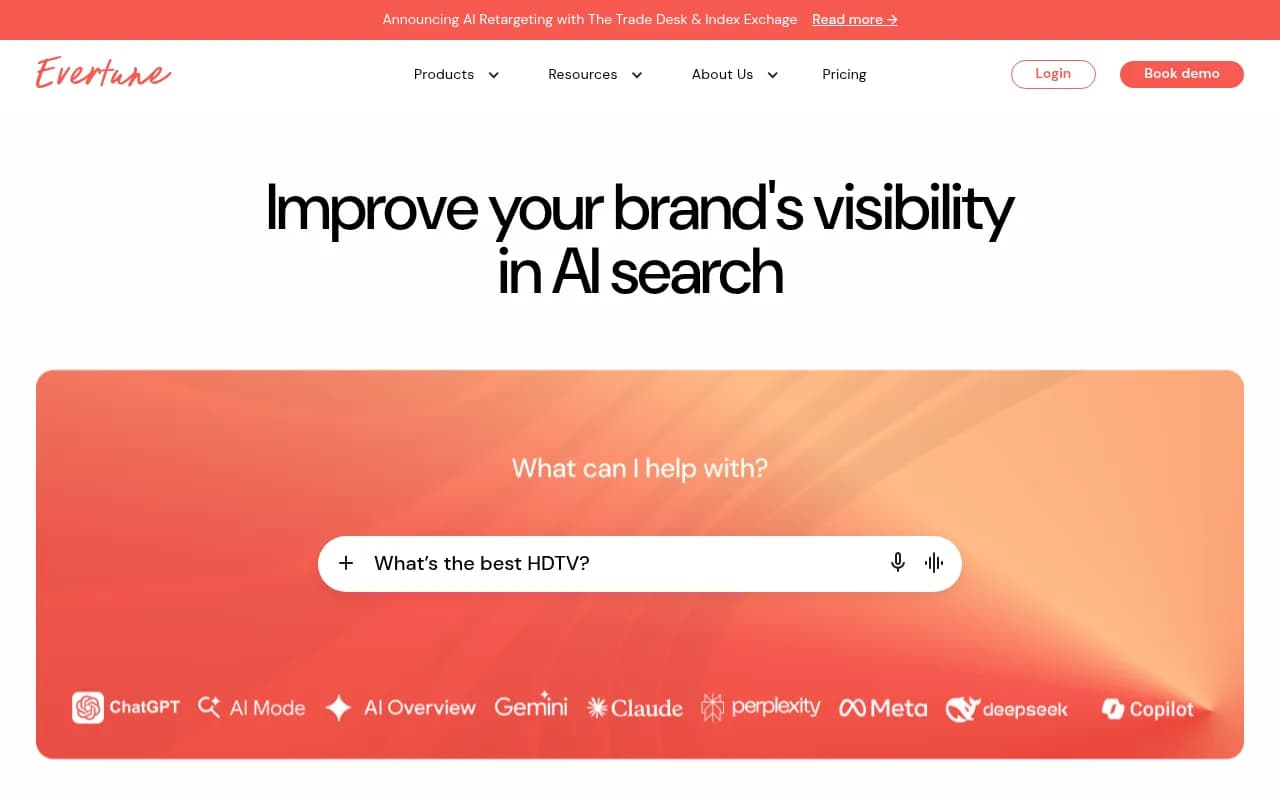
Evertune is a Generative Engine Optimization platform built for Fortune 500 brands and agencies. It combines AI brand monitoring, website optimization for AI crawlers, data-driven content strategy, and partnership activation.
The platform is used by Miro, Roku, Virgin Voyages, and WPP. The pitch: turn AI search into your newest growth channel with comprehensive visibility, competitor intelligence, and optimization tools.
Pricing starts at $3,000/mo with annual contracts. No free trial.
Compared to Bluefish: Evertune and Bluefish target the same Fortune 500 market at similar price points ($3,000-$4,000+/mo). Both emphasize "enterprise-grade" features and white-glove service. The difference: Evertune includes website optimization audits (showing how AI crawlers interpret your site) and partnership activation (identifying influential sources and helping you activate them). Bluefish focuses on monitoring depth and custom audiences. If you need help optimizing your website for AI discovery, Evertune is the better choice. If you want maximum monitoring customization, Bluefish wins.
Best for: Fortune 500 brands and agencies with $36k+/year budgets that need both monitoring and website optimization.
Azoma
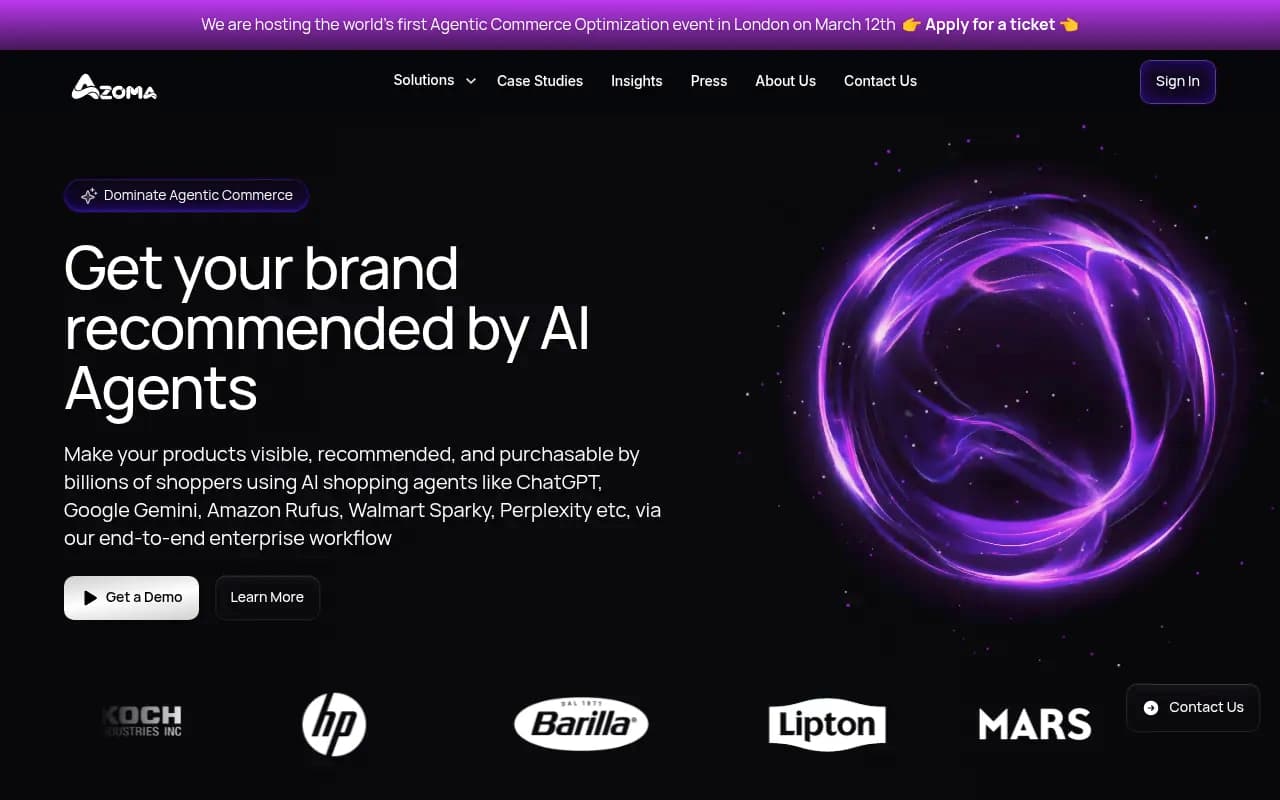
Azoma is an Agentic Commerce Optimization platform focused on AI shopping agents. It helps consumer brands and retailers get discovered in ChatGPT, Amazon Rufus, Walmart Sparky, Google Gemini, and Perplexity shopping features.
The platform monitors product visibility across AI shopping agents, generates optimized product listings at scale, and tracks performance. It's used by HP, Mars, Zappos, and Canadian Tire.
Pricing: Enterprise custom quotes based on SKU count, AI platforms monitored, and markets covered. No transparent tiers or free trial.
Compared to Bluefish: Azoma is a niche player focused exclusively on e-commerce and AI shopping agents. Bluefish is a general-purpose AI visibility platform. If you're a consumer brand or retailer trying to get products recommended by ChatGPT or Amazon Rufus, Azoma is purpose-built for that use case. If you're tracking brand visibility more broadly (not just product recommendations), Bluefish is the better fit. Both have enterprise pricing with no transparency.
Best for: Consumer brands and retailers with large product catalogs that need to optimize for AI shopping agents specifically.
How to choose the right Bluefish alternative
Start with your budget. If you're spending $4,000+/month on Bluefish, you're paying for enterprise features most teams don't need. Promptwatch gives you the full optimization loop (monitoring, content gap analysis, AI content generation, crawler logs, traffic attribution) for $99-$579/mo. That's 7-40× less.
If you're a Fortune 500 brand with a dedicated AI visibility team and enterprise infosec requirements, Bluefish's white-glove service and custom audiences might justify the premium. But most companies in that category should also evaluate Profound (if you need content generation at scale) or Evertune (if you need website optimization for AI crawlers).
If you're a mid-market team that just needs monitoring and competitive intelligence without optimization tools, AthenaHQ costs less than Bluefish ($1,000-$3,000/mo vs $4,000+/mo) and delivers similar monitoring depth.
If you're already paying for Semrush and want to add basic AI visibility tracking, the $99/mo AI Visibility Toolkit is a cheap add-on. But don't expect it to replace a dedicated GEO platform -- the fixed prompt set and limited features make it a supplement, not a solution.
If you're an e-commerce brand focused specifically on AI shopping agents (ChatGPT Shopping, Amazon Rufus, Walmart Sparky), Azoma is purpose-built for that use case.
The real question: do you just want to monitor where you stand, or do you want to actually improve your visibility? Most Bluefish alternatives (AthenaHQ, Semrush, Brandlight) stop at monitoring. Promptwatch, Profound, and Evertune give you optimization tools. Promptwatch is the only one that combines monitoring, content gap analysis, AI content generation, and crawler logs at a price mid-market teams can afford.