Tavily Review 2026
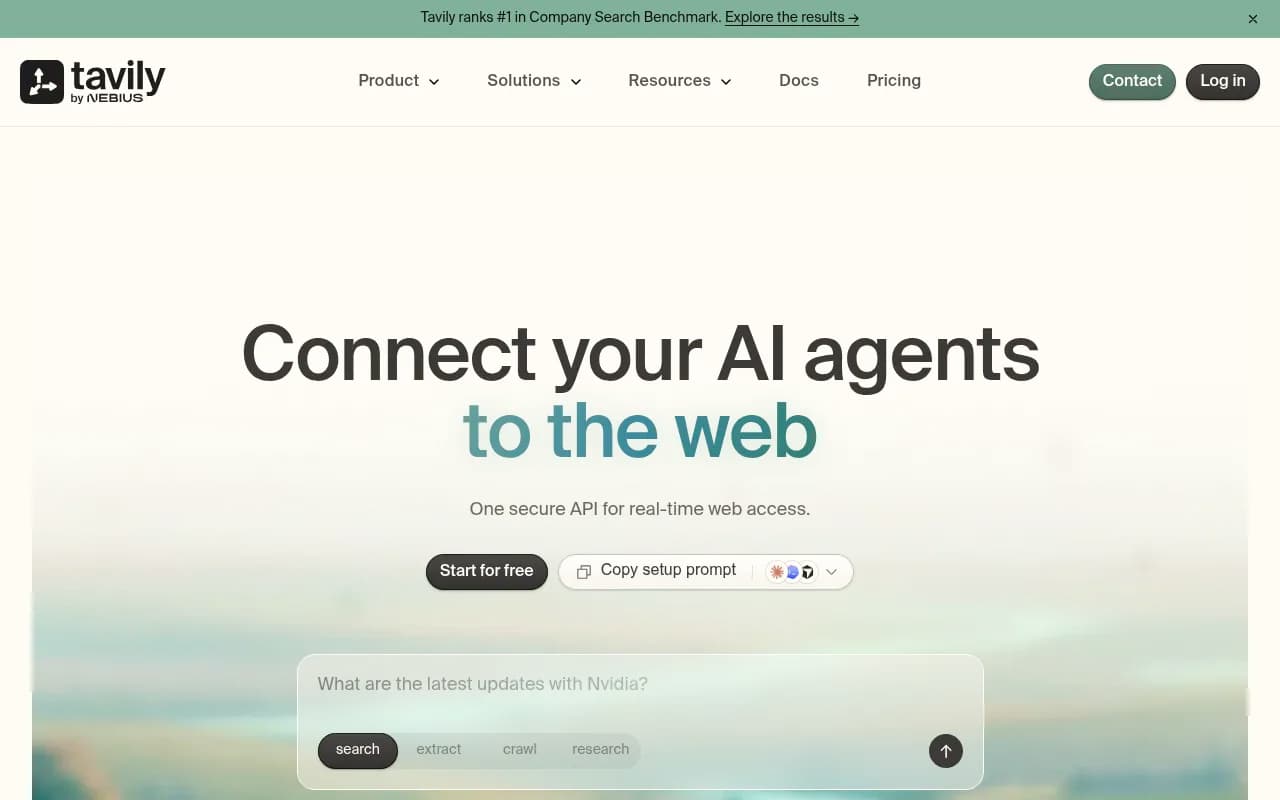
Tavily gives AI agents and RAG apps a single API for live web search, content extraction, crawling, and research. Built for developers and enterprise teams, it returns chunked, model-ready results with PII and prompt-injection safeguards and a 99.99% uptime SLA.
Key takeaways
- Tavily is a search and extraction API made for LLM agents. It returns structured, chunked results instead of a page of blue links, which saves developers the scraping and cleanup work.
- The free tier gives 1,000 credits a month and paid plans run from $30 to $500 a month, with pay-as-you-go at $0.008 per credit. Credit math is easy to get wrong if your agent picks the wrong mode.
- Security is a real selling point: SOC 2, ISO 27001, GDPR, zero data retention, and built-in blocking of PII leakage and prompt injection.
- It is a developer tool. It is not a brand monitoring or AI visibility product, and non-technical marketers will get nothing from it directly.
- Weak spot: JavaScript-heavy single-page apps can come back thin, according to a competitor's comparison, so test your own target sites.
Tavily describes itself as the real-time search engine for AI agents. The pitch is simple. Language models go stale the moment training ends, and they hallucinate when asked about things they never saw. Tavily sits between the model and the open web, runs the search, pulls out the relevant text, and hands it back in a shape an LLM can use immediately. One API, a handful of endpoints, and you can ground an agent in fresh facts.
The company raised a $25M Series A, reported by TechCrunch in August 2025, and the homepage now carries a post titled "Tavily is Joining Nebius." A secondhand LinkedIn post claims a $400M acquisition, but I could not verify the price or terms, so treat that number as unconfirmed. What is not in doubt is adoption: Tavily says 3M+ developers use it and it handles 300M+ requests a month. It has become a default choice in agent frameworks, particularly LangChain, where it shows up in countless tutorials.
The audience is developers building agents, copilots, research assistants, and RAG pipelines, plus enterprise teams that need those agents to touch the web without creating a compliance headache. Named customers on the site include JetBrains, IBM, MongoDB, Mastercard, BMO, monday.com, Writer, Groq, and Rox.
Key features
Search. The core endpoint, tavily.search(), takes a query and returns ranked results with relevant content chunks already extracted. You control a few knobs that matter in practice:
search_depthswitches between a cheap basic pass and a deeper advanced pass.max_resultscaps how many documents come back.include_answercan add an LLM-generated summary on top of the raw results.- Domain and topic filters narrow where results come from.
Compared with Google-style SERP APIs such as Serper or SerpApi, which hand you links and snippets that you must still fetch and clean, Tavily does the retrieval step for you. Brave and Exa sit closer to Tavily in intent, though Exa leans on neural, embedding-based search.
Extract. Give it URLs and it returns cleaned page content. Pricing is clear: every 5 successful extractions cost 1 credit on basic, 2 credits on advanced. You are never charged when an extraction fails, which is a nice touch when you are crawling messy pages at volume.
Crawl and Map. Crawl walks a site and pulls content. Map discovers the structure of a site, with optional natural-language instructions that steer where it goes. Cost depends on pages mapped and whether you use instructions. This puts Tavily in the territory of Firecrawl, though Tavily's pitch is that it is one account for search and crawling rather than two vendors.
Research. A higher-level endpoint that runs a multi-step research job and returns a report. There are two models, mini and pro. A mini request costs 4 to 110 credits, and a pro request costs 15 to 250 credits. That is a wide range, and it is the thing I would watch most closely on a budget. A research call is not a flat price.
Built-in safeguards. The homepage demo shows a query containing an email address getting blocked with a "PII detected" error. Requests pass through security, privacy, and content validation layers that block PII leakage, prompt injection, and malicious sources. If your legal team has ever said "no" to agents browsing the web, this is the feature that changes the conversation. Zero data retention is available for sensitive workloads.
Speed and scale. Tavily claims 180 ms p50 latency on /search and says that makes it the fastest on the market. That is a vendor claim, so benchmark it from your own region. The 99.99% uptime SLA is the more useful promise for production.
Benchmarks. Tavily publishes its own evaluation work. It claims the #1 spot in a Company Search benchmark it built, and it says it ranks first on SealQA and SimpleQA. The company search dataset is on Hugging Face with a stated methodology: the same models for every provider, a shared AI judge, and a max of 10 documents per query. Good transparency, but remember Tavily wrote the benchmark. I would run a small test on your own queries before believing any leaderboard.
Who is it for
The sweet spot is a developer or small team shipping an agent that needs current facts. Think a founder building a sales research bot, a platform engineer adding web grounding to an internal assistant, or a data team enriching company profiles. Rox's case study describes cutting account research from a week to seconds, and Peerbound reports description accuracy rising from 20% to 100%. JetBrains uses it to stop coding assistants from inventing library methods.
Enterprise buyers in finance, legal, and cybersecurity are a second audience. BMO (AML work), Bell Cyber, and Troutman Pepper Locke appear among customers, and the SOC 2, ISO 27001, GDPR, and ZDR badges are aimed squarely at procurement reviews. Students get free access too, according to the pricing page.
Who should skip it? Marketers and SEO teams hoping to see how their brand shows up in ChatGPT or Perplexity. Tavily feeds data to agents. It does not measure brand visibility. Teams that only need classic SERP data for rank tracking will find a plain SERP API cheaper. And anyone scraping JavaScript-heavy single-page apps should test first, since Brave's comparison says Tavily can return empty or incomplete pages there. Brave sells a rival product, so take that with salt, but it matches a common failure mode of extraction tools.
Integrations and ecosystem
The ecosystem is where Tavily is strongest. It works with the major agent frameworks, notably LangChain, and the homepage offers a copy-paste setup prompt for Claude, Codex, and Cursor. Databricks lists Tavily on its MCP Marketplace, IBM's CUGA agent uses it as its web search tool, and JetBrains has integrated it for real-time AI search. AWS and MongoDB appear as ecosystem partners.
Developer experience is solid. The GitHub org is tavily-ai, and the Python SDK covers search, extract, crawl, map, and research. There is a REST API, and docs at docs.tavily.com cover credits, endpoints, and parameters. An MCP server lets MCP-compatible clients call Tavily as a tool. I did not find a Discord community, but there are live Office Hours (one is scheduled for Nov 17) and an in-person event, World of Tavily NYC, on November 12.
Export is not really a concept here. Results come back as JSON, and you pipe them wherever you want.
Pricing and value
Pricing runs on credits. Verify current numbers at tavily.com/pricing before buying.
- Researcher (free): 1,000 credits a month.
- Project: 4,000 credits for $30 a month ($0.0075 per credit).
- Bootstrap: 15,000 credits for $100 ($0.0067).
- Startup: 38,000 credits for $220 ($0.0058).
- Growth: 100,000 credits for $500 ($0.005).
- Pay as you go: $0.008 per credit.
- Enterprise: custom pricing and volume.
A basic search is cheap, and an advanced one costs more. Research calls can burn up to 250 credits each. A dev.to comparison that scored Tavily 8.6/10 warned that an agent unable to pick between basic and advanced mode will either overspend or return shallow results. In practice that means you should hard-code the mode or add guardrails rather than let a model decide freely.
The free tier is generous enough to prototype a real agent. Against Exa, which one Reddit commenter found too expensive at scale, Tavily's tiered credit pricing looks predictable. Against bare SERP APIs it is pricier per query, but you skip the scraping and chunking work, which is the actual cost for most teams.
Strengths and limitations
Strengths
- Results arrive chunked and relevant, so there is less glue code between search and the LLM.
- Security and compliance coverage is unusually complete for a developer API: SOC 2, ISO 27001, GDPR, ZDR, PII blocking, and prompt injection defense.
- Broad framework and marketplace support makes it easy to drop in.
- Failed extractions are free, and the free tier is real.
- Published benchmark data and a public Hugging Face dataset, even if self-authored.
Limitations
- Credit costs vary with mode and endpoint, and research calls can get expensive fast.
- JavaScript-heavy single-page apps may return incomplete content, per a competitor's comparison.
- The benchmark rankings and the speed claims come from Tavily itself. Independent verification is thin.
- The Nebius acquisition news may change roadmap and pricing over time. Watch for announcements.
- It is a retrieval layer only. It does not monitor how AI engines talk about your brand.
Bottom line
If you are building an agent that needs live web context and your company cares about security review, Tavily is one of the easiest ways to get there. Start with the free 1,000 credits, run your real queries against Exa, Brave, and Tavily, and compare answer quality and cost per useful result rather than trusting anyone's leaderboard, including Tavily's.
Best use case in one sentence: giving production LLM agents safe, fast, structured access to fresh web data.
Frequently asked questions
What is Tavily?
How much does Tavily cost?
Who is Tavily for?
Is Tavily secure for enterprise use?
How does Tavily compare to Exa, Brave, and Serper?
Does Tavily have a free plan?
Similar and alternative tools to Tavily