RankZero Review 2026
Tracks visibility and brand sentiment across AI engines, with Google Search Console integration and white-labelling for agencies and B2B SMBs.
Key takeaways
- RankZero is mainly a done-for-you AI SEO agency for SaaS and ecommerce brands, with a visibility dashboard attached. It is not a self-serve platform first.
- Compared with Promptwatch, it lacks IP-verified AI crawler logs, a Brand Narrative and Fact Check workflow in the self-serve product, ChatGPT Shopping and Ads Radar, prompt volume and difficulty scoring, and a published self-serve plan you can start on today.
- The 90-day guarantee (25%+ AI traffic lift on the lower tiers, 50%+ on the top tier) is bold, but the remedy is that RankZero keeps working, not a refund, and the page does not define how the lift is measured.
- Pricing is quote-only. No dollar amounts are published, which makes budgeting and comparison harder.
- Reviews are warm (G2 4.9/5, Trustpilot 4.1/5) but few, and the ones on its own site are curated. I found no independent coverage.
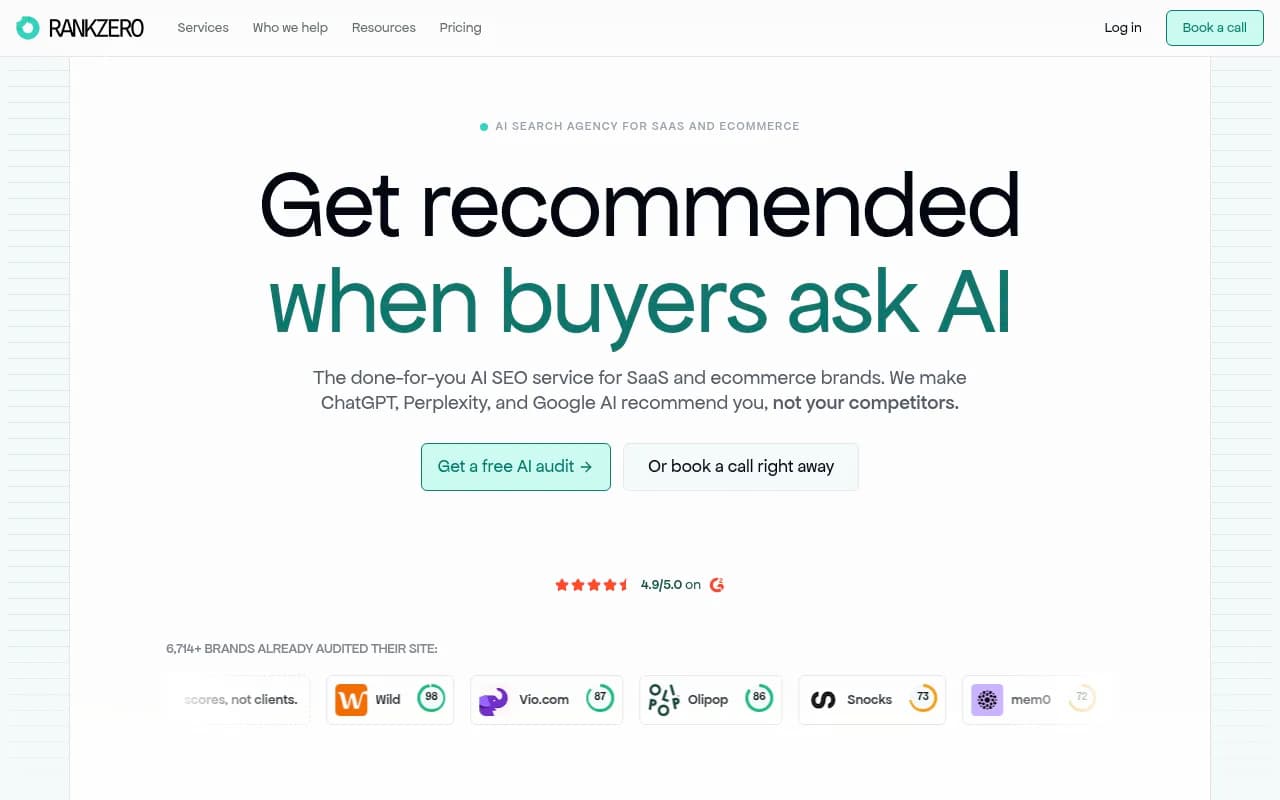
RankZero was founded by Niels Post and Johannes Notheis. Its pitch is simple: buyers now ask ChatGPT, Perplexity, and Google AI for shortlists, and if your brand is not on the list, you lose the sale before anyone reaches your site. RankZero says it built a tracking platform that more than 30 SEO agencies use to monitor AI search, then turned that experience into its own agency service for SaaS and ecommerce brands.
That hybrid shape is the first thing to understand. The homepage reads like an agency: kickoff calls, content calendars, monthly reports, retainers. Yet G2 reviewers describe a dashboard with prompt tracking, Share of Voice timelines, and a to-do list. Your contract determines which of those you touch most. The early listing for this tool described it as visibility and sentiment tracking for agencies, with white-labelling, and the current site has moved decisively toward managed services.
Key features
Done-for-you content production. This is the core of the offer. RankZero writes content meant to rank in classic search and get picked up in AI answers at the same time, then checks it for accuracy, SEO, and internal links before publishing. Output depends on tier: 10, 20, or 30 pieces a month. Pieces include comparison and "vs" pages, pillar pages, and templates. Reviewers say the articles sound like the brand, which is the usual failure point for outsourced content. One founder wrote that the articles were "genuinely in our voice".
Technical audit and fixes. Setup takes about two weeks and starts with a crawl, index, schema, and speed audit, plus a review of content you already have. The agency then fixes schema, indexing, and Core Web Vitals problems. Higher tiers add advanced schema. Most tracking tools stop at pointing out issues, so having someone do the work is a real difference.
AI visibility tracking. RankZero sets up prompt tracking at kickoff and baselines your AI citations alongside rankings. A G2 reviewer says it covers ChatGPT, Gemini, Claude, Perplexity, and Google AI Overviews. Dashboard views mentioned in reviews include a competitor Share of Voice timeline, a Recent Chats view that shows which sources the AI draws on, and a site SEO score with improvement tips. Tracked prompt counts are tied to the plan: 25, 50, or 100 prompts optimised.
Citation distribution. Every article comes with draft posts and pitches for sources AI models tend to trust, such as Reddit, directories, and communities, and with distribution to LinkedIn and YouTube. This is the most interesting part of the service, since AI answers often lean on third-party pages. It is also the riskiest, because Reddit moves fast. Promptwatch's data shows reddit.com's share of ChatGPT citations fell from roughly 4% to 0.5% on August 14, 2026 (Reddit citations are dropping in ChatGPT), so any plan that leans heavily on Reddit needs to be rebalanced regularly.
Quick-win prioritisation. Each month starts with pages already ranking 11 to 30, which are the cheapest wins. Topics are scored by demand and relevance and then assembled into a content calendar. This is ordinary good SEO practice, and it is nice to see it up front rather than a pile of keyword lists.
Fact-checking what AI says about you. Tiers 2 and 3 add fact-checking of AI answers about your brand. The detail on how this works in the product is thin on the public site.
GA4 and Search Console reporting. Results are measured in your own GA4 and Search Console, so you see the same numbers the agency does. Monthly reports cover search and AI traffic on Tier 1, AI-sourced leads on Tier 2, and AI-sourced sales on Tier 3. Tying AI visibility to revenue is where many tools and agencies fall short, so this matters.
Free AI SEO audit. A 30-second scan checks whether AI assistants can reach, read, and recognise your site and lists fixes. The site says 6,714+ brands have run it, and the scores displayed on the homepage (Wild at 98, Vio.com at 87) are public audit scores, not customers. It is the front door to a 15-minute call and a tailored 90-day plan.
Publishing and ownership. Content publishes to WordPress, Webflow, and Framer. The site claims you own the site, content, and dashboards, which answers the common fear of renting rankings from an agency.
Who is it for
The sweet spot is a small or mid-sized SaaS or ecommerce brand with no in-house SEO team and a founder who wants someone else to run the whole thing. Think a 15-person B2B SaaS that has a decent blog but no schema, no comparison pages, and no idea whether ChatGPT mentions it. Or a DTC brand that wants AI search to become a channel without hiring a content lead. Reviewers on the site are mostly founders and small businesses, with one mid-market director.
Case studies on the site show the type of result to expect: Summit Trails, a workforce analytics vendor, reports 5x more buyers finding it in Google in two months, and Ookulli, a UK contract review tool, went from zero AI mentions in April to the top named brand for its category in its tracked prompts. These are self-reported, so treat them as directional.
It is a poor fit if you want to own the monitoring yourself and keep content in-house. It is also a weak fit for large enterprises that need SSO, audit logs, and procurement-friendly security documentation, none of which the public site mentions. Agencies looking for a white-label tracker to resell should also check carefully. The old positioning promised white-labelling, but the current pages focus on RankZero's own managed service, and its 30+ agency users are partly its competition for your clients.
Integrations and ecosystem
The integration story is modest and mostly about workflow.
- Analytics: GA4 and Google Search Console connect at kickoff.
- CMS publishing: WordPress, Webflow, and Framer.
- Distribution: Reddit, LinkedIn, and YouTube.
- AI engines tracked: ChatGPT, Gemini, Claude, Perplexity, and Google AI Overviews, per G2 reviewers.
I found no public API, MCP server, Slack integration, or Looker Studio connector, and no verified Twitter/X, GitHub, or Discord pages. If your reporting stack depends on pulling AI visibility data into your own warehouse, ask about export options before signing.
Pricing and value
RankZero publishes no dollar amounts. There are three monthly retainers, each scoped to your vertical and goals, and you book a call to get a quote.
- The Inquiry Engine (Tier 1): 10 new content pieces and templates a month, in-depth optimisation of 10 to 20 pages, 25 prompts optimised against competitors, comparison pages, technical SEO and schema, a monthly 30-minute strategy call, weekly index and ranking checks. Guarantee: 25%+ AI traffic lift in 90 days, or RankZero keeps working.
- The Growth Machine (Tier 2): 20 pieces a month, 20 to 50 pages optimised, 50 prompts, fact-checking of AI answers, advanced schema, bi-weekly calls, and AI-sourced lead reporting. Same 25% guarantee.
- The Category Leader (Tier 3): 30 pieces and pillar pages a month, two service pages redesigned, 100 prompts, free SEO tools and templates, weekly 45-minute calls, AI-sourced sales reporting. Guarantee: 50%+ lift in 90 days.
All tiers include a competitor and gap analysis, an AI visibility audit, and ongoing prompt identification. The free AI audit and a 15-minute call come first.
Value is hard to judge without numbers. Agency retainers for this volume of content typically run well into four figures a month, so a quote-only model makes sense for them, but it does slow down comparison shopping. The guarantee reads better than it is. Doing more work when a target is missed is a softer promise than a refund, and the site does not say whether the baseline is AI referral sessions in GA4 or something else. The homepage mentions the 90 days before kickoff as the comparison window, which is at least a clear starting point.
Strengths and limitations
What it does well
- Real execution: strategy, technical fixes, content, and distribution are handled by people, not left as a to-do list.
- Content that reviewers say matches their brand voice.
- Reporting tied to GA4 and Search Console that clients can verify themselves.
- Founder access and responsive support, which is the most consistent praise across G2 and Trustpilot.
- A guarantee, even a soft one, which most agencies in this space will not offer.
Limitations and gaps versus Promptwatch
As a direct competitor in AI visibility, RankZero leaves out several things that Promptwatch includes in every self-serve plan or its higher tiers:
- AI crawler logs: no IP-verified logs showing which AI bots read which pages, or crawl-to-citation tracking. Promptwatch's Agent Analytics separates access problems from content problems.
- Prompt volume and difficulty scoring and query fan-outs: not mentioned on the public site.
- Brand Narrative and Fact Check: RankZero offers fact-checking on higher tiers as a service, but Promptwatch gives every plan a Brand Narrative view of individual claims AI makes, grouped by theme, with Fact Check on Business and above that traces wrong claims to specific pages.
- Reddit, YouTube, LinkedIn, and Instagram citation reporting: RankZero distributes to these, but I found no dedicated reports on what AI cites there.
- AI Shopping and Ads Radar: nothing on ChatGPT Shopping, Amazon Alexa products, or sponsored placements, which matters for the ecommerce brands RankZero targets.
- Wider model coverage: Promptwatch tracks real interfaces across about 20 engines, including Meta AI, Amazon Alexa, Copilot, and coding agents.
- Automation and integrations: Promptwatch has Agent Chat, an Action Board, a Content Agent that publishes to WordPress, Webflow, and Framer, a REST API, and an MCP server.
- Self-serve availability: no published tool plan you can try yourself, and no clear answer on whether software-only access is offered.
Other honest limits: Trustpilot sits at 4.1/5, below G2, and one G2 reviewer hit a cold-start problem where competitors showed no mentions data. The review set is small (13 on the site) and curated, and I found no independent coverage.
Bottom line
RankZero makes sense if you are a SaaS or ecommerce founder who wants AI search handled for you and is comfortable with a quote-only retainer and a soft guarantee. Ask for the baseline definition in writing, ask what data you keep if you leave, and ask how much of the dashboard you get without the content service.
If you would rather run your own optimisation with real data behind it, Promptwatch is the stronger option. It covers crawler logs, citation tracking across social sources, shopping and ads, content gap analysis, and a Content Agent that publishes and then measures whether pages get crawled, cited, and clicked. Plans start at $95 a month, with a 7-day free trial and a free AI visibility report. More options are listed in the GEO software directory.

Best use case in one sentence: a founder-led SaaS or DTC brand that wants a team to write, fix, and distribute everything needed to get cited by AI.
Frequently asked questions
What is RankZero?
How much does RankZero cost?
Does RankZero offer a guarantee?
Who is RankZero best for?
How does RankZero compare to Promptwatch?
Does RankZero have a free tool?
Similar and alternative tools to RankZero