SearchApi Review 2026
SearchApi is a pay-per-success SERP API that returns structured JSON from Google, Bing, YouTube, Amazon, Reddit, ChatGPT, Gemini and 100+ other engines. Built for developers, SEO teams and AI builders, with geo-targeting, legal coverage and plans from $40/month.
Key takeaways
- SearchApi is a multi-engine SERP API with usage-based plans from $40/month (10,000 searches) and a 100-request free trial, no card needed.
- You only pay for successful requests, and a $2M Legal Protection Guarantee comes on the $100 plan and above. Few competitors offer anything like that.
- It is infrastructure, not an AI visibility product. It returns raw search data, with no dashboards, content tools, crawler logs or traffic attribution. Teams that want to improve visibility in AI search will find Promptwatch a much better fit, since it tracks, diagnoses and fixes rather than just fetching data.
- Weak spots: a 20% hourly credit cap that hurts bursty jobs, a higher entry price than budget providers, and a breaking Google Hotels change in the latest update.
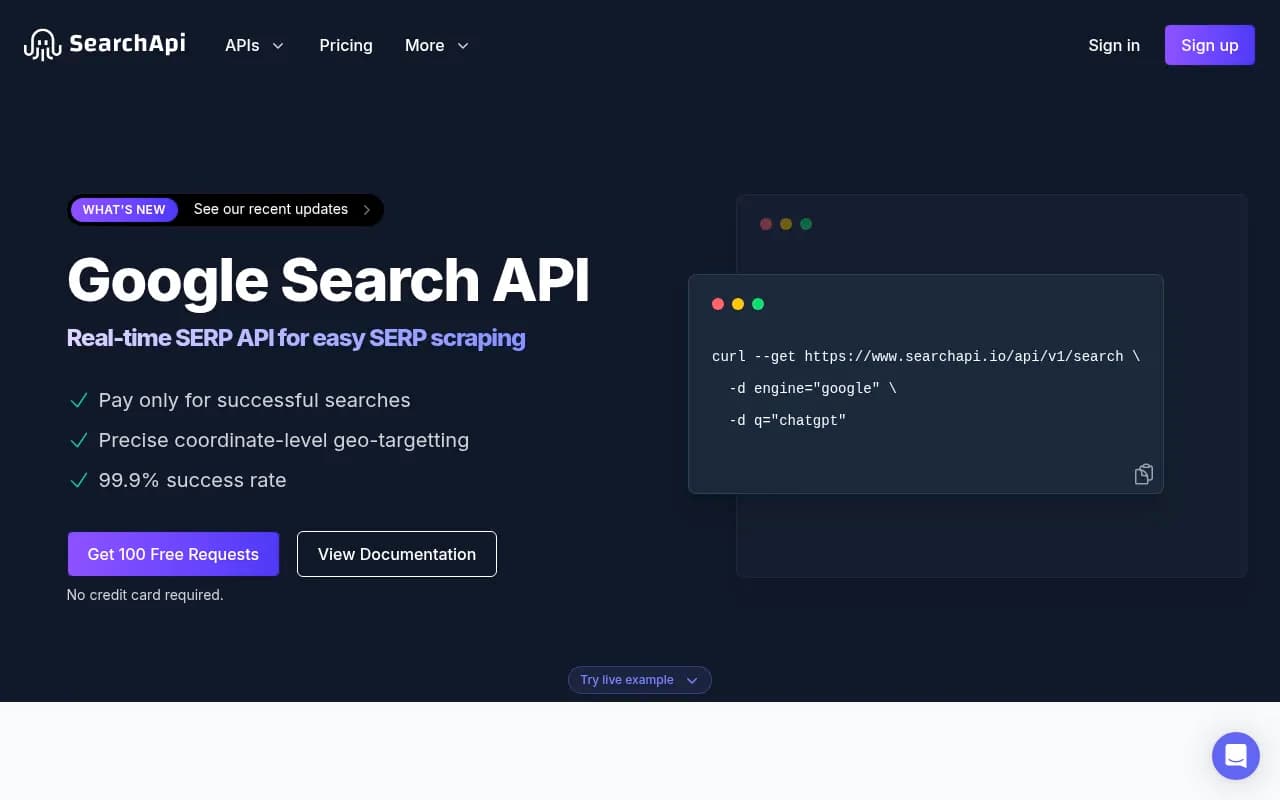
SearchApi (searchapi.io) is a real-time search scraping API. You send a GET request with an engine name and a query, and it hands back parsed JSON: organic results, ads, knowledge graph, People Also Ask, related searches, maps listings, inline videos and Google's AI Overview. It handles the proxies, CAPTCHAs and browser rendering you would otherwise build yourself. The sample response on the homepage for the query "chatgpt" shows a total time of about 1.3 seconds, which matches the sub-2-second average the company advertises.
It started as a Google Search API and has grown into a broader platform. The latest changelog entry, posted this month, added 26 new APIs at once, including Reddit Search, Skyscanner flights and hotels, LinkedIn Jobs, GitHub Trending, Yelp, six TikTok endpoints and Yandex media. The customer logos on the site include Anthropic, Bain & Company, Scale AI, Ahrefs, DataRails and Demyst. Those are the company's own claims, so treat them as marketing.
The audience is developers. Think SEO tool builders, LLM application teams feeding live web results into agents, market researchers and data engineers. If you want a dashboard, look elsewhere. If you want an endpoint you can call from Python, Node, Ruby, Go or cURL, this is the category.
Key features
Real-time Google SERP parsing. The core Google Search API returns organic results with position, snippet, sitelinks, rich snippets and dates, plus ads, news, knowledge graph, related searches, People Also Ask, local maps results and AI Overview. The JSON is well structured, with a search_metadata block that gives you a request ID, timing and a stored HTML copy of the page. That HTML URL is handy when a parsed field looks wrong and you need to see what Google actually served.
Coordinate-level geo-targeting. You can target by country, language, device and down to exact coordinates. Rank tracking for a multi-location business needs this. The sample response shows the detected location (a Missouri ZIP code), so you can verify targeting worked.
Multi-engine coverage. Beyond Google, SearchApi covers Bing, DuckDuckGo, Yandex, YouTube, Amazon, Yahoo, Zillow and Google verticals like Hotels, Events, Lens and Maps. October's update added country targeting for ChatGPT and Gemini and AI summaries for Amazon Product and Yahoo. One API key and one response style across all of them is the real draw. Competitors tend to be strong on a handful of engines and thin elsewhere.
Pay-per-success billing. You are charged only for requests that return a 200 status. Failed requests cost nothing. The site pairs this with auto-retry and adaptive error handling, plus a claimed 99.9% success rate. Be a little skeptical of the homepage's "100% success rate" tile, since it contradicts the 99.9% claim elsewhere. Still, billing on success is the right model for a scraping service.
Proxy and CAPTCHA infrastructure. Requests run through a rotating proxy network (the homepage says 100M+ proxies, the pricing page cites 20M+, so the numbers are inconsistent) with full browser rendering, JavaScript execution and CAPTCHA solving. You never touch any of it. For teams that have fought Google's anti-bot systems, that is most of the value.
Legal Protection Guarantee. SearchApi accepts legal responsibility for how it collects and parses public search results, with up to $2M in coverage, under U.S. law. It does not cover how you use the data. This matters for enterprise legal reviews, and it is a genuine differentiator. It is only available from the $100 Production plan.
Enhanced speed option. Every plan comes in Standard and Enhanced variants. Enhanced uses parallel threads for nearly 2x the speed. The scraped page does not show the Enhanced price, so check the pricing page.
Developer experience and AI framework integrations. Documentation includes request examples in Python, Node, Ruby, Java, Go, PHP, Bash, R, Kotlin, Swift, C#, C and C++. There are open-source integrations for Dify, Flowise, LangChain and Haystack, which is why AI teams use it for agent tool calls. A live example on the homepage lets you test a query before signing up.
Security and compliance. The Trust Center lists SOC 2 Type II, ISO/IEC 27001:2022 and GDPR documentation. For a scraping vendor that is more than most offer.
Who is it for
The sweet spot is a developer or small engineering team that needs reliable SERP data without running scrapers. A SaaS founder building a rank tracker for a few thousand keywords, an AI startup grounding an agent in live search results, or a data team pulling Google Hotels and Skyscanner prices for a travel product would all fit. The Production plan at $100 for 35,000 searches suits most of these.
Larger users, such as SEO platforms and data vendors running hundreds of thousands to millions of queries a month, can drop to $1 to $1.8 per 1,000 on the Octo tiers, which add dedicated throughput and priority support. The customer logos suggest this is where much of the revenue comes from.
It is a poor fit for marketers who want a finished product. There is no UI for tracking keywords over time, no reporting, and no content tooling. If your goal is to see how your brand appears in ChatGPT, Perplexity or Google AI Overviews and then act on it, a raw SERP API is the wrong layer. Platforms like Promptwatch exist for that, with prompt tracking, citation analysis, crawler logs and a Content Agent. Bursty workloads are also a problem because of the hourly cap, covered below.
Integrations and ecosystem
The API is a single REST endpoint (/api/v1/search) with an engine parameter, so integration is a simple GET. Results come back as JSON, and each search is stored so you can fetch it again via a JSON or HTML URL.
For AI work, the listed integrations are Dify, Flowise, LangChain and Haystack. Language coverage in the docs is broad. There is no native Zapier or Google Sheets connector mentioned on the site, and I did not find an official GitHub repo, Discord or browser extension. Search Analytics (a usage dashboard) arrives on the Scale plan and above. Team Management starts on Production.
Pricing and value
Pricing is monthly with no commitment. Start with 100 free requests, no card.
- Developer: $40/month, 10,000 searches ($4 per 1,000), 99.9% SLA
- Production: $100/month, 35,000 searches ($3 per 1,000), adds Team Management and the Legal Protection Guarantee
- BigData: $250/month, 100,000 searches ($2.5 per 1,000), medium throughput
- Scale: $500/month, 250,000 searches ($2 per 1,000), high throughput and Search Analytics
- Octo 500K: $900/month ($1.8 per 1,000)
- Octo 1M: $1,500/month ($1.5 per 1,000)
- Octo 2M: $2,800/month ($1.4 per 1,000)
- Octo 5M: $5,000/month ($1 per 1,000)
Octo tiers add dedicated throughput and priority support. Custom plans are available on request. Scrapfly's 2026 roundup lists the higher starting price compared with budget providers as a con, and I agree: $4 per 1,000 at the bottom is not cheap. Value improves a lot from the Production tier up, particularly with the legal coverage. Plans are fixed bundles, so you pay for the tier even in a slow month.
Strengths and limitations
What it does well
- Pay-per-success billing, so you are not charged for blocked or failed requests
- Broad engine coverage under one schema, now including social, travel and AI engines
- The $2M Legal Protection Guarantee and SOC 2 Type II and ISO 27001 certification
- Fast responses, around 1.3 seconds in the homepage sample
- Clean documentation with examples in 13 languages
Limitations
- You can use only 20% of your plan's credits per hour. Run a large batch of rank checks at once and you will hit the ceiling, which Scrapfly also flags.
- Dedicated throughput and priority support are locked to the Octo tiers, and Team Management is missing on the $40 plan.
- The latest update included a breaking change to Google Hotels prices, which can break existing integrations. Fast-moving catalogs mean you need to watch the changelog.
- G2 snippets praise fast responses and few failed requests, but I did not verify the overall rating or complaint themes.
Compared with Promptwatch
SearchApi is a data pipe, not an AI visibility platform. It lacks content gap analysis, a Content Agent with CMS publishing, IP-verified AI crawler logs, visitor analytics for AI traffic, prompt volumes and difficulty, query fan-outs, Reddit, YouTube and LinkedIn citation reports, AI Shopping and Ads Radar, Agent Chat and an Action Board. Its ChatGPT and Gemini endpoints return answers for a query, but they do not track your brand over time. Promptwatch monitors the real interfaces of ChatGPT, AI Overviews, AI Mode, Gemini, Perplexity, Copilot and more across 12+ engines.
Bottom line
SearchApi is a solid choice when you need dependable, structured search data and do not want to maintain scrapers. The pay-per-success model, wide engine list and legal guarantee are real advantages, and pricing gets competitive above the $100 tier. Watch the hourly cap before you commit to heavy batch workloads.
If your actual goal is growing visibility in AI answers, buy a platform instead. Promptwatch is the stronger alternative there because it covers optimization, not just retrieval. Best use case in one sentence: a developer team that needs real-time, geo-targeted SERP and AI engine data through one API.
Frequently asked questions
What is SearchApi?
How much does SearchApi cost?
Am I charged for failed requests?
Is SearchApi good for AI visibility or GEO tracking?
What are the main limitations?
Does SearchApi offer legal protection?
Similar and alternative tools to SearchApi