llmtxt.info Review 2026
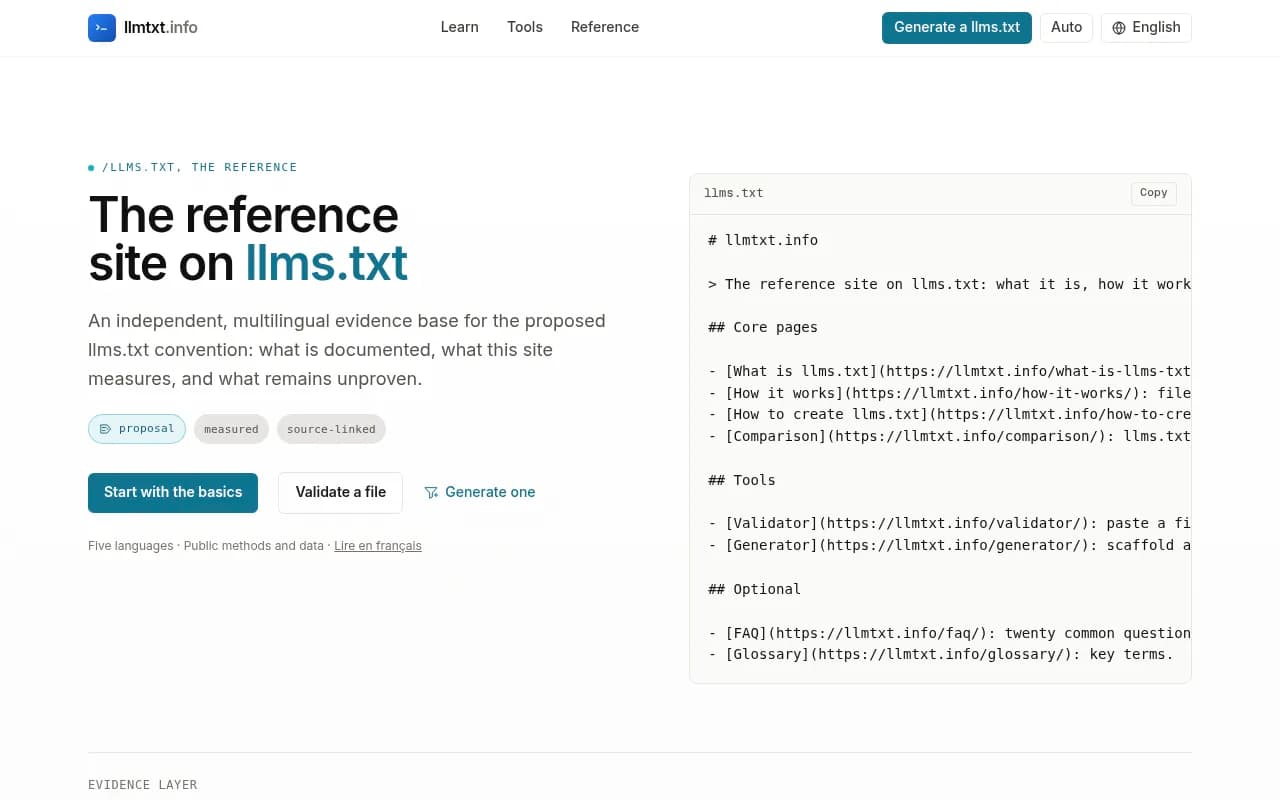
A free tool for generating and validating llms.txt files, plus a guide explaining how to make your site's content readable and usable by AI models.
Key takeaways
- Completely free with no signup, no account system, and no paid tier — llmtxt.info is an editorial and data project, not a SaaS product
- The Observatory is the standout feature: weekly measurements of 217 notable websites with downloadable JSON/CSV, something nobody else publishes at this granularity
- Unusually honest about the convention's limits — the site itself documents that Google does not use llms.txt and that no major LLM provider has confirmed consuming it at inference time
- No social presence, no GitHub repo, and its press coverage comes from PR wires rather than organic editorial — treat the brand accordingly
- Best for developers, technical writers, and SEO/GEO practitioners deciding whether to publish an llms.txt file, not for anyone expecting a full AI visibility workflow
What llmtxt.info actually is
First, a framing correction, because it matters. llmtxt.info is not a software product with a pricing page and seats and onboarding emails. It's a free, independent reference site about the llms.txt convention — the Markdown file proposed by Jeremy Howard of Answer.AI in September 2024 that sits at your site root and gives language models a curated map of your best pages.
The site wraps three things around that topic: a validator, a generator, and a genuinely interesting adoption tracker it calls the Observatory. It also publishes a full guide in five languages (English, French, German, Spanish, Italian) covering everything from file syntax to per-stack deployment instructions for Next.js, Astro, WordPress, Cloudflare Pages, Vercel, and Netlify.
The site is explicit that it isn't affiliated with llmstxt.org, Answer.AI, or any AI provider. That independence cuts both ways — it means the content isn't vendor marketing, but it also means you're trusting an anonymous-ish project with no public team page, no GitHub repo of its own, and a contact email ([email protected]) as the only line of accountability.
The tools: validator and generator
The validator does what you'd hope: paste a file, get conformance diagnostics. No signup wall, no email capture, no "create a free account to see your results." You paste, you read, you leave. The qualification criteria the site uses elsewhere (HTTP 200, plain text content type, valid Markdown H1) are the same ones baked into the diagnostics, so what the validator checks matches what the Observatory measures. That internal consistency is a small thing but it's the kind of thing sloppy projects get wrong.
The generator is a form-based scaffold. You fill in your site name, summary blockquote, and page sections, and it produces a spec-compliant baseline file you can edit. It won't write your file for you — you still need to decide which pages deserve inclusion, which is honestly the hard part anyway. If you want a faster start, Promptwatch also offers a free LLMs.txt generator, and the two are interchangeable for this specific job.
Neither tool will change your life. Both do their jobs cleanly and cost nothing.
The Observatory is the real reason to visit
Here's where llmtxt.info earns its keep. Every week it runs a fixed panel of 217 notable websites and checks whether each serves a qualifying llms.txt file. The latest snapshot I reviewed (August 31, 2026) found 119 of 217 testable hosts, or 54.8%, serving a valid file, with a median file size of 14.0 KB and 83.2% of parsed files including a blockquote summary.
The category breakdown from the prior snapshot is more revealing: developer tools at 68.9% adoption, SaaS at 68.8%, AI/ML companies at 55.6%, but documentation platforms at only 14.3% and media companies at 7.1%. That inversion is odd at first glance — you'd expect docs platforms, the convention's natural constituency, to lead. The site flags its own caveat honestly: the panel is developer-heavy and not a web-wide estimate. A third-party SE Ranking study of 300,000 domains put real-world adoption at just 10.13%.
The data is downloadable as JSON and CSV, the methodology is published, and there's a versioned validator producing public verification receipts. For anyone researching llms.txt adoption — journalists, analysts, SEO teams building a business case — this is the best public dataset I'm aware of.
The honesty is refreshing, and slightly deflating
What sets this site apart from the wave of llms.txt hype content is that it documents the case against its own subject matter. The site states plainly that Google does not use llms.txt for Search or generative features, and that no major LLM provider has publicly confirmed automatic inference-time consumption. It quotes Google's John Mueller's skepticism and cites the SE Ranking finding that an XGBoost model found no correlation between having an llms.txt file and AI citation frequency — removing the variable actually improved the model.
This aligns with what Promptwatch's data shows about markdown files in AI search: markdown makes up roughly 0.05% of all AI search citations, because markdown files like llms.txt are built for AI agents and crawlers to fetch, not for AI search engines to cite. If your goal is being cited in ChatGPT or AI Overviews, publishing an llms.txt file is a low-cost hygiene move, not a strategy. The site says as much, recommending against the file entirely for e-commerce catalogs, media-first sites, sites with unstable URLs, and anything behind heavy auth.
Limitations
No social accounts, no GitHub presence, and press coverage distributed through PR wires (openPR, Getnews) rather than earned editorial. None of this invalidates the work — the methodology pages and corrections ledger suggest real care — but you're relying on the project's self-discipline rather than institutional reputation. The five-language coverage is limited to core pages, not the full guide. And the tools themselves are thin: if you want to know whether AI systems actually read your content, cite your pages, or send you traffic, a validator can't tell you. That requires an AI visibility platform with crawler logs and citation analytics — a category of tool this site deliberately isn't.
Who it's for
Developers and technical writers at SaaS or documentation-heavy companies deciding whether to publish an llms.txt file. SEO and GEO practitioners who need adoption data for a client recommendation. Anyone who's read a breathless "llms.txt will save your SEO" post and wants the sourced, deflationary version. If you already have a file and just need to validate or regenerate it, you'll be in and out in five minutes.
Bottom line
llmtxt.info is a well-built, honest, free resource that does exactly what it claims and nothing more. The Observatory alone justifies bookmarking it. Just go in knowing that the site's own evidence says the file it celebrates is a nice-to-have, not a lever — and if you want to measure whether AI actually uses your content, you'll need a visibility platform on top of it.
Frequently asked questions
What is llmtxt.info?
What is an llms.txt file?
Is llmtxt.info free to use?
Who should use llmtxt.info?
How do I generate an llms.txt file with llmtxt.info?
Can llmtxt.info validate an existing llms.txt file?
Why would I need an llms.txt file for my website?
How is llms.txt different from robots.txt or sitemap.xml?
Does llmtxt.info offer documentation or guides on llms.txt?
Are there alternatives to llmtxt.info for creating llms.txt files?
Similar and alternative tools to llmtxt.info