KIME Review 2026
Tracks presence, sentiment, citations and competitor ad placements across nine AI engines, then turns gaps into automated fixes via agentic executions, MCP and API.
Key takeaways
- KIME is an AI visibility platform that tracks brand mentions, position, sentiment and citations across up to ten AI engines, and pairs it with an execution layer called AWX.
- It is a direct competitor to Promptwatch. It lacks IP-verified AI crawler logs, a Content Agent with CMS publishing to WordPress, Webflow and Framer, Brand Narrative and Fact Check, and Reddit, YouTube, LinkedIn and Instagram citation tracking. It also has no published prompt difficulty scoring or Search Console and Bing overlays.
- Pricing is simple: EUR 99/mo (Explorer), EUR 399/mo (Core), with a 7-day free trial. The catch is the engine cap: 2 engines on Explorer, 3 on Core, and Grok, DeepSeek and Meta AI only on Enterprise.
- The built-in ChatGPT Ads Manager and Campaign Builder are unusual. Few tools in this category tie organic visibility data straight to paid placements.
- KIME publishes no compliance posture (no SOC 2 details), which matters for enterprise procurement.
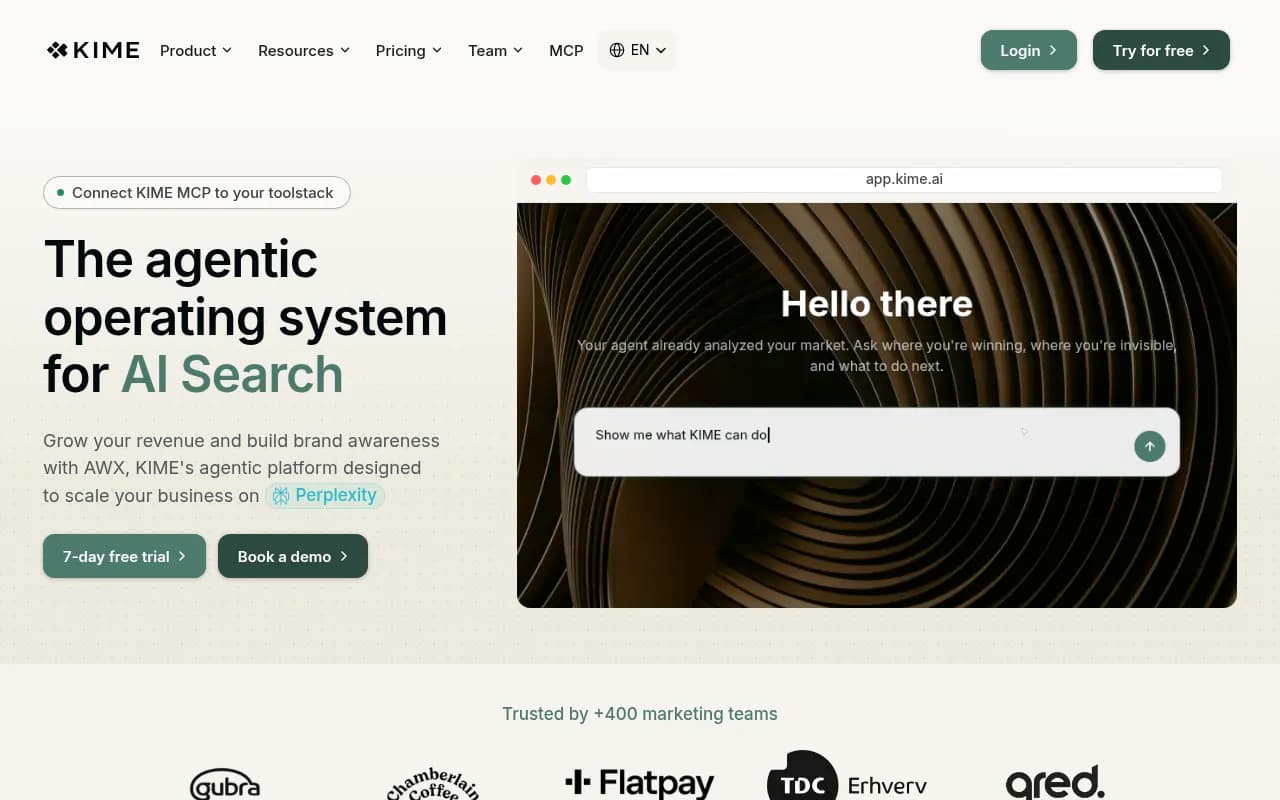
KIME, built by Kime ApS in Copenhagen, calls itself the agentic operating system for AI Search. The pitch is straightforward. You pick prompts, countries and models, KIME runs them against live AI engines daily, and it reports how often your brand shows up, where it ranks in the answer, what sentiment surrounds it, and which sources the models cite. Then it converts the gaps into a ranked list of actions and, through AWX (Agentic Workforce Execution), does some of the work for you.
The company claims more than 400 marketing teams use it, and its logo wall includes Saxo, Gubra, Flatpay, TDC Erhverv, Superb, McDonald's, eComplete and Cocojune. Those are the vendor's own claims, and I found no independent reviews to confirm them. There is a Capterra listing, though I could not verify its review volume. The Nordic customer base is telling: this is a European product aimed at marketing and SEO teams that want monitoring plus a path to action, without enterprise-suite pricing.
Key features
Prompt and visibility tracking. You define the prompts to track, and KIME also suggests prompts. Each response is parsed for brand mentions, position, sentiment and cited sources, and those roll up into a composite 0-100 AI Visibility Score plus share of voice. Everything breaks down by engine, country and language. Languages, countries and brand workspaces are unlimited on every plan, which is generous. A prompt volume estimator helps you decide which prompts matter. Prompts run daily; I found no mention of hourly or 12-hour tracking.
Engine coverage. The product tracks ChatGPT, Perplexity, Gemini, Google AI Overviews, Google AI Mode, Claude, Copilot, plus Grok, DeepSeek and Meta AI on Enterprise. The site is inconsistent here: the homepage copy says nine engines in one place and ten in another, and the pricing page lists seven choosable models. Explorer lets you pick 2, Core lets you pick 3. Claude is accessed via API, so it reflects model knowledge rather than a live interface.
Competitor benchmarking. You can compare your brand against named competitors on the same prompts, with visibility, placement, sentiment and share of voice side by side, plus an industry ranking table. Competitor gap analysis surfaces queries where a rival is named and you are not, and KIME treats that list as your next content brief. It works well for quick "where do we lose" questions.
Citation analytics. KIME shows which domains AI models pull from when they mention you, classified by type (Editorial, UGC, Influencer and so on), with usage share and average citations per response. In the demo data Reddit, YouTube and trade publications show up as sources. It is useful for building outreach targets. It is less deep than tools that classify citations into dozens of content types or track Reddit threads and YouTube videos individually.
AI perception. This view lists the keywords most associated with your brand and the URLs that drive positive, negative or neutral mentions, with a sentiment distribution. It is a good, readable summary of tone. It does not appear to extract individual claims the way a claim-level narrative tool would, and I saw no fact-checking against your own pages.
Actions, Action Center and AWX. KIME turns data into ranked tasks across content, technical and outreach work (for example "Write Best trail running shoes article" or "Optimize product page for AI search"), each with an impact rating and a Pending, Execute, Running, Done flow. AWX then writes content, fixes technical structure and drafts outreach, and you choose which actions run automatically. The limit is volume: 10 executions per month on Explorer, 30 on Core, and 40-100 on Enterprise. That is a meaningful cap for teams hoping to publish at scale. Optimus self-optimisation is also listed, but documentation on how it works is thin.
ChatGPT ads. The Ads Library shows competitor ad placements, the Campaign Builder builds ChatGPT campaigns around visibility gaps, and the Ads Manager handles campaigns, ad groups and ads with impressions, clicks, conversions, spend and CTR. KIME says it is integrated with OpenAI ads. This is the most distinctive part of the product. The demo screens use illustrative data, so I can't vouch for real-world depth.
MCP, API and Data Studio. Every plan includes MCP access for assistants such as ChatGPT, Claude, Cursor, Gemini, Perplexity, VS Code, Windsurf and Cline, plus an API and a Data Studio connector. You can ask "How did our AI visibility change over the last 30 days?" inside your assistant. A KIME chatbot is built into the app too. There is also an AI readiness score and AI traffic reporting.
Who is it for
The best fit is a marketing or SEO team of 3-10 people at a mid-sized brand, often in fintech, travel, e-commerce or consumer goods, that wants a clean AI visibility dashboard with a nudge toward action. The Saxo quote is a good example: the team spotted that ChatGPT was blocked from their site and fixed it. The 5-seat Explorer and 10-seat Core limits suit that size.
Agencies are a second audience. The Agency plan costs EUR 499/mo, with unlimited workspaces, pitch mode, agentic actions and view-only client access. Note the plan includes 18,000 responses and 40 AWX executions per month, which gets thin quickly across a client portfolio.
Who should skip it? Enterprises with strict procurement requirements, since KIME states it does not publish a compliance posture. Teams that need broad multi-model coverage on a modest budget will also feel the 2-3 engine cap. And anyone who wants deep crawler-level diagnostics, or a content engine that publishes straight to a CMS at volume, should look elsewhere.
Integrations and ecosystem
The integration story centers on MCP. KIME's MCP server connects to ChatGPT, Claude, Cursor, Gemini, Perplexity, Codex, GitHub Copilot, VS Code, Windsurf, Cline, DeepSeek, Qwen and Mistral, and the site's logo wall also names WordPress, Shopify, Slack, n8n, Notion, Gmail and Google Analytics as workflow touchpoints. I could not confirm how deep each of those goes. Treat them as MCP-enabled possibilities rather than native, point-and-click integrations.
An API and a Data Studio connector are included on all plans. There is also a public retrieval endpoint at docs.kime.ai for asking questions about the product, and llms.txt and llms-full.txt files, which is a nice touch from a company in this space. I found no official X, GitHub or Discord presence. Exports and dashboard sharing details are not clearly documented.
Pricing and value
- Explorer, EUR 99/mo: 2 engines, 50 unique prompts, 3,000 AI responses a month, 10 AWX executions, 5 seats, email and in-app support.
- Core, EUR 399/mo: 3 engines, 200 prompts, 18,000 responses, 30 AWX executions, 10 seats, plus a 30-minute onboarding walkthrough.
- Enterprise, custom: all models including Grok, DeepSeek and Meta AI, custom prompts and responses, 40-100 AWX executions, 30-50 seats, guest accounts, Slack support, review calls, quarterly workshops and a dedicated account manager.
- Agency, EUR 499/mo: 18,000 responses, 40 AWX executions, unlimited workspaces, pitch mode, view-only client access.
Every tier lists the same feature set, which makes comparison easy. Billing is monthly, quarterly (5% off) or annual (15% off, roughly EUR 339/mo for Core), in EUR, USD, DKK or GBP. Both Explorer and Core come with a 7-day free trial, and no per-seat or per-model fees are charged.
Is it good value? The entry price is competitive and the flat feature set is honest. But the response caps are the real constraint: 3,000 responses a month is small if you track many prompts across several countries. Core at EUR 399 gives you 18,000 responses and 200 prompts, which is closer to what a serious team needs. By comparison, Promptwatch starts at $95/mo with all AI models included on every plan, and Business at $579/mo adds the Content Agent, hourly tracking, Fact Check and Ads Radar. Confirm current numbers on both vendors' pricing pages.
Strengths and limitations
Strengths
- Clean pricing with the same features across plans, plus unlimited countries, languages and brand workspaces.
- ChatGPT Ads Library, Campaign Builder and Ads Manager tie organic gaps to paid placements.
- MCP, API and Data Studio access on every plan, including the cheapest.
- Competitor gap analysis that turns directly into a content brief.
- A readable AI perception and sentiment view, with a 7-day trial and no sales call.
Limitations
- The engine cap is real: 2 on Explorer, 3 on Core, and Grok, DeepSeek and Meta AI are Enterprise only.
- AWX execution is capped at 10-40 runs a month on self-serve plans, so it is not a high-volume content engine.
- No published compliance posture, and the vendor says as much in its own Conductor comparison. It also tracks only the prompts you define.
What it lacks versus Promptwatch
KIME is a direct competitor to Promptwatch, and the gaps are specific. I found no evidence of these in KIME:
- IP-verified AI crawler logs with crawl-to-citation tracking. KIME's AI readiness score is not the same as seeing which bots hit which pages and where they fail.
- A Content Agent with scheduled CMS publishing to WordPress, Webflow and Framer, plus Content Refresh diffs and a Knowledge Base and Brand Book.
- Closed-loop tracking of every published page through crawls, citations, AI traffic and Search Console and Bing data.
- Brand Narrative (claim-level analysis by theme) and Fact Check against your own pages.
- Reddit, YouTube, LinkedIn and Instagram citation reports, plus Offsite Mentions and Page Tracker.
- Prompt difficulty scoring and query fan-out analysis per model.
- AI Shopping tracking for ChatGPT and Amazon Alexa.
- Local GEO/SEO targeting at exact coordinates and up to hourly tracking.
- Coding agent visibility (Codex, Claude Code, OpenCode) and ISO/IEC 27001 certification.
Promptwatch also tracks real user interfaces for ChatGPT, Gemini, Perplexity, Copilot, Alexa and Meta AI across 20 engines and models, with all of them included on every plan.
Bottom line
KIME is a sensible pick for a marketing team that wants affordable AI visibility tracking, competitor benchmarking and a first taste of automated execution, especially if ChatGPT advertising is on the roadmap. The ads tooling is the one area where it does something most rivals do not, and the MCP access on every plan is a good deal.
If you want optimization instead of monitoring with a light execution layer, Promptwatch is the stronger alternative. It adds crawler logs, a Content Agent that publishes to your CMS, claim-level Brand Narrative, social citation tracking and measured results, and it ships ISO/IEC 27001 certification. Try its 7-day free trial or run the free AI visibility report to compare. For more options, browse the GEO software directory at bestgeosoftware.com.
Best use case: a Nordic or European marketing team tracking 50-200 prompts on ChatGPT, Perplexity and Gemini that wants to link visibility gaps to ChatGPT ad campaigns.
Frequently asked questions
What is KIME?
How much does KIME cost?
Does KIME have a free trial?
Which AI engines does KIME track?
Can KIME manage ChatGPT ads?
How does KIME compare with Promptwatch?
Similar and alternative tools to KIME