GetIntel Review 2026
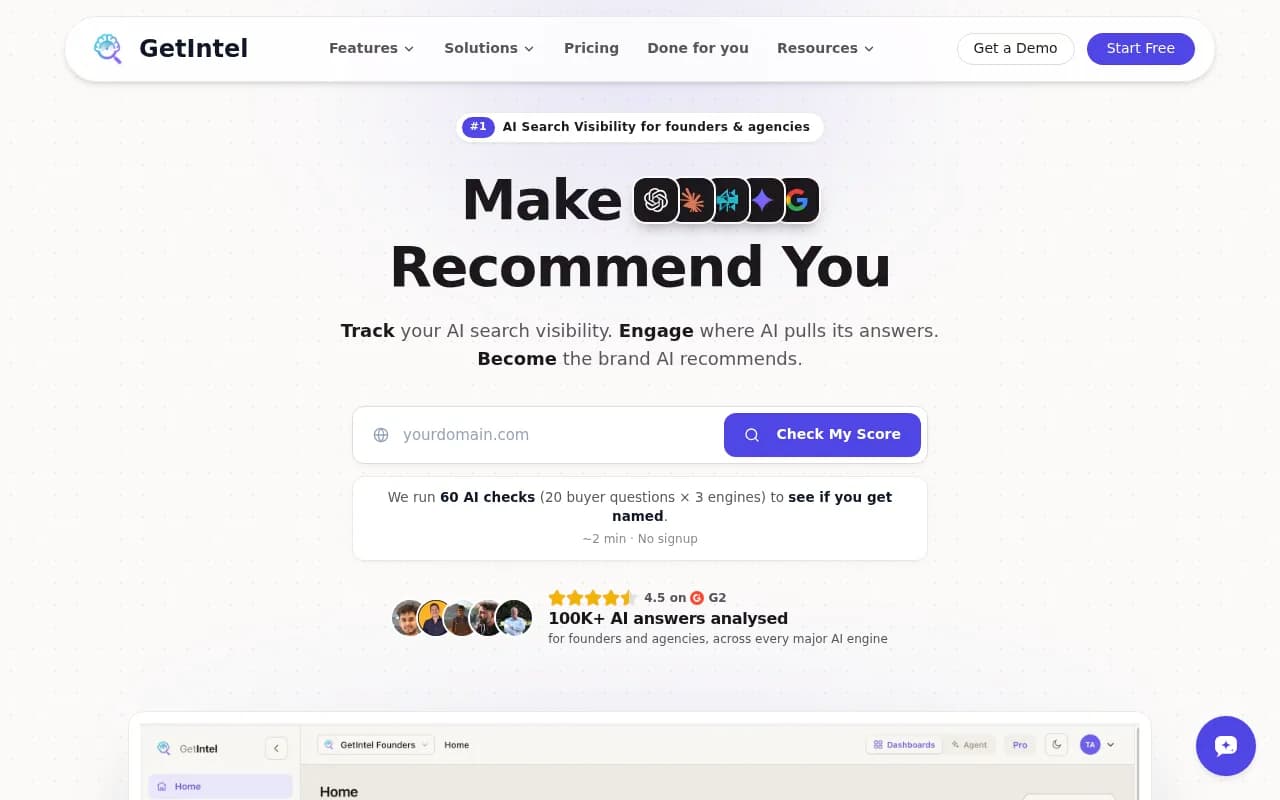
Runs daily scans across ChatGPT, Claude, Perplexity, Gemini and Google AI Overviews, scores visibility by topic, and recommends fixes. Self-serve pricing suits small teams.
Key takeaways
- GetIntel is a low-cost AI visibility tracker with plans from $29/mo (Monitor), $79 (Pro) and $149 (Growth), each with a 7-day free trial. Agency pricing is per client.
- Its angle is the fix workflow: it drafts llms.txt files, schema, Wikidata entries and counter-articles, then hands them to your own coding agent (Claude Code, Cursor) as a reviewable diff.
- Monitoring-heavy and lighter than Promptwatch: it has no built-in Content Agent with Webflow or Framer publishing, no IP-verified crawler log depth, no Brand Narrative with Fact Check, no ChatGPT Shopping or Ads Radar, and no prompt volume and difficulty data that Promptwatch offers.
- Claude is only tracked on Growth and the Partner agency tier, and only weekly. The homepage headlines Claude prominently, so read the plan limits closely.
- Independent reviews are thin. The G2 4.5 badge and testimonials are self-published, so run the trial before committing.
GetIntel (getintel.ai) is an AI search visibility platform aimed at founders, small SaaS teams and agencies. It runs buyer-style prompts through ChatGPT, Perplexity, Gemini and Google AI Overviews (with Claude as a fifth engine on the top tier), scores how often you get named, and turns the gaps into ranked tasks. The pitch is simple: most tools tell you where you are missing and stop, and GetIntel tries to draft the fix too.
The company has also built some press attention around its AI Software Index, a dataset covering 126 software categories. Coverage by The Next Web, Business Insider and Yahoo Finance picked up its finding that ChatGPT and Gemini recommend different number-one software in about a third of categories. That is a marketing asset more than a product feature, but it shows the team publishes its own research. Customer logos on the site include Kissflow, Magicbricks, MoEngage, Intrycks and RingOwl.
It is built for people who find $500+ per month enterprise platforms hard to justify. I would describe it as a tracker with a workflow layer bolted on, priced like a tool for small teams.
Key features
Real-interface data collection. GetIntel says it captures answers from the actual ChatGPT, Perplexity, Gemini and AI Overviews interfaces rather than API responses. That matters because user-facing answers and citations often differ from API output. Promptwatch also collects from real interfaces, while many cheaper trackers still lean on APIs, so this is a good sign at the price.
Daily visibility scoring by topic. Each buyer question falls into a topic, and each topic gets its own score based on citation rate, share of voice and average citation rank. Runs are kept over time, so you can see which topics moved and when. The home dashboard charts visibility, share of voice, average position and citations against the other brands AI names in your category. Four engines refresh daily; Claude on Growth refreshes weekly.
Prompt tracking. A prompt grid shows every buyer question and, per engine, whether you were recommended, only mentioned, or absent. Plans cap the number of questions: 25 on Monitor, 60 on Pro, 120 on Growth. Those caps are lower than what some competitors give you, but fine for a single product with a focused category. There is no prompt volume or difficulty scoring, so you pick questions without knowing how often they are actually asked.
Citation source intelligence. A Sources view charts the most cited domains in your category and shows where your domain sits. GetIntel claims 87% of citations in its probing pointed at third-party sources, which matches the broader pattern in Promptwatch Data on social media citations by AI model, where citation sources vary sharply by engine.
Reddit signal tracking. GetIntel files Reddit threads in your market by topic and writes a weekly summary: what buyers raised, which tools they named, and whether you came up. One testimonial from Magicbricks says competing tools lacked Reddit. Worth knowing that Promptwatch Data shows reddit.com's share of ChatGPT citations collapsed from about 4% to 0.5% on August 14, 2026, so Reddit's value differs by engine. It still matters for AI Overviews and AI Mode. GetIntel does not appear to cover YouTube, LinkedIn or Instagram citations.
Ranked tasks and fix drafting. This is the distinctive part. On Pro and above, gaps become ranked tasks across On-page, Off-page, UGC and Technical categories. For each, GetIntel drafts an artifact: an llms.txt file, schema markup, a Wikidata entry, a counter-article, an outreach email. You hand it to Claude Code or Cursor through MCP, and it lands as a pull request in your real site. Where you connect WordPress or Ghost, or verified outreach email, it can ship directly. Nothing goes out without approval.
Fix verification. Every shipped fix is logged with its date, so changes in topic score sit next to the work that preceded them. One example on the site reads "Cited 0 to 4 of 12 buyer questions in this topic after publishing the 6 article gaps." It is a simple cause-and-effect log, not controlled attribution, but it is more than most trackers offer.
AI crawler and visitor tracking. Pro includes AI crawlers and AI visitors on your site, plus head-to-heads and brand perception. I could not verify how deep the crawler logs go, whether visits are IP-verified, or how they compare with dedicated crawler analytics such as Promptwatch's AI crawler logs.
Pitch reports and agency tooling. You can scan a prospect and send them their own report: 10 per month on Monitor, 30 on Pro, 75 on Growth. Agency plans separate each client's questions, competitors, scores and tasks, with branded reports.
Who is it for
The sweet spot is a SaaS founder or a two-to-ten person marketing team tracking 25 to 120 buyer questions for one product. If you are a bootstrapped startup that wants to know why ChatGPT recommends a competitor and what to change on your site, the $79 Pro plan covers most of it. Developers will like that fixes arrive as diffs in tools they already use.
Agencies are the second audience. Pricing is per client rather than per seat: $79 per client from 3 clients (Studio, from $237/mo), $59 per client from 10 (Agency, from $590/mo), custom from 25 (Partner). GetIntel claims about 70% margin when reselling. A boutique SEO shop with 5 to 15 clients and a need for pitch reports will find that structure sensible. Agency plans are sold through a booking call, not self-serve.
It is a weaker fit for enterprises needing SSO, audit logs, white-label portals and ISO certification on paper, and for teams that want a platform to write and publish at scale without a developer workflow. If nobody on your team uses Claude Code or Cursor, the headline feature loses much of its value. Large e-commerce brands wanting shopping and ads visibility should look elsewhere. Teams that need Claude as a daily-tracked engine should also note the limit.
Integrations and ecosystem
- Google Search Console connection for search data alongside AI data.
- Ahrefs on a bring-your-own-key basis.
- API and MCP access, including on the Monitor plan, which is how coding agents pull tasks.
- Looker Studio connector and CSV export for reporting.
- Publishing to WordPress or Ghost, plus verified outreach email.
- Claude Code and Cursor as the execution layer for fixes.
The scraped pricing table did not show which tier gets which integration, so confirm that before buying. There is no sign of a Slack integration, Webflow or Framer publishing, or a browser extension.
Pricing and value
- Monitor, $29/mo: 25 buyer questions, 5 competitors, 1 market, 2 seats. Monitoring only, with no ranked tasks or fix drafting. Includes Looker Studio, API and MCP.
- Pro, $79/mo (most popular): 60 questions, 10 competitors, several markets, unlimited seats. Adds ranked tasks, drafted fixes, head-to-heads, brand perception, Reddit signals, AI crawlers and AI visitors.
- Growth, $149/mo: 120 questions, 20 competitors, plus Claude as a fifth engine refreshed weekly. Otherwise identical to Pro.
- Agencies: Studio $79 per client (3 to 9 clients), Agency $59 per client (10 to 24), Partner custom (25+).
- Done for you: $1,000 per month, with a 30-day refund and you keep the work.
Every self-serve plan has a 7-day free trial, and annual billing saves 20%. Next to competitors, this is cheap. GetIntel's own comparison claims Scrunch has a $250 floor. Promptwatch starts at $95/mo (Essential), $245 (Professional) and $579 (Business), with the Content Agent, crawler logs and local targeting on higher tiers. Check promptwatch.com/pricing for current numbers. The Monitor plan is thin because it strips out the very task workflow that makes GetIntel interesting, so most buyers will land on Pro.
Strengths and limitations
Strengths
- Very low entry price with a working workflow at $79.
- Fix drafting through your own coding agent is a clever, developer-friendly idea with human approval built in.
- Reddit signal summaries are useful and relatively rare.
- Agency pricing per client is transparent and easy to model.
- Published research (the AI Software Index) shows real data effort.
Limitations
- Claude is weekly and only on Growth or Partner, despite the homepage branding.
- Prompt limits are modest, and there is no prompt volume or difficulty scoring.
- Independent reviews are scarce. The G2 4.5 and testimonials are self-published.
- The coding-agent workflow assumes you have someone technical.
What it lacks compared to Promptwatch
GetIntel is mostly a monitoring tool with a drafting layer. Compared with Promptwatch, it is missing:
- A Content Agent that plans, writes and publishes to WordPress, Webflow and Framer on a schedule, plus Content Refresh for existing pages.
- Content gap analysis that maps your pages against the prompts AI answers.
- IP-verified AI crawler logs with a crawl-to-citation path per page.
- Fuller visitor analytics with conversion tracking for AI-referred traffic, and Bing Webmaster data next to Search Console.
- Brand Narrative and Fact Check against your own pages.
- YouTube, LinkedIn and Instagram citation tracking, plus Page Tracker and Offsite Mentions.
- ChatGPT and Amazon Alexa shopping visibility and Ads Radar.
- Query fan-outs, prompt volumes and difficulty scores.
- Agent Chat, an Action Board, local GEO targeting at exact coordinates, hourly tracking, and Meta AI, Alexa and coding agent coverage.
- ISO/IEC 27001 certification and SSO for enterprise reviews.
Bottom line
GetIntel is a sensible pick for a founder or small agency that wants a cheap daily tracker, a ranked to-do list and a developer workflow that turns tasks into pull requests. The Pro plan at $79 gives most of the value, and the 7-day trial costs nothing to test.
If you want optimization, not just monitoring, Promptwatch is the stronger alternative. It writes and publishes content, reads AI crawler logs, attributes AI traffic and verifies that each fix worked. You can try it free for 7 days or start with the free AI visibility report. For more options, the GEO software directory at bestgeosoftware.com lists other tools. Best use case: a bootstrapped SaaS team with a developer who wants low-cost daily tracking and code-ready fixes.

Frequently asked questions
What is GetIntel?
How much does GetIntel cost?
Does GetIntel track Claude?
Does GetIntel publish content automatically?
How does GetIntel compare with Promptwatch?
Is there a free plan?
Similar and alternative tools to GetIntel