Key takeaways
- Ads in ChatGPT are now common. Promptwatch Data shows ads in an average of 20.1% of web-searching responses between May 20 and August 17, 2026, with the past-7-day average at 32.4%.
- Brand-specific prompts are about 18% of ad-bearing responses and competitor comparison prompts about 8.6%. Both are small segments, but they are the ones where hijacking hurts most.
- A single check proves nothing. Run your branded prompts daily across several days and record the advertiser, ad copy, and landing page each time.
- Traditional brand bidding tools watch Google and Bing. AI ads need a tracker that reads the real ChatGPT interface.
- Hijacking is also an opportunity. If you are the smaller brand, comparison prompts for bigger rivals are still lightly contested.
What brand hijacking looks like in AI ads
In paid search, brand hijacking is simple. Someone types your company name into Google, and a competitor's ad sits above your organic listing. You have probably seen it. Maybe you have done it.
AI ads work the same way, with a twist. The user is not typing a keyword. They are asking a question like "Is [your brand] worth it for a 10-person team?" or "[Your brand] vs [competitor]". The model runs a web search, writes an answer, and an advertiser's unit appears next to it. If that advertiser is a rival, they have hijacked a conversation you were supposed to own.
Two patterns matter:
- Direct competitor on your brand prompt. A rival appears when someone asks about you by name.
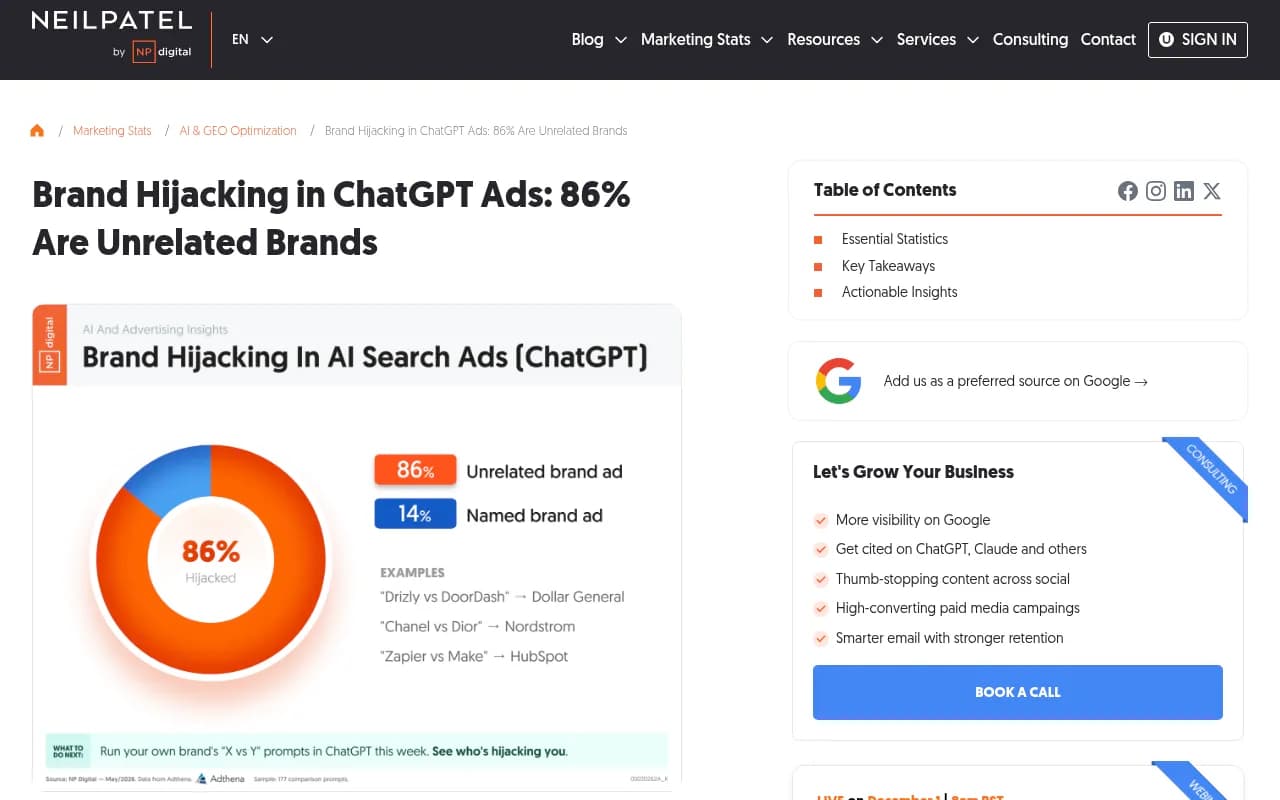
- Unrelated third party on a comparison prompt. Adthena data cited by Neil Patel, covering 177 comparison prompts, says 86% of ChatGPT ads on brand comparison queries came from unrelated brands. The examples given include Dollar General on a Drizly vs DoorDash prompt and HubSpot on a Zapier vs Make prompt. I could not verify the methodology beyond the page description, so treat it as a directional third-party figure rather than a benchmark.
The second pattern surprised me. You might expect the ad to come from one of the two brands in the comparison. Often it comes from someone who simply wants the traffic.
How often does this actually happen?
Before you panic, get a sense of the baseline. Promptwatch Data's ChatGPT Ads Over Time report covers May 20 to August 17, 2026, and counts only responses that searched the web, returned at least one citation, and completed ad extraction.
- ChatGPT served no ads until May 27, when they appeared in 1.69% of responses.
- On July 1 the rate jumped past 30% and has mostly stayed between the low 20s and high 30s since. The peak was 43.9%.
- The 90-day average is 20.1%. The past 30 days averaged 29.6%, up 22.6% on the previous 30.
By prompt type, the past-7-day mix of ad-bearing responses was organic 73.3%, brand-specific 18.0%, and competitor comparison 8.6%.
One caveat from Promptwatch is worth repeating. That is a volume mix, not the likelihood that a prompt type triggers an ad. If your monitor has mostly organic prompts, organic will dominate. So do not read 18% as "brand prompts rarely get ads." Measure your own prompts.
Step 1: Build a branded prompt set that reflects real behavior
Your monitor is only as good as the prompts in it. Hijackers target the questions buyers actually ask, not just your brand name.
Start with these groups:
- Brand-only: "What is [Brand]?", "Is [Brand] legit?", "[Brand] reviews"
- Pricing and plans: "How much does [Brand] cost?", "[Brand] free trial"
- Alternatives: "[Brand] alternatives", "cheaper than [Brand]"
- Direct comparisons: "[Brand] vs [Competitor]" for your top five or six rivals
- Product-line variants and common misspellings
- Persona phrasing: how a CFO asks versus how a developer asks
Keep prompt types separate by tag. Promptwatch's own advice is to compare advertisers per segment, since brand-specific and competitor-comparison prompts can attract different advertisers than organic ones. If you lump everything together, the interesting signal disappears.
Also fix the market. Ads differ by country and language, so create separate monitors for each. A rival bidding on your name in the US may not be present in Germany.
Step 2: Track ads over several days, not one run
This is where most teams go wrong. They run a prompt once, see no ad, and move on. Or they see one and escalate to legal.
Ad rates in ChatGPT swing day to day. The daily rate has ranged from single digits to nearly 44%. A single run can land on an outlier day in either direction. Promptwatch recommends checking ad visibility across several days before drawing conclusions, and I agree. A practical rule: treat an advertiser as a real hijacker only after they appear on the same prompt on at least three separate days in a week.
For every detection, record:
- Date, time, model, country, and the exact prompt
- Advertiser name and domain
- Ad headline and body copy
- Landing page URL
- Whether the ad names your brand
- A screenshot or saved response
That last item matters if you ever file a complaint. Evidence collected from the real interface beats memory.
Step 3: Choose the right monitoring tool
There are really three categories of tools here, and they cover different gaps.
| Tool type | What it watches | Good for | Gap |
|---|---|---|---|
| Paid search brand protection (Adment, The Search Monitor) | Google, Bing, Yahoo, YouTube branded ads, affiliates | Trademark violations, affiliate ad hijacking | Mostly classic search, though Adment has added an AI Radar for ChatGPT |
| Google Ads Auction Insights | Advertisers competing on your own campaigns | Quick check on who overlaps with you in search | Only covers your own Google campaigns, nothing on AI answers |
| AI visibility platforms with ads tracking | Ads shown in AI answers on your tracked prompts | Seeing which advertisers and landing pages win your prompts | Coverage differs by vendor |
Paid search brand protection tools
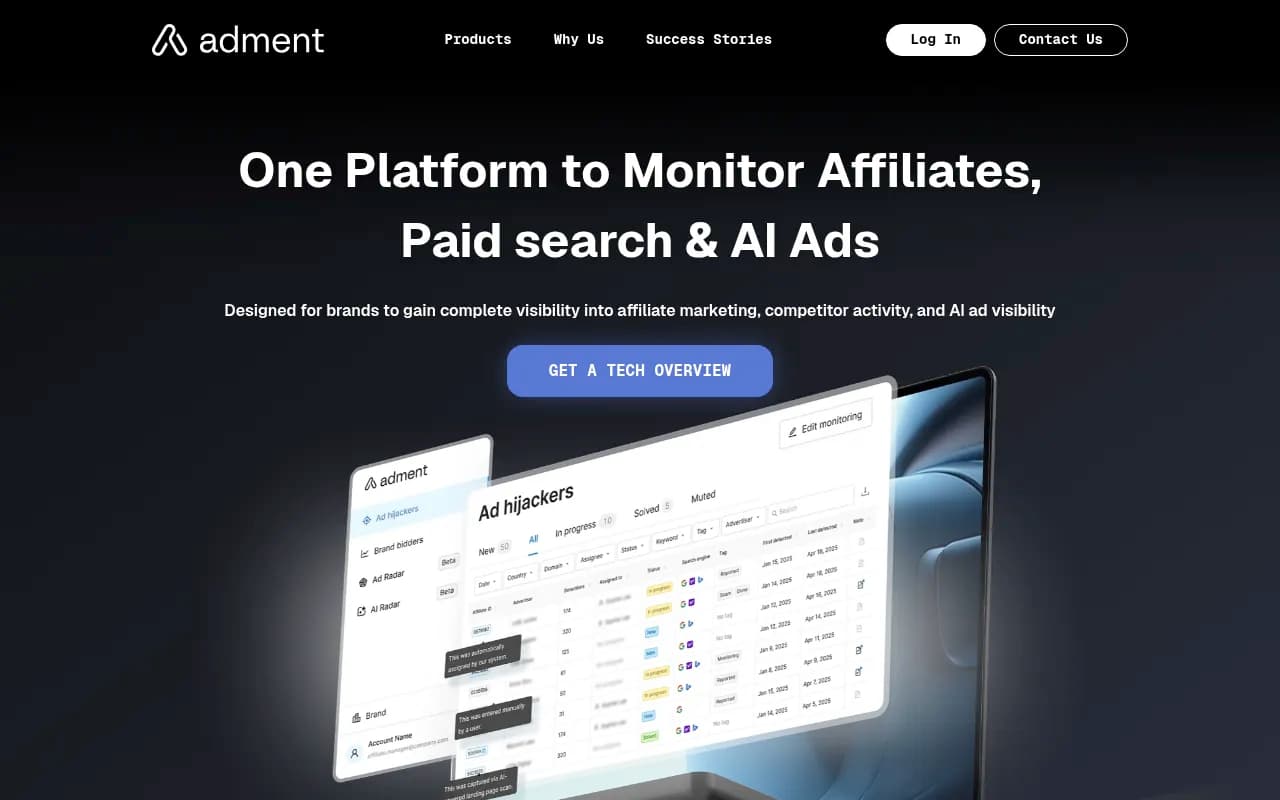
Adment positions itself as one platform for affiliates, paid search, and AI ads. Its AI Radar feature claims to detect new advertisers when they appear in ChatGPT, show which prompts trigger competitor ads, and surface ad creatives and landing pages. I have not verified it beyond the vendor's description, so request a demo and test it on your own prompts.
The Search Monitor takes a similar approach for classic search, scanning paid results to detect competitors and affiliates using your brand in ad copy and documenting trademark violations. It is built for the Google and Bing side of the problem. Growbydata describes brand bidding monitoring as tracking every text ad shown on your brand name and variations and recording who placed it. Useful, but again, search ads, not AI answers.
Google Ads Auction Insights
The cheap first check, as one r/PPC thread puts it: open your brand campaigns, go to Auction Insights, and see which advertiser domains compete on the same terms. It is free and takes five minutes. It tells you nothing about ChatGPT.
AI visibility platforms
For AI answers specifically, you need a tool that collects data from the actual user interface, because ads do not show up in API outputs. Promptwatch has an Ads Radar that shows which advertisers bid on your tracked prompts, their ad copy and claims, and the landing pages they send visitors to, viewed by ad or by prompt. It sits next to citation tracking, so you can see in one place whether you are losing the ad slot and the citations at the same time. Ads Radar is on Business, every agency plan, and Enterprise. Check promptwatch.com/pricing for current plans. More detail is on the ChatGPT ads page.

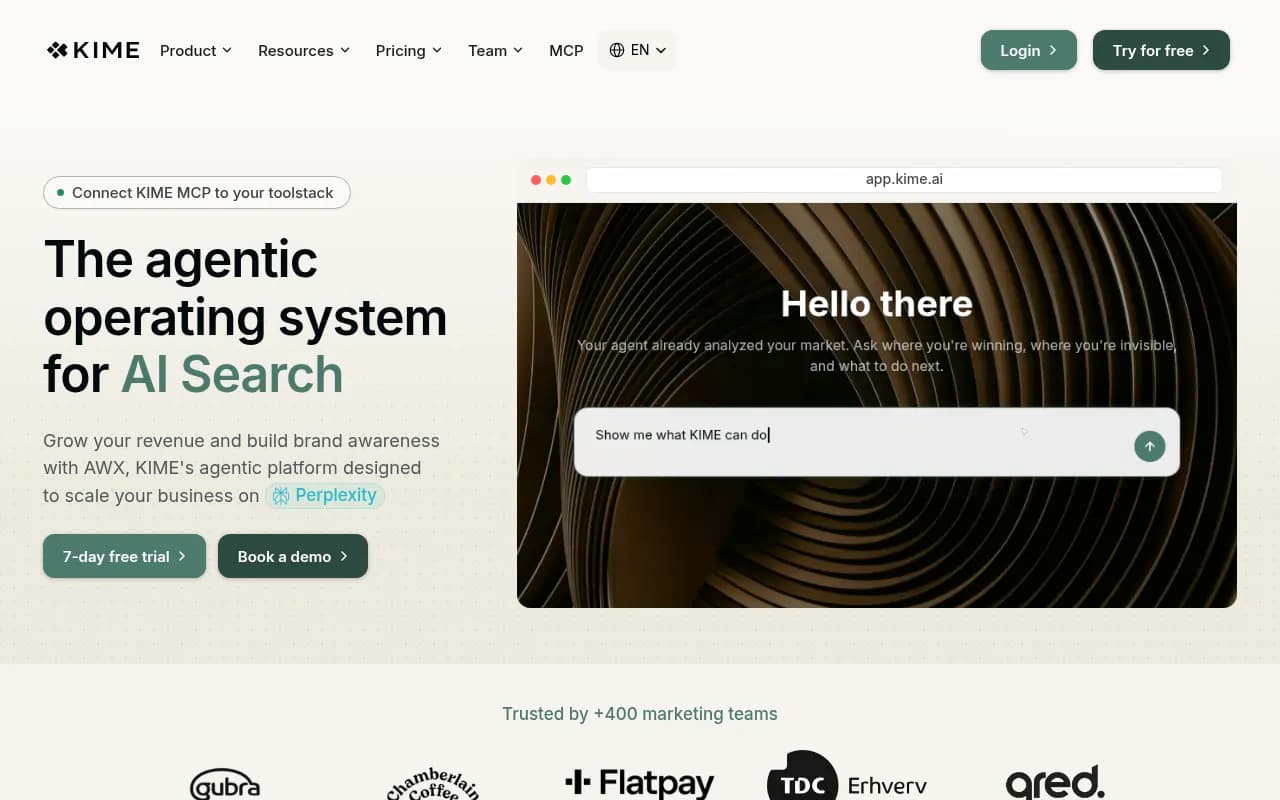
Other AI visibility tools in the catalog also mention ad insights. KIME advertises tracking across nine engines with ad insights, for example. Verify what each one actually captures before buying: does it record advertiser names, ad copy, and landing pages, or only whether an ad appeared?
If you want to compare more options, the GEO software directory at bestgeosoftware.com lists dozens of them.
Step 4: Analyze what you find
A list of advertisers is not an analysis. Sort what you collect into three questions.
Who is it?
Classify each advertiser:
- Direct competitor in your category
- Adjacent vendor whose product partly overlaps
- Affiliate or reseller bidding on your name
- Unrelated brand buying comparison intent
Affiliates deserve extra attention. If you run a partner program, an affiliate may be breaking your terms. That is a contract problem, and you can fix it without involving any platform.
What are they saying?
Read the ad copy and landing page as a skeptical customer. Common red flags:
- The ad uses your brand name to imply an affiliation
- Claims about your product that are false or outdated
- A "comparison" page that misstates your pricing or features
- Your trademark in headline copy where a platform's policy forbids it
For claims about you, Promptwatch's Brand Narrative can also help you see what AI says about you in organic responses, which gives context for whether the ad is contradicting or reinforcing it.
How much is it costing you?
Tie detections to your own data. If you have visitor analytics that separate AI-referred traffic, watch branded conversion rates for dips that coincide with a new advertiser appearing. ChatGPT stopped sending a referrer on October 8, 2026, so tag your own links with utm_source=chatgpt.com where you can, otherwise your attribution will undercount.
Be honest about causation. A drop in branded conversions has many possible causes. Use detection dates as a clue, not proof.
Step 5: Decide how to respond
You have four main options. They are not mutually exclusive.
| Response | When to use it | Effort |
|---|---|---|
| Ignore and monitor | A single ad appears briefly, no false claims | Low |
| Bid on your own branded prompts | Competitors appear consistently and conversion is slipping | Medium, ongoing spend |
| Report to the platform | Trademark misuse or false claims in the ad | Medium, slow |
| Legal or partner enforcement | Affiliate breach or repeated trademark abuse | High |
On reporting: I found no verified details on OpenAI's ad policy for brand or trademark terms, and the bidding mechanics are not well documented yet. Check the current OpenAI advertising policies directly before filing. In Google Ads, you can file a trademark complaint through Google's legal support forms. The Search Monitor's advice is to be relentless about reporting, while remembering that engines allow your brand in a display URL.
Should you just bid on your own name?
Sometimes. In search, the standard way to test this is to pause brand ads in a controlled window and measure the effect on total traffic and conversions against baseline. Use the same logic here. If competitors are not actually showing on your branded prompts, you are paying for clicks you would have gotten anyway. If they are showing on most days, defending is cheaper than losing deals.
Watch your own cost too. Rising CPCs on brand terms can point to increased competition from affiliates or competitors, and the Search Monitor suggests closer monitoring before aggressive bid increases.
Win the answer, not just the ad
Ad slots are only one part of an AI response. The text of the answer and its citations matter at least as much. Promptwatch Data shows almost half of ChatGPT responses cite 10 or more unique domains, per its unique domains per response report (Sep 28 to Oct 4, 2026). So the user sees a crowded source list. If your own pages are not cited on your branded prompts, a rival's ad is not your only problem.
Two things help:
- Publish clear product, pricing, and comparison pages. Promptwatch's content type data shows product pages are the most cited type in ChatGPT at 22.4% of citations (Sep 28 to Oct 4, 2026).
- Make sure AI crawlers can read those pages. Crawler logs, such as those in Promptwatch's Agent Analytics, show whether bots reach your pages or hit errors.
Step 6: Flip it and use the opportunity
The Neil Patel page makes a point I think is right: bidding on competitor comparison queries as the unrelated third party looked wide open at the time of that data. Comparison prompts are only about 8.6% of ad-bearing responses in Promptwatch's data, so the segment is small, but small can mean cheap.
If you do this, follow the old brand bidding etiquette from paid search:
- Do not put the competitor's name in your headline if the platform's policy bans it
- Keep the comparison accurate and defensible
- Send traffic to a landing page that actually compares the two, ideally with third-party validation
- Expect the same treatment in reverse
I would not rely on this for long. Every playbook that works gets copied.
A weekly monitoring routine
Here is a routine that takes about an hour a week once the setup is done.
- Review new advertisers on branded and comparison prompts for the past 7 days.
- Check whether each new advertiser appeared on more than one day.
- Save evidence for anything that makes false claims or misuses your trademark.
- Compare your branded conversions and AI-referred traffic against the previous week.
- Check Google Ads Auction Insights for overlap on classic search.
- Log decisions: ignore, defend, report, or escalate.
If your team is stretched, an agency can run this for you. 1001 SEO Media handles AI search monitoring for clients and uses Promptwatch for it, though a competent in-house marketer can run the routine above alone.
Common mistakes
- Judging from one prompt run on one day
- Tracking only your brand name and skipping comparison and alternative prompts
- Mixing countries and languages in a single monitor
- Assuming every competitor ad is a trademark violation. Many are legal comparison bidding
- Reporting without saved evidence
- Spending on defensive bids without ever testing what happens when you stop
What to do this week
Pick your ten most important branded and comparison prompts. Put them in a tracker that reads the real ChatGPT interface and run them daily for seven days. At the end, you will know whether hijacking is a real problem for you or just something you read about. If you want a free starting point, Promptwatch's free AI visibility report scans how ChatGPT, Gemini, and Perplexity talk about your brand, and the 7-day trial gives you enough time to see who is advertising on your prompts.