
Key takeaways
- Writesonic has the widest AEO stack, but the full Action Center and the engines beyond ChatGPT, Gemini and AI Overviews sit on the Enterprise tier.
- Frase is the cheapest way in ($39/mo billed yearly) and the only one of the four that drafts, publishes to your CMS and tracks AI citations in one product. It says its AI visibility tracking "does not auto-fix".
- Scalenut is the most promotional on pricing. Black Friday discounts were live when we checked, so the list price is the number to compare.
- Surfer has the strongest standalone tracker for the money (five engines), but the content side is still the classic editor.
- None of the four gives you crawler logs or AI traffic attribution. If you need to prove that AEO work is paying off, you will probably pair one of them with a dedicated visibility platform.
What AEO means for a content tool
Answer engine optimization is the work of getting your brand named and cited inside ChatGPT, Gemini, Perplexity and Google AI Overviews. A content tool can help in three ways: it tells you what AI currently says (tracking), it tells you what to change (analysis), and it changes it (writing, publishing, schema).
Most of these products started as SEO writers or SERP scorers and bolted tracking on later. That history shows. When you compare them, I'd ignore the marketing and ask three things:
- How many AI engines are covered at the tier you will actually buy?
- How many prompts can you track, and how often?
- Does the tool only monitor, or does it also act?
One caveat before the details. Pricing in this category moves almost monthly, and all four vendors had changed plan names or structures within the past year. Treat every number below as a snapshot from late November 2026 and confirm on the vendor's pricing page.
The four tools at a glance
| Tool | Entry price | Engines at entry tier | Tracking depth | Acts on the findings? |
|---|---|---|---|---|
| Frase | $39/mo billed yearly ($49 monthly) | ChatGPT, Google AI | 50 prompts tracked per month | Writes and publishes; tracking does not auto-fix |
| Scalenut | $59/mo list | ChatGPT, Google AI Overviews | 10 prompts, weekly refresh | GEO Action Center plus article generation |
| Writesonic | $79/mo billed annually | ChatGPT, Gemini, Google AI Overviews | 50 prompts, 150 answers per day | 15 AI articles and site audits; full Action Center on Enterprise only |
| Surfer | AI Search Analytics around $82/mo (verify on surfer.ai/pricing) | ChatGPT, Perplexity, Gemini, AI Mode, AI Overviews | 50 prompts daily across five brand spaces | Classic content editor; agent marked coming soon |
The tracking figures for Frase, Scalenut and Writesonic come from their pricing pages. Surfer's plan details are less certain: our scrape of its pricing page returned only a form, so the $82 and prompt numbers come from a third-party review (RankBull, September 2026). Check them before you buy.
Writesonic
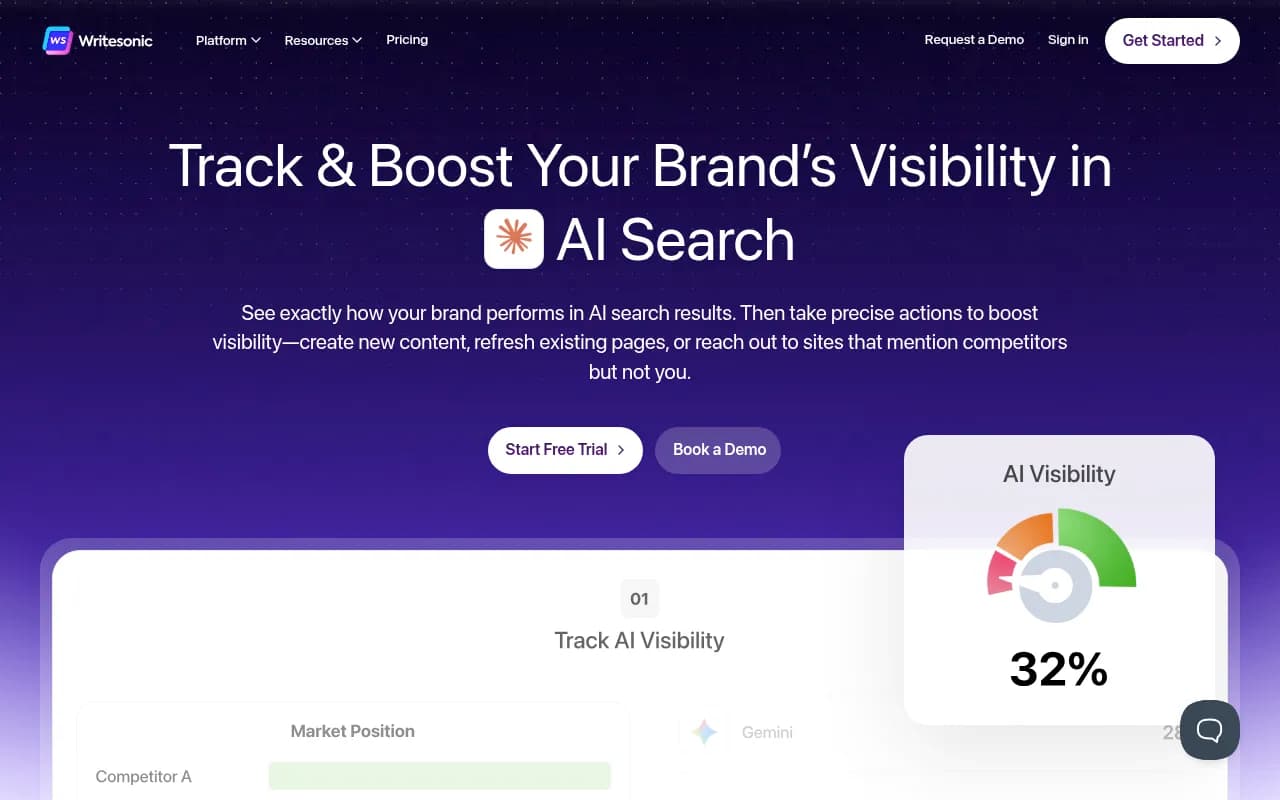
Wriesonic has rebranded as an "AI Search Visibility Platform", and the pivot is real. Older reviews describe a cheap, template-heavy writing tool starting around $20 a month. That tool no longer exists at that price.
What you get
The Starter plan at $79/mo tracks ChatGPT, Gemini and Google AI Overviews with 50 prompts and 150 answers per day, plus 15 AI articles, 10 site audits and ads monitoring. Basic is $199/mo (100 prompts, 25 articles, 2 users) and Growth is $399/mo (200 prompts, 50 articles, 3 users, 2 projects, sentiment analysis).
The wider AEO toolkit is where Writesonic stands apart on paper: an Action Center that prioritizes fixes, schema automation, robots.txt auditing for GPTBot, ClaudeBot and PerplexityBot, and citation outreach. Enterprise tracks ten platforms, including Perplexity, Claude, Grok, AI Mode and Meta AI, and adds Fact Check, citation decay and social citations from YouTube, LinkedIn and Reddit.
The catch
Gating. Perplexity and Claude tracking are Enterprise-only. On Growth, the Action Center is a trial with five off-page and five on-page actions a month. So the headline feature list describes the custom-priced plan, not the one most teams will buy.
Two more flags. Earlier research said Writesonic has a genuine free plan. Its pricing page now shows a 7-day trial only, so don't count on a free tier. And the page meta description says "self-serve from $99/mo" while the cards show $79, so check what you are billed at checkout.
Writesonic is also weaker as a classic SERP scorer than Surfer or Frase. If your team lives in a content editor with a live score, that matters.
Frase
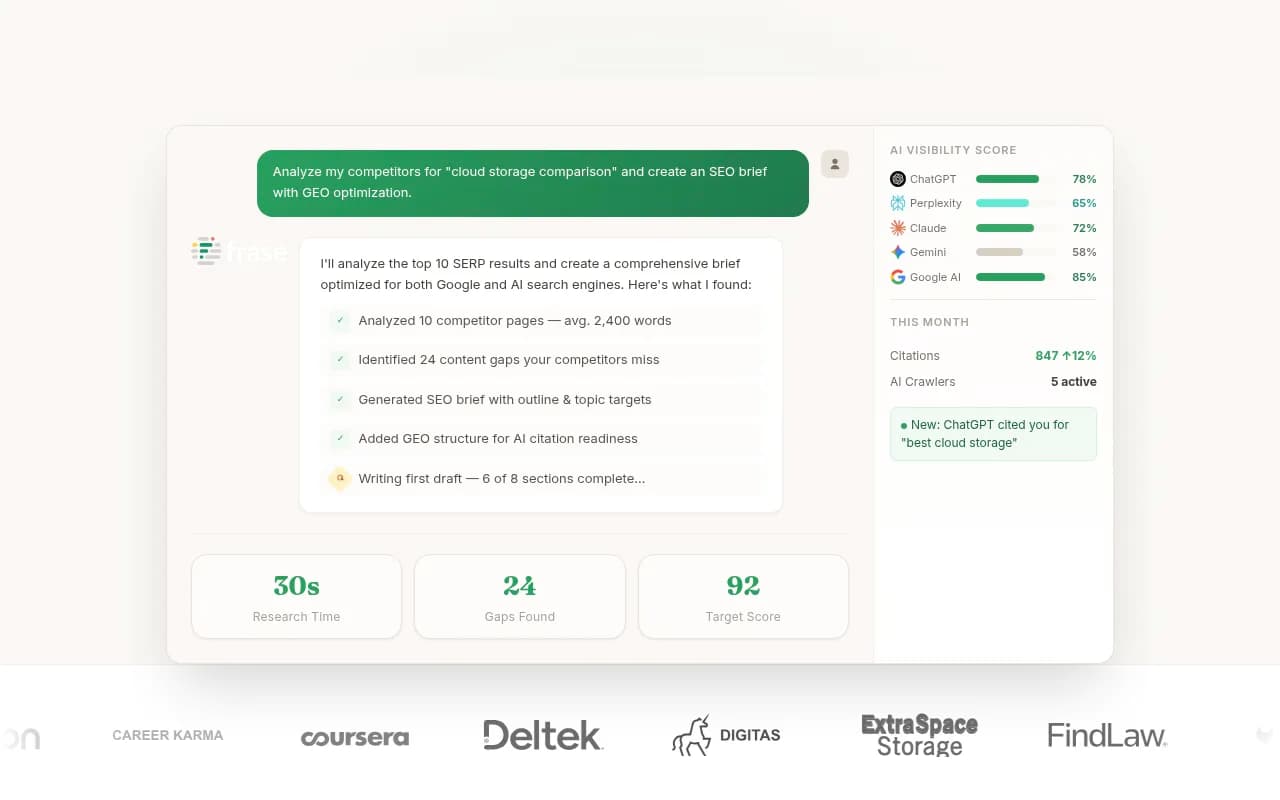
Frase has changed the most. The old story was a $15 brief builder for bloggers. The current one is an agent that researches, drafts, publishes and monitors.
What you get
- Starter at $39/mo billed yearly: 1 seat, 1 site, 10 articles and 50 audit pages per month, SEO and GEO scores, AI visibility on ChatGPT and Google AI.
- Professional at $103/mo: 3 seats, 5 sites, 40 articles, 250 audit pages, AI crawler monitoring and Perplexity tracking.
- Scale at $239/mo: 5 seats, 10 domains, 100 articles, 1,000 audit pages, plus Claude and Gemini tracking and exportable client reports.
Publishing goes straight to WordPress, Webflow, Sanity and Wix, or to its own FraseCMS. Content Guard watches pages for ranking and traffic decay (10 pages on Starter, 75 on Professional, 300 on Scale), proposes a fix and republishes when you approve.
That decay feature is more useful than it sounds. Promptwatch Data's content half-life study tracked pages ChatGPT cited on July 6, 2026 for 90 days. Product pages, reviews and how-tos reached their half-life after 74 to 77 days, and news lost half its pages within 36 days. If your content is going to fall out of citations on a schedule, a refresh workflow earns its keep.
The catch
Engine coverage is tiered hard. If you want Gemini or Claude tracked, you are on the $239 plan. And Frase is upfront that its AI visibility monitoring alerts you but does not fix anything by itself. The fixing happens through the content workflow, which you drive.
Standalone keyword research is thin compared with Semrush or Ahrefs, so many teams keep a research tool alongside it.
Scalenut

Scalenut sits between an AI writer and an SEO optimizer. Cruise Mode walks you from keyword to outline to first draft, and its keyword clustering has a good reputation (Alex Birkett calls it better than Semrush's and Ahrefs's, which is his opinion, not a benchmark).
What you get
Starter lists at $59/mo: 10 tracked prompts with a weekly refresh on ChatGPT and Google AI Overviews, one workspace and 5 articles a month. Plus is $89/mo list. The product set includes a GEO Action Center, AI Visibility, Social Upreach and a Backlinks Marketplace. A RankBull review notes four seats even on the entry tier and Perplexity arriving at a $199 Professional tier, but we could not confirm the higher tiers because our pricing capture was truncated.
The catch
A Black Friday sale was running at 65% off annual plans with triple the limits, which dropped Starter to about $21/mo. That is a promotion, not a standing rate. Ten prompts refreshed weekly is also thin tracking. It is enough to sample your visibility, not enough to measure share of voice with any confidence.
AI drafts still need a real editing pass, and the plan names have shifted several times this year.
Surfer
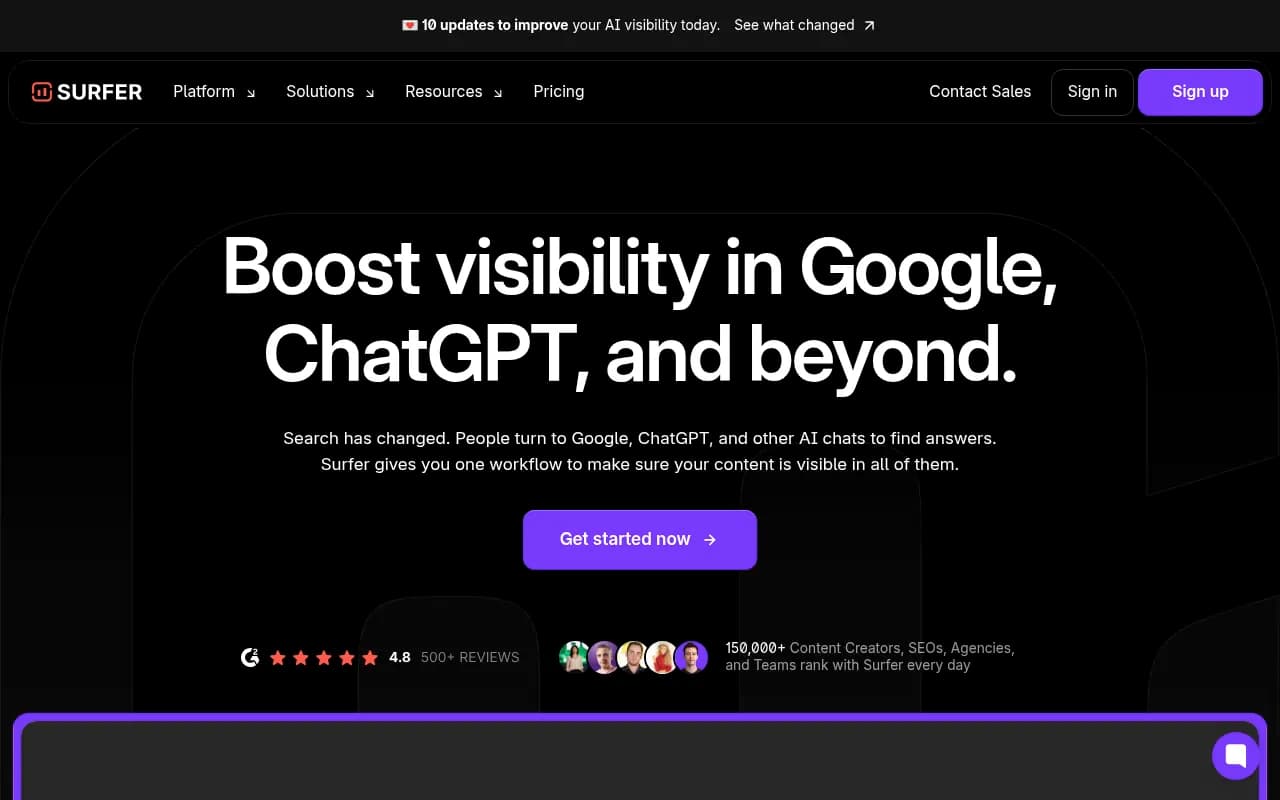
Surfer also calls itself an "AI Search Visibility Platform" now, and splits the product in two: AI SEO for content and rankings, and an AI tracker for visibility.
What you get
Per the RankBull review, the standalone AI Search Analytics runs 50 prompts daily across five brand spaces and covers ChatGPT, Perplexity, Gemini, AI Mode and AI Overviews. That is the broadest engine coverage at the lowest tier of the four. The content editor is the real-time NLP scorer Surfer built its name on, and it is still the best of the group at telling you what the top-ranking pages cover that yours doesn't.
The catch
Surfer doesn't write your draft and doesn't publish it. Its agent is marked coming soon, and the homepage claim that Surfer-optimized content is more likely to be cited has no published source. I'd treat that claim as marketing until someone shows the data. Surfer's editor optimizes for what ranks in Google. That correlates with AI citation, but it is not the same thing.
What actually gets cited in AI answers
Before you pick on features, it helps to know what AI engines cite. Promptwatch's ChatGPT citation share by content type data (Sep 28 to Oct 4, 2026) found product pages are the most cited type at 22.4% of classified citations, with landing pages at 16.8%. Listicles are 13.6%, how-tos 8.7%, docs 7.5% and comparisons 5.9%. For commercial prompts, product pages, landing pages, listicles and comparisons add up to almost 70% of citations.
That has a practical consequence. A content optimizer built around blog-post scoring helps with some of those formats and not others. Product, landing and pricing pages need to be factual and complete, and comparison pages need to exist. Whichever tool you pick, aim it at those page types, not only at blog posts.
Head-to-head: which does what
| Capability | Writesonic | Frase | Scalenut | Surfer |
|---|---|---|---|---|
| Drafts articles | Yes | Yes | Yes | No |
| Publishes to a CMS | Not confirmed | WordPress, Webflow, Sanity, Wix, FraseCMS | WordPress, Shopify | No |
| Content decay or refresh | Citation decay (Enterprise) | Content Guard on every paid tier | Not confirmed | Content editor only |
| Schema automation | Yes | Schema attached on publish | Not confirmed | No |
| AI crawler monitoring | robots.txt auditing | From Professional | Not confirmed | Not confirmed |
| Perplexity tracking | Enterprise | Professional | Higher tier (unconfirmed) | Included in tracker |
| Claude tracking | Enterprise | Scale | Not confirmed | Not listed |
| Sentiment | Growth and up | Not confirmed | Not confirmed | Not confirmed |
The blanks matter. "Not confirmed" means we could not verify it from the vendor's own page, not that the feature is absent.
Which one should you pick
- You want to track and fix in the same product on a small budget: Frase. It is the only one at this price that drafts, publishes and monitors decay.
- You care most about breadth of engines for the least money: Surfer's tracker, as long as you already have a way to write and publish.
- You want a visibility platform that also writes, and you can afford Growth or Enterprise: Writesonic.
- You want clustering and planning with a writer attached, and you can live with light tracking: Scalenut.
If budget is the only constraint, Starter-level tracking across these tools is roughly equivalent: two or three engines and a few dozen prompts. The differences show up in what happens after you see a gap.
What none of them measure
Here is the limit of this category. All four tell you whether you are mentioned. None of them gives you IP-verified logs of which AI bots crawled your pages, ties AI-referred visits to conversions, or traces which third-party pages the models actually cite for you. Those are the questions that separate "our visibility score moved" from "AI search sent us revenue".
If that is what you need, a dedicated platform like Promptwatch covers it. It monitors the real interfaces of ChatGPT, Google AI Overviews, Gemini, Perplexity and others, shows crawler activity through AI crawler logs, and its Content Agent writes and publishes to WordPress, Webflow or Framer, then checks whether the new page gets crawled and cited. Plans start at $95/mo, with a 7-day free trial; confirm on promptwatch.com/pricing.

The sensible stack for many teams is one of the four tools here for drafting and on-page work, plus a visibility platform for measurement. If you want to browse more options, the GEO software directory lists dozens of trackers.
How to run a fair trial
Every one of these vendors offers a 7-day trial, which is short. Prepare before you start:
- Write down 20 to 30 prompts your buyers actually ask, with a mix of branded, comparison and category questions.
- Pick three existing pages that should be cited and haven't been: one product page, one comparison, one how-to.
- Run the same prompts in each tool and note which engines you can see at the tier you would really buy.
- Use the tool's recommendations on one page, publish, and check again in two to three weeks. Seven days won't show you a citation change, so judge the workflow, not the result.
Bottom line
For most small teams, Frase gives the most AEO capability per dollar because it closes the loop from tracking to published page. Writesonic has the most ambitious feature list, but you will probably need Enterprise to get it. Surfer is the best tracker-per-dollar and the best scorer, with no writing or publishing. Scalenut is a fine planning and drafting tool whose tracking is still light. Pricing changed in every one of these products this year, so verify each number on the vendor's page before you commit.
FAQ
Which tool has the best AEO features overall?
On feature count, Writesonic, but its best features are Enterprise-only. On what you get at the entry tier, Frase for the write-publish-monitor loop and Surfer for engine coverage.
Is Scalenut's Black Friday price real?
It is a promotion. At the time of writing it was 65% off annual plans with triple limits. Compare list prices if you plan to stay past the first year.
Do these tools prove AEO work increases traffic?
No. They report visibility inside AI answers. Attributing traffic and conversions requires analytics on your own site, and crawler logs to see whether AI bots read your pages.
Does schema markup help AI citations?
The evidence is mixed. RankBull cites an Ahrefs study of 1,885 pages that found a 4.6% drop in AI Overview citations after adding JSON-LD. Don't buy a tool mainly for schema automation.
Can I use two of these together?
Yes, and many teams do. Surfer for scoring plus Frase or Writesonic for drafting is common. Check seat and prompt limits so you aren't paying twice for the same tracking.
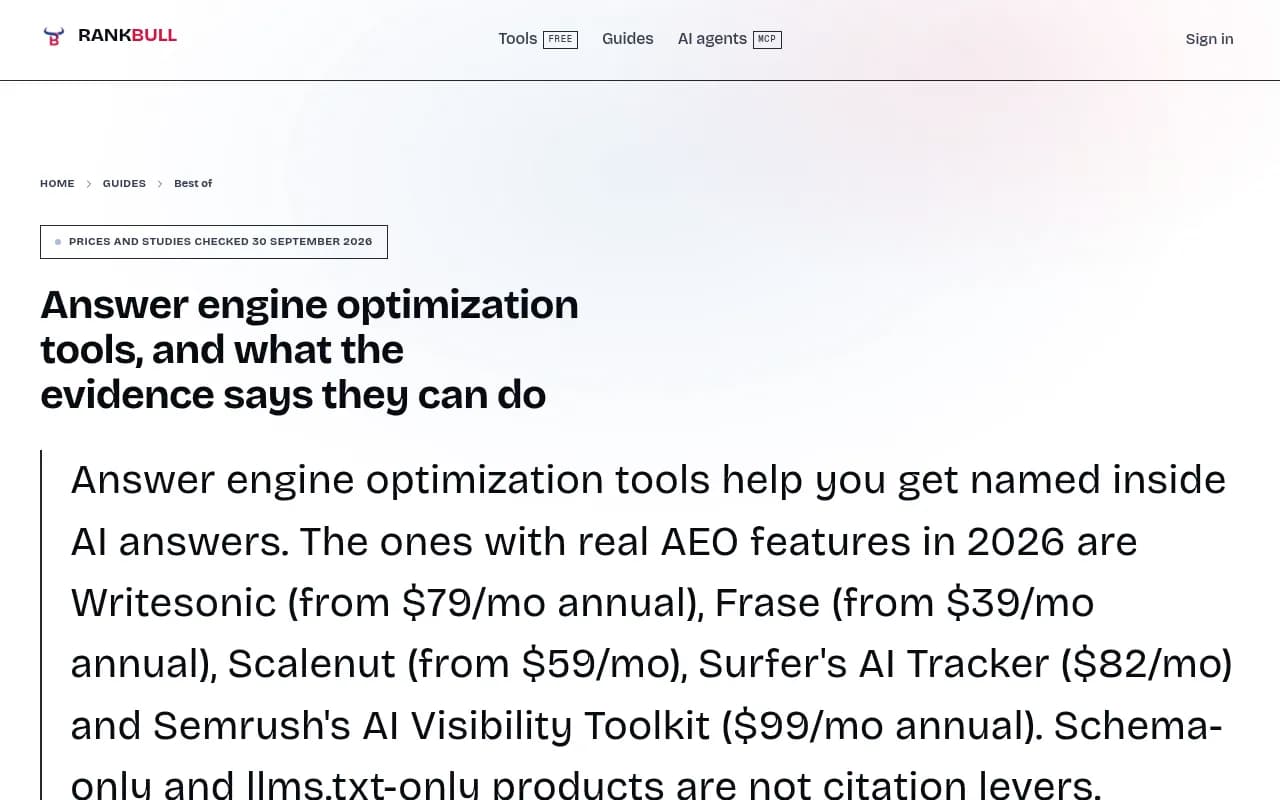
The table above comes from RankBull's published comparison, which prices eleven tools from their own pages. RankBull sells a competing product, so read its ranking with that in mind, but the price list is useful as a cross-check.