Key takeaways
- Research from Chatoptic found only 62% overlap between Google's top-ranking pages and what ChatGPT actually cites -- meaning 38% of your SEO wins are invisible to AI search engines.
- Google SEO and AI visibility are optimized differently: Google rewards backlinks and on-page signals; AI models reward authoritative, conversational, citation-worthy content spread across the web.
- The gap is measurable. You can run a prompt-by-prompt audit to find exactly where competitors are getting cited and you're not.
- Fixing the gap requires new content formats, not just tweaking existing pages -- FAQ-style answers, comparison articles, and definitional content perform best in AI citations.
- Tools built specifically for AI visibility tracking (not traditional SEO tools) are now essential for understanding where you stand.
You're number one on Google. The traffic dashboard looks great. Your SEO team just wrapped a successful quarter.
Then a potential customer asks ChatGPT "what's the best [your category] tool?" and your brand doesn't appear. Not in the answer. Not in the citations. Not even as an honorable mention.
This is the 2026 visibility gap, and it's affecting brands that have done everything right by traditional SEO standards.
The 62% overlap problem explained
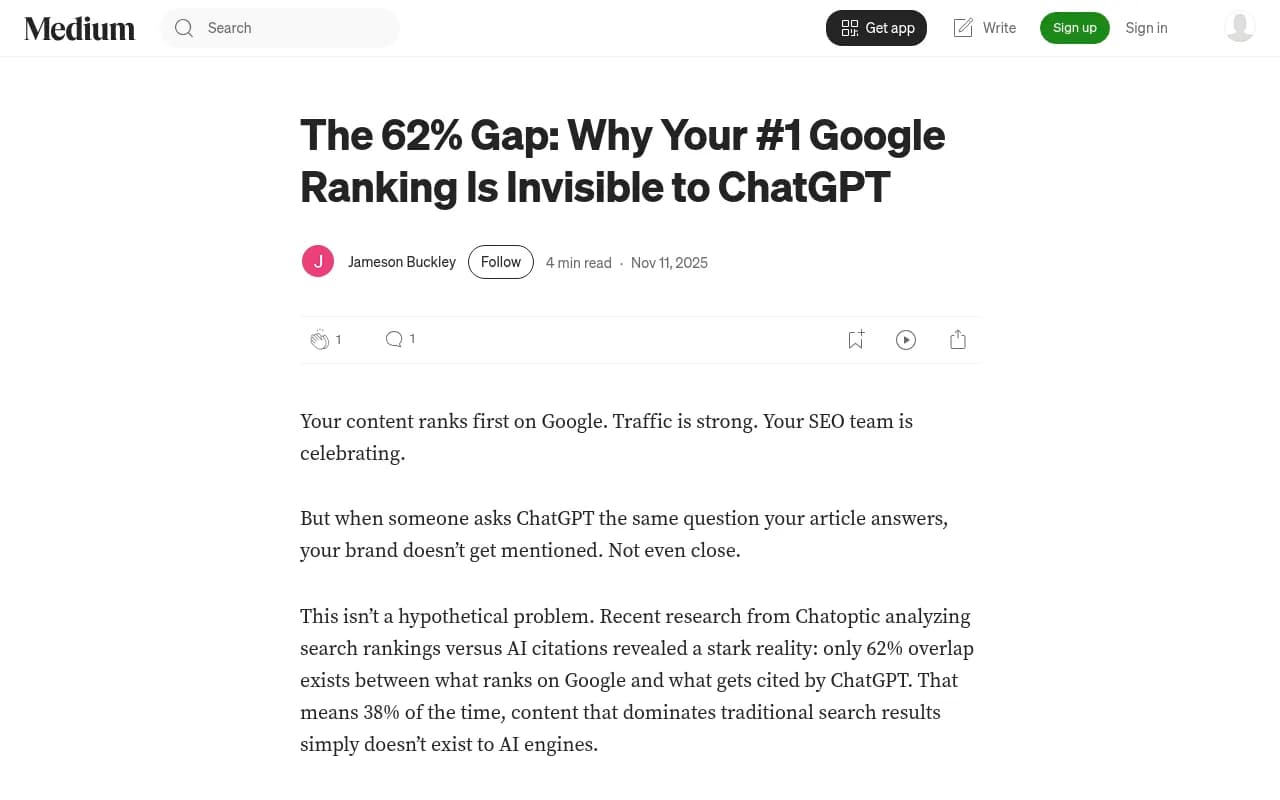
Research analyzing search rankings versus AI citations found that only 62% of content that ranks on Google also gets cited by ChatGPT. That 38% gap isn't random noise -- it reflects a fundamental difference in how these two systems decide what's worth surfacing.
Google's algorithm is built on decades of link graph analysis, on-page signals, and user behavior data. It rewards pages that other pages link to, that load fast, and that match specific keyword queries. ChatGPT's citation behavior works differently. It draws from its training data and, in browsing mode, from what it considers authoritative, well-structured, and conversational sources. A page can be technically perfect for Google and completely wrong for an AI model.
The practical consequence: your competitors who rank #5 on Google but have invested in AI-optimized content might be getting cited far more often in ChatGPT, Perplexity, and Claude responses. They're capturing the conversational market share while you're watching your Google traffic plateau.
Why Google SEO doesn't automatically translate to AI visibility
There are a few specific reasons why strong Google performance doesn't carry over:
Keyword density vs. conversational clarity. Google-optimized content often targets specific keyword phrases, sometimes at the expense of natural language. AI models prefer content that reads like a clear, direct answer to a question. If your article is structured around a keyword like "best project management software 2026" but doesn't actually answer "what makes a project management tool good for remote teams?" in plain language, AI models will skip it.
Backlinks vs. brand presence. Google cares deeply about who links to you. AI models care about where your brand appears across the broader internet -- Reddit discussions, YouTube mentions, third-party review sites, industry publications. A brand with modest backlinks but active community presence can outperform a link-heavy competitor in AI citations.
Page structure vs. answer structure. A typical SEO article might bury the direct answer under an introduction, some background context, and a few headers. AI models want the answer near the top, clearly stated. If they have to parse through 400 words of preamble to find what they're looking for, they'll cite someone else.
Domain authority vs. topic authority. High domain authority helps in Google. AI models are more interested in whether your content demonstrates genuine expertise on a specific topic. A specialized blog with deep knowledge on a narrow subject can outperform a high-DA generalist site in AI citations for that topic.
How to run your own gap analysis
The gap analysis process is straightforward, but it takes some discipline to do properly.
Step 1: Map your target prompts
Start by listing the questions your customers actually ask. Not your keyword list -- the real questions. "What's the difference between X and Y?" "Which tool should I use for Z?" "How do I solve [specific problem]?" These are the prompts AI users are typing, and they're different from how people search Google.
For each prompt, manually check what ChatGPT, Perplexity, and Claude say. Note which brands get mentioned, which sources get cited, and whether your brand appears anywhere.
Step 2: Identify the citation sources
When AI models do cite sources, look at what they're citing. Is it a Reddit thread? A comparison article on a third-party site? A YouTube video? An industry publication? This tells you where the AI models are looking for information about your category -- and where you're not showing up.
Step 3: Compare your content against what gets cited
Take the pages that AI models are citing for your target prompts and compare them to your own content. Look for:
- Do the cited pages answer the question more directly than yours?
- Are they structured differently (more FAQ-style, more conversational)?
- Do they cover angles your content misses entirely?
- Are they shorter and more focused, or longer and more comprehensive?
This comparison usually reveals the content gaps pretty quickly.
Step 4: Check your brand mentions across the web
AI models don't just cite your website. They synthesize information from everywhere. Search Reddit for your brand name and your category. Check if you're mentioned in YouTube reviews. Look at what third-party sites say about you. If the broader web conversation about your category doesn't include your brand, that's a gap that no amount of on-page SEO will fix.
Tools like Promptwatch automate much of this process -- running prompts across multiple AI models, tracking which competitors get cited, and surfacing the specific content gaps you need to fill.

The content types that AI models actually cite
Based on what consistently gets cited across ChatGPT, Perplexity, and Claude, certain content formats perform significantly better than others.
Direct answer articles. Content that answers a specific question in the first paragraph, then expands with supporting detail. The structure mirrors how AI models want to present information to users.
Comparison and "vs." content. "Tool A vs. Tool B" articles get cited constantly because they answer a high-intent question directly. If someone asks ChatGPT to compare two products in your category, it will often cite a well-structured comparison article.
Definitional and explainer content. "What is X?" and "How does Y work?" articles perform well because they establish your brand as a source of clear, reliable information on a topic.
FAQ pages with substantive answers. Not the thin FAQ pages with two-sentence answers, but genuine Q&A content that treats each question as worth a real response.
Data and research content. Original research, surveys, and data-backed claims get cited heavily. If you publish a study with a specific finding, AI models will reference it.
What doesn't perform well: heavily promotional content, thin category pages, content that assumes the reader already knows your brand, and anything that reads like it was written for a keyword rather than a person.
The Reddit and YouTube factor
This one surprises a lot of marketers. A significant portion of AI citations come from Reddit threads and YouTube videos, not brand websites. When someone asks ChatGPT for a recommendation, it often pulls from Reddit discussions where real users have shared opinions.
If your brand isn't being discussed positively (or at all) on relevant subreddits, that's a visibility gap that's hard to close with website content alone. The same applies to YouTube -- review videos and comparison content on YouTube influence what AI models say about your category.
This doesn't mean gaming Reddit or flooding YouTube with promotional content. It means being genuinely present in the communities where your customers talk. Answering questions. Sharing useful information. Building a reputation that shows up in the organic conversations AI models are trained on.
Tools for tracking and closing the gap
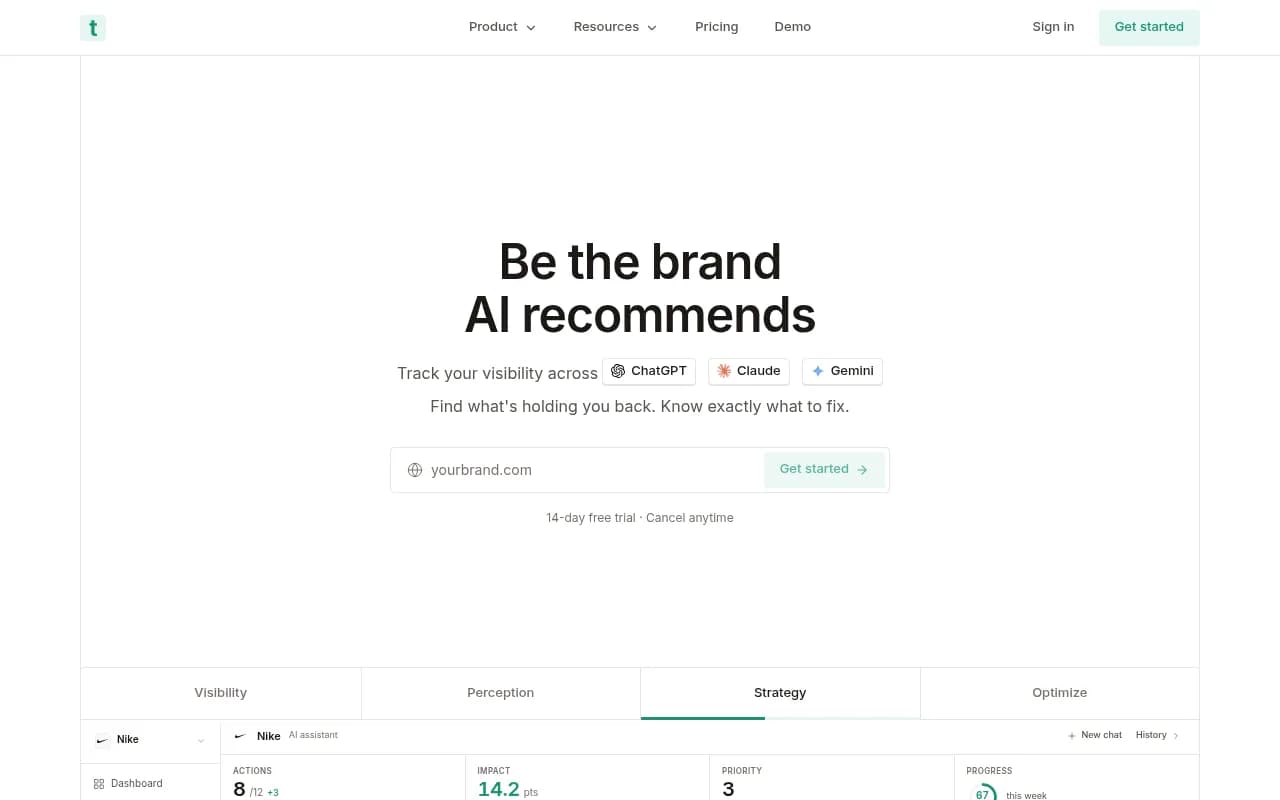
Manually checking AI responses across multiple models for dozens of prompts doesn't scale. There's now a solid category of tools built specifically for AI visibility tracking.
Here's a comparison of some options worth knowing about:
| Tool | AI models tracked | Content gap analysis | Traffic attribution | Best for |
|---|---|---|---|---|
| Promptwatch | 10+ (ChatGPT, Claude, Perplexity, Gemini, Grok, etc.) | Yes (Answer Gap Analysis) | Yes (GSC, snippet, logs) | Full optimization loop |
| Profound | Multiple | Limited | No | Mid-market monitoring |
| Otterly.AI | Several | No | No | Basic monitoring |
| Peec AI | Multiple | No | No | Multi-language tracking |
| AthenaHQ | 8+ | No | No | Monitoring-focused |
| SE Ranking | Multiple | Partial | No | Teams already using SE Ranking |




The core distinction between these tools is whether they help you act on what they find. Most monitoring tools will tell you that you're invisible for a given prompt. Fewer will tell you why, and fewer still will help you create content to fix it.
What "fixing the gap" actually looks like in practice
Let's say your gap analysis reveals that for the prompt "best email marketing tool for e-commerce," three competitors are consistently cited by ChatGPT and you're not. Here's what the fix typically involves:
First, look at what those competitors have published that you haven't. Maybe they have a detailed comparison article specifically about email marketing for e-commerce, with concrete examples and data. You have a generic email marketing page.
Second, create content that directly answers the prompt. Not a page optimized for the keyword "email marketing e-commerce" but an article that genuinely answers "what's the best email marketing tool for e-commerce stores and why?" with specific reasoning, comparisons, and evidence.
Third, make sure the content is structured for AI consumption. Lead with the answer. Use clear headers. Include specific data points. Write in a way that makes it easy for an AI model to extract and cite a specific claim.
Fourth, build the off-site presence. Share the content in relevant communities. Get it mentioned in third-party roundups. Create a YouTube video covering the same topic. The goal is to make your perspective on this question appear in multiple places across the web.
This isn't fast. But it's the actual work required to close the gap.
The monitoring habit you need to build
One gap analysis isn't enough. AI models update their training data, new competitors publish content, and the prompts your customers use evolve. The brands that will win AI visibility over the next few years are the ones that treat it as an ongoing discipline, not a one-time project.
That means running regular prompt checks across the AI models your customers use, tracking your citation rate over time, and connecting AI visibility to actual traffic and revenue. The last part is harder than it sounds -- AI-referred traffic often shows up as direct traffic in analytics, which is why dedicated attribution tools matter.
The honest reality about timeline
If you start today, you won't see results next week. AI models don't update in real-time the way Google does. Content you publish now may take weeks or months to appear in AI citations, depending on how quickly crawlers index it and how training cycles work.
That's actually an argument for starting sooner. Every week you wait is a week your competitors are building the citation history that AI models will draw on for months. The brands that invested in AI visibility in 2024 and 2025 are already seeing compounding returns. The gap between them and late movers is widening.
Your Google rankings are an asset. They represent real work and real expertise. But they're not a guarantee of AI visibility -- and in 2026, AI visibility is increasingly where high-intent buyers are making decisions. The gap analysis is how you find out exactly where you stand.