Key takeaways
- Scrunch AI was acquired by Sitecore in 2026, pivoting it firmly into enterprise CMS territory and away from its original mid-market and agency audience.
- GEO tools built around a single customer segment (enterprise-only, SMB-only, or agency-only) carry real business risk: when the segment shifts, the product follows -- and existing customers get left behind.
- The GEO market is consolidating fast. Standalone monitoring tools are being absorbed into larger platforms, which often strips out the flexibility that made them useful.
- The most durable AI visibility platforms in 2026 are those that serve multiple segments AND close the loop from monitoring to content creation to revenue attribution.
- Before committing to any GEO tool, check whether it can grow with you -- and whether it's still independently operated.
The Sitecore acquisition changes everything about how to read Scrunch
In mid-2026, Scrunch confirmed what had been rumored for months: it is now a Sitecore company.

Sitecore is an enterprise content management and digital experience platform. It sells to large organizations with complex content workflows, IT governance requirements, and six-figure contracts. That's a very specific buyer -- and it's not the marketing team at a 50-person SaaS company that originally signed up for Scrunch to track their ChatGPT citations.
This matters because Scrunch had positioned itself as an accessible, mid-market-friendly GEO platform. Its TechCrunch coverage from early 2025 described it as helping companies "audit and optimize how they appear on various AI search platforms." Its beta launch announcement talked about giving "more businesses" the tools to win in AI search. The language was inclusive. The pricing was approachable.
Post-acquisition, that positioning is gone. When a company gets absorbed into an enterprise CMS vendor, the product roadmap follows the enterprise buyer. Features that don't serve large content teams with Sitecore integrations will get deprioritized. Pricing will drift upward. The SMB and agency customers who built workflows around Scrunch are now passengers on a bus headed somewhere else.
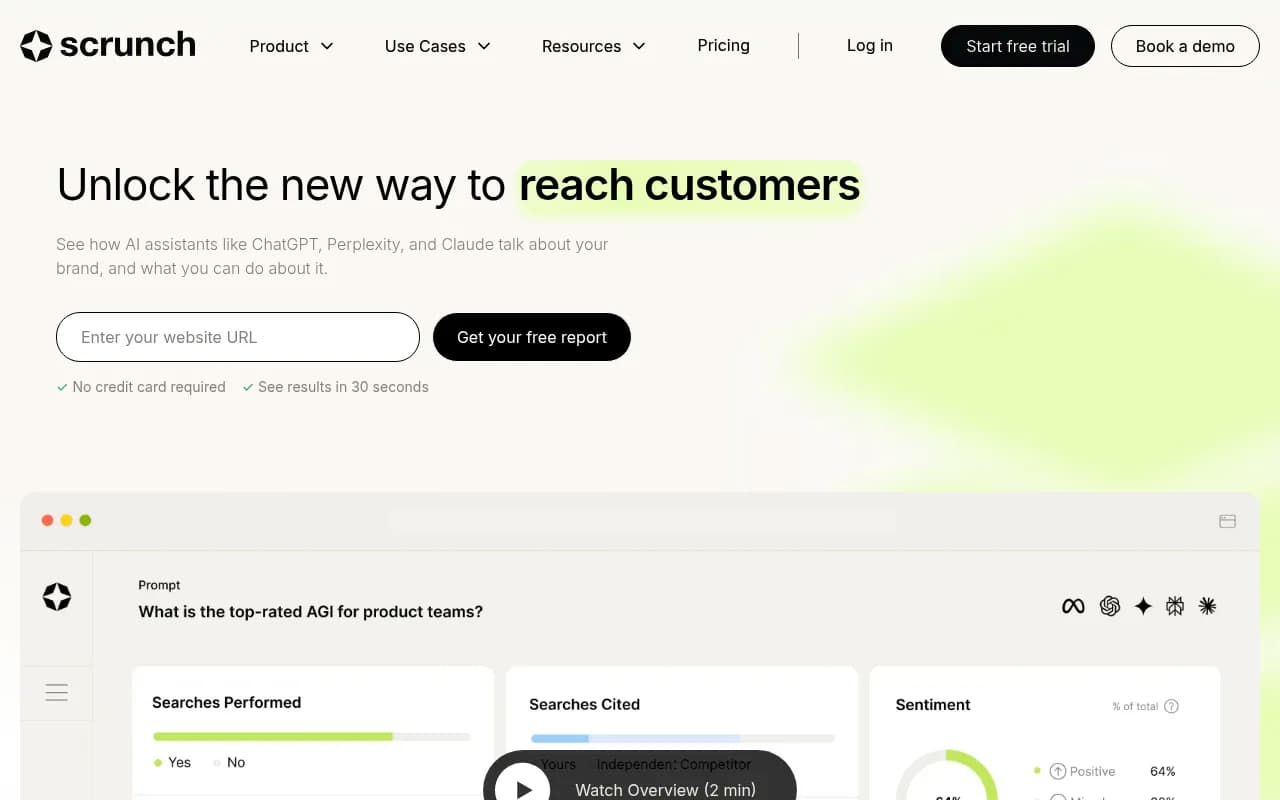
This isn't a criticism of Scrunch specifically. The team built something real. But the acquisition is a useful case study in a structural risk that runs through the entire GEO tool market right now.
Why single-segment GEO tools are fragile
The GEO and AI visibility market is only a few years old. Most tools in it were built by small teams who identified a specific pain point and a specific buyer. That's how startups work. But it creates a concentration problem.
When your entire product is designed around one customer type, a few things can go wrong:
The segment moves. Enterprise marketing teams in 2026 are under pressure to consolidate their martech stacks. They're not adding new point solutions -- they're asking vendors to prove ROI and fit into existing platforms. A GEO tool that only serves enterprise buyers is now competing for budget against tools that do ten other things.
The segment gets acquired. If your best customers are enterprise brands, you become an attractive acquisition target for a larger platform that wants to add AI visibility to its suite. That's exactly what happened with Scrunch. The acquirer gets the enterprise relationships; the smaller customers get a product that no longer prioritizes them.
The segment consolidates around a few winners. Enterprise buyers do extensive vendor evaluations. Once they pick a platform, they stick with it for years. A GEO tool that loses a few enterprise accounts to a competitor doesn't just lose revenue -- it loses the reference customers that drive the next round of enterprise sales.
The same logic applies in reverse for tools that only target SMBs or only target agencies. SMB customers churn fast when budgets tighten. Agency-only tools get squeezed when agencies standardize on a single platform for all their clients.
The durable GEO platforms are the ones that serve multiple segments without compromising the product for any of them.
What Scrunch actually built (and what gets lost in an acquisition)
To be fair to Scrunch, the platform had real capabilities. The LinkedIn review data shows strong scores across monitoring (4.6/5), insights (4.5/5), and its Agent Experience Platform (4.4/5). The AXP feature -- which delivers AI-optimized versions of website content directly to AI agents -- was genuinely differentiated. Not many GEO tools were thinking about the agent-side of the equation, not just the user-facing citation.
The platform also covered citation tracking, shopping visibility, site maps for AI consumption, and agent traffic analysis. That's a solid feature set.
But here's the problem with acquisitions: features don't always survive them. When Sitecore integrates Scrunch into its platform, the AXP becomes a feature of a $200k/year enterprise CMS deal, not a standalone tool a growth marketer can spin up in an afternoon. The monitoring dashboards get rebuilt to fit Sitecore's data model. The pricing gets bundled. The self-serve trial disappears.
This is the pattern. It happened with content marketing tools, with social listening tools, and with SEO platforms. The acquired product becomes a checkbox on the acquirer's feature list, not a living, evolving product.
The broader consolidation trend in GEO tools
Scrunch isn't an isolated case. The GEO market is going through its first wave of consolidation, and it's happening faster than most people expected.
There are roughly three categories of tools right now:
Monitoring-only platforms that show you where your brand appears in AI responses. These are the most common and the most vulnerable. They're easy to build, which means they're easy to replicate. When a larger platform adds AI monitoring as a feature (Semrush, Ahrefs, and others have already started), the standalone monitoring tool loses its reason to exist.


Monitoring plus insights platforms that add some analysis on top of the raw data -- competitor comparisons, prompt tracking, visibility scores. These are more defensible, but still primarily passive. They tell you what's happening; they don't help you change it.


Full-loop optimization platforms that close the gap between "here's where you're invisible" and "here's the content that will fix it." These are the hardest to build and the most durable, because the value compounds over time. Every piece of content you create based on gap analysis improves your visibility, which generates new data, which informs the next piece of content.

Promptwatch sits in this third category. It tracks visibility across 10 AI models, identifies which prompts competitors rank for that you don't, and then generates content specifically designed to close those gaps. The cycle from gap identification to content creation to citation tracking is built into the same platform. That's a different product category than what Scrunch was, and it's why the acquisition risk is lower -- the value isn't just in the monitoring data, it's in the workflow.
A comparison of where major GEO tools stand in 2026
| Tool | Monitoring | Content generation | Crawler logs | Multi-segment | Independent |
|---|---|---|---|---|---|
| Promptwatch | Yes (10 models) | Yes (Content Agents) | Yes | Yes | Yes |
| Scrunch (Sitecore) | Yes | No | Yes (AXP) | Enterprise-focused | No (acquired) |
| Profound | Yes | No | No | Enterprise | Yes |
| AthenaHQ | Yes | No | No | Mid-market | Yes |
| Otterly.AI | Yes | No | No | SMB/Agency | Yes |
| Peec.ai | Yes | No | No | SMB | Yes |
| Semrush | Partial | Partial | No | All segments | Yes |
The pattern is clear. Most tools stop at monitoring. The ones that go further -- into content creation, crawler analysis, and revenue attribution -- are the ones that are harder to replace with a checkbox feature in a larger platform.
What this means if you're evaluating GEO tools right now
The Scrunch acquisition is a useful forcing function. It makes you ask questions you should be asking about any GEO tool you're considering:
Is the company independently operated? An acquisition can happen at any time. But a company that's been acquired once is no longer making product decisions based on its customers -- it's making them based on its parent company's roadmap.
Who is the product actually built for? Read the case studies, not the marketing copy. If every customer story is a Fortune 500 brand, the product is built for Fortune 500 brands. If you're a 20-person agency, you're using a product that wasn't designed with you in mind.
Does the tool help you act, or just observe? Monitoring data has diminishing returns. After the third month of seeing that your competitor ranks for prompts you don't, you need a tool that helps you do something about it. If the platform's answer is "export to CSV and figure it out yourself," that's a problem.
What happens to your data if the company gets acquired? This is a practical question that most people skip. Your prompt tracking history, your competitor benchmarks, your citation data -- these are valuable. Make sure you understand the data portability terms before you commit.
Can the pricing grow with you? A tool that's cheap at 50 prompts and prohibitively expensive at 500 prompts will force you to switch at exactly the wrong moment -- when you've built enough data to actually use it.
The tools worth watching as alternatives
If you're reconsidering Scrunch or evaluating the market fresh, here are some platforms that are worth a serious look:
Promptwatch covers the full loop: gap analysis, content generation, crawler logs, and traffic attribution. It's used by brands like Booking.com and Center Parcs, which gives it enterprise credibility, but the pricing structure (starting at $99/month) means it's accessible to smaller teams too. That multi-segment approach is exactly what makes a GEO platform durable.
Profound has strong enterprise monitoring capabilities and good prompt tracking. It's monitoring-focused, so you'll need to bring your own content workflow, but the data quality is solid.
AthenaHQ covers 8+ AI search engines and has a clean interface. Again, primarily monitoring -- but it's well-built for teams that have a separate content operation.
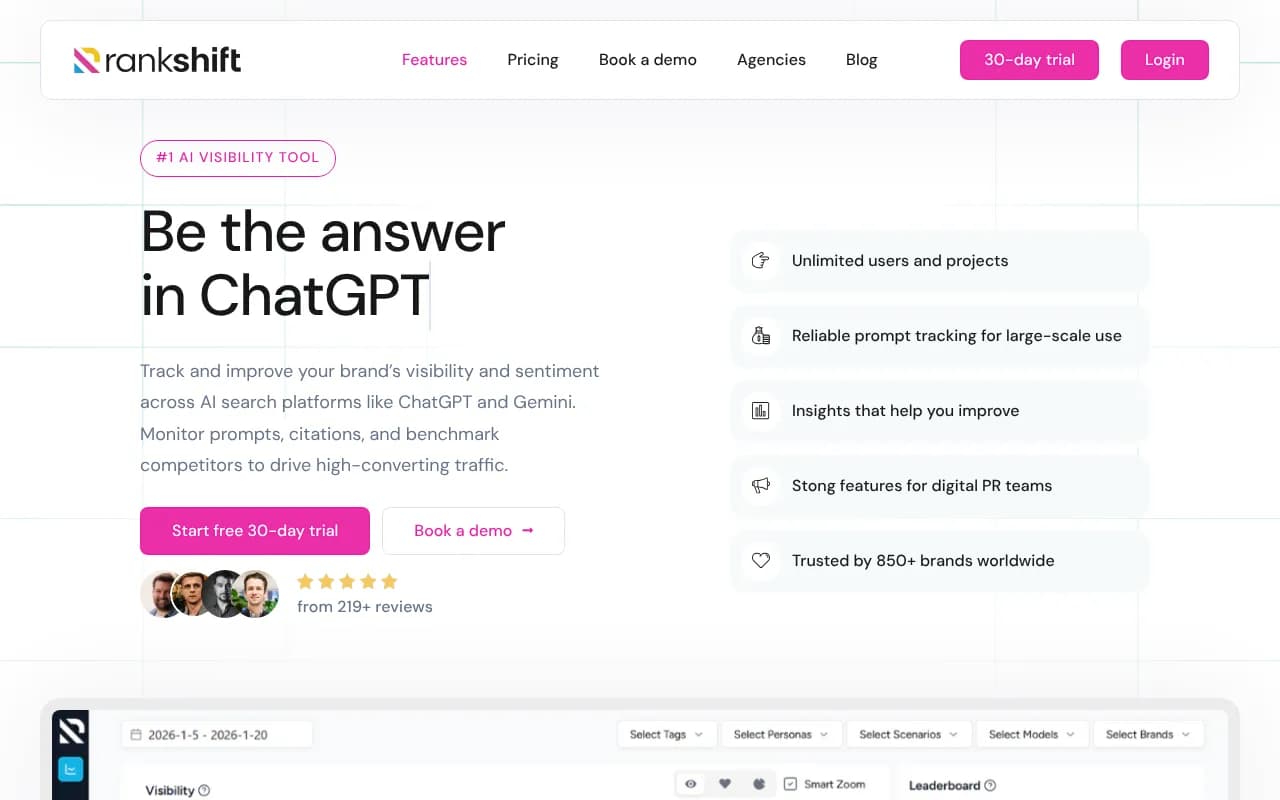
Rankshift is worth considering for teams that want LLM tracking without the enterprise price tag. Lighter on features but easier to get started.
Bluefish targets Fortune 500 brands specifically. If you're in that tier, it's worth evaluating. If you're not, it's probably not built for you -- which is exactly the point this article is making.
The real lesson from Scrunch's pivot
The GEO market is young enough that most tools are still figuring out who they're for. Scrunch figured it out -- and then got acquired by a company that had a different answer to that question.
The warning sign isn't that Scrunch got acquired. Acquisitions happen. The warning sign is that the acquisition was possible because the product had a clear ceiling: it was built for enterprise buyers, and Sitecore was a natural home for it. The mid-market and agency customers who were using it were always secondary.
Any GEO tool that's built around a single customer segment has the same ceiling. It's either going to get acquired, pivot, or slowly lose relevance as larger platforms add monitoring features as table stakes.
The tools that will still be independently useful in three years are the ones that have figured out how to serve multiple segments without compromising the product -- and that have built enough workflow depth that they can't be replaced by a feature checkbox.
That's a high bar. Not many tools clear it right now. But it's the right bar to hold them to.