Key takeaways
- Google AI Mode is now a distinct search surface that traditional rank trackers can't see -- you need a dedicated AI visibility platform to know if you're being cited there.
- Most platforms in this space are monitoring-only: they show you where you're invisible but don't help you fix it.
- Promptwatch is the only platform in this comparison that closes the full loop -- gap analysis, AI content generation, and citation tracking -- rather than stopping at the dashboard.
- SE Ranking is the best pick if you want AI visibility data inside an existing SEO workflow without switching tools.
- Semrush suits teams already standardized on its ecosystem; its AI toolkit is solid but uses fixed prompts.
- Profound is the strongest pure-monitoring option for enterprise teams that need deep reporting and stakeholder dashboards.
- Peec AI is clean and well-priced for smaller teams, but lacks content optimization and crawler-level data.
Why Google AI Mode changes everything
Google AI Mode launched as a dedicated conversational search experience -- a full tab in Google Search where users get AI-generated answers instead of a list of links. It's different from AI Overviews (which appear inline on the standard results page). AI Mode is its own surface, with its own citation logic, its own ranking signals, and its own set of winners and losers.
The problem: almost no traditional SEO tool tracks it properly. Rank trackers show you position 1-10 on the blue-link page. They say nothing about whether Google AI Mode is citing your brand, quoting your content, or recommending a competitor instead.
That gap is why the AI visibility platform category exists -- and why picking the right one matters more now than it did 12 months ago.
This guide compares five platforms that have made tracking Google AI Mode (alongside other AI engines like ChatGPT, Perplexity, Claude, and Gemini) a core part of their offering. We'll go platform by platform, then put them side by side so you can make a clean decision.
The five platforms at a glance
Before going deep, here's the comparison table. We'll unpack each row below.
| Platform | Google AI Mode tracking | Content generation | Crawler logs | Prompt volume data | Starting price |
|---|---|---|---|---|---|
| Promptwatch | Yes | Yes (AI Content Agents) | Yes | Yes | $99/mo |
| SE Ranking | Yes (AI Visibility Toolkit) | No | No | No | ~$65/mo |
| Semrush | Yes (fixed prompts) | No (separate tools) | No | No | ~$140/mo |
| Profound | Yes | No | No | Limited | Custom / ~$500+/mo |
| Peec AI | Yes | No | No | No | $95/mo |
Promptwatch
Promptwatch is the platform that has moved furthest past pure monitoring. It tracks 10 AI models -- including Google AI Mode, Google AI Overviews, ChatGPT, Perplexity, Claude, Gemini, Grok, DeepSeek, Copilot, and Meta AI -- and it does so by querying models the way real users do, not just through APIs. That distinction matters because user-facing answers and citations can differ from what an API returns.

What separates Promptwatch from every other tool in this comparison is what happens after you see the data. Most platforms show you a visibility score and leave you to figure out the rest. Promptwatch has a built-in action loop:
- Answer Gap Analysis shows you exactly which prompts your competitors rank for in AI responses but you don't -- and what content your site is missing to close those gaps.
- Content Agents generate articles, listicles, comparisons, and briefs grounded in real prompt data, citation patterns, and competitor analysis. This isn't generic AI writing -- it's content built to answer the specific questions AI models are already exposing as gaps.
- Page-level tracking then shows which of your pages are being cited, how often, and by which models. Agent Analytics shows the timeline from publish to crawl to citation.
The crawler log feature is worth calling out specifically. Promptwatch gives you real-time logs of AI crawlers (ChatGPT's bot, Claude's crawler, Perplexity's spider) hitting your website -- which pages they read, errors they encounter, and how often they return. Most competitors in this comparison don't have this at all.
Other capabilities: Reddit and YouTube citation tracking, ChatGPT Shopping monitoring, prompt volume and difficulty scores, query fan-outs, offsite citation analysis, competitor heatmaps, and multi-language/multi-region support.
Pricing runs from $99/month (Essential: 1 site, 50 prompts, 5 articles) to $249/month (Professional: 2 sites, 150 prompts, 15 articles, crawler logs) to $579/month (Business: 5 sites, 350 prompts, 30 articles). Agency and enterprise pricing is custom. A free trial is available.
The honest caveat: if you genuinely only need a monitoring dashboard and have no interest in content creation or optimization, Promptwatch has more horsepower than you'll use. But for teams that want to actually improve their AI visibility -- not just measure it -- nothing else in this list comes close.
SE Ranking
SE Ranking is an all-in-one SEO platform that added an AI Visibility Toolkit to its existing suite. If your team is already running keyword research, rank tracking, backlink analysis, and site audits inside SE Ranking, the AI monitoring layer slots in without requiring a new tool or a new workflow.
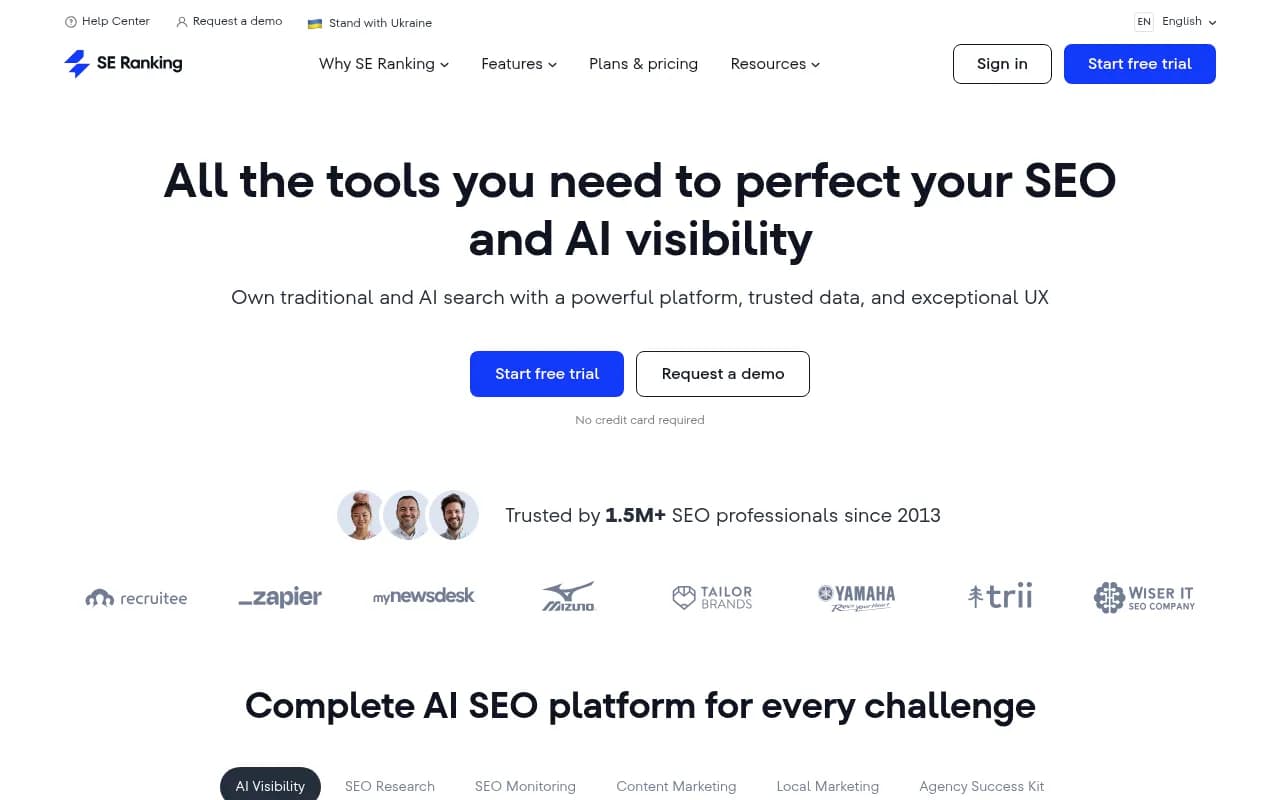
The AI Visibility Toolkit tracks brand mentions and citations across AI search engines including Google AI Mode. You can see share of voice, citation frequency, and how your brand compares to competitors in AI-generated answers. It's solid data, clearly presented.
Where SE Ranking falls short for teams with serious AI visibility ambitions: it doesn't generate content, doesn't have crawler logs showing AI bot activity on your site, and doesn't give you prompt volume data to prioritize which gaps to close first. It's a monitoring layer on top of an SEO platform -- which is exactly what it's designed to be, and exactly the right fit for teams that want that.
Pricing starts around $65/month for the Essential plan, making it one of the more affordable options here. The AI toolkit is included in higher-tier plans.
Best for: SEO teams that want AI visibility data without switching platforms, and who are comfortable doing the content work themselves.
Semrush
Semrush is the most widely used digital marketing platform in this comparison, and its AI Visibility Toolkit is a natural extension of the brand monitoring and keyword research features the platform has offered for years.
The toolkit tracks how your brand appears in AI-generated answers across major models. The main limitation, noted consistently across independent reviews: Semrush uses fixed prompts rather than dynamic prompt tracking. That means you're monitoring a predetermined set of queries rather than discovering new prompts your customers are actually using. For teams that want to find unknown gaps, this is a meaningful constraint.
Semrush also doesn't connect AI visibility data to content generation in any integrated way. You'd use ContentShake or the Writing Assistant separately, then manually connect the dots. It works, but it's not a closed loop.
That said, Semrush has genuine advantages. Its competitive intelligence database is enormous. If you're already paying for Semrush and want to add AI visibility monitoring without a separate subscription, the toolkit is a reasonable starting point. And for enterprise teams that have standardized on Semrush across multiple departments, keeping AI visibility in the same platform simplifies reporting.
Pricing starts around $140/month for the Pro plan. The AI Visibility Toolkit is available on higher tiers.
Best for: Teams already on Semrush who want basic AI monitoring without adding another vendor.
Profound
Profound is the strongest pure-monitoring platform in this comparison. It's built specifically for enterprise teams that need deep AI visibility reporting, stakeholder-ready dashboards, and the ability to track brand presence across multiple AI engines at scale.

The platform covers Google AI Mode alongside ChatGPT, Perplexity, Claude, and others. Its reporting is detailed -- you can slice visibility data by model, by topic cluster, by competitor, and by time period. For a VP of Marketing presenting AI visibility trends to a board, Profound's dashboards are genuinely useful.
The gap: Profound is a monitoring platform. It doesn't help you create content to close the gaps it finds, doesn't have crawler logs, and doesn't have the prompt volume data that would help you prioritize which gaps matter most. You get excellent visibility into the problem; the solution is left to you.
Pricing is custom and typically starts well above $500/month, making it a harder sell for smaller teams. It's positioned squarely at enterprise.
Best for: Enterprise marketing and SEO teams that need sophisticated reporting and have separate content resources to act on what they find.
Peec AI
Peec AI is a clean, focused AI visibility tracker that covers multiple AI models including Google AI Mode. It's well-designed, reasonably priced, and does what it promises: tracks how often your brand appears in AI-generated answers and shows you how that changes over time.

The platform supports multi-language tracking, which is useful for brands operating across markets. Its pricing is transparent -- $95/month for the Starter plan (3 AI models, 50 prompts), $245/month for Pro (150 prompts, 2 projects), $495/month for Advanced (350 prompts, multi-country, GSC/GA/Looker integrations).
What Peec AI doesn't have: content generation, crawler logs, prompt volume data, Reddit/YouTube citation tracking, or ChatGPT Shopping monitoring. It's a monitoring tool, and a good one, but it stops at the dashboard.
The pricing is actually quite similar to Promptwatch's -- $95/month vs $99/month at entry level -- which makes the comparison direct. At similar price points, Promptwatch gives you considerably more capability, particularly if content optimization is part of your workflow.
Best for: Smaller teams or those new to AI visibility tracking who want a clean, affordable starting point without complexity.
Head-to-head: which platform wins on what
Here's a more detailed feature breakdown across the five platforms:
| Feature | Promptwatch | SE Ranking | Semrush | Profound | Peec AI |
|---|---|---|---|---|---|
| Google AI Mode tracking | Yes | Yes | Yes | Yes | Yes |
| ChatGPT tracking | Yes | Partial | Yes | Yes | Yes |
| Perplexity tracking | Yes | Partial | Yes | Yes | Yes |
| Dynamic prompt discovery | Yes | No | No (fixed) | Limited | No |
| Prompt volume & difficulty | Yes | No | No | No | No |
| Answer Gap Analysis | Yes | No | No | No | No |
| AI content generation | Yes | No | No | No | No |
| AI crawler logs | Yes | No | No | No | No |
| Reddit/YouTube tracking | Yes | No | No | No | No |
| ChatGPT Shopping tracking | Yes | No | No | No | No |
| Offsite citation analysis | Yes | No | No | Partial | No |
| Multi-language/region | Yes | Yes | Yes | Yes | Yes |
| Traffic attribution | Yes | No | No | No | No |
| Starting price | $99/mo | ~$65/mo | ~$140/mo | Custom | $95/mo |
| Free trial | Yes | Yes | Yes | Demo only | Yes |
How to pick the right platform for your team
The decision mostly comes down to one question: do you want to monitor your AI visibility, or do you want to improve it?
If you want to monitor, Profound is the most powerful option for enterprise teams with budget to match. Peec AI is the cleanest and most affordable for smaller teams. SE Ranking is the right call if you're already in that ecosystem. Semrush makes sense if you're already paying for it and don't want another subscription.
If you want to actually improve your AI visibility -- find the gaps, create content that closes them, track the results -- Promptwatch is the only platform here that does all three. The action loop (gap analysis → content generation → citation tracking) is what makes it an optimization platform rather than a dashboard.
A few other factors worth weighing:
- If Google AI Mode is your primary concern (rather than ChatGPT or Perplexity), all five platforms cover it, but Promptwatch's crawler logs give you the deepest view of how Google's AI crawler is actually interacting with your site.
- If you're an agency managing multiple clients, Promptwatch's agency pricing and multi-site support are worth looking at. SE Ranking also has strong agency features built into its core platform.
- If you're a solo marketer or a very small team, Peec AI's simplicity has real value. Starting simple and adding complexity later is a reasonable approach.
The monitoring-only trap
One thing worth naming directly: a lot of teams buy an AI visibility tool, get a dashboard full of data, and then... don't change anything. The monitoring becomes a reporting exercise rather than an optimization program.
This isn't a knock on any specific platform. It's a structural problem with monitoring-only tools. When the tool's job ends at "here's your visibility score," the burden of figuring out what to do falls entirely on your team. That's fine if you have the content resources and the strategic clarity to act. Many teams don't.
The reason Promptwatch has grown to 1,480+ brands -- including Booking.com, Center Parcs, and others -- is that it removes that gap. The Answer Gap Analysis tells you specifically what content to create. The Content Agents create it. The tracking shows you whether it worked. That's a workflow, not just a report.
Bottom line
Google AI Mode is a real search surface with real traffic implications, and tracking it properly requires a dedicated platform. The five tools in this comparison all do that -- they differ on depth, price, and what they help you do with the data.
For teams serious about improving their AI visibility rather than just measuring it, Promptwatch is the clear choice. For teams that want monitoring inside an existing SEO workflow, SE Ranking or Semrush will serve you well. For enterprise-grade reporting without the optimization layer, Profound is the strongest option. And for a clean, affordable starting point, Peec AI gets the job done.
The category is moving fast. Whatever platform you choose, the brands that will win in AI search are the ones that treat it as an optimization problem -- not a reporting one.