Key takeaways
- Sitecore acquired Scrunch for approximately $225 million in June 2026, folding it into an enterprise DXP stack that most SMBs and agencies can't justify.
- If you were using Scrunch for AI visibility monitoring, you now need a replacement -- ideally one that doesn't just show you a dashboard but helps you act on what it finds.
- Promptwatch is the strongest like-for-like replacement with the widest model coverage, content generation, and crawler logs. Several lighter alternatives work well for smaller budgets.
- The key question to ask any replacement: does it only monitor, or does it help you fix the gaps it finds?
What happened with Scrunch
On June 3, 2026, Sitecore announced it had acquired Scrunch for around $225 million, according to Bloomberg. Scrunch had built a solid reputation as an AI visibility platform -- helping brands understand where they appeared (or didn't appear) in AI-generated answers across ChatGPT, Perplexity, Gemini, and others.

The acquisition makes sense for Sitecore. They get Scrunch's insights engine and Agent Experience Platform (AXP), which they're combining with their own DXP to let enterprise customers publish AI-optimized content across channels. Eric Stine, Sitecore's CEO, framed it as helping brands "show up with greater clarity, authority, and relevance" in AI-generated answers.
That's a compelling pitch -- for enterprise customers already paying for Sitecore licenses.
For everyone else, the math doesn't work. Scrunch is now bundled into an enterprise DXP stack. If you're an SMB, a mid-market brand, or a digital agency running multiple client accounts, you're not buying Sitecore just to get AI visibility monitoring. You need a standalone alternative.
The good news: there are several strong options, and some of them are genuinely better than Scrunch was as a standalone tool.
What to look for in a Scrunch replacement
Before jumping to a list, it's worth being clear about what Scrunch actually did well and where the gaps were.
Scrunch's core value was visibility: you could see where your brand appeared in AI answers, which competitors were getting cited instead, and which topics you were missing. That's useful. But like most tools in this category, Scrunch was primarily a monitoring platform. It showed you the problem. Fixing it was your problem.
When evaluating replacements, look for:
- Coverage across multiple AI models (ChatGPT, Perplexity, Gemini, Claude, Grok, etc.)
- Prompt tracking with volume and difficulty data, not just binary mention/no-mention
- Content gap analysis that maps your site against what AI models are actually citing
- Content generation or briefs grounded in real citation data
- Crawler logs showing which AI bots are visiting your pages and when
- Agency features: multi-client dashboards, white-label reporting, seat management
- Pricing that doesn't require an enterprise contract
The best Scrunch alternatives in 2026
Promptwatch -- best overall replacement
Promptwatch is the most complete replacement for Scrunch, and it goes further than Scrunch did on almost every dimension.

Where Scrunch monitored visibility, Promptwatch closes the loop. Its Answer Gap Analysis shows you exactly which prompts competitors are appearing for that you're not -- with the specific content gaps your site has. Then its Content Agents generate articles, listicles, and comparisons grounded in real prompt data and citation analysis. You can see which pages AI crawlers are visiting, when those pages move from crawl to citation, and which models are citing them.
For agencies, the multi-client setup, white-label reporting, and Looker Studio integration make it practical to manage AI visibility across dozens of accounts without losing your mind.
Coverage spans 10 models: ChatGPT, Perplexity, Google AI Overviews, Google AI Mode, Claude, Gemini, Meta/Llama, DeepSeek, Grok, and Copilot. It also tracks ChatGPT Shopping and Reddit/YouTube citations -- two channels most competitors ignore entirely.
Pricing starts at $99/month for one site and 50 prompts, with agency and enterprise tiers available. There's a free trial.
The honest caveat: if you only need basic monitoring and don't want to touch content generation, Promptwatch has more capability than you'll use. But if you're serious about improving AI visibility rather than just watching it, that's a feature, not a problem.
Peec AI -- good for multi-language tracking

Peec AI is a solid mid-tier option with strong multi-language support. If you're tracking AI visibility across multiple markets or languages, it handles that better than most tools at its price point. The interface is clean and the reporting is straightforward. It's monitoring-focused, so don't expect content generation or crawler logs, but for teams that just want reliable data across models and regions, it works well.
AthenaHQ -- strong on competitive analysis

AthenaHQ tracks your brand across 8+ AI search engines and puts particular emphasis on competitive benchmarking. You can see how you stack up against specific competitors for specific prompts, which makes it useful for positioning work. Like most tools in this space, it's primarily a monitoring platform -- there's no content generation built in -- but the competitive intelligence layer is genuinely useful for agencies doing strategy work for clients.
Rankability -- agency-ready reporting
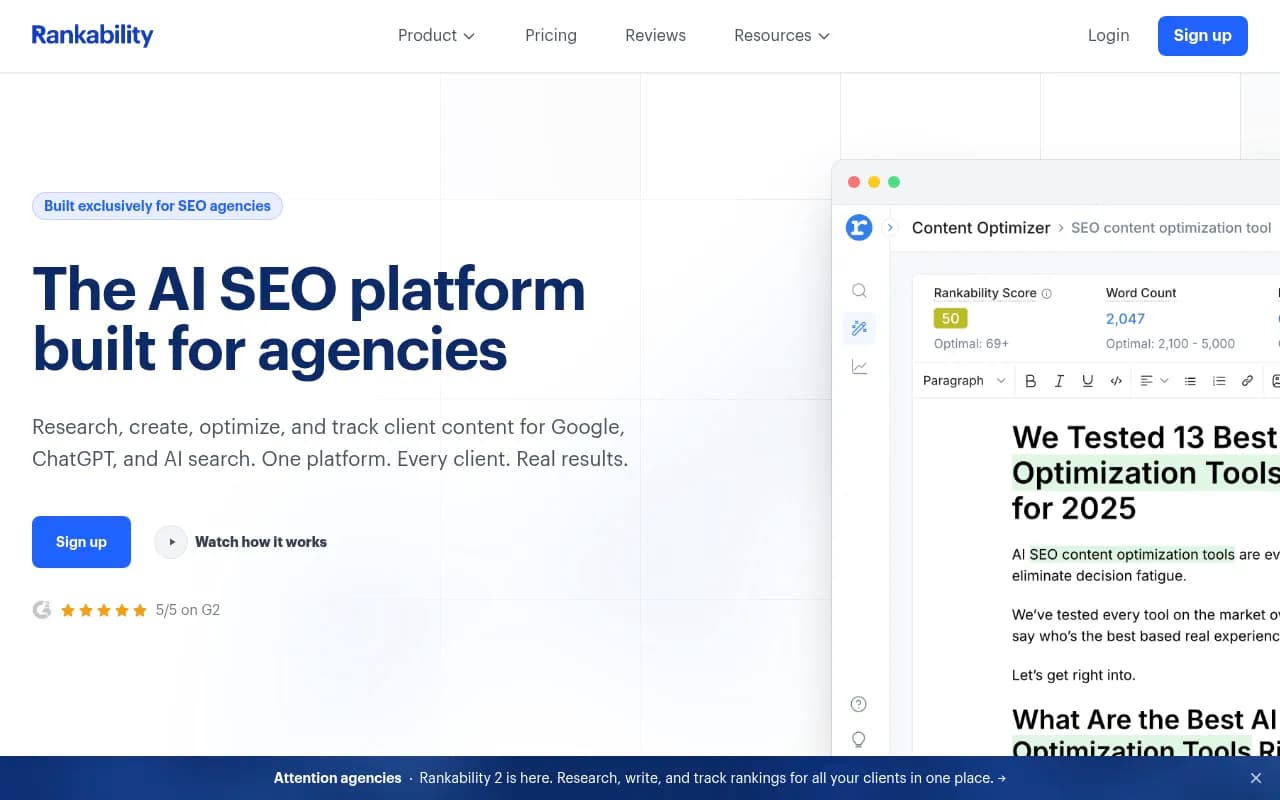
Rankability sits in an interesting spot: it's built with agencies in mind and has stronger workflow and reporting features than most pure AI visibility tools. If your main pain point with Scrunch was the lack of agency-friendly dashboards or client reporting, Rankability addresses that directly. It also covers broader SEO workflows, so it can partially consolidate your stack.
Otterly.AI -- lightweight and affordable

Otterly.AI is the budget-friendly option. It's monitoring-only -- no content generation, no crawler logs -- but it covers the major AI models and gives you a clear picture of brand mentions and citation trends. For small businesses or freelancers who just want to know if they're showing up in AI answers without spending hundreds per month, it's a reasonable starting point.
Profound -- enterprise-grade alternative

Profound is the closest competitor to what Scrunch was trying to become before the Sitecore acquisition. It has strong tracking capabilities across AI search engines and solid analytics. Pricing is higher than most SMB-friendly tools, and it lacks some of the content optimization features you'd get from Promptwatch, but for mid-market brands that want depth without committing to a full DXP stack, it's worth evaluating.
SE Ranking AI visibility -- for teams already using SE Ranking
If you're already paying for SE Ranking's SEO suite, their AI visibility toolkit is a natural add-on rather than a separate purchase. It won't replace a dedicated GEO platform for serious AI search work, but for teams that want AI monitoring folded into their existing SEO workflow without adding another vendor, it's a practical choice.
Comparison table
| Tool | Model coverage | Content generation | Crawler logs | Agency features | Starting price |
|---|---|---|---|---|---|
| Promptwatch | 10 models | Yes (AI content agents) | Yes | Yes (multi-client, white-label) | $99/mo |
| Peec AI | Multiple | No | No | Limited | ~$49/mo |
| AthenaHQ | 8+ models | No | No | Moderate | ~$99/mo |
| Rankability | Multiple | No | No | Strong | ~$99/mo |
| Otterly.AI | Major models | No | No | Minimal | ~$29/mo |
| Profound | Multiple | No | No | Moderate | ~$200/mo |
| SE Ranking (AI add-on) | Multiple | No | No | Moderate | Add-on to existing plan |
Who should use what
The right choice depends on what you actually needed Scrunch for.
If you were using Scrunch for monitoring and want a direct replacement with more capability, Promptwatch is the obvious move. It covers more models, adds content generation, and includes crawler logs that Scrunch didn't have. The action loop -- find gaps, generate content, track results -- is what separates it from the monitoring-only tools.
If you were using Scrunch mainly to show clients a dashboard and need agency-friendly reporting, Rankability or AthenaHQ are worth a look. Both have stronger client-facing features than most pure AI visibility tools.
If budget is the primary constraint and you just need basic monitoring, Otterly.AI gets you started without a significant monthly commitment.
If you're already on SE Ranking for traditional SEO, check whether their AI visibility add-on covers your needs before adding another platform.
What the Sitecore acquisition means for the market
The $225 million price tag tells you something about where enterprise software companies think AI search visibility is heading. Sitecore didn't buy Scrunch for its current revenue -- they bought it to own the AI optimization layer inside their DXP.
That's a reasonable bet. AI search is genuinely changing how buyers discover products and services. The brands that figure out how to appear in AI-generated answers early will have a real advantage. Sitecore is betting that enterprise customers will want that capability baked into their content platform rather than managed through a separate tool.
For SMBs and agencies, though, the acquisition creates a gap. Scrunch was one of the more capable standalone platforms, and it's now effectively off the table for anyone not running Sitecore. The remaining standalone options have gotten better -- and some, like Promptwatch, have capabilities that Scrunch never had -- but the market is still maturing.
The practical advice: don't wait. AI search visibility is already affecting traffic and brand perception. The brands that start tracking and optimizing now will have more data, more content, and more citations by the time this market fully matures.
How to migrate from Scrunch
If you're actively using Scrunch and need to move, here's a reasonable migration path:
- Export your current prompt list and any historical data Scrunch has stored. Do this before your access changes.
- Map your prompts to the new platform. Most tools let you import a list of prompts or keywords to track.
- Run both platforms in parallel for 2-4 weeks if possible. This lets you validate that the new tool is catching the same citations and gives you a baseline for comparison.
- Audit your content gaps. This is a good moment to run a fresh gap analysis -- you may find that Scrunch's data was incomplete or that the competitive landscape has shifted.
- Set up crawler log monitoring if your new platform supports it. This is the piece most teams skip, and it's genuinely useful for understanding how AI bots are interacting with your site.
The migration itself isn't technically complex. The harder part is deciding which platform to commit to, because switching again in six months is expensive in both time and data continuity.
Final thought
The Sitecore-Scrunch deal is a sign that AI search visibility has moved from "interesting experiment" to "enterprise priority." That's good for the category overall, but it does leave SMBs and agencies looking for alternatives that are actually priced and built for them.
The tools above are all real options. The one that will serve most teams best is the one that doesn't just show you where you're invisible -- it helps you do something about it.