Key takeaways
- Every competitor ad points to a landing page. Collect those destinations and you can see which offers, angles and funnels a competitor is betting on.
- No free source gives you a complete list. Build a coverage ledger that records what you found, where, and what is still missing.
- Cluster ads by destination URL, then compare the messaging on those pages against your own content to find gaps.
- Treat ad counts and spend estimates as hypotheses. They are modelled, not actual budgets or conversion data.
- Turn each gap into a content brief: a page, a comparison, a FAQ, or a proof asset you do not have yet.
Why competitor ad landing pages are worth mining
Most teams look at competitor ads the wrong way. They screenshot the creative, argue about the hook, and move on. The destination URL, the field that tells you what the company actually sells and to whom, sits unread.
A paid landing page is an expensive page. Someone pays for every click that lands on it, so it usually carries the offer and angle a competitor believes in most. That makes it a better research source than a blog post, which may have been written for a keyword and forgotten.
The point of this guide is not to copy those pages. It is to find what they say, what they skip, and which questions buyers still have after reading them. Those are your content gaps.
The workflow has six steps:
- Pick the competitors and define scope.
- Find their ad landing pages and log them.
- Cluster ads by destination to map funnels.
- Extract messaging themes from each page.
- Compare against your own content and find gaps.
- Turn gaps into briefs and monitor changes.
Step 1: Pick competitors by paid overlap, not just organic overlap
Your organic competitors and your paid competitors are not always the same companies. A publisher may outrank you for a term while a smaller product company buys the same term every day.
The Content Marketing Institute's piece on competitor landing page analysis suggests using tools like Ahrefs and SpyFu to find your top competitors in the paid space, then evaluating their pages. That is still a sensible starting point. Aim for 3 to 5 competitors. More than that and you will drown in pages.
Tools that can surface paid competitors:
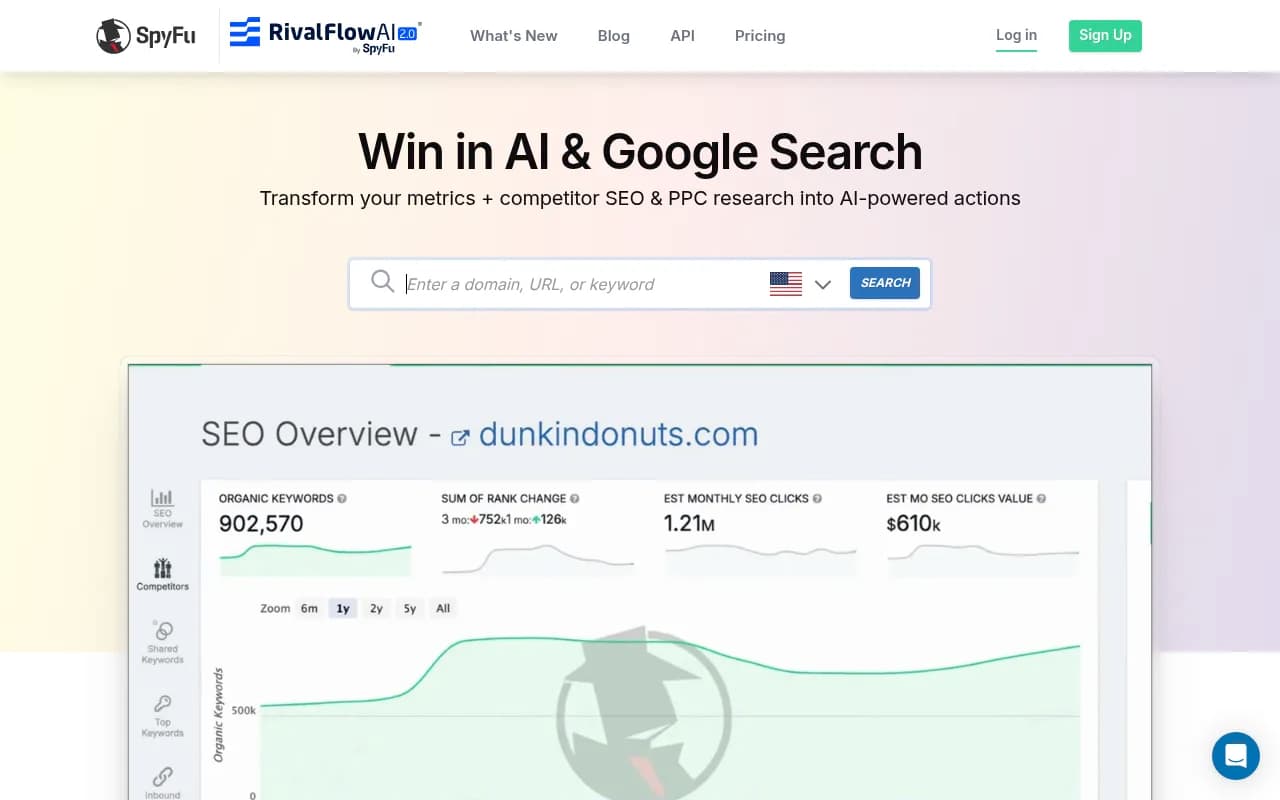
SpyFu shows the keywords a competitor buys and their ad history. Semrush's Advertising Research shows ad copy, keywords and landing pages. Both are covered in the pricing section below.
Step 2: Find the landing pages and build a coverage ledger
This is where most workflows fall apart. People gather URLs in a spreadsheet, lose track of where each one came from, and end up with what AdManage's guide calls a URL graveyard.
Free sources and what they actually show
| Source | What you get | Watch out for |
|---|---|---|
| Meta Ad Library | Active ads, plus separate archives for social issue, election and political ads, an EU archive for the past year, and a UK archive of ads that ran after July 1, 2025 | The 7-year window applies to political and social-issue ads, not all commercial ads. Record the category and region for each observation |
| Google Ads Transparency Center | Search by advertiser or website, with region and date filters. Free, no account needed | If no destination link is exposed, log it as missing. Do not assume a similar page is the same one |
| TikTok Commercial Content Library | Ads available to users in the EEA, Switzerland and the UK | Emphasises advertiser metadata and reach more than clean destination URLs. Do not infer a final URL |
AdManage's guide (published Dec 29, 2025, updated Oct 31, 2026) is blunt about the limit here: no public source guarantees every landing page, personalised route or experiment. Do not claim completeness. Record coverage instead.
The coverage ledger
For each search you run, log:
- The source and the query you used.
- Filters applied: country, region, dates, category, activity status.
- What came back: the ad reference, the exposed URL, the actual page state.
- Capture context: date, device, and whether you were logged in or saw a consent banner.
- Unresolved items: no destination exposed, redirect error, region restriction.
- Next review: owner, priority, follow-up date.
This feels bureaucratic until the first time someone asks "did we check TikTok for them?" and you have an answer.
The per-page record
Then keep one row per landing page:
competitor | platform | ad proof link | final URL (after redirects)
geo/language | funnel stage | offer type | date first seen
Funnel stage separates a cold landing page from a checkout page. Offer type is something like discount, free trial or demo. Always capture the final URL after redirects, because ad URLs often carry tracking parameters and bounce through a redirect.
A simple Airtable base works well for this, with one table for the ledger and one for pages.
Step 3: Cluster ads by destination to map the funnel
Once you have ads and URLs, group the ads by where they point. AdLibrary's guide from June 2026 walks through this with a DTC supplement example: 240 active ads, which collapse into six landing pages when grouped by destination. Those are a subscription offer, a quiz funnel, a bundle page, two advertorials and a product detail page.
Six pages means six funnels. The 240 ads are traffic feeders.
The ratio of ads per page is the first signal. A page getting 90 of 240 ads is the workhorse. A page with 3 ads that started last week is an experiment. If the ad count on that page grows over the next month, it probably graduated.
You do not need a paid tool to do this at small scale. Ten competitors with 20 ads each is 200 rows, which a spreadsheet handles fine. Past that, a tool that extracts destination URLs programmatically saves real time. AdLibrary's Starter plan was listed at 7 euros for the first month, then 29 euros a month, with prices rising January 1. Check their pricing page before you buy.
What to read from a cluster
- Offer archaeology: which offers appear on which pages (discount, trial, demo, quiz, bundle).
- Angle-to-page mapping: which ad angles feed which page.
- Launch signals: new URLs appearing, old ones going quiet.
- Message match: whether the ad promise and the page headline actually line up. A mismatch is something you can exploit with your own ads and content.
One caution, straight from the research: ad count and page availability do not tell you how well a page converts. Spend estimates are modelled approximations. A competitor can run a page with 90 ads because it works, or because nobody has had the nerve to turn it off. I did not find any independent conversion benchmarks for this kind of analysis, so treat what you see as a hypothesis to test in your own account.
Step 4: Extract messaging themes from each page
Now read the pages. For each one, capture:
- The headline and subhead.
- The primary call to action, and how many times it repeats. Landerlab's 2026 best-practices guide recommends a single consistent CTA repeated at three points: near the hero, after building desire mid-page, and near the close. See how closely competitors follow that.
- Claims and proof: numbers, logos, testimonials, certifications.
- Objections addressed: pricing, switching cost, integration, security.
- Format: long or short, video or static, quiz or form.
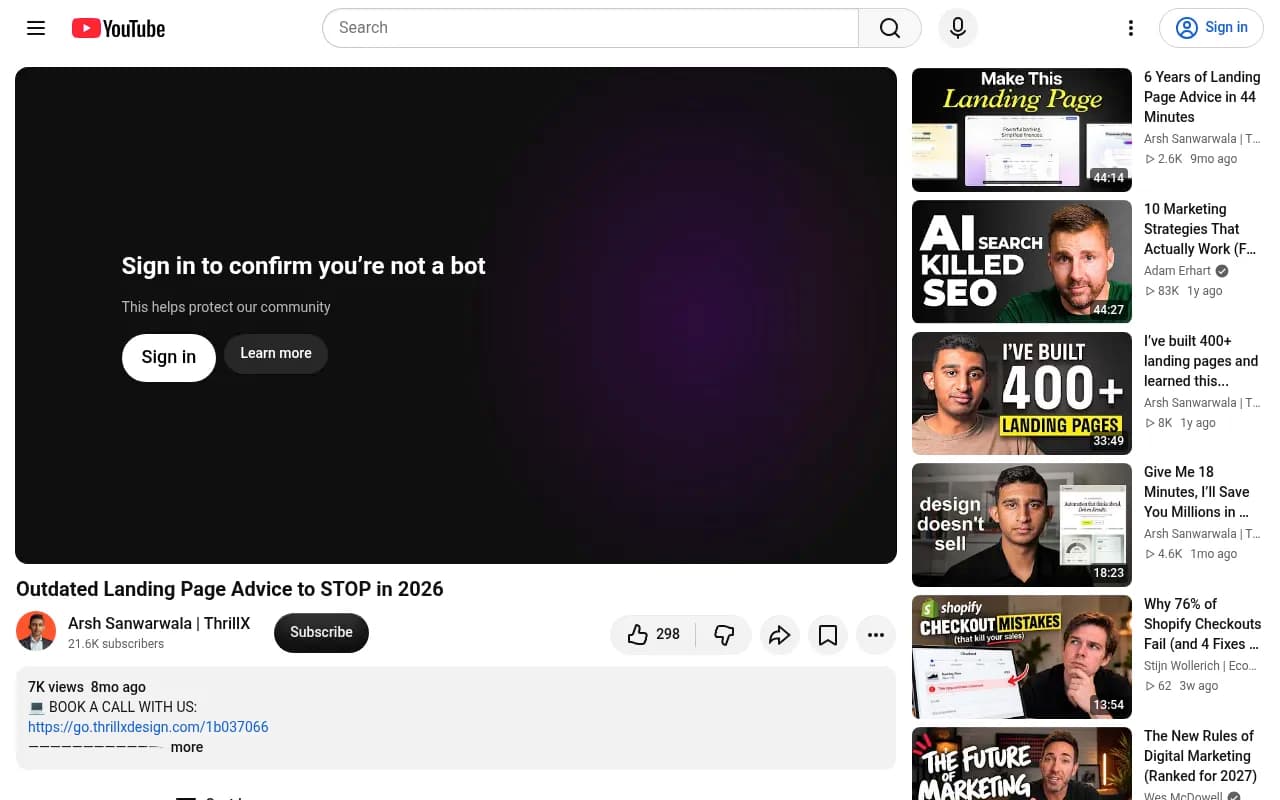
Long versus short is worth a note. A 2026 video from the ThrillX team argues that shorter pages always converting better is outdated advice, and that the right length depends on traffic source, awareness level and intent. That is one agency's view from auditing landing pages, not a benchmark, but it matches what you will see in the clusters: advertorials run long, retargeting pages run short.
Using an LLM to find themes
With 3 or 4 pages per competitor, an LLM is faster than highlighting by hand. A Coursiv guide on using Claude for marketing suggests pasting in several competitor landing pages and asking what messaging themes repeat, what is conspicuously absent, and where there might be a positioning gap.
A prompt along those lines:
Below are the landing page texts from three competitors who run paid
ads against our category. For each one, list the headline promise,
the main proof points, and the objections they address. Then tell me:
1. Which messaging themes repeat across all of them.
2. Which buyer questions none of them answer.
3. Where a positioning gap might exist for a product that [your
   differentiator].
Quote the exact line from the page for every claim you make.
The last line matters. Ask for quotes, or the model will happily invent a competitor claim that sounds right. Spot check two or three quotes against the live page every time.
Step 5: Compare against your own content to find the gaps
You now have a list of themes competitors push in paid. Map them against what you have published.
Build a grid with competitor themes down the side and your content across the top. For each cell, mark one of three states: covered well, covered thinly, not covered. The "not covered" and "thinly" rows are your gaps.
| Competitor theme | Seen on (pages) | Your coverage | Gap type |
|---|---|---|---|
| Free migration from [rival] | 4 of 5 competitors | None | Missing page |
| Pricing transparency | 2 of 5 | Pricing page only | Thin, needs comparison content |
| Security and compliance proof | 3 of 5 | Footer badge | Missing proof asset |
| Integration list | 5 of 5 | Docs only | Wrong format for buyers |
Add the keyword layer
Paid themes are one half. The other half is search demand. The Ahrefs Content Gap tool lets you enter your domain alongside 3 or 4 competitors and shows keywords where at least two competitors rank in the top 10 and you are absent. Run it against the same competitor set, then cross-reference.
A theme that appears in competitor ads and has organic keyword demand where you are absent is a strong content candidate. A theme that only appears in ads may be a paid-only angle, worth testing but not worth a full article yet.

Semrush's Keyword Gap does a similar job and also finds terms competitors buy and you do not.
Types of gap you will find
- Missing page: a competitor has a dedicated page for a use case, audience or comparison and you do not.
- Thin page: you cover it in a paragraph, they give it a full page with proof.
- Missing proof: they show numbers, logos or certifications and you only make claims.
- Format gap: they use a quiz, calculator or video where you have text.
- Objection gap: they answer a question you never address.
Step 6: Turn gaps into briefs and keep watching
Prioritise gaps by two things: how often competitors repeat the theme, and how close it sits to purchase. A theme on 4 of 5 competitor pages that maps to a commercial keyword goes first.
Each brief should have:
- The gap and the evidence (which competitor pages, with links to your ledger rows).
- The buyer question being answered.
- The angle you will take that differs from the competitor's.
- The proof you can actually provide.
- The format and target keyword.
Tools that help with the briefing and writing stage include Surfer SEO, Clearscope and Frase.

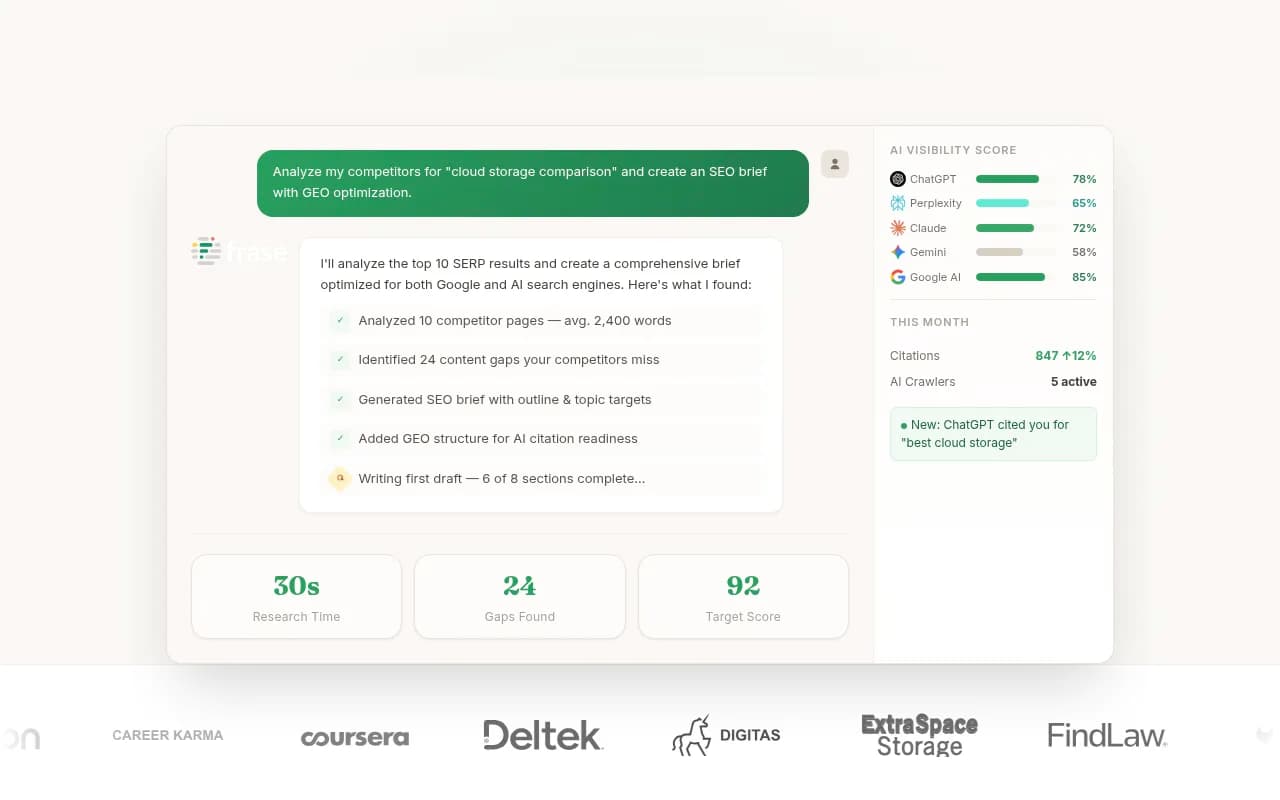
They score content against what ranks. They will not tell you what is missing from a competitor's paid message, which is why the manual analysis above comes first.
Monitor changes
Landing pages change. A headline swap or a new offer is a signal. Re-run your ledger on a schedule, monthly for fast-moving categories and quarterly otherwise. SpyFu's Ad History view shows how a competitor's ad copy changed over time, which helps you spot a shift in angle before the page changes.
For page-level change detection, a website monitor can alert you when a competitor page's text changes.
Paid tool pricing and what to expect
Prices below come from Hawky's roundup, which says it checked vendor pricing pages in September and October 2026. Hawky sells tools in this category itself, so confirm on the vendor sites. Another roundup (getaob.com) lists different numbers for some of the same tools, so figures shift.
| Tool | What it covers | Listed price (Hawky roundup) |
|---|---|---|
| Semrush | Ad copy, keywords and landing pages via Advertising Research; Keyword Gap; Shopping ad research | $139/mo monthly, or $117.33/mo billed annually; higher tiers at $199, $299 and $549/mo |
| SpyFu | Keywords competitors buy, ad history | Basic $39/mo ($29/mo annual); Pro + AI $119/mo after a $59 first month; Team/Agency $249/mo |
| Adbeat | Display, native and programmatic ads, ad networks and landing pages | Standard $249/mo; Advanced $399/mo |
| AdLibrary | Destination URL extraction and clustering | Starter 7 euros first month, then 29 euros/mo |
| Free stack | Meta Ad Library, Google Ads Transparency Center, TikTok library | Free |
Hawky's suggested budget stack is Auction Insights, the Transparency Center and SpyFu Basic for about $39 a month. For a team starting out, that is enough to run this workflow end to end. Add a paid ad-intelligence tool when the spreadsheet stops scaling.
If you want to compare more options in the broader software space, the directory at SurferStack covers tools by category.
Where AI search fits in
One tie-in worth noting: SpyFu's homepage now pitches visibility in Google Search and AI answers. The gaps you find in paid pages often show up in AI answers too. If buyers ask ChatGPT or Gemini about a use case and a competitor's page answers it while yours does not, you lose that mention as well as the click.
Once you publish content to fill a gap, it is worth checking whether AI engines pick it up. A platform like Promptwatch can track whether your new pages get cited and which prompts they appear for, and it has a free AI visibility report if you want a baseline first.

That is a follow-up step, not part of the core workflow. The ad-page analysis stands on its own.
Mistakes that waste the effort
- Copying instead of differentiating. If your page says the same thing in the same order, you have made a worse version of theirs.
- Treating the Ad Library as complete. It is not, and the coverage ledger exists so you can say so.
- Guessing URLs. If a library does not expose the destination, log it as missing.
- Trusting spend estimates. They are modelled. Use them to rank, not to budget.
- Skipping the date. A page you captured in March may be gone by June. Always log when and on what device you saw it.
- Stopping at paid themes. Cross-check against search demand before writing.
I also did not find any expert guidance on the legal or ethical limits of copying competitor pages, so the safe approach is the one above: study the structure and claims, then write original content with your own proof.
A one-week schedule
| Day | Task |
|---|---|
| 1 | Choose 3 to 5 paid competitors; set up the ledger and page record |
| 2 | Search Meta, Google and TikTok libraries; log everything including misses |
| 3 | Cluster ads by destination; mark workhorse pages and experiments |
| 4 | Read pages; run the LLM theme extraction and verify quotes |
| 5 | Build the theme grid against your content; add Content Gap keyword data |
| 6 | Prioritise gaps and write briefs |
| 7 | Set the monitoring schedule and review date |
By the end of the week you have a ranked list of gaps, each backed by specific competitor pages. That beats a vague sense that a rival is doing something clever.
If you need more help on the SEO side of this, the team behind this network, 1001 SEO Media, runs content strategy and SEO audits for brands that want a second pair of eyes on their gap analysis.