Key takeaways
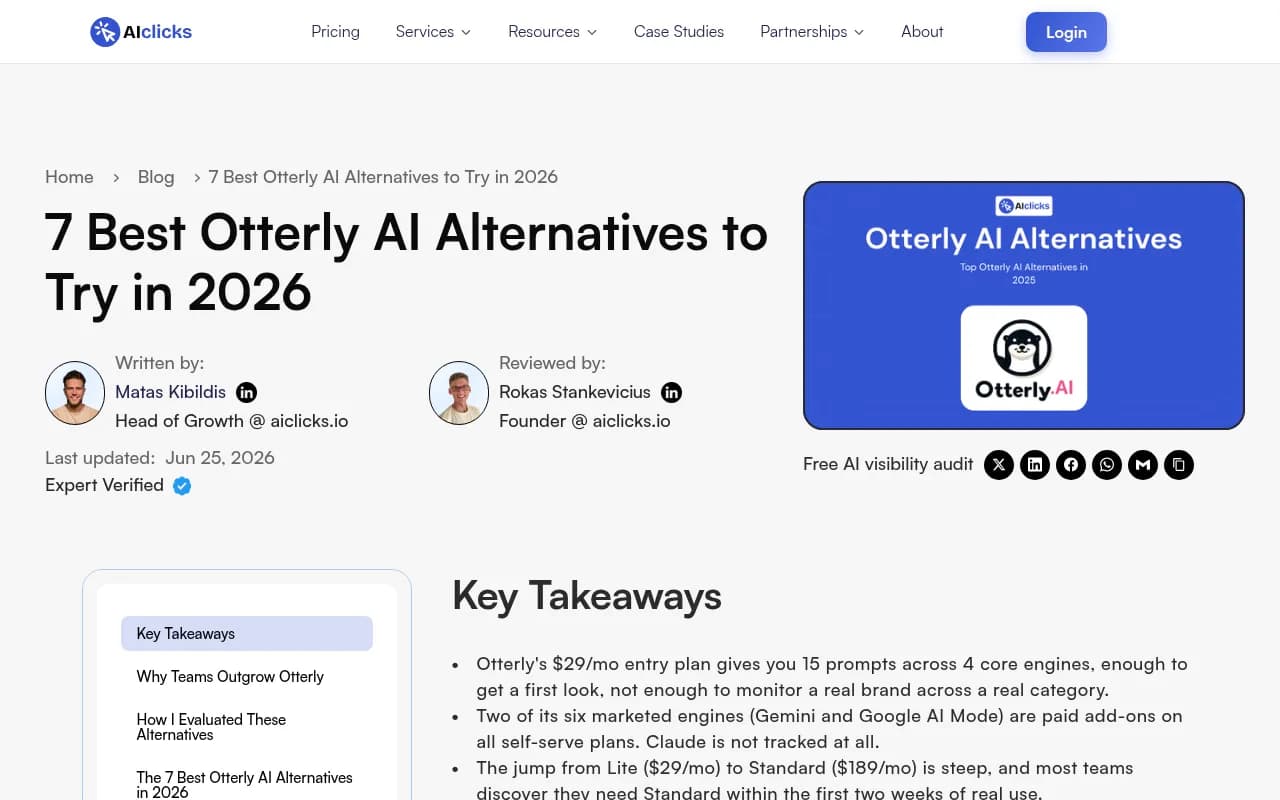
- Otterly.AI is a solid entry-level monitoring tool, but it has no content generation, no crawler logs, and no way to act on the data it shows you.
- The jump from Otterly's Lite plan ($29/mo) to Standard ($189/mo) is steep, and most teams hit the prompt limits within two weeks of real use.
- The best alternatives split into two camps: full-stack platforms that track AND generate content, and analytics-first tools that go deeper than Otterly on the data side.
- If your team's goal is to actually improve AI visibility -- not just measure it -- you need a platform with content generation built in.
- Promptwatch is the only platform in this comparison rated as a leader across all categories, with an end-to-end loop from gap analysis to content generation to citation tracking.
Otterly.AI does one thing reasonably well: it shows you whether your brand is appearing in AI-generated answers. For a first look at AI visibility, that's fine. But content teams quickly run into a wall. You can see that competitors are getting cited in ChatGPT responses for prompts you care about. You can watch your visibility score sit flat. What you can't do is fix it -- because Otterly gives you no tools to act on what it shows you.
As one user put it bluntly on Reddit: "It tracks the source, but gives zero actionable strategy on how to restructure content to get cited."
That's the core problem. Visibility data is only worth paying for if it tells you what to do next. This guide focuses specifically on alternatives that close that gap -- tools that go beyond dashboards and help content teams actually create the articles, briefs, and optimized pages that AI models want to cite.

Why content teams outgrow Otterly
Before getting into alternatives, it's worth being specific about what's missing. Otterly's limitations aren't just about price.
The prompt limits are tight. The Lite plan gives you 15 prompts across four AI engines -- enough to run an experiment, not enough to monitor a real brand across a real category. The Standard plan at $189/mo is a significant jump, and even then you're working without crawler logs, without content generation, and without any way to understand why you're missing from AI responses.
Two of Otterly's six marketed AI engines (Gemini and Google AI Mode) are paid add-ons on all self-serve plans. Claude isn't tracked at all. For a tool whose entire value proposition is AI coverage, those are real gaps.
And the update cycle is slow. AI search results shift constantly -- weekly snapshots can't keep pace with how quickly LLM outputs change, especially if you're trying to measure the impact of content you just published.
None of this makes Otterly a bad tool. For a solo marketer who wants a quick read on brand mentions in ChatGPT, it works. But for a content team trying to improve AI visibility systematically, it's a starting point, not a solution.
The 5 best Otterly.AI alternatives for content teams
1. Promptwatch -- best overall for teams that want to act, not just monitor
Promptwatch is the most complete platform in this space, and the only one that covers the full loop: find the gaps, create content to fill them, track the results.

The Answer Gap Analysis is what separates it from every monitoring-only tool. It shows you exactly which prompts competitors are visible for that you're not -- and more importantly, it shows you the specific content your site is missing. Not "you appeared in 3 out of 10 responses" but "here are the topics, angles, and questions AI models are already answering from competitor pages that you haven't covered."
From there, Content Agents generate articles, listicles, comparisons, and content briefs grounded in real prompt data. This isn't generic AI writing -- it's content built around the specific gaps the analysis identified, with citation data, prompt volumes, persona targeting, and competitor analysis baked in. You're not guessing what to write; you're filling documented holes.
The tracking side is equally thorough. Page-level citation tracking shows which of your pages are being cited, how often, and by which AI models. The crawler log feature (available from the Professional plan) shows when AI crawlers like ChatGPT and Perplexity hit your site, which pages they read, and when those pages move from crawled to cited. Most competitors don't have this at all.
Promptwatch monitors 10 AI models including ChatGPT, Perplexity, Google AI Overviews, Google AI Mode, Claude, Gemini, Grok, DeepSeek, Copilot, and Meta AI. It also tracks Reddit and YouTube -- two channels that directly influence what AI models recommend but that most tools ignore entirely.
Pricing starts at $99/mo for the Essential plan (1 site, 50 prompts, 5 articles). Professional is $249/mo (2 sites, 150 prompts, 15 articles, crawler logs). Business is $579/mo (5 sites, 350 prompts, 30 articles). A free trial is available.
For content teams specifically, the combination of gap analysis and content generation is the key differentiator. You're not just measuring a problem -- you're solving it.
2. Writesonic -- best for teams that want tracking and content creation in one platform
Writesonic started as an AI writing tool and has since built out AI search visibility tracking on top of it. That history shows in the product: the content creation side is genuinely strong, and the integration between tracking data and content output is tighter than most.
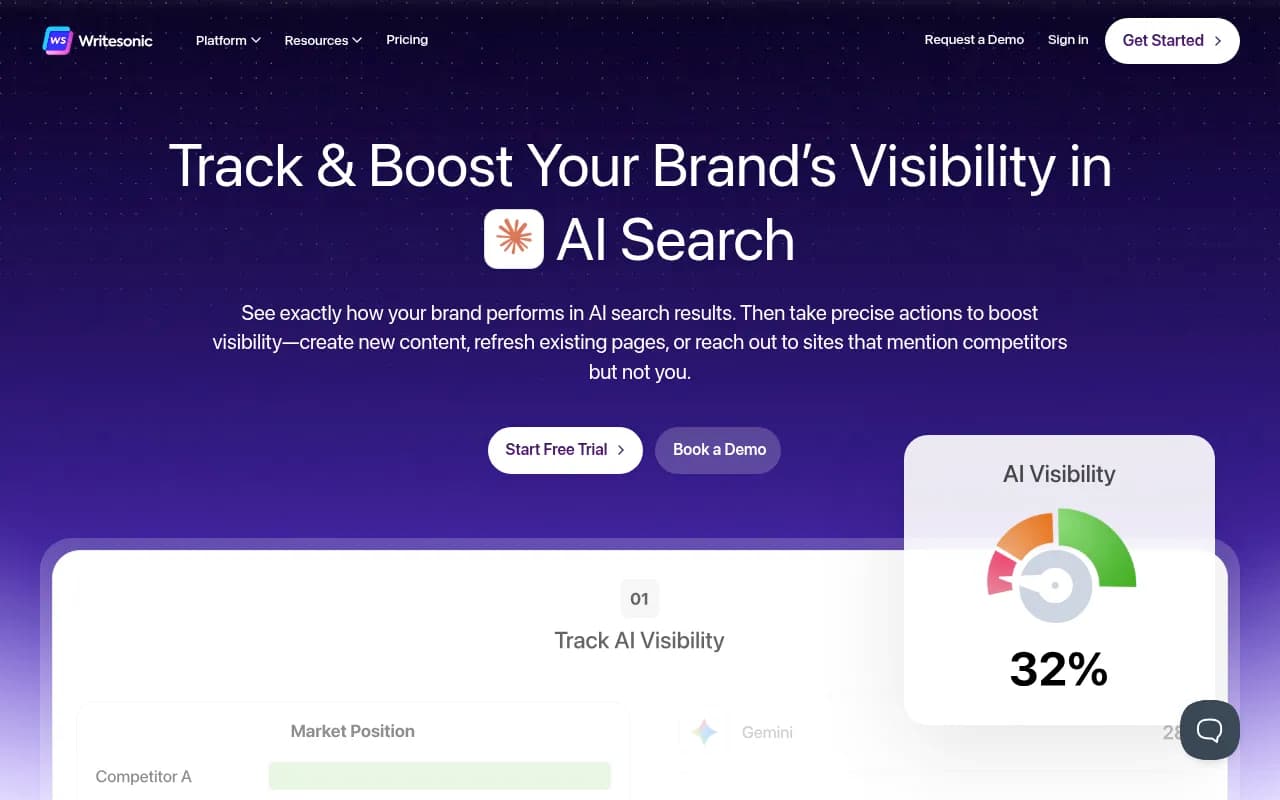
The platform tracks brand mentions across ChatGPT, Perplexity, Google AI Overviews, and several other models, then surfaces content recommendations based on where you're missing. The writing tools cover articles, product pages, and social content, and they're informed by the visibility data rather than operating in a separate silo.
Where Writesonic is weaker: the analytics depth doesn't match a dedicated GEO platform. Prompt volume data is limited, there are no crawler logs, and the competitive intelligence features are less detailed than what you'd get from Promptwatch or AthenaHQ. It's a better fit for teams whose primary workflow is content production and who want AI visibility data as a supporting input, rather than teams running serious GEO programs.
Pricing is competitive, with plans starting around $99/mo for the AI visibility features.
3. AthenaHQ -- best for enterprise teams that need depth on the analytics side
AthenaHQ is a monitoring-focused platform that goes significantly deeper than Otterly on the data side. It tracks across 8+ AI engines, offers detailed competitive heatmaps, and provides prompt-level analysis that helps teams understand not just where they appear but why.

The competitive intelligence is a genuine strength. You can see which competitors are winning for specific prompts, what sources AI models are citing in their responses, and how visibility shifts over time across different models. For enterprise teams that need to report on AI visibility to stakeholders, the reporting tools are more polished than Otterly's.
The limitation for content teams: AthenaHQ is primarily a monitoring and analytics platform. It doesn't generate content. You'll get excellent data about what to fix, but the actual fixing -- writing the articles, updating the pages -- happens elsewhere. That's a meaningful workflow gap if your team is trying to move fast.
AthenaHQ is also priced at the higher end of the market, which makes more sense for enterprise brands with dedicated SEO teams than for mid-market content teams working with tighter budgets.
4. SE Ranking -- best for teams already running an SEO suite
SE Ranking is an all-in-one SEO platform that added an AI Visibility Toolkit, making it a practical choice for teams that don't want to pay for a separate GEO tool on top of their existing SEO stack.
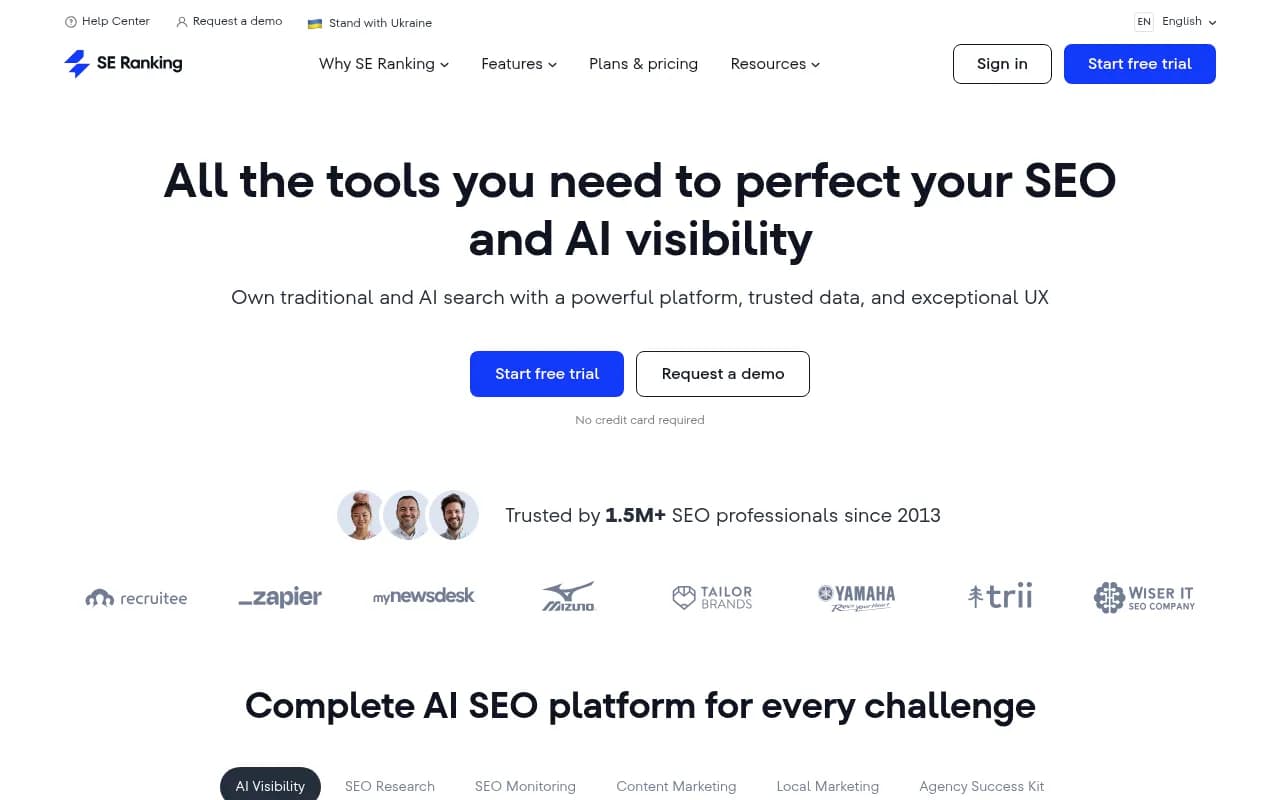
The AI visibility features cover prompt tracking, brand mention monitoring across major LLMs, and competitive comparison. The integration with SE Ranking's broader keyword research, site audit, and rank tracking tools is the real selling point -- you get a unified view of traditional search and AI search without managing two separate platforms.
The trade-off is depth. SE Ranking's AI visibility module is solid but not specialized. Prompt volume data is limited, there's no content generation tied to the AI visibility findings, and the crawler log functionality isn't there. For teams that are primarily SEO-focused and want AI visibility as an add-on, it's a sensible choice. For teams where GEO is the primary focus, the lack of depth will eventually become a constraint.
Pricing is reasonable, with AI visibility features available on mid-tier plans starting around $65-$100/mo depending on the configuration.
5. Peec AI -- best for clean, precise AI analytics without the noise
Peec AI takes a different approach: instead of trying to be a full-stack platform, it focuses on doing AI visibility analytics well. The interface is clean, the data is precise, and the multi-language support is genuinely strong -- useful for brands operating across multiple markets.

Peec tracks brand mentions across major AI models, provides share-of-voice analysis, and offers competitive benchmarking. The reporting is straightforward and easy to share with clients or stakeholders who don't need to dig into the underlying data.
Like AthenaHQ, Peec is monitoring-only. There's no content generation, no content briefs, no crawler logs. It's a better analytics tool than Otterly -- more accurate, more detailed, better multi-language support -- but it has the same fundamental limitation: it shows you the problem without helping you solve it.
For agencies that need clean reporting for clients, or for teams that already have a content production workflow and just need better data to feed into it, Peec is worth considering. For teams looking for an end-to-end solution, it's a partial answer.
How these tools compare
Here's a direct comparison across the dimensions that matter most for content teams:
| Platform | AI models tracked | Content generation | Crawler logs | Prompt volume data | Reddit/YouTube tracking | Starting price |
|---|---|---|---|---|---|---|
| Promptwatch | 10 | Yes (Content Agents) | Yes | Yes | Yes | $99/mo |
| Writesonic | 6+ | Yes (AI writing suite) | No | Limited | No | ~$99/mo |
| AthenaHQ | 8+ | No | No | Yes | No | Enterprise |
| SE Ranking | 5+ | No | No | Limited | No | ~$65/mo |
| Peec AI | 6+ | No | No | Limited | Yes (limited) | ~$49/mo |
| Otterly.AI | 4 (6 with add-ons) | No | No | No | No | $29/mo |
The pattern is clear. If you need content generation alongside tracking, the field narrows quickly. Writesonic and Promptwatch are the two platforms that genuinely combine both -- and Promptwatch goes further on the analytics side, with crawler logs, prompt volume scoring, and the Answer Gap Analysis that ties the two together.
How to choose the right alternative
The right tool depends on what your team is actually trying to do.
If your goal is to improve AI visibility and you want a platform that helps you do that end-to-end -- gap analysis, content generation, citation tracking -- Promptwatch is the clearest choice. The action loop (find gaps, create content, track results) is what makes it an optimization platform rather than another monitoring dashboard.
If your team is primarily a content production team and you want AI visibility data to inform what you write, Writesonic is worth evaluating. The writing tools are strong, and the integration between tracking and content is tighter than most.
If you're an enterprise team that needs deep analytics and polished reporting, and you have a separate content team to handle the actual writing, AthenaHQ gives you the most detailed picture of what's happening in AI search.
If you're already paying for SE Ranking and want to add AI visibility without a second subscription, the AI Visibility Toolkit is a reasonable starting point -- just know you'll hit its limits if GEO becomes a serious priority.
If you need clean, multi-language AI analytics for client reporting, Peec AI is the most focused option in this group.
One thing worth saying directly: monitoring-only tools have a ceiling. You can track your AI visibility score every week, but if you're not creating content that fills the gaps AI models are exposing, the number won't move. The tools that are genuinely useful for content teams in 2026 are the ones that connect the data to the work.
Final thought
The GEO tool market has grown fast, and most of the tools in it are still primarily dashboards. They show you data. They don't help you do anything with it. Otterly fits that description -- it's a fine monitoring tool, but "fine monitoring" isn't enough if your team's job is to actually rank in AI search results.
The alternatives above each solve a different piece of the puzzle. But if you want a single platform that takes you from "here's where you're invisible" to "here's the article that fixes it" to "here's proof it's working," Promptwatch is the only one in this list that does all three.