Key takeaways
- Most AI visibility tools are monitoring dashboards -- they show you where you're invisible but don't help you fix it.
- The tools that delivered real results in 2025 combined tracking with content gap analysis and optimization features.
- Coverage matters: the best platforms monitor ChatGPT, Claude, Gemini, Perplexity, Grok, and Google AI Overviews simultaneously.
- Price ranges vary wildly ($0 to enterprise custom), but mid-tier tools ($99-$249/mo) often punch above their weight.
- If you want to move from monitoring to actually improving your AI visibility, look for platforms with content generation, citation analysis, and crawler log access.
There's a question most marketing teams haven't fully reckoned with yet: when someone asks ChatGPT to recommend a tool in your category, does your brand come up?
For most brands, the honest answer is: they don't know. And that's the problem.
AI search isn't a future trend anymore. ChatGPT crossed 400 million weekly active users in early 2025. Perplexity is processing hundreds of millions of queries per month. Google AI Overviews appear on roughly half of all searches. The gatekeepers have changed, and the old playbook -- rank on page one, get traffic -- doesn't map cleanly onto how AI models surface information.
This guide covers the tools that actually matter for AI search visibility in 2026. Not a generic roundup of everything with "AI" in the name, but a practical look at what each platform does, where it falls short, and which type of team it actually suits.
What separates a good AI visibility tool from a mediocre one
Before diving into specific tools, it's worth being direct about what the category actually requires.
A lot of platforms launched in 2024-2025 that essentially do one thing: they send prompts to AI models and report back whether your brand was mentioned. That's useful data. But it's a starting point, not a solution. Knowing you're invisible in ChatGPT doesn't tell you why, what to do about it, or whether fixing it will actually drive traffic.
The tools worth paying for in 2026 do more than monitor. They help you understand which content gaps are causing you to miss mentions, what competitors are doing differently, which AI crawlers are (or aren't) indexing your pages, and how to create content that AI models actually want to cite.
Here's a quick framework for evaluating any tool in this space:
| Capability | Why it matters |
|---|---|
| Multi-model tracking | ChatGPT and Perplexity behave differently; you need both |
| Competitor benchmarking | Visibility is relative -- you need to know who's winning |
| Content gap analysis | Shows which prompts you're missing and why |
| Citation source tracking | Reveals which pages/domains AI models actually cite |
| AI crawler logs | Shows whether AI bots are even reading your site |
| Content generation | Helps you act on the gaps you find |
| Traffic attribution | Connects AI visibility to actual revenue |
| Prompt volume/difficulty | Helps prioritize which battles to fight |
With that in mind, here are the platforms that stood out in 2025 -- and what they're actually good for.
The top 10 AI search visibility tools
1. Promptwatch -- best for brands that want to act, not just watch
Promptwatch is the platform that most clearly solves the "now what?" problem. Where most tools stop at showing you a visibility score, Promptwatch builds the entire optimization loop: find the gaps, create content to fill them, track the results.

The Answer Gap Analysis feature is genuinely useful -- it shows you the specific prompts where competitors are getting cited but you're not, and what content your site is missing that would change that. The built-in AI writing agent then generates articles, listicles, and comparisons grounded in citation data from over 880 million analyzed citations. That's not generic content; it's content engineered around what AI models actually cite.
Other standout features: real-time AI crawler logs (so you can see when ChatGPT or Perplexity bots visit your site, which pages they read, and what errors they hit), prompt volume and difficulty scoring, query fan-outs, Reddit and YouTube citation tracking, and ChatGPT Shopping monitoring. It covers 10 AI models including Google AI Mode, DeepSeek, Grok, and Mistral.
Pricing starts at $99/mo for the Essential plan (1 site, 50 prompts, 5 articles), $249/mo for Professional (2 sites, 150 prompts, crawler logs), and $579/mo for Business (5 sites, 350 prompts). Free trial available.
Best for: Marketing and SEO teams that want to improve their AI visibility, not just measure it.
2. Profound -- enterprise breadth and depth
Profound has built a reputation as the go-to platform for large organizations managing multiple brands. The executive dashboards are polished, the prompt and model coverage is extensive, and features like AI inclusion share and visibility decay tracking are genuinely useful for enterprise reporting.

The trade-off is price and complexity. Profound's enterprise plans are custom-quoted and tend to run significantly higher than mid-market alternatives. It's also primarily a monitoring and analytics platform -- strong on data, lighter on helping you act on it. No content generation, no crawler logs, no Reddit tracking.
Pricing: Starter at $99/mo (billed annually); enterprise custom.
Best for: Large brands and agencies with dedicated analytics teams who need deep reporting and can handle the optimization work separately.
3. Semrush (with AI Overview tracking)
Semrush added AI visibility tracking to its core platform via the AI Overview module, and for teams already living in Semrush, it's a natural extension. You get AI search monitoring alongside keyword research, backlink analysis, and content tools -- all in one dashboard.
The limitation is that Semrush's AI tracking uses fixed prompt sets rather than custom prompts, which means you're monitoring a predefined list of queries rather than the ones your actual customers are asking. There's also no AI traffic attribution, no crawler logs, and no content generation specifically engineered for AI citation.
Still, if you're already paying for Semrush and want a baseline view of your AI visibility without adding another tool, the AIO add-on ($99/mo per domain) is a reasonable starting point.
Best for: Existing Semrush users who want AI visibility data without switching platforms.
4. Ahrefs Brand Radar
Ahrefs took its brand monitoring expertise and applied it to AI search, which makes sense given how much overlap there is between traditional authority signals and AI citation patterns.
Brand Radar tracks how your brand appears across AI models and surfaces citation sources, which is useful for understanding which content is driving mentions. The catch: like Semrush, it uses fixed prompts rather than custom ones, and there's no AI traffic attribution to connect visibility data to actual site traffic or revenue.
Best for: Teams already using Ahrefs who want a quick read on AI brand visibility without a separate subscription.
5. Otterly.AI -- accessible entry point
Otterly.AI is one of the more accessible tools in the space, with a clean interface and straightforward monitoring across major AI models. It's a good starting point for smaller teams or individuals who want to understand their AI visibility without a steep learning curve or enterprise pricing.

The honest limitation: Otterly is a monitoring tool. It shows you where you stand but doesn't offer content gap analysis, content generation, crawler logs, or visitor analytics. For teams that just want a dashboard to check in on periodically, that's fine. For teams trying to actively improve their ranking, it's a starting point that you'll quickly outgrow.
Best for: Small businesses and solo marketers who want basic AI visibility monitoring at an accessible price.
6. AthenaHQ -- solid monitoring across 8+ models
AthenaHQ covers a solid range of AI models (8+) and provides clean competitive benchmarking. The interface is well-designed and the data is reliable.

Like several others in this list, AthenaHQ is primarily a monitoring platform. It doesn't offer content optimization or generation capabilities, which means you're on your own when it comes to acting on what you find. That's not a dealbreaker for teams with strong content operations, but it's worth knowing upfront.
Best for: Marketing teams that want reliable multi-model monitoring and can handle their own content strategy.
7. SE Ranking (AI visibility toolkit)
SE Ranking has been building out its AI visibility features steadily, and the result is a capable mid-market option that sits between basic monitoring tools and full-featured platforms like Promptwatch.
The AI visibility toolkit tracks brand mentions across major models, provides competitor comparisons, and integrates with SE Ranking's existing SEO features. It's not as deep as Profound for enterprise use cases, but it's more affordable and still covers the core monitoring needs.
Best for: Mid-size businesses that want AI visibility tracking alongside traditional SEO tools at a reasonable price.
8. ZipTie -- deep analysis for specific use cases
ZipTie takes a more analytical approach to AI visibility, with a focus on deep diagnostic analysis rather than broad monitoring. It's particularly useful for understanding why your brand is or isn't being cited in specific contexts.
The platform is better suited to teams that want to understand the mechanics of AI citation rather than track visibility at scale. It's not the right tool for ongoing monitoring of a large prompt set, but for a deep-dive audit, it's worth considering.
Best for: SEO specialists and analysts who want to understand the "why" behind AI visibility patterns.
9. Peec AI -- multi-language tracking
Peec AI's main differentiator is its multi-language support, which matters more than most tools acknowledge. AI search behavior varies significantly by language and region -- a brand that's well-cited in English responses may be nearly invisible in German or Spanish ones.

For brands operating across multiple markets, Peec AI's language coverage is genuinely useful. The platform covers the core monitoring features (brand mentions, competitor tracking, sentiment) across multiple AI models and languages.
Best for: International brands and agencies managing visibility across multiple language markets.
10. Rankscale -- AI search ranking focus
Rankscale focuses specifically on ranking within AI search results, with features designed around understanding and improving your position in AI-generated responses.
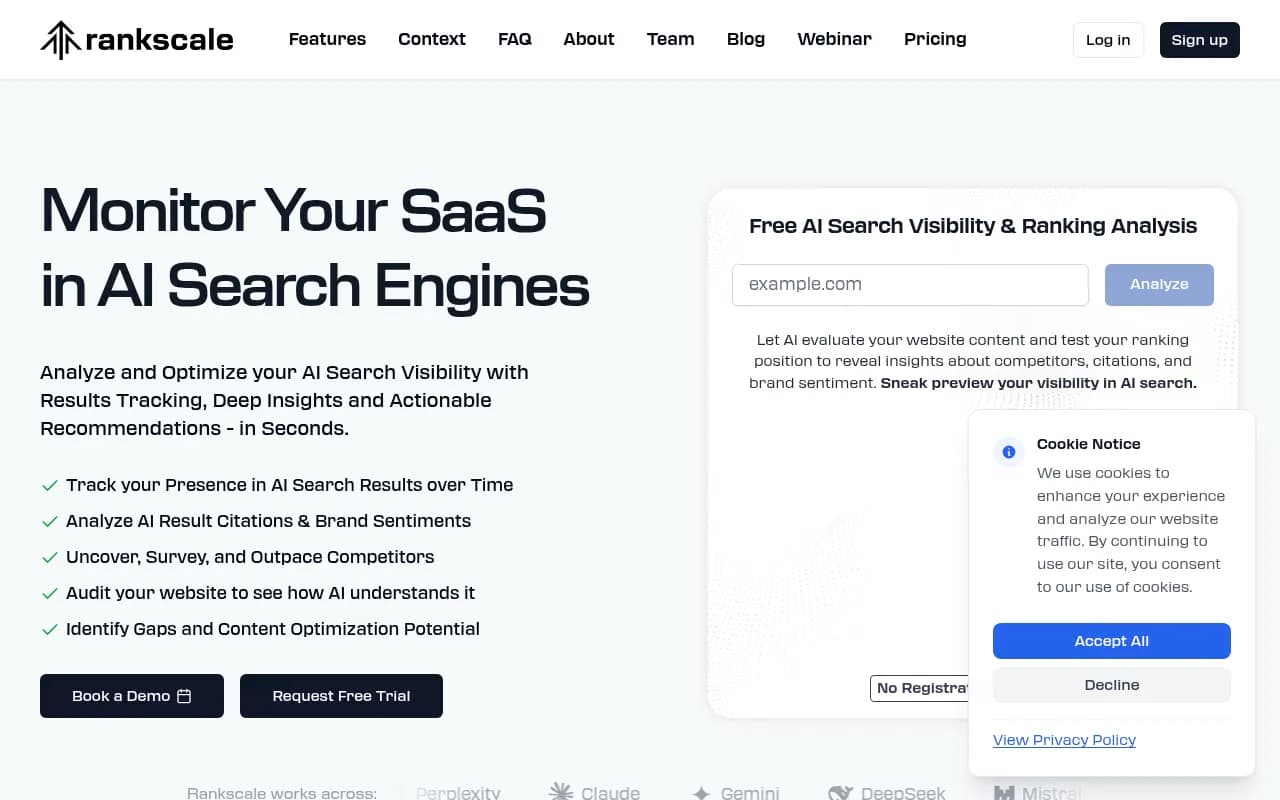
It's a more specialized tool than the broad monitoring platforms, which makes it useful for teams with a specific focus on AI search ranking rather than general brand visibility. The feature set is narrower but more targeted.
Best for: Teams with a specific focus on improving AI search rankings rather than broad brand monitoring.
How these tools compare at a glance
| Tool | Monitoring | Content gaps | Content generation | Crawler logs | Traffic attribution | Starting price |
|---|---|---|---|---|---|---|
| Promptwatch | Yes (10 models) | Yes | Yes | Yes | Yes | $99/mo |
| Profound | Yes | Limited | No | No | No | $99/mo (annual) |
| Semrush | Yes (fixed prompts) | No | No | No | No | $99/mo add-on |
| Ahrefs Brand Radar | Yes (fixed prompts) | No | No | No | No | Included in Ahrefs |
| Otterly.AI | Yes | No | No | No | No | Freemium |
| AthenaHQ | Yes (8+ models) | No | No | No | No | Custom |
| SE Ranking | Yes | No | No | No | No | From ~$65/mo |
| ZipTie | Yes (diagnostic) | Limited | No | No | No | Custom |
| Peec AI | Yes (multi-language) | No | No | No | No | From ~$49/mo |
| Rankscale | Yes | No | No | No | No | Custom |
The monitoring-only trap
One pattern worth naming directly: most tools in this space are monitoring dashboards. They're useful for answering "are we visible?" but they leave you stuck when the answer is no.
The gap between knowing you're invisible and knowing what to do about it is where most teams lose time. You can see that a competitor gets cited for "best project management software for remote teams" and you don't -- but that data alone doesn't tell you what content to write, how to structure it, which AI models are most likely to pick it up, or whether your site is even being crawled properly.
That's why the distinction between monitoring tools and optimization platforms matters. Tools like Promptwatch are built around closing that loop -- find the gap, create the content, track the improvement. Most others stop at step one.
If you're just starting out and want to understand your baseline AI visibility, a monitoring tool is fine. But if you're trying to actively compete for AI citations, you'll need something that helps you act on the data.
What actually drives AI citations
Based on the citation data that's emerged from platforms analyzing hundreds of millions of AI responses, a few patterns are consistent:
Structured, specific content gets cited more than generic overviews. AI models prefer sources that directly answer a specific question rather than broadly covering a topic.
Domain authority still matters, but it's not the whole story. Reddit threads, YouTube videos, and niche publications regularly get cited alongside high-authority domains. AI models are pulling from wherever the most relevant answer lives.
Freshness is a factor, but not in the same way as traditional SEO. AI models don't always prefer the newest content -- they prefer content that's accurate and comprehensive. But outdated information that contradicts current reality does hurt citation rates.
Being crawled is a prerequisite. If AI bots aren't reading your pages, you can't be cited. This sounds obvious, but many sites have technical issues (robots.txt configurations, slow load times, crawl errors) that prevent AI crawlers from accessing content. Tools with crawler log access, like Promptwatch, let you see this directly rather than guessing.
Which tool should you actually use?
It depends on where you are and what you need.
If you're just starting to understand AI visibility and want a low-cost entry point, Otterly.AI or Peec AI give you a baseline without a big commitment.
If you're already using Semrush or Ahrefs and want to add AI visibility data without switching tools, the built-in features of those platforms are a reasonable starting point -- just know their limitations around fixed prompts and lack of attribution.
If you're managing multiple brands at enterprise scale and need deep reporting for executive stakeholders, Profound is worth the investment.
If you want to actually improve your AI visibility -- not just measure it -- Promptwatch is the platform built for that. The combination of content gap analysis, AI content generation, crawler logs, and traffic attribution means you can run the full optimization cycle rather than just watching your visibility score and wondering what to do next.
The AI search landscape has moved fast, and it will keep moving. The brands that figure out the optimization loop now -- find gaps, create targeted content, track results -- will have a meaningful head start over those still treating AI visibility as a reporting exercise.