Key takeaways
- ChatGPT alone processes over 2 billion queries daily, and AI-referred sessions to websites grew 527% year-over-year through mid-2025 -- this is no longer a niche trend
- Google AI Overviews now trigger on roughly 18-21% of all searches, and zero-click rates have hit 43%, meaning nearly half of all searches end without anyone visiting a website
- AI engines don't rank pages -- they cite sources. Getting cited requires different signals than traditional SEO: authority, directness, structured answers, and entity clarity matter most
- Most brands are still measuring the wrong things. Keyword rankings tell you almost nothing about AI visibility
- The gap between brands actively optimizing for AI citation and those still doing traditional SEO is widening fast
The numbers coming out of AI search in 2026 are genuinely hard to process. ChatGPT surpassed Amazon in monthly website visitors. Perplexity is growing faster than any search product in history. Google AI Overviews appear on roughly 21% of all search results, and nearly half of all Google searches now end without a single click.
And yet most marketing teams are still reporting on keyword rankings.
This guide pulls together what the data from over a billion AI responses actually shows -- where AI engines pull their citations from, what signals they respond to, which industries are winning and losing, and what you can realistically do about it right now.
The scale of the shift is bigger than most people realize
Let's start with the raw numbers, because they matter.
ChatGPT handles over 2 billion queries daily. AI-referred sessions to websites grew 527% year-over-year through mid-2025. BCG's January 2026 update on discoverability noted that roughly 60% of searches already end without a click -- a trend that's been building for years but has accelerated sharply with AI Overviews.
The zero-click rate hitting 43% specifically for AI-influenced searches is the number that should concern every brand with a content strategy. It doesn't mean traffic is dead. It means the game has changed: visibility now happens before the click, inside the AI response itself.
What's interesting -- and this comes up in the Reddit thread on r/digital_marketing from earlier this year -- is that traffic is down for many sites, but visibility isn't necessarily down. Some brands are getting mentioned in AI responses constantly without receiving a single referral click. That's a new kind of brand exposure that traditional analytics completely misses.
How AI engines actually decide what to cite
This is where most AEO advice goes wrong. People treat it like SEO with extra steps -- optimize your meta descriptions, add FAQ schema, done. But the citation logic is meaningfully different.
It's about authority signals, not just relevance
Traditional search engines rank pages that are relevant to a query. AI engines synthesize answers and then look for sources that can back up specific claims. The question they're asking is: "Which source is most authoritative and trustworthy for this specific piece of information?"
That means a mid-sized brand with deep, well-structured content on a narrow topic can outperform a major publisher that covers the same topic superficially. Depth beats breadth for AI citation purposes.
Directness matters more than comprehensiveness
AI engines prefer content that answers questions directly, near the top of the page, in plain language. BCG's discoverability report makes this point clearly: "AI answer engines prioritize clear, direct responses that match how people naturally ask questions."
The old SEO instinct to bury the answer after 400 words of preamble actively hurts you here. If someone asks "what is the best CRM for small businesses," an AI engine will preferentially cite a page that answers that question in the first two sentences, not one that spends three paragraphs explaining what a CRM is first.
Entity clarity is a surprisingly big factor
AI models resolve entities -- they need to understand who you are, what you do, and how you relate to other entities in your space. If your brand, product names, and key people aren't clearly defined across your site and across the web (Wikipedia, Wikidata, structured data, consistent mentions), AI engines may simply not know what to do with you.
This is one of the most underrated aspects of AEO. A brand that's been around for 20 years with inconsistent naming conventions across its web presence can be effectively invisible to AI engines, while a two-year-old startup with clean entity signals gets cited regularly.
Citation patterns vary significantly by AI model
Not all AI engines cite the same way. Perplexity is the most citation-heavy -- it shows sources prominently and pulls from a relatively wide range of domains. ChatGPT is more selective and tends to favor well-known publishers and sources with strong domain authority. Google AI Overviews pull heavily from pages that already rank well in traditional search, which creates a compounding advantage for established SEO performers.
Claude tends to be more cautious about citing specific sources and more likely to synthesize without attribution. Gemini's behavior has shifted significantly since the AI Overviews rollout and continues to evolve.
The practical implication: you can't optimize for "AI search" as a monolith. The signals that get you cited on Perplexity aren't identical to the signals that get you into a Google AI Overview.
What the citation data actually shows
Analysis of large-scale citation datasets reveals some consistent patterns that hold across models.
Long-form, structured content dominates
Pages that get cited regularly tend to be longer (typically 1,500+ words), well-structured with clear headings, and written to answer specific questions rather than to rank for broad keywords. This isn't surprising -- AI engines are looking for authoritative, comprehensive treatments of topics.
Reddit and YouTube are citation sources, not just traffic sources
This one surprises people. AI engines -- particularly ChatGPT and Perplexity -- regularly cite Reddit threads and YouTube videos as sources. A highly-upvoted Reddit comment explaining a technical concept can appear in an AI response alongside a Forbes article. YouTube transcripts from authoritative creators get pulled into answers.
This means your brand's presence on Reddit (through genuine community participation, not spam) and YouTube (through educational content) directly affects your AI visibility. Most brands aren't thinking about this at all.
The "freshness" signal is real but misunderstood
AI engines do weight recency, but not uniformly. For fast-moving topics (AI tools, current events, product releases), freshness matters a lot. For evergreen topics (how to write a business plan, what is compound interest), a well-established page from 2022 can still dominate citations in 2026.
The mistake is treating freshness as a blanket requirement and churning out thin updated content. A shallow article published last week loses to a thorough article from two years ago, almost every time.
Domain authority still matters, but the floor has dropped
High domain authority still correlates with citation frequency. But the correlation is weaker than it is for traditional search rankings. Niche sites with genuine expertise in a specific area are getting cited at rates that would have been impossible in traditional SEO. The playing field isn't level, but it's more level than it was.
The industries seeing the biggest impact
Not every sector is affected equally. The data shows some clear patterns.
Finance, health, and legal content are heavily filtered by AI engines due to YMYL (Your Money Your Life) considerations. These categories see more conservative citation behavior -- AI engines are more likely to cite established institutions and less likely to cite newer or smaller publishers, regardless of content quality.
B2B software and SaaS is one of the most active categories for AI citation. Comparison queries ("best CRM for startups," "HubSpot vs Salesforce for small teams") are extremely common in AI search, and the brands that have invested in detailed comparison content are winning disproportionately.
Travel, retail, and local services are seeing significant disruption from AI Overviews specifically. Google's AI Overviews now answer "best hotels in Barcelona" or "plumbers near me" with synthesized responses that reduce click-through rates substantially.
E-commerce is a special case. ChatGPT's shopping features are evolving rapidly, and product recommendations inside AI responses are becoming a meaningful channel. Brands that aren't tracking when their products appear in ChatGPT shopping carousels are missing an emerging revenue stream.
What "optimizing for AI citation" actually looks like in practice
Here's where the rubber meets the road. The strategies that consistently show up in the data:
Answer the question first, explain second
Restructure your content so the direct answer appears in the first paragraph. Then provide the context, nuance, and supporting detail. This matches how AI engines scan and extract content.
Use question-based headings
Headings like "What is X?" and "How does Y work?" are more likely to be matched to conversational queries than keyword-stuffed headings. This isn't new advice, but the data shows it's more important for AI citation than it ever was for traditional SEO.
Build topical authority, not just page authority
AI engines reward sites that cover a topic comprehensively. A site with 50 well-written articles on email marketing will get cited more often for email marketing queries than a site with one excellent email marketing article and 500 articles on unrelated topics. Topical clustering isn't just an SEO tactic anymore -- it's an AI visibility strategy.
Make your entity signals explicit
Use structured data (Schema.org) to define your organization, your products, your people. Ensure your brand name is consistent across your site, your social profiles, your press coverage, and any third-party directories. If you have a Wikipedia page or Wikidata entry, keep it accurate. These signals help AI engines resolve who you are with confidence.
Publish where AI engines look
Beyond your own site: contribute to industry publications, get quoted in news articles, participate in relevant forums, create YouTube content. AI engines pull from a wide ecosystem. Your brand's footprint across that ecosystem directly affects how often you get cited.
The measurement problem nobody talks about enough
Here's an honest assessment: most teams don't have good visibility into their AI citation performance. Traditional analytics tools weren't built for this. Google Search Console shows you traditional search clicks. Your rank tracker shows you keyword positions. Neither tells you whether ChatGPT mentioned your brand 10,000 times last month.
This is a genuine gap. The brands that are pulling ahead right now are the ones that have instrumented AI visibility as a separate measurement track -- tracking citation frequency across models, monitoring which pages get cited and which don't, and connecting that data back to traffic and revenue.
Platforms like Promptwatch are built specifically for this -- tracking citations across 10+ AI models, showing which pages are being cited and how often, and connecting AI visibility to actual traffic through crawler log analysis. That kind of closed-loop measurement is what separates teams that are guessing from teams that are optimizing.

For teams that want to track AI visibility alongside traditional SEO metrics, tools like Semrush and Ahrefs have added some AI monitoring capabilities, though their coverage is more limited.
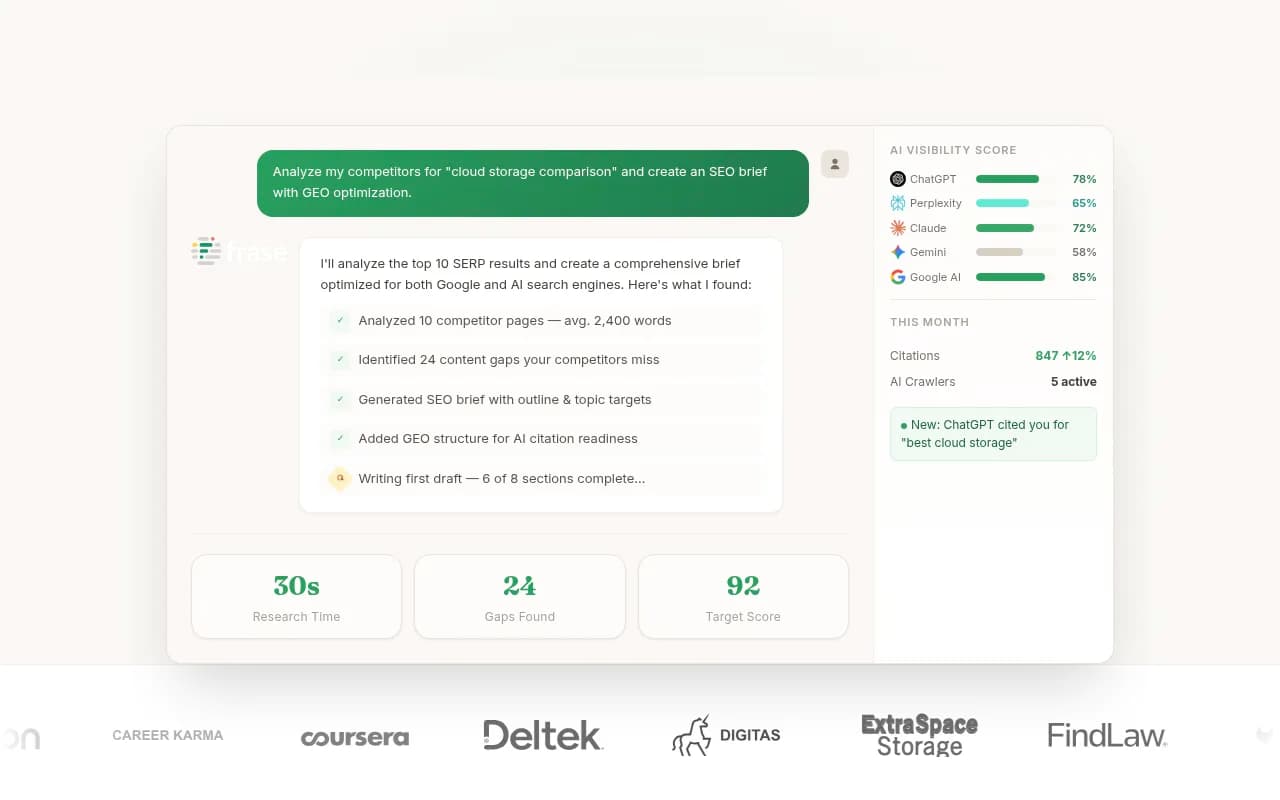
For content-focused teams looking to optimize what they publish, Frase has built out solid AEO-specific features around structuring content for AI citation.
The competitive landscape comparison
Here's a quick look at how different approaches to AEO stack up:
| Approach | What it covers | What it misses | Best for |
|---|---|---|---|
| Traditional SEO tools (Semrush, Ahrefs) | Keyword rankings, backlinks, technical SEO | AI citation tracking, LLM visibility, crawler logs | Teams still primarily focused on Google organic |
| Basic AI monitoring tools (Otterly, Peec.ai) | Brand mentions in AI responses | Content gap analysis, traffic attribution, crawler logs | Teams that want a simple dashboard to start |
| Full AEO platforms (Promptwatch) | Citations, crawler logs, content gaps, traffic attribution, competitor analysis | Nothing significant -- this is the full stack | Teams serious about AI visibility as a revenue channel |
| Manual tracking (running queries yourself) | Whatever you think to check | Everything systematic | Early-stage experimentation only |
The honest reality is that the "manual tracking" approach -- running queries in ChatGPT and noting whether you appear -- is where most teams still are. It's better than nothing, but it's not a strategy.



What BCG's discoverability research adds to the picture
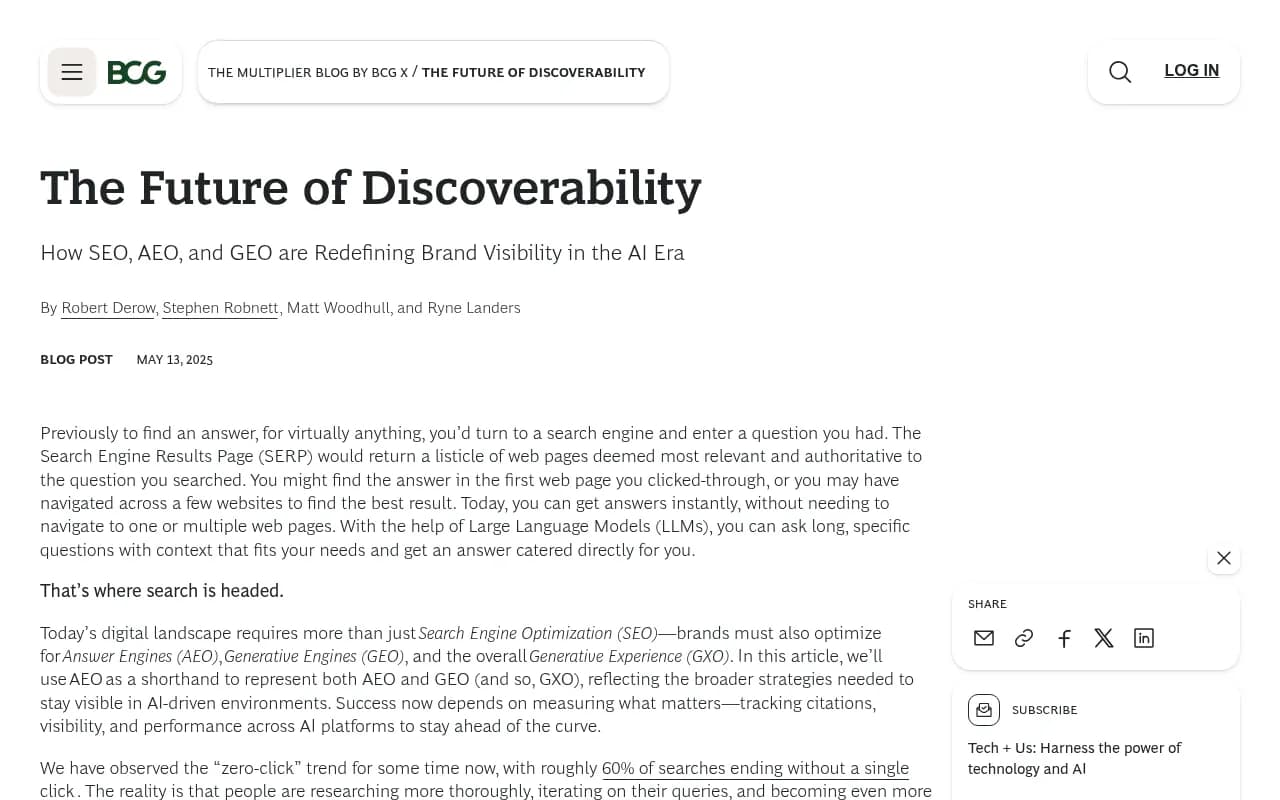
BCG's January 2026 update on the future of discoverability makes a point worth sitting with: the zero-click trend isn't purely bad news. They observed that users who do click after an AI interaction tend to be further along in their decision process -- higher intent, more informed, more likely to convert.
This reframes the AEO opportunity. You're not just trying to recover lost traffic. You're trying to be the brand that gets credited during the research phase -- so that when the user does click, they're already primed to trust you.
That's a different kind of marketing than most teams are used to. It's closer to PR and thought leadership than to traditional SEO. The brands that understand this are investing in genuine expertise signals: original research, expert bylines, data-backed content, and third-party validation.
The honest state of play
AEO in 2026 is real, it's measurable, and the gap between brands that are doing it and brands that aren't is already visible in the data. But it's also still early enough that getting serious about it now puts you ahead of most competitors.
The fundamentals aren't mysterious: be authoritative, be direct, be structured, build topical depth, and show up across the ecosystem where AI engines look. The harder part is measurement -- knowing whether what you're doing is actually working, which pages are getting cited, and which prompts you're missing.
That's the work. Not the tactics, but the discipline of closing the loop between what you publish and what AI engines actually cite.
The brands winning in AI search right now aren't doing anything exotic. They're doing the basics well, measuring the right things, and iterating faster than everyone else.