Key takeaways
- Traditional Google rankings don't guarantee visibility in AI Overviews, ChatGPT, or other AI search engines -- a phenomenon called the "AI Search Gap"
- AI models prioritize structured, entity-rich content with clear topical authority, not just keyword optimization
- Tools like Promptwatch help identify which prompts competitors appear in but you don't, then generate content engineered for AI citation
- Closing the gap requires content gap analysis, AI-optimized writing, and tracking visibility across multiple AI models
- Most brands are invisible in AI search despite strong Google rankings because they're optimizing for the wrong retrieval system
You check your rankings. Position 1 for your target keyword. Traffic is solid. Everything looks good.
Then you open ChatGPT and ask the same question a customer would ask. Your brand doesn't show up. Not in the answer, not in the sources, nowhere.
You try Perplexity. Same result. Google AI Overviews? Still nothing.
This is the AI Search Gap -- the growing divide between traditional search visibility and AI search visibility. Your content can rank on Google and still be completely invisible when an AI model generates an answer.
Why traditional rankings don't translate to AI visibility
Google's ranking algorithm and AI retrieval systems are fundamentally different. Google ranks pages. AI models retrieve and synthesize information from multiple sources to generate answers.
Here's what that means in practice:
Google cares about:
- Backlinks and domain authority
- Keyword placement and density
- Page speed and technical SEO
- User engagement signals (CTR, dwell time)
AI models care about:
- Entity recognition and topical authority
- Structured, parseable content
- Direct answers to specific questions
- Citation-worthy facts and data points
- Brand mentions across the web (not just your site)
A page optimized for Google might have perfect keyword placement, strong backlinks, and fast load times. But if the content is vague, lacks clear entity associations, or doesn't directly answer questions, AI models skip it.
The retrieval problem: how AI models decide what to cite
AI models don't "rank" content the way Google does. They retrieve it.
Retrieval is about matching the user's query to the most relevant, citation-worthy sources in the model's training data or real-time search results. If your content isn't structured in a way that makes it easy to extract and cite, the model moves on.
Consider this example:
Query: "What's the best project management tool for remote teams?"
Your page (optimized for Google): "Looking for project management software? Our platform helps teams collaborate effectively with powerful features designed for modern workplaces. Streamline your workflow today!"
Competitor's page (optimized for AI): "The best project management tools for remote teams in 2026 are Asana, Monday.com, and ClickUp. Asana excels at task dependencies, Monday.com offers the most customization, and ClickUp provides the best value for small teams."
The competitor's content is structured, specific, and directly answers the question. AI models cite it. Your page, despite ranking well on Google, gets ignored.
Entity authority: the hidden ranking factor
AI models prioritize entities -- brands, people, places, concepts -- that are clearly associated with a topic.
If your brand isn't recognized as an authority on the topic, AI Overviews and ChatGPT skip you even if you rank #1 on Google. This is why established brands often dominate AI citations while smaller sites with better content get ignored.
Entity authority is built through:
- Consistent mentions across authoritative sources (news sites, Wikipedia, industry publications)
- Structured data markup (schema.org) that explicitly defines your brand and its relationship to topics
- Knowledge Graph presence (Google's entity database)
- Brand mentions in Reddit threads, YouTube videos, and other platforms AI models crawl
Most brands focus on on-page SEO and backlinks. They ignore the broader web presence that AI models use to determine authority.

The content structure problem
AI models prefer content that's easy to parse and extract. Long-form blog posts with vague introductions, buried answers, and meandering narratives don't work.
Here's what does:
Direct answers upfront: Start with the answer, then explain. AI models often pull from the first 100-200 words.
Structured formatting: Use headings, bullet points, tables, and numbered lists. AI models can extract structured data more reliably than prose.
Entity-rich language: Mention specific brands, products, people, and concepts by name. Avoid vague references like "this solution" or "our platform."
Citation-worthy facts: Include statistics, dates, prices, and other concrete data points. AI models cite sources that provide verifiable information.
Question-based headings: Structure sections around the actual questions users ask. "How much does X cost?" beats "Pricing Overview."
Why Google AI Overviews are different from ChatGPT
Google AI Overviews and ChatGPT use different retrieval systems, which means you can be visible in one and invisible in the other.
| Factor | Google AI Overviews | ChatGPT (with search) |
|---|---|---|
| Data source | Real-time Google index | Real-time Bing search + training data |
| Ranking signals | Google's ranking algorithm + AI synthesis | Relevance to query + citation quality |
| Entity bias | Strong preference for Knowledge Graph entities | Broader entity recognition |
| Content freshness | Prioritizes recent content | Less emphasis on recency |
| Domain authority | High weight on traditional SEO signals | More weight on content quality and structure |
This is why brands often see different results across AI platforms. A page that ranks well on Google and appears in AI Overviews might still be invisible in ChatGPT if it lacks the structured, entity-rich content ChatGPT's retrieval system prioritizes.
The Reddit and YouTube factor
AI models increasingly cite Reddit threads and YouTube videos -- sources that traditional SEO largely ignores.
Why? Because these platforms contain real user discussions, product comparisons, and unfiltered opinions. When someone asks ChatGPT "What do people actually think about X?", it pulls from Reddit. When they ask for a tutorial, it cites YouTube.
If your brand isn't mentioned in these discussions, you're invisible in a growing segment of AI search results.
Most brands don't track Reddit mentions or YouTube coverage. They focus exclusively on their own website and traditional backlinks. That's a mistake.
How to diagnose your AI visibility gap
Before you can fix the gap, you need to measure it. Here's how:
Step 1: Identify your core prompts List the questions and queries your target customers ask. Not keywords -- actual questions. "What's the best X for Y?" "How do I solve Z problem?" "X vs Y comparison."
Step 2: Test your visibility Enter each prompt into ChatGPT, Perplexity, Claude, and Google AI Overviews. Note whether your brand appears in the answer or sources.
Step 3: Compare to Google rankings Check where you rank on Google for the same queries. If you rank well on Google but don't appear in AI results, you've found the gap.
Step 4: Analyze competitor visibility Repeat the process for competitors. Which brands appear consistently in AI results? What content are they producing that you're not?
Step 5: Track over time AI visibility changes faster than Google rankings. Set up recurring checks (weekly or monthly) to monitor trends.
Tools like Promptwatch automate this process. You define your prompts, and the platform tracks your visibility across 10+ AI models, identifies gaps, and shows you which competitors are winning.
Content gap analysis: finding what's missing
Once you know where you're invisible, the next step is figuring out why.
Content gap analysis for AI search is different from traditional SEO gap analysis. You're not looking for missing keywords -- you're looking for missing answers, entities, and structured content.
Here's what to look for:
Missing question coverage: Which questions do competitors answer that you don't? AI models cite sources that directly address the user's query.
Missing entity associations: Which brands, products, or concepts are mentioned in competitor content but not yours? AI models prioritize entity-rich content.
Missing structured data: Do competitors use tables, lists, or schema markup that makes their content easier to extract?
Missing external mentions: Are competitors cited in Reddit threads, YouTube videos, or news articles that you're not?
Missing content formats: Do competitors publish comparison pages, listicles, or how-to guides that you don't?
The goal is to identify the specific content gaps that explain why AI models cite competitors but not you.
Creating AI-optimized content
Once you've identified the gaps, you need to create content that AI models will actually cite.
Here's the framework:
1. Start with the answer Put the core answer in the first 100 words. No fluff, no preamble. AI models often pull from the introduction.
2. Use question-based structure Organize content around the actual questions users ask. Each section should answer a specific question.
3. Include comparison tables AI models love tables. Compare features, pricing, pros/cons, or use cases in a structured format.
4. Mention entities explicitly Name specific brands, products, people, and concepts. Avoid vague references.
5. Add citation-worthy data Include statistics, dates, prices, and other concrete facts. Cite your sources.
6. Use schema markup Add structured data for FAQs, how-tos, products, and reviews. This helps AI models parse your content.
7. Optimize for multiple AI models Test your content in ChatGPT, Perplexity, and Google AI Overviews. Adjust based on what gets cited.
Most brands write for Google and hope AI models pick it up. That doesn't work. You need to write specifically for AI retrieval.
The role of AI content generation
Writing AI-optimized content at scale is time-consuming. This is where AI content generation tools come in.
But not all AI writing tools are built for AI search visibility. Most generate generic SEO content optimized for Google, not AI citation.
The difference: tools built for AI search (like Promptwatch's AI writing agent) analyze real citation data, prompt volumes, and competitor visibility to generate content that AI models actually cite. They structure content around questions, include entity-rich language, and format for easy extraction.
Generic AI writing tools produce content that reads well but doesn't get cited. AI-optimized tools produce content engineered for retrieval.
Tracking and measuring AI visibility
You can't improve what you don't measure. Tracking AI visibility is different from tracking Google rankings.
Here's what to monitor:
Visibility score: What percentage of your target prompts result in a brand mention or citation? Track this across multiple AI models.
Citation frequency: How often does your brand appear in AI-generated answers? Compare to competitors.
Source attribution: Which pages on your site are being cited? Are AI models pulling from your best content or random pages?
Prompt coverage: Which prompts are you visible for? Which ones are you missing?
Traffic attribution: How much traffic is coming from AI search? Use referrer tracking, Google Search Console, or server logs to measure.
Most brands track Google rankings obsessively but have no idea how visible they are in AI search. That's a blind spot.

The traffic attribution problem
Here's the uncomfortable truth: AI citations don't always drive traffic.
When ChatGPT or Perplexity mentions your brand, users often don't click through. They get the answer they need and move on. AI Overviews are even worse -- Google's own data shows that AI Overviews reduce organic clicks by 20-60% depending on the query.
This means visibility in AI search is not the same as traffic from AI search.
So what's the point?
Brand awareness: Being cited by AI models builds brand recognition. Users see your name, even if they don't click.
Trust and authority: AI citations signal credibility. If ChatGPT recommends your product, users trust it more.
Competitive defense: If competitors are visible in AI search and you're not, you're losing mindshare.
Future-proofing: AI search is growing. Being invisible now means being irrelevant later.
The goal isn't just traffic -- it's presence. Being part of the conversation matters, even if users don't click immediately.
Why most brands are failing at this
The AI Search Gap exists because most brands are still optimizing for 2015-era SEO.
They focus on:
- Keyword density
- Backlink counts
- Domain authority
- Page speed
These still matter for Google. But they don't matter for AI search.
AI models care about:
- Entity authority
- Structured content
- Direct answers
- External mentions
- Citation-worthy facts
Most brands don't track AI visibility, don't analyze content gaps, and don't optimize for AI retrieval. They assume that ranking on Google is enough.
It's not.
The competitive advantage of early adoption
Right now, most brands are invisible in AI search. The ones that figure this out early have a massive advantage.
Why? Because AI models have limited "citation slots." When ChatGPT generates an answer, it cites 3-5 sources. If you're one of those sources, your competitors aren't.
The brands that dominate AI citations now will build entity authority that's hard to displace later. Just like early SEO adopters built domain authority that still pays off today.
This is a land grab. The brands that move first win.
Tools for closing the AI visibility gap
You can't fix this manually. The volume of prompts, the number of AI models, and the speed of change make manual tracking impossible.
Here are the tools that actually help:
For tracking visibility: Promptwatch monitors 10+ AI models, tracks competitor visibility, and identifies content gaps. It's the only platform that combines tracking with content generation.
For content optimization: Clearscope and Surfer SEO help optimize content for Google, but they don't account for AI retrieval. Tools like Promptwatch's AI writing agent are built specifically for AI citation.
For entity tracking: Brandlight and Mentions.so track brand mentions across AI models and help you understand where your entity authority is strong or weak.
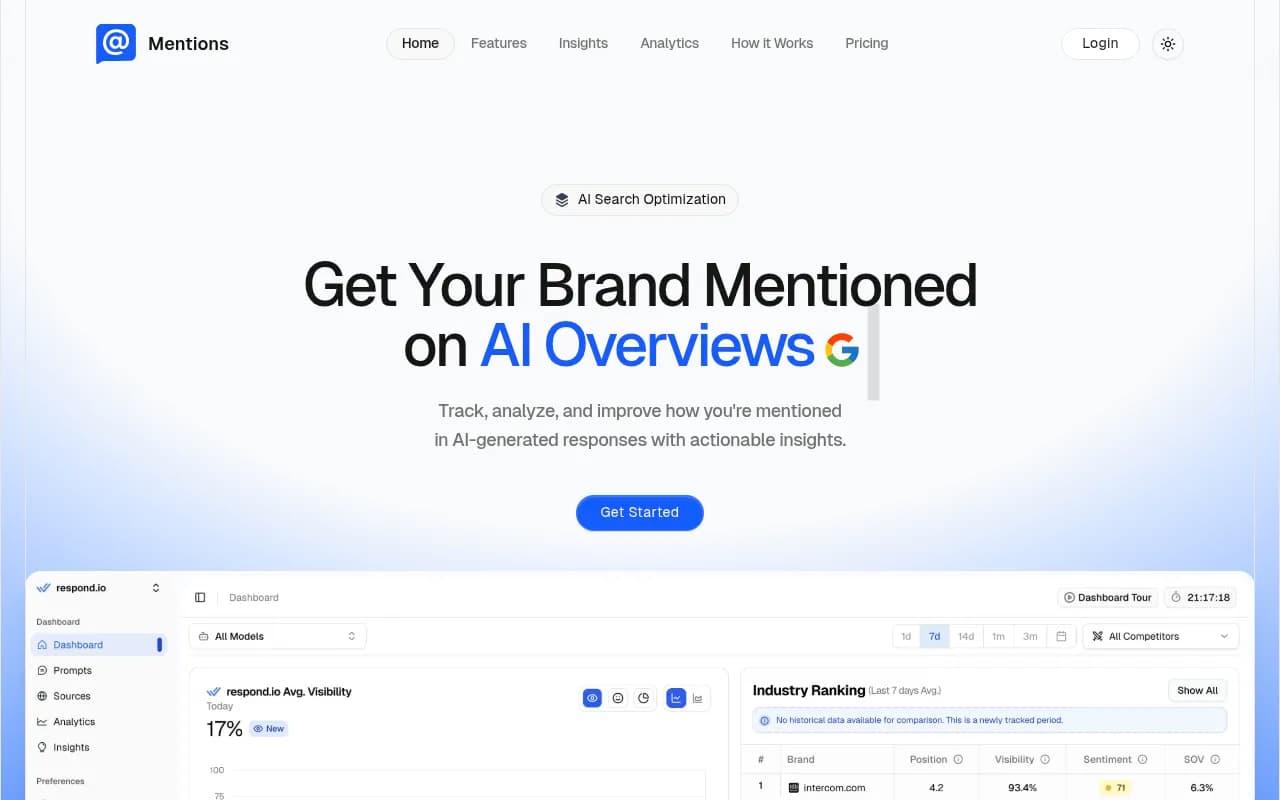
For Reddit and YouTube monitoring: Most AI visibility tools ignore Reddit and YouTube. Promptwatch includes Reddit and YouTube insights as part of its core platform.
What to do next
If you're reading this and realizing you have an AI visibility gap, here's the action plan:
Week 1: Measure the gap Test your top 20 prompts in ChatGPT, Perplexity, and Google AI Overviews. Document where you appear and where you don't.
Week 2: Analyze competitors Repeat the process for your top 3 competitors. Identify which prompts they dominate and what content they're producing.
Week 3: Identify content gaps List the questions, entities, and structured content your competitors have that you don't.
Week 4: Create AI-optimized content Write or generate 5-10 pieces of content specifically designed for AI citation. Use question-based structure, entity-rich language, and comparison tables.
Week 5: Track results Re-test your prompts. Measure whether your new content is being cited. Adjust based on what works.
This isn't a one-time project. AI search is evolving fast. You need ongoing tracking, content creation, and optimization.
The reality check
The AI Search Gap is real. Your Google rankings don't protect you. If you're invisible in AI search, you're losing traffic, mindshare, and competitive positioning.
Most brands will ignore this until it's too late. They'll keep optimizing for Google while their competitors build AI visibility.
The brands that win are the ones that recognize the shift and act now.
Your content can rank #1 on Google and still be invisible in AI search. That's the gap. Close it before your competitors do.