Key takeaways
- Rewriting existing pages often beats publishing new ones. In one documented case, a B2B software company went from 14% to 38% AI citation share in 90 days by restructuring existing pages. They created zero new content.
- AI Overviews reward structure, not volume. Direct-answer H2s, 40–75 word answer blocks placed under headings, tables, and FAQ formatting consistently outperform long-form prose for citation extraction.
- Google AI Overviews cites roughly 10 sources per answer, about double ChatGPT's ~5, which makes it one of the more accessible surfaces for mid-authority sites to break into.
- Some tactics sound plausible but do almost nothing. Markdown files account for just 0.05% of AI search citations, and Google has explicitly listed "rewriting content just for AI systems" as a tactic it doesn't reward.
- Measure before and after. Without a baseline citation share, you can't tell whether your rewrite worked or whether you just got lucky on a few prompts.
Why rewriting beats writing new content
Here's a pattern I keep seeing, and it's a little uncomfortable for content teams: companies producing 40+ pieces per month, ranking on page one of Google, and appearing in fewer than 15% of AI answers for their target queries. That's the situation Acquia described in a 2026 case study of a global B2B software company. Good content, good rankings, invisible to AI.
The fix wasn't more content. The team restructured their top-traffic product and solution pages using answer-engine formatting: direct-answer H2s, FAQ blocks, and consistent product naming across all properties. AI citation share went from 14% to 38% within 90 days. No new pages. The pages were already good; they just weren't extractable.
This matters because most teams respond to AI invisibility by publishing more. That's the instinct. But AI Overviews don't have a content-volume problem, they have an extraction problem. A page that buries its answer in paragraph four of a meandering narrative can rank well in Google and still be useless to a retrieval system looking for a clean, self-contained passage to cite.
Rewriting is also cheaper and faster. You already have the research, the expertise, and the page authority. You're changing the packaging, not the product.
What AI Overviews actually cite (and what that means for your rewrite)
Before you rewrite anything, it helps to know what the engine prefers to pull. Promptwatch's data on AI Overview citation types gives you a concrete target.
In July 2026, Google AI Overviews cited roughly 18% listicles, 16.3% product pages, 15.1% how-tos, and 13.5% news articles, with video, social posts, landing pages, and comparisons making up the rest. The bigger story: product pages overtook listicles as the single most-cited format in late July, the first time that's happened. If your rewrite targets commercial pages, you're swimming with the current for once.
ChatGPT is even more product-heavy. Product pages made up about 32.8% of ChatGPT Search citations in July 2026, nearly a third of everything cited, and up from roughly 18% in March. So a rewrite that gives your product pages structured specs, clear pricing, and fresh availability data pays off across multiple engines.
One more number worth knowing: Google AI Overviews cites about 10 sources per answer on average, roughly double ChatGPT's ~5, and that count stays steady over time. Ten slots is forgiving. It's one reason mid-authority domains have a real shot here, and it's why tightly focused pages that fully answer one question outperform broad pages that partially cover ten.
The before-and-after approach: how to see your own problem
The most useful thing about the case study format is that it forces honesty. You can't claim a rewrite worked unless you know what the page looked like before and what citation share it had before. Here's how I'd set that up.
Step 1: Establish the before
Pick 10–20 target prompts that reflect what your buyers actually ask. Not keyword lists, questions. "How much does X cost," "X vs Y," "best [category] for [use case]." Run them through AI Overviews weekly and record whether you're cited, who is cited instead, and what content type each citation is.
You can do this manually for a small set, but it gets tedious fast and you'll want citation trend history. Tools like Promptwatch can track this for you: which of your pages get cited, for which prompts, and how that changes after a rewrite.

Step 2: Score each page for extractability
One framework from a 2026 audit of 300+ client pages (KG Web Designer's AI Overview rewrite framework) found that citation-friendly passages average 40–75 words, sit directly under an H2, and lead with the answer. Shorter than that and the passage loses context when extracted. Longer and it gets cut mid-thought.
Their triage logic is worth borrowing. Pages scoring 55–79 on their citation scorecard are rewrite candidates. Below 55, the page is unlikely to recover as a traffic driver no matter what you do, and you should restructure it minimally for citation value only. That last part is the honest caveat most rewrite case studies skip: not all traffic is recoverable, and pretending otherwise sets you up for disappointment.
Step 3: Document the before state
Screenshot the page. Record the structure: how many H2s, whether any heading is a direct question, where the core answer lives, whether data is in tables or buried in sentences. This feels like busywork until three months later when someone asks "wait, what did the page look like before?" and nobody remembers.
Case study 1: the narrative case study that AI can't cite
Acquia published a before-and-after pair that captures the whole problem in two short passages. Here's the before, the type of content AI ignores:
"One of our enterprise customers came to us struggling with content visibility. They had a large, well-resourced content team and were producing a significant volume of high-quality material, but they weren't seeing the results they expected in search. After working with us, they achieved much better visibility, and their team felt more aligned on their content goals."
Now the after, the type AI cites:
"Challenge: A global B2B software company was producing 40+ pieces of content per month but appearing in fewer than 15% of AI-generated answers for their target queries, despite ranking on page one of Google for most of them. Solution: Restructured top-traffic product and solution pages using AEO formatting: direct-answer H2s, FAQ blocks, consistent product naming across all properties. Result: AI citation share increased from 14% to 38% within 90 days."
Same story. Same company. But the second version is machine-extractable: an AI engine can independently pull the challenge, the solution, and the result, and cite any of them as a standalone fact. The first version contains none of those things in a usable form. This is the entire discipline in miniature, and you can apply it to case studies, product pages, service descriptions, anything.
Case study 2: a rewrite with an honest outcome
The Anandam Yoga School case from KG Web Designer's framework is the rarer kind of case study, the kind that admits what didn't work. The agency was explicit that some of the site's lost traffic categories were largely non-recoverable, per their own triage step, and they didn't claim to have rewritten that traffic back into existence. They restructured what was recoverable and stopped chasing the rest.
I find this more useful than a triumph story, because it tells you where rewriting ends. If a page lost rankings because the query itself now gets answered in the AI Overview with no click-through to anyone, no amount of restructuring brings the click back. The goal shifts: get cited, accept that the citation is the win, and stop measuring the page by 2019 metrics.
That reframing matters. Chartbeat's 2026 analysis found small publishers lost roughly 60% of search referral traffic versus 22% for large publishers, and Pew Research found click rates fall to about 8% when an AI summary shows versus 15% without one. The click pie is smaller. The citation pie is the new pie.
The rewrite framework: six changes that move citation share
Onely, whose rewrite methodology frames this as "structural engineering, not just content updates," walks through restructuring for AI extraction with Q&A formats and clear headers, plus optimizing entities and E-E-A-T signals. Here's how I'd combine that with the formatting data into a working checklist.

1. Convert key H2s into questions, and answer them immediately
Every major section should be a question your buyer actually asks, followed by a 40–75 word direct answer under the heading. No throat-clearing, no "it depends," no three paragraphs of context first. If the answer needs nuance, give the clean version first and the nuance second. Extraction systems take the clean version; human readers get both.
2. Replace prose that describes data with the data itself
This is the highest-leverage change in the whole framework. In the 300-page audit mentioned earlier, pages using tables were cited 4.2x more often than prose describing the same data. Numbered lists ran 2.7x, bullet lists 1.8x. If your pricing section is four sentences about your pricing philosophy, it's invisible. If it's a pricing table, it's a citation candidate.
3. Use definitive phrasing
Cited text uses definitive statements ("X costs $Y," "X causes Y") roughly twice as often as hedged phrasing. This is hard for writers trained to hedge, and honestly, sometimes hedging is more accurate. But there's a difference between epistemic honesty and vague mush. "Costs typically range from $50 to $200 depending on volume, with most teams paying around $90" is both honest and extractable. "Costs can vary significantly based on a number of factors" is neither.
4. Add FAQ blocks, but only with real questions
FAQ blocks work because they're pre-chunked question-and-answer pairs, exactly the shape AI Overviews wants to extract. The catch: they only work with questions people actually ask. Scroll through your support inbox, sales call notes, and the "People also ask" box for your queries. Five real questions beat twenty invented ones.
5. Fix entity consistency
If your product is called "CloudSync Pro" on the product page, "CloudSync" in the blog, and "the platform" in case studies, you're fragmenting your own entity. AI systems connect mentions to entities; inconsistent naming weakens that connection. This is invisible work with outsized payoff, and it's usually a find-and-replace-scale effort.
6. Refresh the dated material
Content freshness is one of the core factors Onely identifies for AI search ranking. A 2023 statistics section that no longer matches reality doesn't just underperform, it can make the whole page look stale to a retrieval system comparing it against fresher competitors. Update the numbers, the screenshots, the pricing, and the date.
What not to do
Google's own guidance on AI Overviews, as summarized in presentations from search liaisons, lists tactics it considers unhelpful: creating txt files and other special markup, "chunking" content, seeking inauthentic mentions, and rewriting content just for AI systems. That last one needs unpacking, because it sounds like it contradicts this entire article.
It doesn't. Rewriting a page so it clearly answers a real question is helpful to humans and machines, which is what Google rewards. Rewriting a page by injecting question headings and answer-shaped paragraphs onto content that doesn't actually answer them is the spam version, and it shows.
The markdown rabbit hole deserves a specific warning, because it keeps coming up. Promptwatch's analysis of 1.6M+ citations found that markdown (.md) files account for just 0.05% of AI search citations. HTML accounts for 99.94%. Publishing an .md mirror of your pages "for the LLMs" has essentially zero payoff for AI search. Markdown matters for AI coding agents reading your docs, which is a different channel. Put that effort into HTML clarity and semantic headings instead.
And skip the chase for inauthentic mentions. Promptwatch's data shows ChatGPT's Reddit citations collapsed from roughly 4% to 0.5% of citation share in August 2026, so the "seed Reddit with mentions" playbook is decaying in real time anyway.
Measuring the after
Run the same prompts on the same schedule, from the same locations if you can. A/B the pages if you have enough traffic for statistical significance; if you don't, sequential before/after measurement across 90 days is the realistic standard.
Some practical notes on reading the results:
- Isolate the engine. Perplexity cites almost exactly 10 sources per answer with very little variance, which makes it the most testable engine for a rewrite. Microsoft Copilot's citation count swings wildly, so treat changes there as noise, not signal.
- Give it time. The Acquia result took 90 days. Crawlers have to re-fetch, indexes have to update, and models have to re-ingest. Two weeks is too early to declare failure.
- Watch which pages gained, not just aggregate share. Page-level citation data tells you which structural changes actually moved the needle, so you can repeat the winners.
For teams doing this at any real scale, a visibility platform that tracks citation trends per page and per prompt pays for itself quickly. Promptwatch's citation analytics classify every citation by content type and source type and show ramp-up and decay per cited page, which is exactly the feedback loop a rewrite program needs. If you're comparison shopping, the AI visibility tools directory at ai-rank-tools.com covers the monitoring side, and bestgeosoftware.com lists the broader GEO platforms.
Tools for the rewrite itself
You don't strictly need software for any of this. A text editor, the formatting rules above, and discipline will do it. But if you're rewriting at scale, content optimization tools help with the brief-writing and entity-coverage parts, and scoring tools help prioritize which pages to touch first.
Here's how the main options compare for a rewrite workflow:
| Tool | Starting price | What it does for rewrites | Caveat |
|---|---|---|---|
| Promptwatch | $95/mo | Tracks citations per prompt and page, shows content gaps, generates GEO content briefs with git-diff-style update suggestions for existing pages | Monitoring plus optimization, not a writing editor |
| Surfer SEO | $99/mo | Content scoring, SERP analyzer, topical maps; AI Tracker for GEO visibility is a separate add-on | AI writing carries per-article fees on top of the subscription |
| Clearscope | $129/mo | Content grading and inventory tracking, unlimited users on all plans | Pricing sources vary; verify current rates before buying |
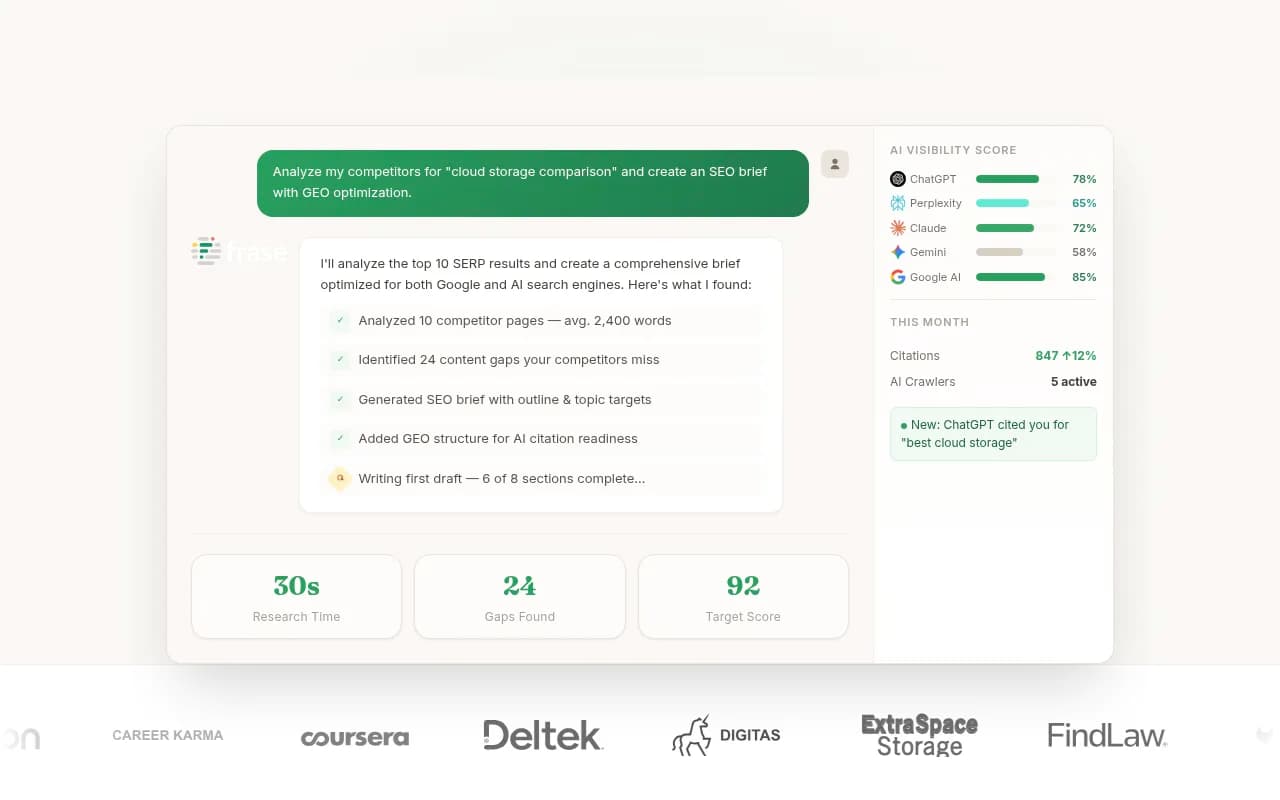
| Frase | $15/mo | Research, briefs, and a Content Guard feature that monitors and republishes content, built for maintenance at scale | Lighter on AI-visibility measurement |
| Dashword | $99/mo | Briefs, optimization reports, content monitoring | Secondary sourcing on pricing; check live |

One warning on scores: they're proxies, not proof. Clearscope itself has pointed out that even the best content-score correlation with rankings is weak (their cited Originality.ai study showed a 0.26 correlation for their own score), so treat any "AI readiness" score as a triage signal, not a guarantee. The only measurement that counts is whether you actually got cited.
Putting it together
A realistic rewrite program looks like this: pick 10 target prompts, record your baseline citation share, audit your candidate pages with the 40–75-word answer-block and structure rules, rewrite the top three to five pages, wait 60–90 days while tracking weekly, then double down on the structural changes that produced citations and drop the ones that didn't.
The Acquia case proves the ceiling is high (14% to 38% with zero new content). The yoga school case proves the floor is real (some traffic never comes back). Both are true at once, and the pages that win are the ones where a machine can lift a clean, self-contained, factually confident answer out of the page and stand behind it. Rewrite for that, measure honestly, and let the before-and-after data, not the playbook, tell you what to do next.