Key takeaways
- All four tools track brand mentions across AI models like ChatGPT, Claude, and Perplexity -- but they differ significantly in what you can do with that data.
- Promptwatch is the only one of the four that closes the loop from monitoring to content creation to traffic attribution, making it the strongest choice for teams that want to actually improve their AI visibility, not just observe it.
- Hall AI and LLM Pulse are solid monitoring tools with clean interfaces, but both stop short of helping you fix the gaps they surface.
- Promptmonitor is the most affordable entry point, but its feature depth reflects that price.
- If you're choosing between these four, the right pick depends on whether you need a tracker or an optimization platform.
The AI visibility tool market has exploded. Two years ago there were maybe a dozen options. Now there are well over a hundred, and the mid-range tier -- roughly $50 to $300 per month -- is the most crowded. That's where Promptwatch, Hall AI, LLM Pulse, and Promptmonitor all live.
The pitch from all four is roughly the same: "Know when ChatGPT, Perplexity, and Claude mention your brand." That's table stakes now. The real question is what happens after you see the data. Can the tool help you do something about it? Or does it just show you a number going up or down while you try to figure out what to do next?
This guide breaks down each tool honestly -- what it does well, where it falls short, and who should actually use it.
What these tools actually do (and what they don't)
Before getting into the specifics, it's worth being clear about the two categories these tools fall into:
Monitoring tools track how often your brand appears in AI responses, which models mention you, how sentiment looks, and how you compare to competitors. They're useful for awareness and reporting.
Optimization platforms do all of that, but then help you act on what you find. They show you which prompts you're missing, help you create content to fill those gaps, and track whether that content actually improves your visibility over time.
Most tools in this comparison are monitoring tools. One of them isn't.
Promptwatch
Promptwatch is the most fully-featured of the four, and it's the only one that goes beyond monitoring into actual optimization. The core workflow is built around three steps: find the gaps, create content to fill them, and track the results.

The Answer Gap Analysis is what separates it from the rest. It shows you exactly which prompts your competitors are appearing for that you aren't -- not just "you're missing visibility," but the specific questions and topics where AI models are recommending someone else. That's genuinely useful information, and most tools in this space don't offer anything like it.
From there, Promptwatch has a built-in AI writing agent that generates articles, listicles, and comparisons based on real citation data (over 880 million citations analyzed). This isn't a generic content generator -- it's trained on what AI models actually cite, so the output is designed to get picked up by ChatGPT, Claude, and Perplexity rather than just sitting on your site.
On the monitoring side, Promptwatch covers 10 AI models including Google AI Overviews, Google AI Mode, DeepSeek, Grok, and Meta AI -- a broader set than most competitors. It also has AI crawler logs (real-time data on which AI crawlers are visiting your pages and what errors they hit), ChatGPT Shopping tracking, Reddit and YouTube citation tracking, and multi-language/multi-region support.
Traffic attribution is handled through a code snippet, Google Search Console integration, or server log analysis -- so you can connect AI visibility to actual revenue, not just impressions.
Pricing starts at $99/month for the Essential plan (1 site, 50 prompts, 5 articles), $249/month for Professional (2 sites, 150 prompts, 15 articles, crawler logs), and $579/month for Business (5 sites, 350 prompts, 30 articles). A free trial is available.
Best for: Marketing and SEO teams that want to improve their AI visibility, not just report on it. Also strong for agencies managing multiple clients.
Hall AI
Hall AI focuses on tracking how AI platforms cite and discuss your brand. The interface is clean and the setup is fast -- you can get a monitoring dashboard running in a few minutes without much configuration.

It covers the major AI models (ChatGPT, Claude, Perplexity, Gemini) and gives you visibility scores, citation tracking, and competitor comparisons. The sentiment analysis is decent, and the reporting is clear enough to share with stakeholders who don't want to dig into raw data.
Where Hall AI falls short is on the action side. It tells you where you're visible and where you're not, but it doesn't tell you why, and it doesn't help you fix it. There's no content gap analysis, no writing tools, no crawler logs. If you see your visibility score drop, you're on your own to figure out what changed and what to do about it.
It's also worth noting that Hall AI's prompt coverage is more limited than Promptwatch's. You're working with a smaller set of tracked queries, which can give you an incomplete picture of how you're actually performing across AI search.
Best for: Smaller teams or individuals who want a clean, low-friction way to monitor brand mentions in AI responses and don't need optimization capabilities.
LLM Pulse
LLM Pulse positions itself as a comprehensive LLM response tracking and monitoring platform. It covers multiple AI models, tracks brand mentions and citations, and provides competitive benchmarking.
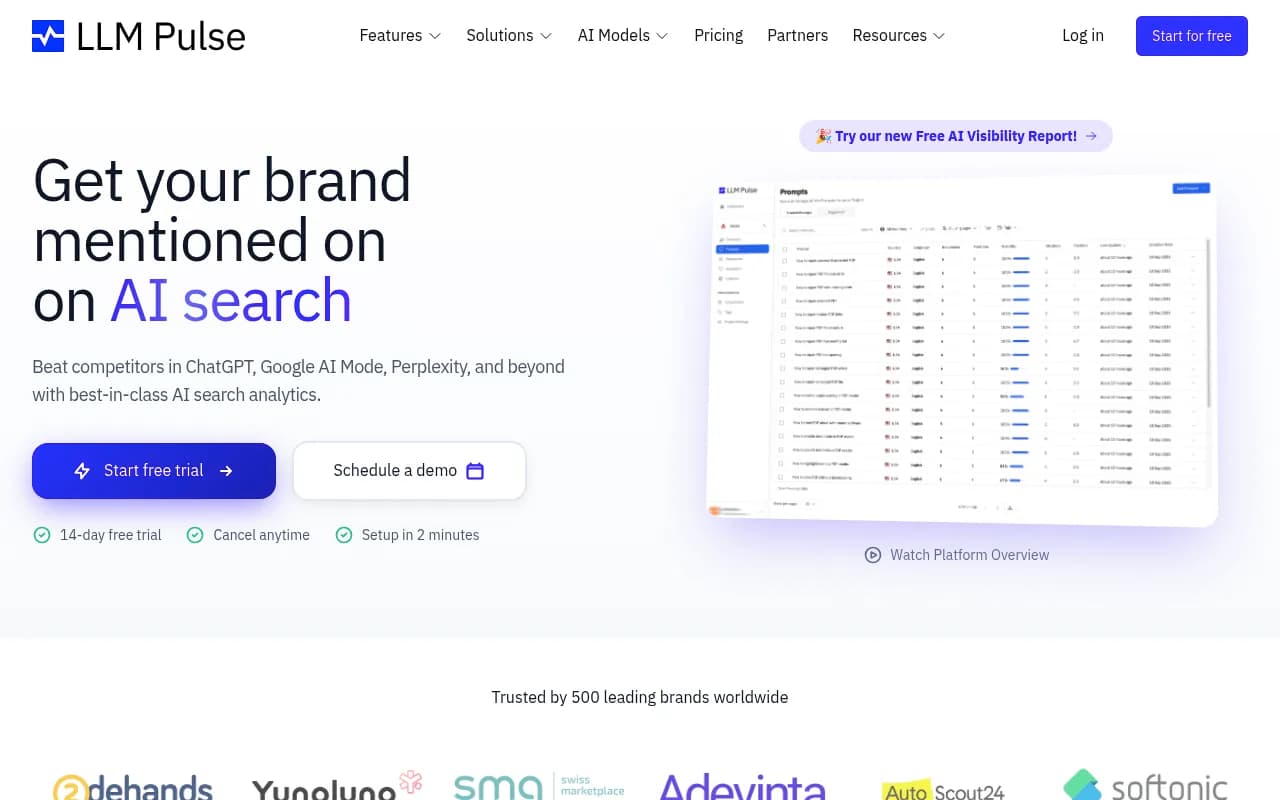
The standout feature is its depth on the monitoring side. LLM Pulse gives you reasonably detailed breakdowns of how your brand appears across different models, with trend data over time. The competitor comparison views are useful for understanding relative positioning.
LLM Pulse has also published content positioning itself as a resource for teams evaluating Hall AI alternatives, which suggests it's actively targeting the same mid-market audience. The pricing is accessible, and the onboarding is straightforward.
The limitations are similar to Hall AI's: strong on data, light on action. There's no content generation, no gap analysis that tells you what to create, and no traffic attribution. You get a clear picture of where you stand, but the path from "here's the data" to "here's what to do" is left to you.
Best for: Teams that want more monitoring depth than Hall AI offers but aren't ready to invest in a full optimization platform. Good for competitive benchmarking and reporting.
Promptmonitor
Promptmonitor is the most affordable option in this comparison. It tracks AI visibility across the main models and gives you a basic dashboard for monitoring brand mentions and sentiment.
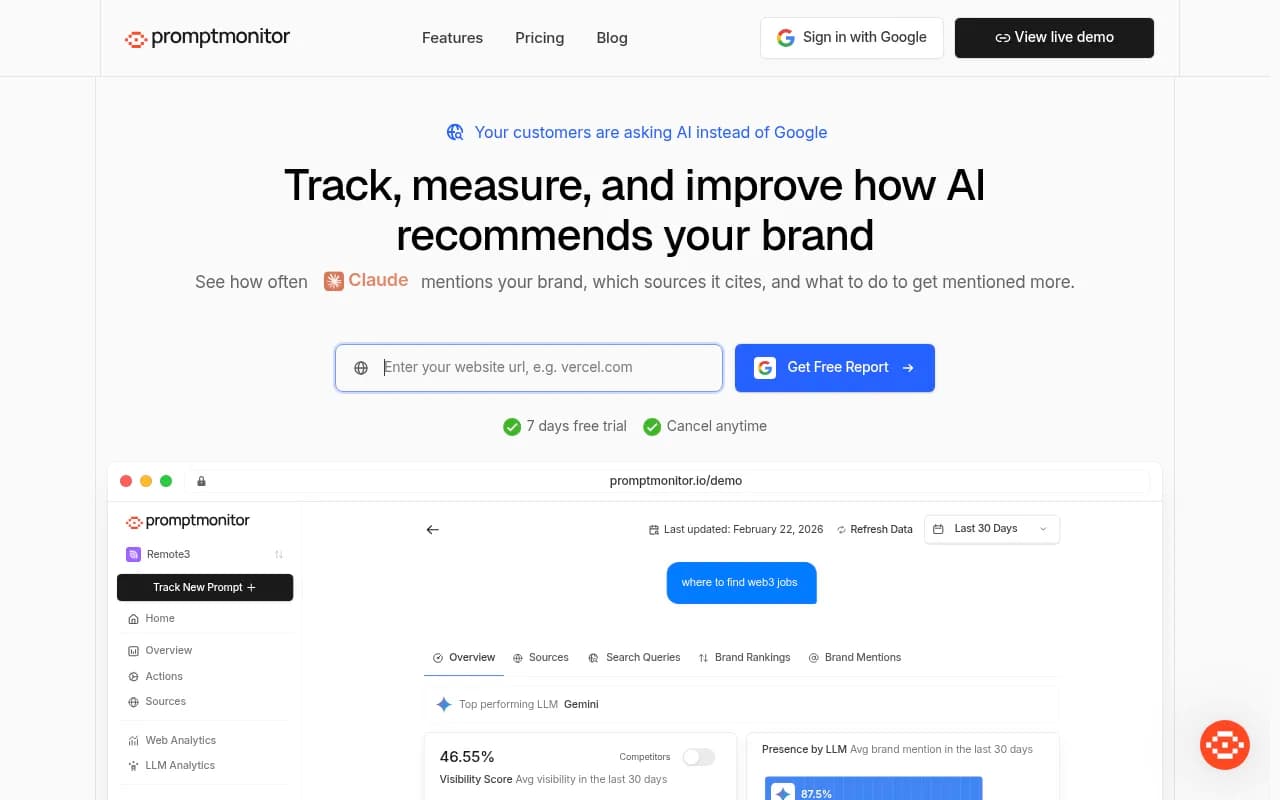
The value proposition is simplicity and price. If you're just starting to think about AI visibility and want to understand whether your brand is showing up in ChatGPT or Perplexity responses, Promptmonitor gets you there without a significant budget commitment.
The trade-off is feature depth. Promptmonitor doesn't have the competitive analysis depth of LLM Pulse, the clean reporting of Hall AI, or anything close to Promptwatch's optimization capabilities. The prompt coverage is limited, and the data granularity is basic compared to the other three.
For a small business or solo marketer who wants to dip a toe in without committing to a more expensive platform, it's a reasonable starting point. But teams that are serious about AI visibility will outgrow it quickly.
Best for: Small businesses and individual marketers who want basic AI visibility monitoring at a low price point.
Side-by-side comparison
| Feature | Promptwatch | Hall AI | LLM Pulse | Promptmonitor |
|---|---|---|---|---|
| AI models tracked | 10 (incl. DeepSeek, Grok, Meta AI) | 4-5 major models | Multiple models | Major models |
| Answer gap analysis | Yes | No | No | No |
| Built-in content generation | Yes | No | No | No |
| AI crawler logs | Yes (Professional+) | No | No | No |
| Traffic attribution | Yes (GSC, snippet, logs) | No | No | No |
| Reddit/YouTube citation tracking | Yes | No | No | No |
| ChatGPT Shopping tracking | Yes | No | No | No |
| Competitor heatmaps | Yes | Basic | Yes | No |
| Multi-language/region | Yes | Limited | Limited | No |
| Prompt volume & difficulty scores | Yes | No | No | No |
| Starting price | $99/mo | Mid-range | Mid-range | Low |
| Free trial | Yes | Yes | Yes | Yes |
| Best for | Optimization + monitoring | Clean monitoring | Monitoring depth | Budget entry |
The core difference: monitoring vs. optimization
This is the thing worth dwelling on. Every tool in this comparison will show you a visibility score. They'll all tell you that you appeared in X% of responses for a given prompt. That's useful to know.
But knowing you're at 23% visibility for "best project management software" doesn't tell you what to do. It doesn't tell you which specific prompts you're losing to competitors, what content those competitors have that you don't, or what you should write to close the gap.
That's the difference between a monitoring tool and an optimization platform. Hall AI, LLM Pulse, and Promptmonitor are monitoring tools. They give you data. Promptwatch is built around the assumption that data without action is just a dashboard you check and then close.
The Answer Gap Analysis specifically is worth calling out because it's the kind of feature that changes how you work. Instead of looking at a visibility score and wondering what to do, you get a list of specific prompts where competitors are winning and you're not -- with the context to understand why and the tools to fix it.
Who should use which tool
Use Promptwatch if you want to actually improve your AI visibility over time. If you're a marketing or SEO team with content resources, the combination of gap analysis and content generation is genuinely useful -- not just for reporting, but for doing the work. It's also the right choice for agencies managing multiple clients who need to show measurable progress.
Use Hall AI if you want a clean, fast monitoring setup and don't need optimization features. It's a good fit for teams that mainly need to track brand mentions and report on them to stakeholders, without the complexity of a full GEO platform.
Use LLM Pulse if you want more competitive depth than Hall AI offers and your primary use case is benchmarking against competitors. The monitoring data is solid, and the pricing is accessible.
Use Promptmonitor if you're just starting out and want to understand the basics of AI visibility without committing significant budget. Expect to upgrade as your needs grow.
A note on the broader market
These four tools represent a slice of a much larger market. Platforms like Profound, Otterly.AI, Peec AI, and AthenaHQ are also competing in this space, each with their own positioning.




Most of them share the same limitation as Hall AI and LLM Pulse: they're strong on monitoring and light on helping you act. The trend in 2026 is toward platforms that close the loop between data and action -- and that's where the meaningful differentiation is happening.
If you're evaluating tools beyond these four, the questions to ask are: Does it show me which specific prompts I'm losing? Does it help me create content to win those prompts? Can I connect AI visibility to actual traffic and revenue? The answers will narrow the field quickly.
Bottom line
For pure monitoring, Hall AI and LLM Pulse are both solid options at accessible price points. Promptmonitor works if budget is the primary constraint.
But if you're investing in AI visibility because you want to improve it -- not just track it -- Promptwatch is the only tool in this comparison that's built for that. The gap analysis, content generation, crawler logs, and traffic attribution work together in a way that none of the monitoring-only tools can match.
The AI search landscape is moving fast. Brands that are just watching their visibility scores in 2026 will be behind the ones that are actively optimizing for them.