Key takeaways
- Profound is the self-serve measurement and agent platform, with the most published security detail (SOC 2 Type II, HIPAA assessment) and public entry pricing of about $99 and $399 a month.
- Evertune is the statistics-heavy option. It samples models at large volume, has a 25M-person consumer panel, and is the only one of the three with a paid-advertising layer.
- Brandlight sells a platform plus a strategy team to multi-brand enterprises. It is custom-priced, starts with a paid 3-month pilot, and has no free trial.
- Almost every comparison article on this topic is written by one of the vendors. Treat head-to-head claims as marketing until you test them yourself.
- Run a paid pilot or proof of concept on your own prompts before committing to any of them.
Why this comparison is harder than it looks
I went through the comparison pages for these three vendors, and the pattern is hard to miss. Profound's site says Profound wins. Evertune's site says Evertune wins. Brandlight's own "best AI visibility tools" list puts Brandlight first and describes Profound as a tool that leaves execution entirely to you. Third-party writeups from Menra, Nick Lafferty and others also sell something. I found no independent head-to-head test and no analyst report that ranks Brandlight against the other two.
So this guide does what it can: it separates what each vendor says about itself from what is reasonably corroborated, flags where sources conflict, and gives you a way to test the claims yourself.
The three platforms are not really the same kind of product, even though they land on the same shortlists. That matters more than any feature checklist.
The three platforms at a glance
| Profound | Evertune | Brandlight | |
|---|---|---|---|
| Core idea | Self-serve measurement plus agents that do content work | Statistical sampling of models plus consumer panel, with a paid ads layer | Measurement plus executed activation with a strategy team |
| Best fit | Marketing teams with people who act on data; agencies | Brands that want rigorous perception data and may buy AI ads | Fortune 500 multi-brand, multi-market organizations |
| Pricing | Starter ~$99/mo, Growth ~$399/mo, Enterprise custom | Mostly unpublished; a third party cites Pro at $800/mo (unverified) | Custom, paid 3-month pilot, no free trial |
| Free trial | 7-day trial reported | No | No |
| Security detail | SOC 2 Type II, HIPAA assessment, SSO/SAML (vendor-stated) | No public SOC 2 or HIPAA advertised (per Profound) | Closed-network processing and SOC 2-level posture claimed (vendor-stated) |
| Service model | Self-serve plus customer success | Self-serve plus customer success | Platform plus AI strategists and engineers |
Pricing figures come from vendor and third-party pages dated around mid-2026. Confirm them with each vendor.
Profound

Profound is the best known of the three. Its own materials say it raised a $180M Series D at a $1.8B valuation, with Sequoia and Kleiner Perkins leading. Some third-party pages still quote an older $96M Series C at a $1B valuation. Those pages are stale on this point, but check the press release before you repeat any number in a board deck.
How it collects data
Profound monitors the front end of AI engines, meaning the answers users actually see, rather than relying only on API output. It adds Agent Analytics, which reads CDN and hosting logs to show which AI crawlers hit your site and which pages they pull. Its Prompt Volumes dataset is built from licensed real-user conversations (Profound states 2B+ on its own page; other pages say 1.5B or 1.9B, so the number varies by source and date).
That front-end approach matters. Promptwatch Data's average sources per response report shows that engines behave very differently: ChatGPT cites about 5 sources per web-search answer, Google AI Overviews about 10, Perplexity almost exactly 10, and Copilot swung from under 2 to nearly 17 before settling low. A tool that reports one blended number across engines hides those differences.
What you get
- Answer Engine Insights for visibility, citations, accuracy and sentiment
- Agents and Profound Sheets for running content workflows, with human approval before publishing
- Agency Mode, with client workspaces and pitch environments
- Integrations for GA4, Slack, Cloudflare, Fastly, Akamai, CloudFront, Vercel, Netlify, GCP and WordPress, plus Adobe Experience Manager nodes for agents
- An MCP server and a Claude connector
Pricing and fit
Starter at about $99/month is ChatGPT only, with 50 prompts. Growth at about $399/month is the first tier with multi-engine monitoring. Enterprise is custom. One third-party writeup estimates typical enterprise contracts at $30,000 to $100,000+ per year, while another guesses $2-5K+ a month. Both are estimates, not published figures.
Engine coverage is stated inconsistently. Profound's own page says up to nine answer engines on Enterprise, while Brandlight says 10 and another reviewer says 10+. Ask for the exact list in your contract.
Profound makes sense if you have people whose job is to act on data. As one reviewer put it, without that person you are paying enterprise prices for a dashboard you open once a month.
Evertune
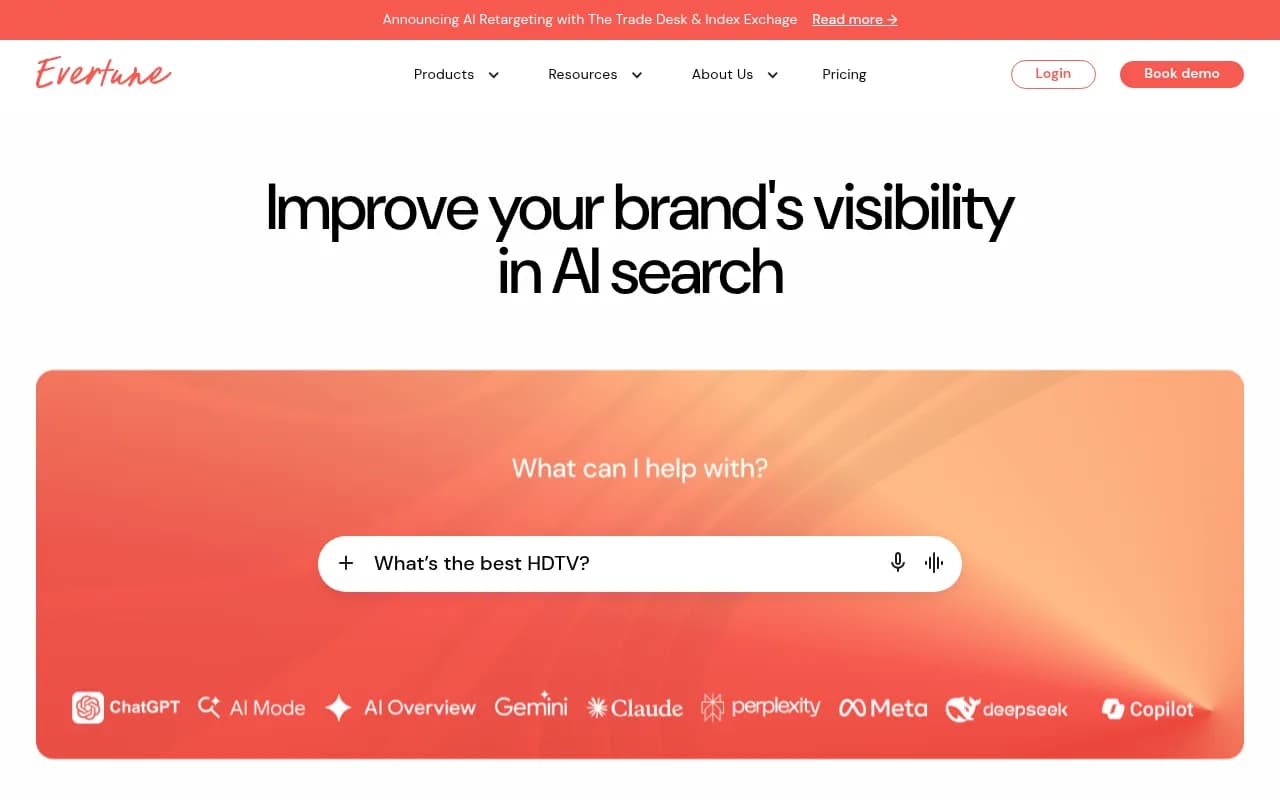
Evertune was founded by veterans of The Trade Desk and has raised roughly $19-20M (its own page and Profound's page disagree slightly). Customers named across sources include WPP, Roku, Canada Goose, HexClad, Miro and athenahealth. It is named in Gartner's 2026 Market Guide and Forrester's Q3 2026 AEO landscape, according to the research I reviewed.
How it collects data
Evertune's pitch is statistical rigor. It says it samples each prompt 100 times per model across 11+ models, where most tools sample once a day. It also uses EverPanel, a consumer panel of about 25 million people and 150M+ conversations, clustered into broad topics rather than fixed keyword phrases. It has API-level access to base models, which lets it separate what a model knows from what a search-augmented answer retrieves.
The tradeoff, according to Profound's competing page, is that Claude, Meta AI and DeepSeek are measured through the API only, and API output can differ from what a consumer sees in the UI. Evertune argues the base-model view is exactly what agentic commerce will lean on. Both positions are defensible, and neither vendor is a neutral narrator.
What you get
- AI Brand Index, Word Association and Consumer Preferences reports
- Source attribution tying mentions back to specific domains and pages
- An Insights and Action Agent, a Prompt Agent, and Content Studio (tests message variants and exports Markdown or HTML)
- Partner Connect, pushing source lists to impact.com, PartnerStack, The Trade Desk and Index Exchange
- An Ads Agent that can build ChatGPT ad campaigns around your visibility gaps
The ads layer is the real differentiator. Neither Profound nor Brandlight sells it the same way, although Profound has shipped OpenAI Ads nodes for its agents. If paid placement inside AI answers is on your 2026-2027 roadmap, Evertune is the one to take seriously.
Watch-outs
- Pricing is mostly unpublished. A $800/month Pro tier appears in one third-party article and is unverified.
- No public SOC 2 or HIPAA claim was found, and G2 shows no reviews. Regulated buyers should ask directly.
- One review calls it "less of a daily-use dashboard, more of a deep analysis platform." That is worth testing with the people who would open it every week.
- Topic-level clustering means less visibility into demand for individual prompts.
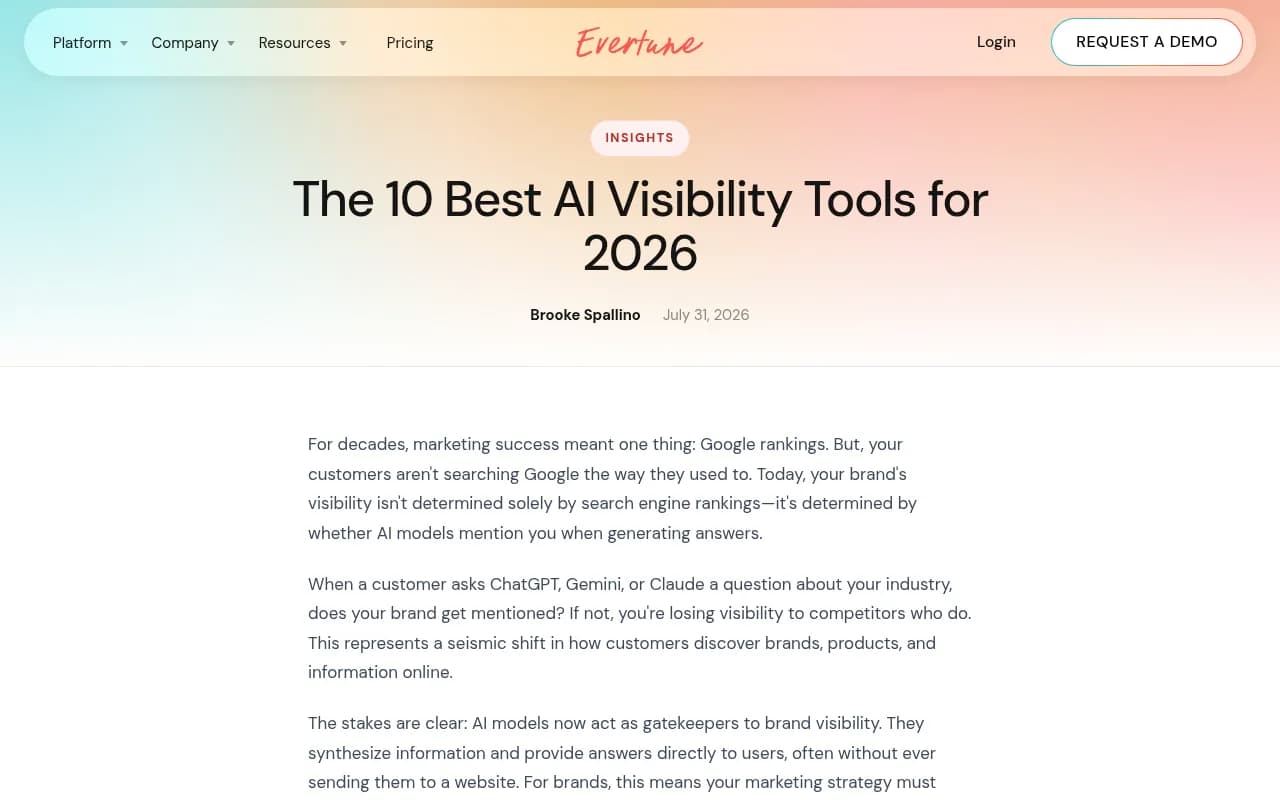
The screenshot above is a good reminder of the bias issue: it is Evertune's own list, and it names Evertune the top pick.
Brandlight
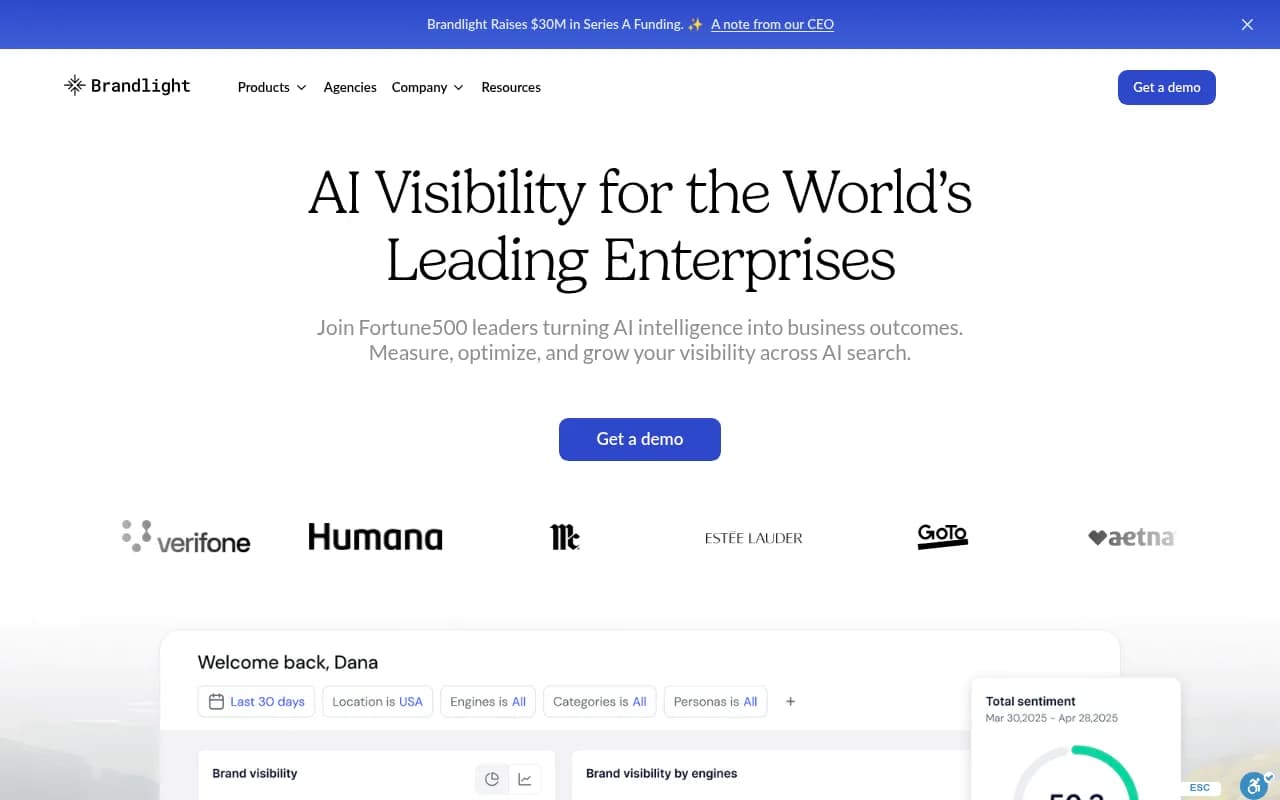
Brandlight is the odd one out, and deliberately so. It targets Fortune 500-class, multi-brand, multi-market organizations and sells a platform plus a services layer: AI strategists and forward-deployed engineers who execute alongside a lean team. There is no free trial. Engagements typically begin with a paid 3-month pilot.
What the vendor says it does
- A See, Shape, Act loop in one data layer covering owned, third-party, social, retail, paid and agentic-commerce surfaces
- Pre-built, funnel-tagged prompt sets built from licensed AI-panel data and search signals, so you do not have to pick prompts
- Prescriptive recommendations (fix this page, create this content, partner with this publisher) tied to source data
- A multi-agent content workflow that enforces brand and legal rules and routes drafts to your CMS for review. It does not auto-publish.
- Closed-network processing, so your data is not shared back with external model providers
Its headline proof point is a Kimberly-Clark engagement where it reports moving 12 of 12 brands into the top three across major LLMs, plus 100% paid-pilot-to-annual conversion and zero enterprise churn. Those are all self-reported.
What I could not verify
The research turned up inconsistencies worth knowing about:
- Brandlight's own article lists seven engines, while elsewhere it reports tracking 13.
- The "100M+ AI answers analyzed" and "CB Insights Leader" claims come from Brandlight's own pages.
- An agency comparison on Profound's blog says Brandlight tracks the fewest engines of the tools it lists and has the shortest track record.
- I found no independent pricing and no independent security documentation.
That does not make the product bad. It means the diligence burden is on you. Ask for the SOC 2 report, the engine list, and a reference customer in your vertical before the pilot starts.
One claim from Brandlight's research is worth testing in your own category: that roughly 85% of sources AI cites for category questions are third-party or social. Promptwatch Data's social media citations by AI model report points the other way for ChatGPT specifically, with just 0.46% of its citations coming from social platforms between Sep 28 and Oct 4, 2026, versus 12.2% for Google AI Overviews. Third-party sources still matter, but the mix depends heavily on the engine, which is another reason to demand per-engine reporting.
Head-to-head on what actually matters
Data collection
Profound leans on front-end capture and server logs. Evertune leans on high-volume sampling and a panel, with API access for base models. Brandlight leans on licensed panel data for prompt selection and its own source typing. None of these is automatically right. Ask each vendor how many times a prompt is sampled, in which interface, in which country, and how they handle the run-to-run variance that makes single-day snapshots noisy.
Action and execution
This is where the three really diverge.
| Question | Profound | Evertune | Brandlight |
|---|---|---|---|
| Who does the work? | Your team plus agents | Your team plus agents and partners | Brandlight's team plus your stakeholders |
| Publishes content? | Via agents with approval; CMS nodes such as AEM | Content Studio exports Markdown/HTML | Routes drafts to your CMS for review |
| Paid AI placement | OpenAI Ads nodes | Ads Agent for ChatGPT campaigns | Not a headline feature |
| Crawler log analytics | Yes (Agent Analytics) | Bot Analytics on Enterprise | Not confirmed in the research |
Security and compliance
Profound publishes the most: SOC 2 Type II, an independent HIPAA assessment, SSO/SAML, audit logging and AES-256 encryption. Brandlight describes an enterprise-grade posture built for SOC 2-level review, but I could not verify certificates. Evertune advertises none publicly, according to a competitor. If you are in finance, healthcare or another regulated sector, this row may decide the shortlist before features do.
Price transparency
Profound is the only one with public entry tiers. Evertune and Brandlight are sales-led. Budget for a pilot either way.
Which one should you pick?
- You have an in-house AEO or SEO team and want self-serve depth, crawler analytics and agent workflows: Profound.
- You are an agency running AEO for many clients: Profound's Agency Mode is built for it, though also look at tools aimed at agencies in the directory at bestgeosoftware.com.
- You care most about how models describe your brand and want statistical confidence, or you plan to buy AI ads: Evertune.
- You are a multi-brand enterprise with a thin team and need someone to coordinate PR, retail, social and content: Brandlight.
- You work in a regulated sector and need paper proof now: start with Profound, and push the others for documents.
A fair pilot checklist
- Give all vendors the same 50 to 100 prompts, plus 3 competitors, in the same countries.
- Ask each to show raw answers, not only scores, so you can spot-check against the real ChatGPT, AI Overviews and Perplexity interfaces.
- Ask how often each prompt is sampled and how variance is handled.
- Request the security documents and the exact list of engines and whether each is UI-based or API-based.
- Define a success metric up front, such as visibility change on 10 priority prompts after 90 days, plus any AI referral traffic you can see in your analytics.
- Ask each vendor to show how platform activity connects to citations, referral traffic and revenue, and how they separate correlation from causation. Nobody has this fully solved.
Other platforms worth a look
If none of the three fits, the field is wide. Promptwatch is the option I would add to a shortlist if you want monitoring and the execution loop in one product. Promptwatch pairs real-UI tracking with IP-verified AI crawler logs, visitor analytics and a Content Agent that writes and publishes against your visibility gaps, at published prices starting at $95/month.

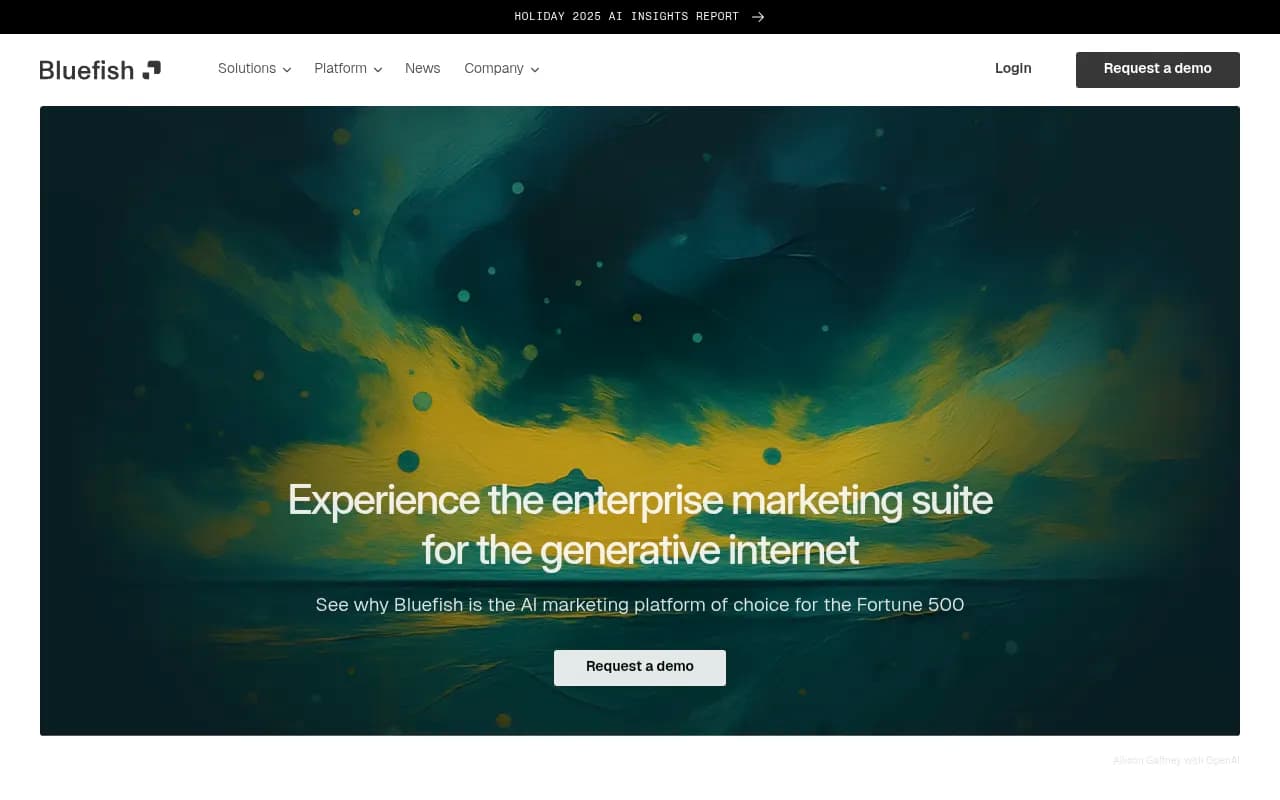
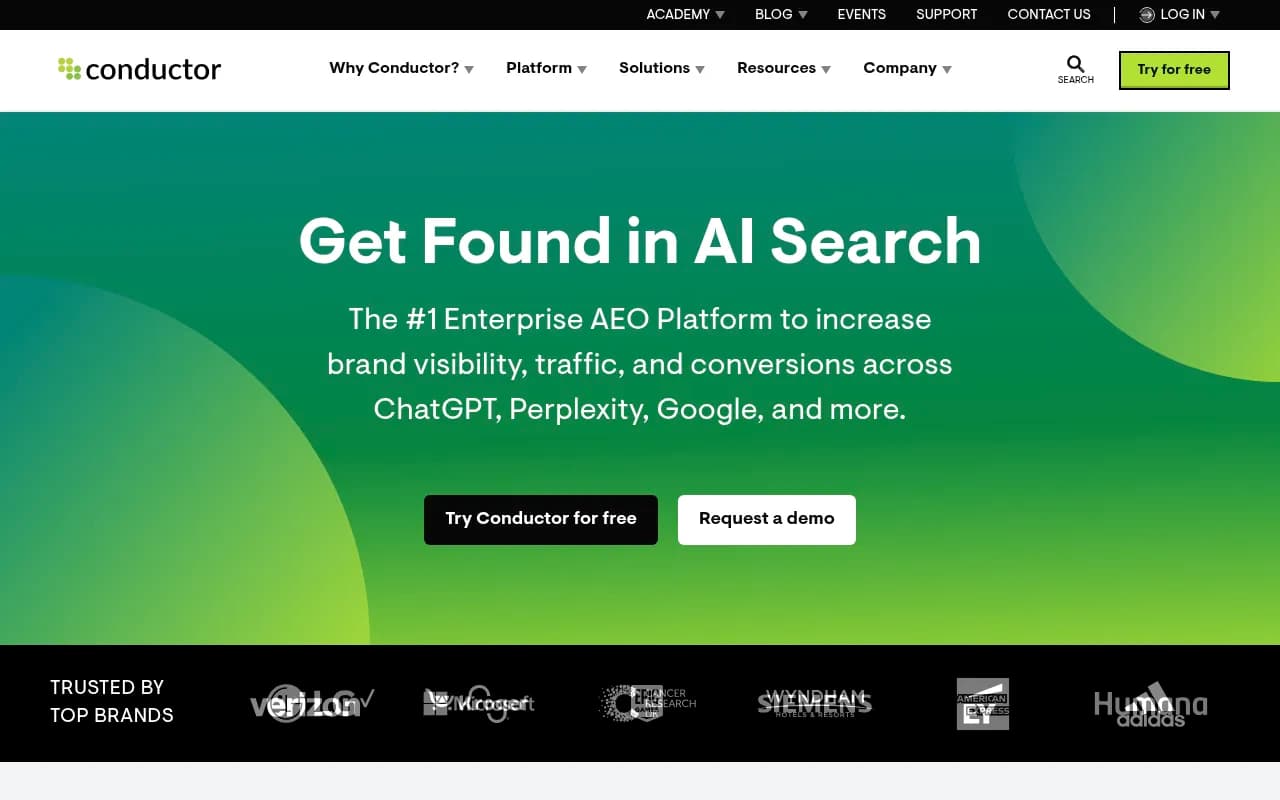
Other enterprise-leaning names in our catalog include Bluefish, Scrunch AI and Conductor:
For budget-conscious teams, Peec AI and Otterly.AI are the usual starting points:


For a wider view of options, browse the GEO software directory at bestgeosoftware.com or the AI rank tracking directory at ai-rank-tools.com.
Bottom line
Pick by operating model first and features second. Profound is a tool your team runs. Evertune is a measurement and advertising system with strong statistics. Brandlight is a service-heavy partnership for large, multi-brand organizations. Run a short, identical pilot, demand raw answers, and treat every vendor-authored comparison, including the ones cited here, as a sales document.