Key takeaways
- A visibility score tells you that AI isn't naming you. Crawler logs, audits, and page-level citation data tell you why.
- An engine can't cite a page it never fetched, so check crawler access before you rewrite anything.
- Promptwatch, Profound, Scrunch, and Frase all offer some log or page-level view. Many cheaper trackers only report prompts and mentions.
- Entry pricing on Profound ($99 for one engine, 50 prompts, one seat) pushes many teams to look elsewhere, but price is the weaker reason to switch. Diagnostic depth is the stronger one.
- A simple order of operations: logs first, then audit, then page-level citations, then content.
Why a score isn't a diagnosis
I've watched a lot of teams open an AI visibility dashboard, see a number that is lower than a competitor's, and then not know what to do on Monday morning. The number is real. It just isn't actionable.
The core mechanic behind most trackers is the same: schedule prompts, store responses, draw a chart. That is why there are dozens of tools in this category and why so many feel interchangeable. What separates them is whether they can explain a miss.
There are four reasons AI might not cite you, and each needs different evidence:
- The crawler never reached the page (robots.txt, CDN or WAF rules, errors, timeouts).
- The crawler reached it, but the page is thin, outdated, or structured poorly.
- The page is fine, but a competitor or a third-party source answers the question better.
- The page ranks in Google and Bing but simply isn't what AI retrieves for that prompt.
A tracker that only logs mentions can't separate these. Crawler logs cover the first. Audits cover the second. Page-level citation data covers the third and fourth.
Where Profound fits, and why people look elsewhere
Profound is a genuinely strong product. It was early, it has real-user prompt volume data, front-end response capture, an Amazon Rufus shopping module, and it now has a Pages view that combines citations, bot activity, and page health. Its entry tier is $99 and covers a single engine with 50 prompts and one seat. Perplexity and Google AI Overviews reportedly push you to $399, and the Growth tier caps prompts at 100 with three seats. Broader model coverage is enterprise-priced.

So the two usual complaints are cost curve and breadth. Both are fair. But if you're shopping for an alternative, I'd frame the question differently: which tool shows me the evidence for why I'm missing, and what do I do with it?
What to look for: the diagnostic stack
Crawler logs
The most underrated data source in this category. Server or CDN logs show which AI bots hit which URLs, what status codes they got, and how often. Promptwatch's own data illustrates why this matters. In its AI crawler traffic report (weeks of June 8 to September 6, 2026), OpenAI accounted for 79.8% of verified AI crawler requests in the week of August 31 to September 6, down from 94.8% in the week of June 8 to 14. The mix is shifting, and Anthropic, Google, Perplexity, and Mistral take up the rest.
The report also gives a practical test. Compare your own logs to that mix. If a provider is a large share overall but close to zero in your logs, you are probably blocked or unreachable for that provider. Then check robots.txt, CDN, and WAF rules for each one. One caveat from the same report: a provider's share can be training traffic, answer-time fetches, or both, so look at which bot inside the provider is doing the work.
IP verification matters too. User agents are trivially spoofed, so logs that match requests against the operator's published IP ranges are far more trustworthy than raw user-agent counts. Promptwatch's crawler fetch data on Meta-WebIndexer is a good example of why: that one bot went from about 2% to nearly 38% of tracked AI crawler requests between mid-July and August 9, 2026. If you weren't watching logs, you'd never have known.
Site audits
If the crawler arrives and the page still doesn't get cited, look at the page. Good audits flag broken links, orphaned pages, pages missing from the sitemap, duplicate titles, stale content, and thin copy. They're not glamorous. They're also where a surprising share of the fixes live.
Page-level citation data
Domain-level share of voice hides the interesting part. You want to know which URLs get cited, for which prompts, how long they stay cited, and which pages rank in Google or Bing but never appear in AI answers. That last query is the quickest way to find your biggest content gap.
There's data on why this decay matters. Promptwatch's content half-life report tracked every page ChatGPT cited on July 6, 2026 for 90 days. Landing pages and docs stayed cited longest, while news lost half its pages within 36 days. A page-level view lets you see decay before it costs you.
Comparison: tools that explain the miss
This is my read of the diagnostic depth of each option, based on vendor-published material. Verify current features and pricing on each vendor's site before you buy.
| Tool | Crawler logs | Site audit | Page-level citations | Content workflow |
|---|---|---|---|---|
| Promptwatch | IP-verified logs via Cloudflare, Vercel, Fastly, WordPress, raw logs | Weekly, 21 checks | Yes, with Page Tracker and 360 Insights | Content Agent, Action Board, CMS publishing |
| Profound | Agent Analytics, Cloudflare integration | Page health in Pages view | Yes | Agentic projects, approval before publish |
| Frase | AI crawler log | On-page checks | Citation tracking | Research, drafting, publishing, Content Guard |
| Scrunch | Audits how AI agents read your site | Agent-read audits | Yes | Page optimizations metered by plan |
| Ahrefs Brand Radar | No | Separate Ahrefs audit | Per-URL AI responses | None |
| Peec AI / Otterly.ai | Limited or none | Limited | Prompt-level citations | None |
The alternatives, in practice
Promptwatch
Promptwatch is the one I'd start with if the question is specifically "why aren't we cited?", because it puts the evidence in one place. The IP-verified crawler logs show which AI bots read which pages, which errors they hit, and a crawl-to-citation path with a citation rate per page. Spoofed bots are filtered out. Weekly site audits run 21 checks, and the page-level layer overlays Google Search Console and Bing data with AI crawls and citations. That makes the "ranks in Google, never cited by AI" question answerable in a couple of clicks.

The difference from a pure tracker is what happens next. The Action Board turns the findings into a prioritized to-do list, and the Content Agent can plan, write, and publish pages against the gaps to WordPress, Webflow, or Framer, then track whether those pages get crawled and cited. Plans start with a free Explore tier (ChatGPT only), and paid plans begin at $95 a month. Confirm current pricing at promptwatch.com/pricing. Business ($579) adds the Content Agent and local targeting. For comparison, the entry price lands close to Profound's but includes all models, site audit, and crawler analytics tiers on the paid plans.
Frase
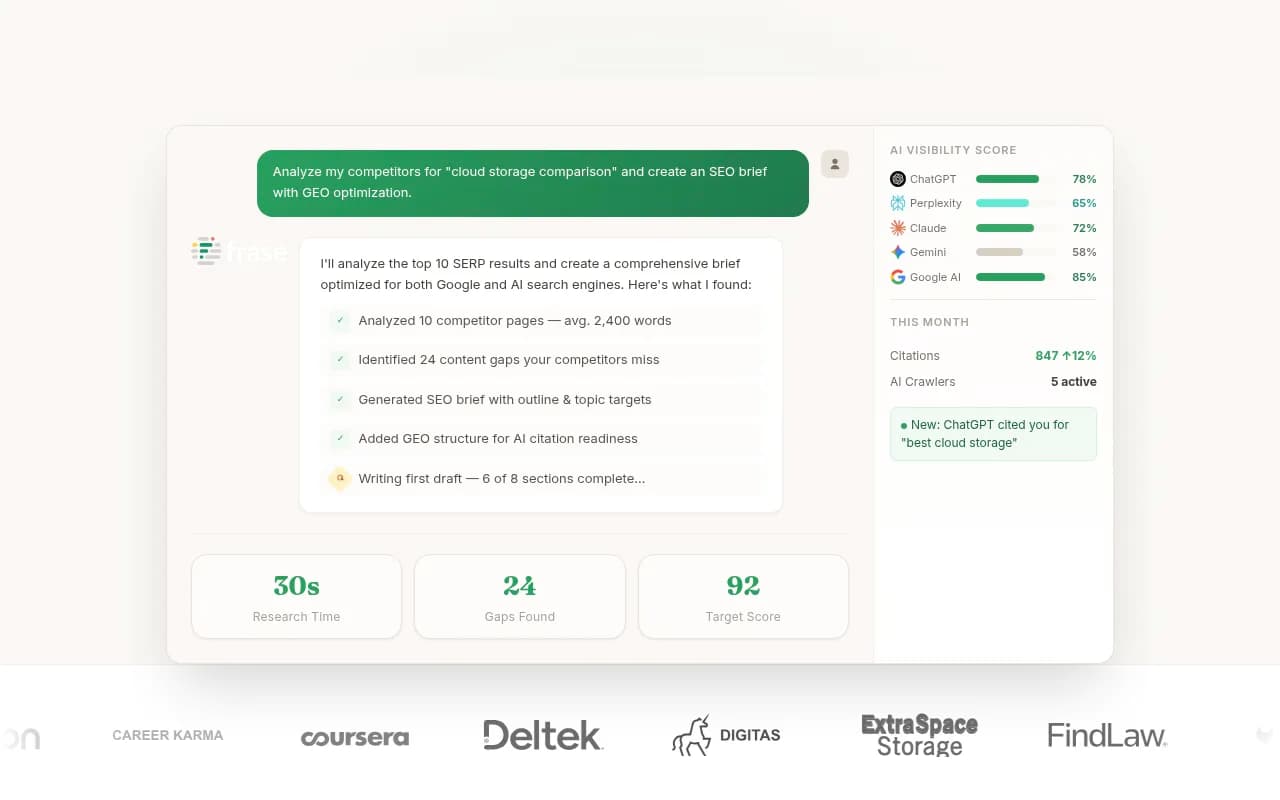
Frase leads its own Profound-alternatives ranking, and it deserves a look if you want tracking and content work in a single tool. Its AI crawler log shows which crawlers reached which pages, and Content Guard watches published pages via Search Console for ranking and traffic decay, then drafts corrections. It's strongest for teams who already live in an SEO writing workflow.
Scrunch
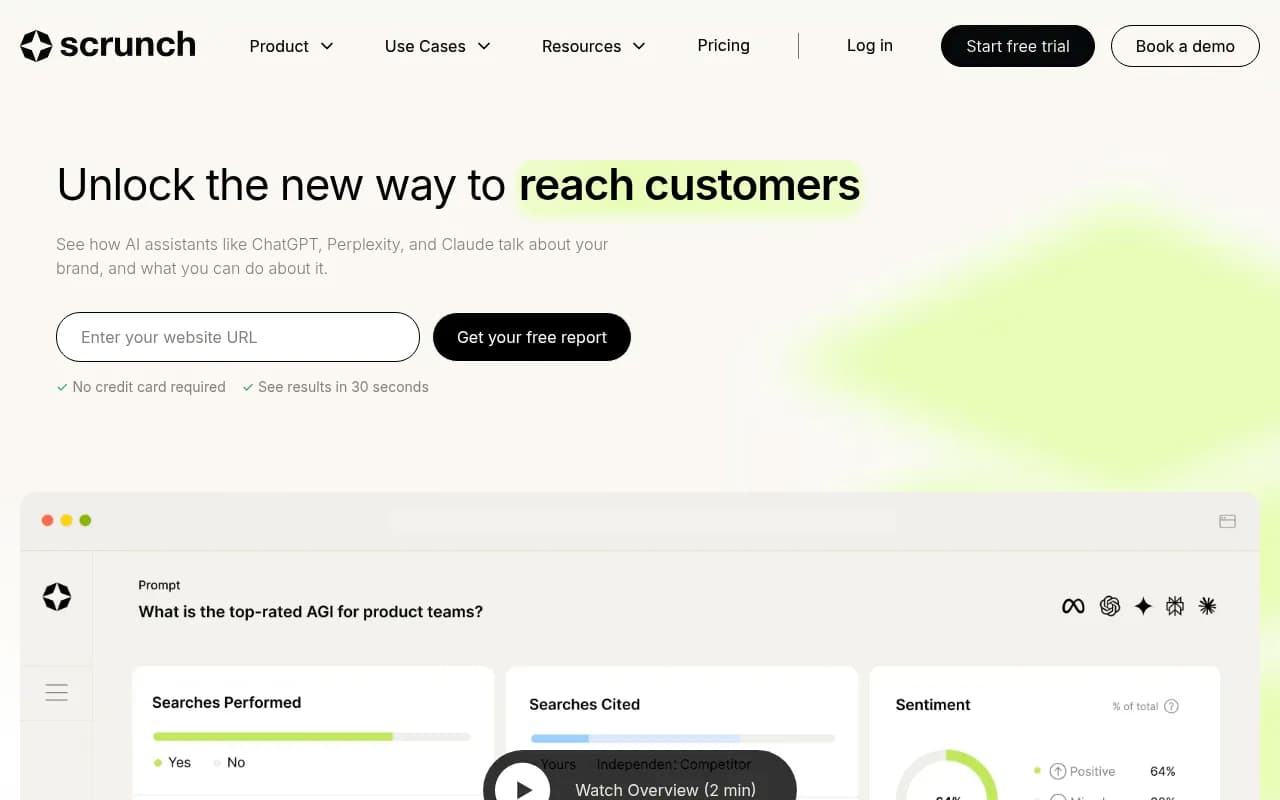
Scrunch watches brand presence and audits how AI models crawl and describe your pages. It sells an Agent Experience Platform at Enterprise level for teams who treat AI agents as their own audience. If your worry is that agents misread your site rather than skip it, this angle is useful.
Ahrefs Brand Radar
Brand Radar's pitch is data architecture. Its prompts come from real search data, specifically People Also Ask questions with measurable volume behind them, rather than hypothetical prompts someone invented. It also lets you pull every AI response citing a specific URL. The trade-off is that you pay for the broader Ahrefs ecosystem, and it doesn't give you AI crawler logs.
Peec AI and Otterly.ai
Both are cheaper, cleaner trackers. Otterly is among the lowest-cost paid options for mentions and citations across the major engines. If all you need is a cited-or-not signal, they're fine. If you need to explain a miss, expect to pair them with logs and an audit from somewhere else.


Other log and audit options worth knowing
DarkVisitors specializes in tracking AI agents, bots, and LLM referrals visiting your site, which makes it a lightweight way to get bot visibility without a full platform.
If you want a classic technical crawl alongside, Screaming Frog and Sitebulb cover the on-site health side that AI-specific tools sometimes skim.
For more options in this category, the GEO software directory lists far more tools than fit here.
A free manual route
You can get partway without paying. Bing Webmaster Tools added an AI Performance report in public preview in February 2026, showing total citations, average cited pages, page-level citation counts, and a visibility trend across Microsoft Copilot and Bing's AI summaries. Combine that with your own server logs, a robots.txt review, and manual spot checks of your target prompts. It's slow, and it only covers one ecosystem, but it teaches you what the paid tools are automating.
A diagnostic workflow you can run this week
Step 1: read the logs before you rewrite
Pull 30 days of logs. Filter for verified AI crawlers. For each major provider, check whether your key pages were fetched at all. If a page has zero AI crawler visits, the copy isn't the problem yet. Fix access first: robots.txt, CDN bot rules, WAF challenges, and JavaScript-only rendering.
Step 2: check status codes
A crawler that visits and gets a 403, 429, or 5xx is the same as one that never came. Plain-language crawl failure explanations, which some platforms provide, save real debugging time.
Step 3: audit the pages that were fetched but not cited
Run a site audit on those URLs. Look for thin content, missing headings, stale dates, duplicate titles, and orphaned status.
Step 4: compare against what does get cited
Promptwatch's citation data shows what ChatGPT favors. Product pages are the most cited content type at 22.4% of citations (September 28 to October 4, 2026, per Promptwatch Data), followed by landing pages and listicles. Almost half of ChatGPT responses cite 10 or more unique domains (Promptwatch Data), so there's usually room for a well-matched page. If your page type doesn't match what gets cited for that prompt, that's your fix.
Step 5: look at fan-outs
ChatGPT rewrites a prompt into several web searches. Promptwatch's data shows that on August 8, 2026 ChatGPT began using the site: operator at scale, jumping from about 0.4% to about 17% of fan-out queries (report). If your page doesn't match the sub-queries, it won't be retrieved however good it is.
Step 6: publish, then verify
After you fix something, confirm that crawlers return, then see whether citations follow. Without that loop you're guessing.
Which one should you pick?
- Want the full stack from logs to published fix: Promptwatch.
- Already deep in Profound and just want cheaper breadth: look at Promptwatch, Peec AI, or Otterly.ai.
- Writing-heavy team that wants tracking inside a content tool: Frase.
- Worried about how agents interpret your site: Scrunch.
- Already an Ahrefs shop: Brand Radar, plus a separate log source.
- Budget of zero: Bing's AI Performance report plus your own logs.
If you'd rather hand the whole thing to specialists, 1001 SEO Media runs this kind of diagnostic work for clients as part of its GEO and technical SEO services.
The tool matters less than the habit. Check whether the bot could read the page before you decide the page is bad. Most teams skip that step, and it's the cheapest one.
For more rank-tracking options, see the AI rank tracker directory.