Key takeaways
- Peec.ai is a clean, accessible entry point for AI visibility tracking, but it's primarily a monitoring tool with limited optimization capabilities
- Most teams hit its ceiling when they need multi-engine coverage, content gap analysis, or agency-scale workflows
- The best alternatives split into two camps: monitoring-focused tools (good for data) and full optimization platforms (good for actually improving your visibility)
- If you want to go beyond dashboards and start fixing what's broken, look for tools with content generation, citation analysis, and crawler log access
- Promptwatch is the only platform in this space rated as a "Leader" across all categories in a 2026 comparison of 12 GEO platforms
Peec.ai had a good run as an early mover. When AI search visibility was still a niche concern in early 2025, it was one of the few tools that let marketers see how their brand appeared in ChatGPT, Perplexity, and Google AI Overviews. The dashboard was clean. Setup took minutes. For a lot of teams, it was the first time they'd ever seen their AI search presence quantified.
But "first tool you tried" and "best tool for the job" are different things. As AI search matured through 2025, the gaps in Peec.ai became harder to ignore: prompt ceilings on lower plans, limited engine coverage, and -- most critically -- no real path from "here's your data" to "here's how to improve."
This guide covers 10 alternatives that went further. Some are better monitors. Some are full optimization platforms. A few do things Peec.ai never attempted.

What Peec.ai actually does well (and where it falls short)
Before dismissing it entirely: Peec.ai is genuinely good at what it does. Multi-language tracking, a simple prompt setup, and solid Google AI Overview monitoring made it a reasonable starting point. Teams in the r/SEO community and LinkedIn circles praised it for accessibility.
The recurring complaints, though, were consistent across 2025:
- Costs scaled badly for large prompt sets
- Engine coverage was limited compared to newer entrants
- Results accuracy varied across industries
- There was no content optimization layer -- you could see where you were invisible, but the tool wouldn't help you fix it
- Agency workflows (client workspaces, white-label reports) were underdeveloped
That last point is the real dividing line. Monitoring tells you what's happening. Optimization tells you what to do about it. Most Peec.ai alternatives in 2025 fell into one of those two camps -- and the best ones bridged both.
The 10 alternatives worth knowing
1. Promptwatch -- best for full-cycle AI visibility optimization
Promptwatch is the most complete platform in this space, and the gap between it and pure monitoring tools is significant. Where Peec.ai shows you a visibility score, Promptwatch shows you the score, explains why it's low, and then helps you create content to fix it.
The core workflow: Answer Gap Analysis identifies which prompts your competitors rank for but you don't. The built-in AI writing agent then generates articles, listicles, and comparisons grounded in citation data from 880M+ analyzed citations. You publish, track the results at the page level, and watch your visibility scores move. That loop -- find gaps, create content, measure improvement -- is what separates it from every monitoring-only tool.
Other standout features: real-time AI crawler logs (see exactly which pages ChatGPT, Claude, and Perplexity are reading on your site), ChatGPT Shopping tracking, Reddit and YouTube citation analysis, prompt volume and difficulty scoring, and competitor heatmaps across 10 AI models. It also integrates with Looker Studio and Google Search Console for traffic attribution.
Used by 6,700+ brands including Booking.com and Center Parcs. Starts at $99/month.

2. Scrunch AI -- best for brand narrative monitoring
Scrunch sits at the premium end of the market, and its differentiator is brand safety. It doesn't just track whether you appear in AI responses -- it analyzes how you're described, detects hallucinations (false claims AI models make about your brand), and maps customer journeys through AI interactions.
The GA4 integration is genuinely useful: you can connect AI visibility data to actual traffic and conversion metrics, which most tools can't do. Engine coverage is broad, including ChatGPT, Claude, Perplexity, Gemini, Google AI Overviews, AI Mode, and Meta AI.
For enterprise teams worried about brand misinformation in AI responses, Scrunch is probably the most serious option available. The price reflects that.
3. Profound -- best for entity-driven SEO teams
Profound focuses on precision: entity extraction, attribution mapping, and AI Overview tracking with more granularity than most tools offer. If your SEO strategy is built around entity optimization and topical authority, Profound's approach aligns well with that workflow.
It's particularly strong for teams that want to understand why AI models cite certain sources -- not just whether they cite yours. The competitor presence monitoring is detailed, and the pricing starts at $99/month, making it accessible for mid-size teams.

4. AthenaHQ -- best for multi-engine analysts
AthenaHQ tracks across 8+ AI engines and positions itself as a competitive intelligence platform for brands competing in AI-native search. The multi-engine coverage is genuinely comprehensive, and the interface is built for analysts who want to slice data by engine, prompt type, and competitor.
The limitation: like most tools in this space, AthenaHQ is primarily a monitoring platform. It shows you where you stand but doesn't generate content or provide optimization workflows. Starting price is $295/month, which is on the higher end for what's essentially a tracking tool.

5. SE Visible -- best for marketing leaders who want strategic context
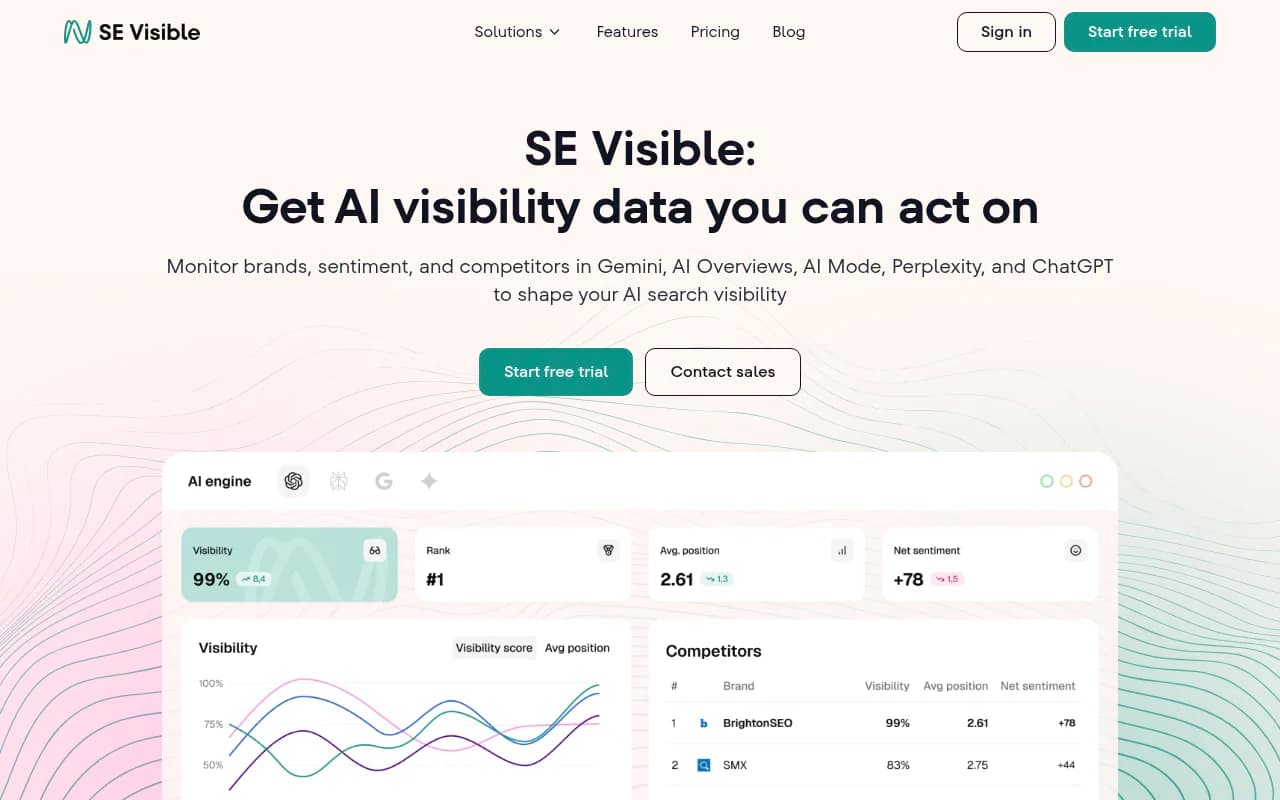
SE Visible (from SE Ranking) takes a different angle than most visibility tools. Rather than raw prompt-level data, it's built around strategic reporting: share of voice, competitor benchmarking, and sentiment analysis across AI responses.
The target audience is CMOs and marketing leaders who need to present AI visibility data to stakeholders, not just SEO practitioners who want to dig into prompt-level metrics. The $189/month starting price is reasonable for what it offers, and the SE Ranking pedigree means the underlying data infrastructure is solid.
6. Otterly.AI -- best affordable entry point
If Peec.ai felt expensive for what it delivered, Otterly.AI is worth a look. It's one of the more accessible tools in the space, with a straightforward interface and coverage across the main AI engines.
The honest caveat: Otterly.AI is a monitoring tool, full stop. No content generation, no crawler logs, no citation analysis beyond the basics. But for small teams or solo marketers who just need to know where they stand in ChatGPT and Perplexity without a complex setup, it does the job without overcomplicating things.

7. Rankscale AI -- best for rank-focused tracking
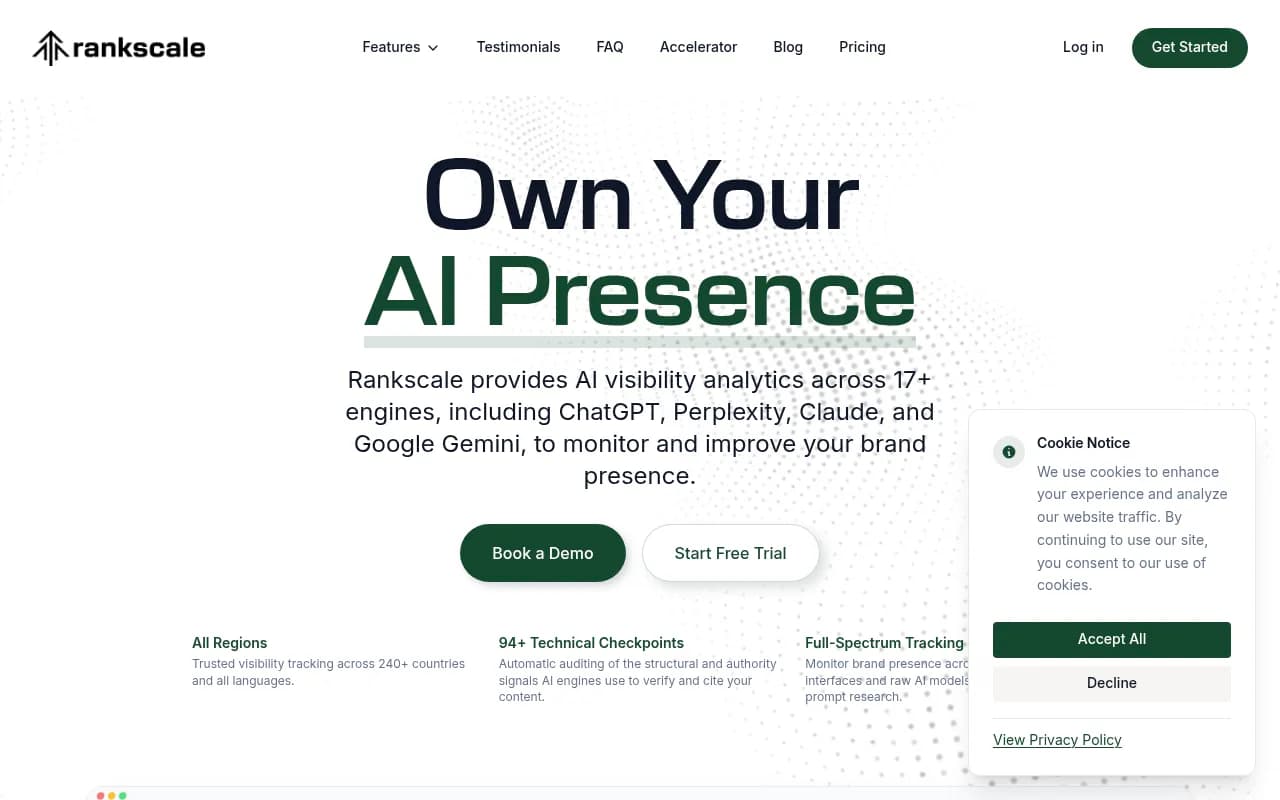
Rankscale AI approaches the space from a traditional rank-tracking mindset applied to AI search. If your team is already comfortable with rank tracking workflows and wants to extend that to AI engines, the mental model here is familiar.
It tracks position-style metrics across AI responses, which makes it easier to report on progress in terms your stakeholders already understand. Less suited for teams that want deep content optimization or citation analysis, but a reasonable fit for teams transitioning from traditional SEO reporting.
8. Writesonic -- best for content-forward teams
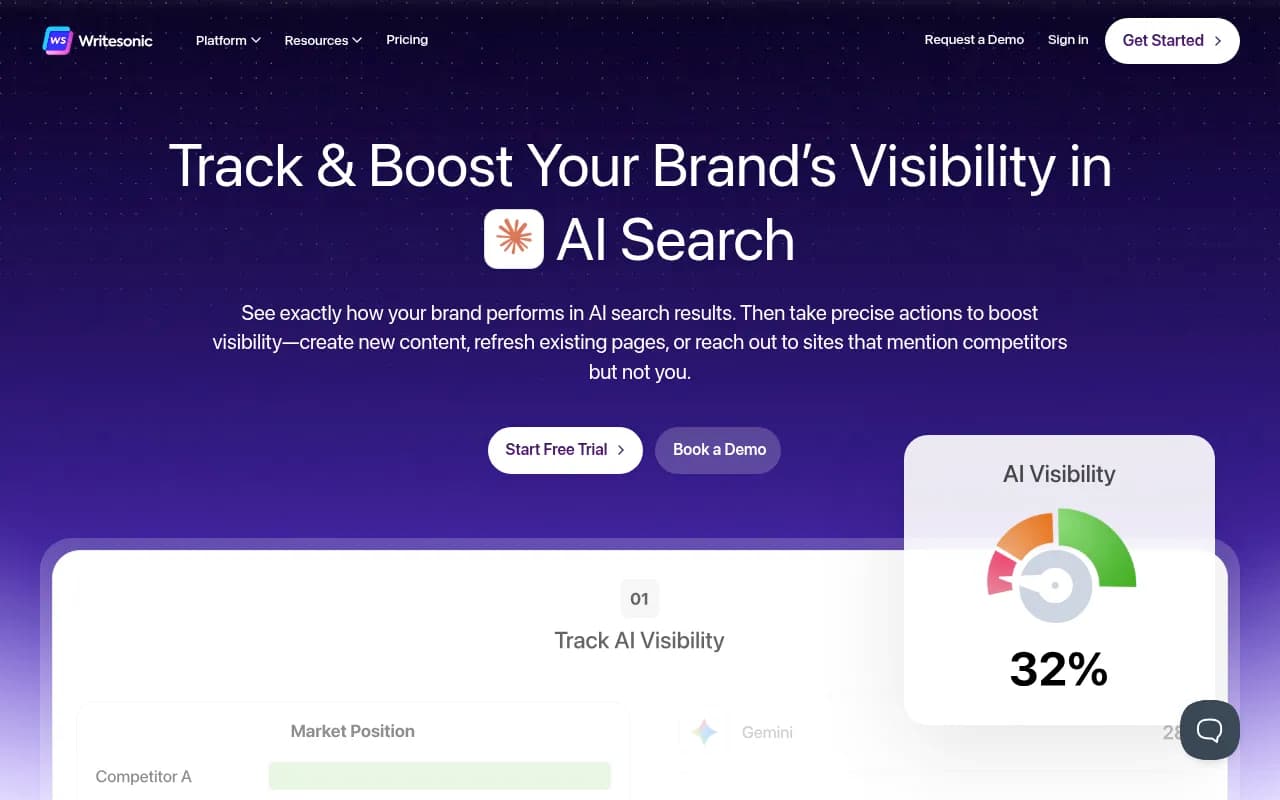
Writesonic expanded from AI writing into GEO and AI visibility tracking, which gives it an interesting angle: the content creation and the visibility tracking live in the same platform. If your team is already using Writesonic for content, the AI visibility layer is a natural extension.
The tracking covers ChatGPT, Google AI Mode, Gemini, Perplexity, and Claude, and the optimization workflows are more developed than most pure-monitoring tools. Starting at $199/month, it's positioned for enterprises and agencies focused on improving citations, not just measuring them.
9. LLMrefs -- best affordable on-ramp for small teams
LLMrefs is one of the more budget-friendly options for teams that need basic AI visibility tracking across ChatGPT, Perplexity, and a handful of other engines. The feature set is lean -- this isn't a platform for deep competitive analysis -- but the price point makes it accessible for startups and small businesses that want to dip their toes in without committing to a $200+/month platform.
Think of it as a step up from manually querying AI engines yourself, without the overhead of an enterprise tool.
10. Rankability -- best for agencies
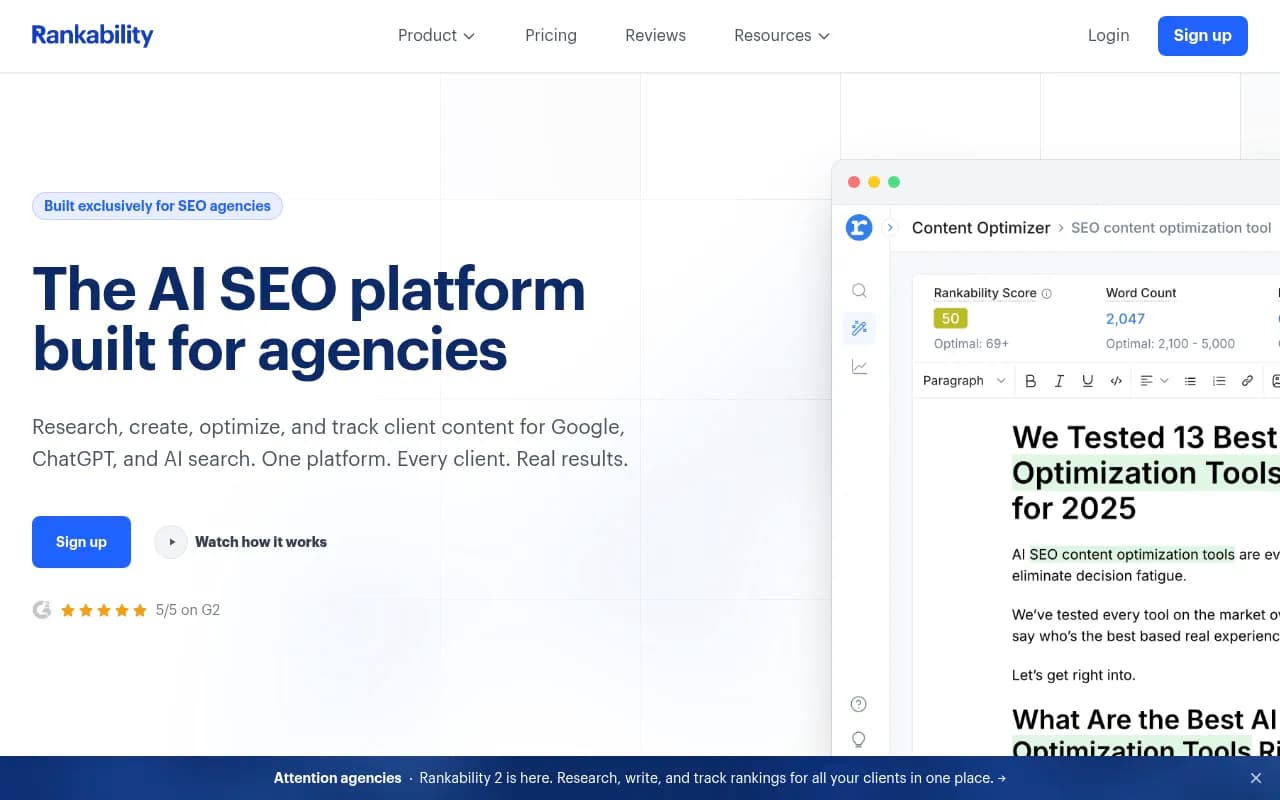
Rankability is built specifically for agencies managing multiple client accounts. The workflow is designed around client reporting, with white-label options and multi-client dashboards that Peec.ai never really addressed.
If you're an agency that got frustrated with Peec.ai's single-account focus, Rankability's structure will feel immediately more sensible. The AI visibility tracking is solid, and the agency-specific features (client workspaces, branded reports) are the main reason to choose it over more general-purpose tools.
How the tools compare
Here's a side-by-side view of the key dimensions that matter when choosing between these platforms:
| Tool | Engine coverage | Content generation | Crawler logs | Agency features | Starting price |
|---|---|---|---|---|---|
| Promptwatch | 10 engines | Yes (AI writing agent) | Yes | Yes | $99/mo |
| Scrunch AI | 7+ engines | No | No | Limited | Custom |
| Profound | Google AIO + others | No | No | No | $99/mo |
| AthenaHQ | 8+ engines | No | No | Limited | $295/mo |
| SE Visible | Multiple | No | No | Limited | $189/mo |
| Otterly.AI | Core engines | No | No | No | Low |
| Rankscale AI | Multiple | No | No | No | Varies |
| Writesonic | 5 engines | Yes (native) | No | Limited | $199/mo |
| LLMrefs | Core engines | No | No | No | Low |
| Rankability | Multiple | No | No | Yes | Varies |
| Peec.ai | Core engines | No | No | No | Varies |
The pattern is clear: most tools are monitoring dashboards. Promptwatch and Writesonic are the two platforms that combine tracking with content creation. Promptwatch goes further with crawler logs, citation analysis, Reddit/YouTube tracking, and ChatGPT Shopping -- features that don't exist elsewhere in a single platform.
How to choose the right one
The honest answer depends on what you're actually trying to do.
If you just want to know where you stand -- a quick read on your AI visibility across a few engines -- Otterly.AI or LLMrefs will get you there cheaply. Peec.ai itself might still be fine for this.
If you need strategic reporting for stakeholders and competitive benchmarking, SE Visible or AthenaHQ are built for that use case.
If you're an agency managing multiple clients, Rankability's structure makes more sense than most alternatives.
If you're worried about brand safety and AI hallucinations, Scrunch AI is the most serious option for that specific concern.
If you want to actually improve your AI search visibility -- not just measure it -- you need a platform with content optimization built in. That's a short list: Promptwatch and Writesonic are the main options, and Promptwatch covers more ground (crawler logs, citation analysis, 10 engines, ChatGPT Shopping tracking, prompt volume scoring).
The teams that got the most out of AI visibility tools in 2025 weren't the ones with the prettiest dashboards. They were the ones who used the data to create content, fix indexing issues, and close the loop between visibility and revenue. That requires more than a monitoring tool.
A note on the monitoring-only trap
One thing worth saying directly: a lot of teams spent 2025 collecting AI visibility data without doing much with it. The dashboards looked impressive in quarterly reviews, but the underlying visibility scores didn't move.
That's the monitoring-only trap. You can track your share of voice across 10 AI engines every week, but if you're not creating content to fill the gaps, fixing the pages AI crawlers can't read, or understanding which citations are actually driving traffic -- the data is just noise.
The tools that helped teams break out of that pattern were the ones that connected monitoring to action. Find where you're invisible. Understand why. Create content that fills the gap. Measure whether it worked. That's the cycle that moves the needle.
Most tools in this list handle step one. A few handle steps one and two. Only Promptwatch is built around all four steps as a single workflow.