Key takeaways
- Surfer SEO and Clearscope are built for Google rankings -- they're excellent content optimization tools, but they don't track or optimize for AI search engines like ChatGPT, Perplexity, or Gemini.
- Peec.ai monitors AI visibility across multiple LLMs but stops at reporting -- it doesn't help you create or optimize content to close the gaps it finds.
- Promptwatch is the only platform in this comparison that covers both the tracking side (AI citations, crawler logs, prompt intelligence) and the content creation side (AI-grounded content agents, answer gap analysis), making it the strongest choice if you want to rank in both Google and AI search.
- If your only goal is Google rankings, Surfer SEO or Clearscope are solid picks. If AI visibility matters at all, you need a different tool in the stack -- or a platform that handles both.
The question used to be simple: does your content rank on Google? Now there are two parallel search ecosystems to think about. Google still sends traffic. But ChatGPT, Perplexity, Claude, and Gemini are increasingly where people go first -- and those platforms don't return ten blue links. They return one answer, with a handful of citations if you're lucky.
So the real question in 2026 is: which tool actually helps you show up in both places?
This comparison looks at four platforms that come up constantly in SEO conversations: Peec.ai, Promptwatch, Surfer SEO, and Clearscope. They're not all trying to solve the same problem, which is exactly why the comparison is worth doing carefully.
What each platform actually does
Before getting into feature-by-feature comparisons, it helps to understand what category each tool belongs to. Two of these are content optimization tools. One is an AI monitoring tool. One is an end-to-end AI visibility and optimization platform. That distinction matters more than any individual feature.
Surfer SEO
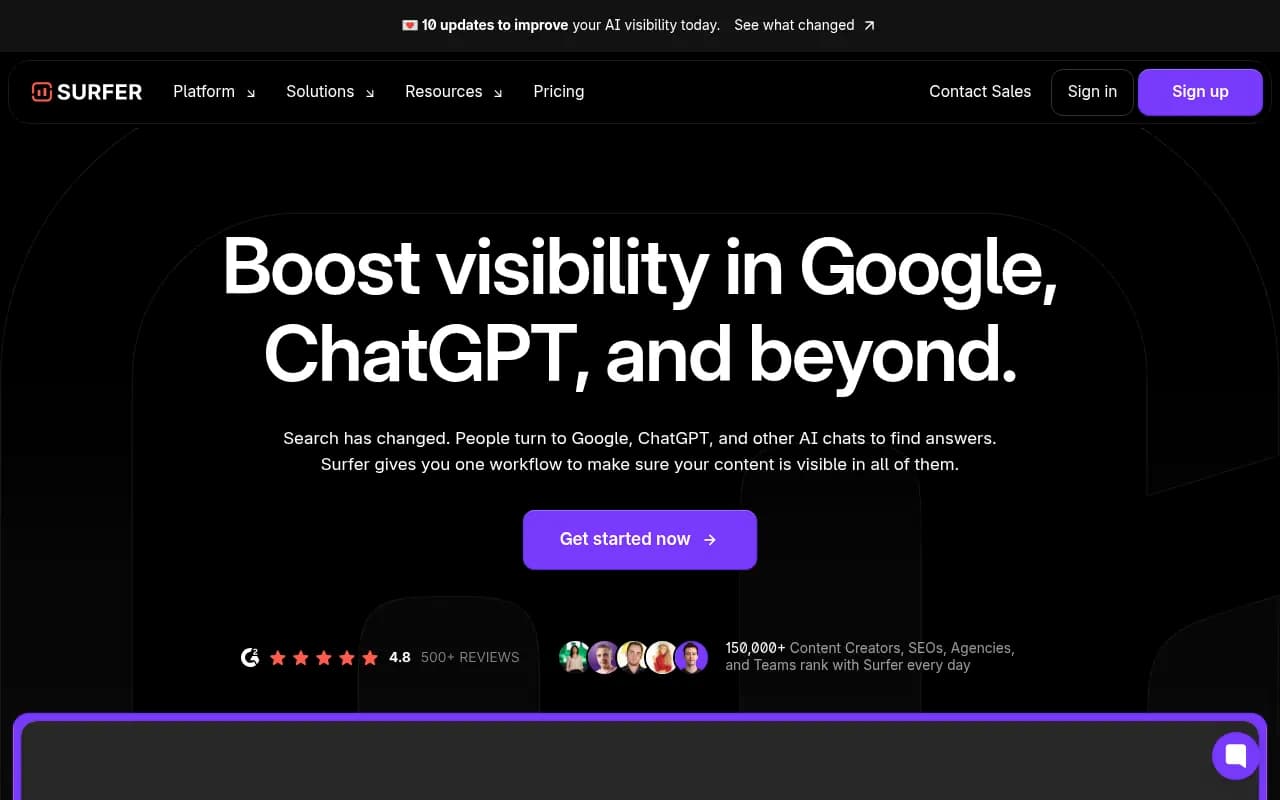
Surfer SEO is a content optimization platform built around Google rankings. It analyzes the top-ranking pages for a given keyword and tells you how to structure your content -- word count, heading usage, NLP terms to include, internal links, and so on. The Content Editor gives you a real-time score as you write. It's genuinely useful for on-page SEO.
Surfer has added some AI writing features over time, and it does surface data about Google AI Overviews in limited ways. But its core product is built around traditional SERP analysis. It doesn't track how ChatGPT or Perplexity respond to queries about your brand or topic. It doesn't show you which pages are being cited by AI models. It doesn't generate content specifically engineered to win AI citations.
Clearscope
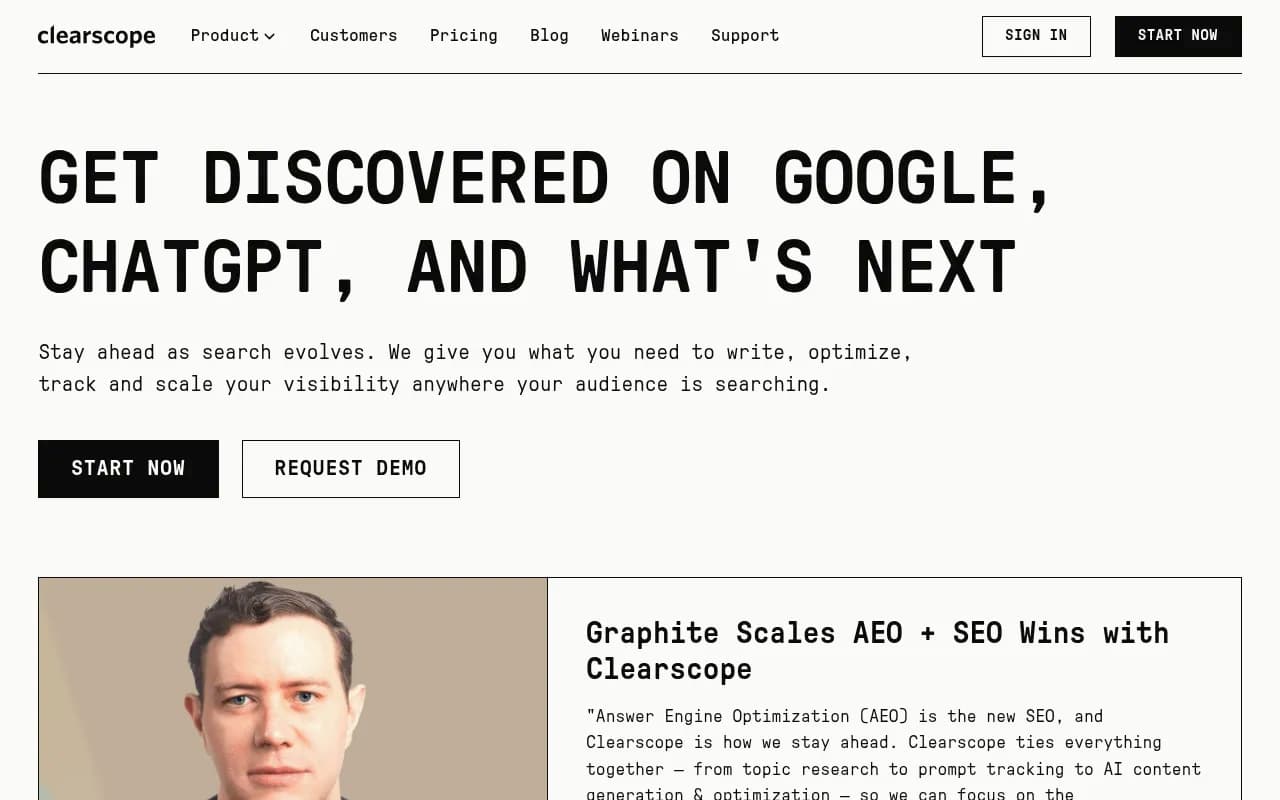
Clearscope takes a similar approach to Surfer but with a stronger focus on semantic relevance. It uses IBM Watson to score content against the top-ranking pages for a keyword, surfacing related terms and concepts that signal topical depth to Google. Editors love it because the interface is clean and the recommendations are easy to act on.
Like Surfer, Clearscope is fundamentally a Google optimization tool. It doesn't monitor AI search engines, doesn't track citations in LLM responses, and doesn't have any mechanism for understanding why ChatGPT might or might not recommend your content.
Peec.ai
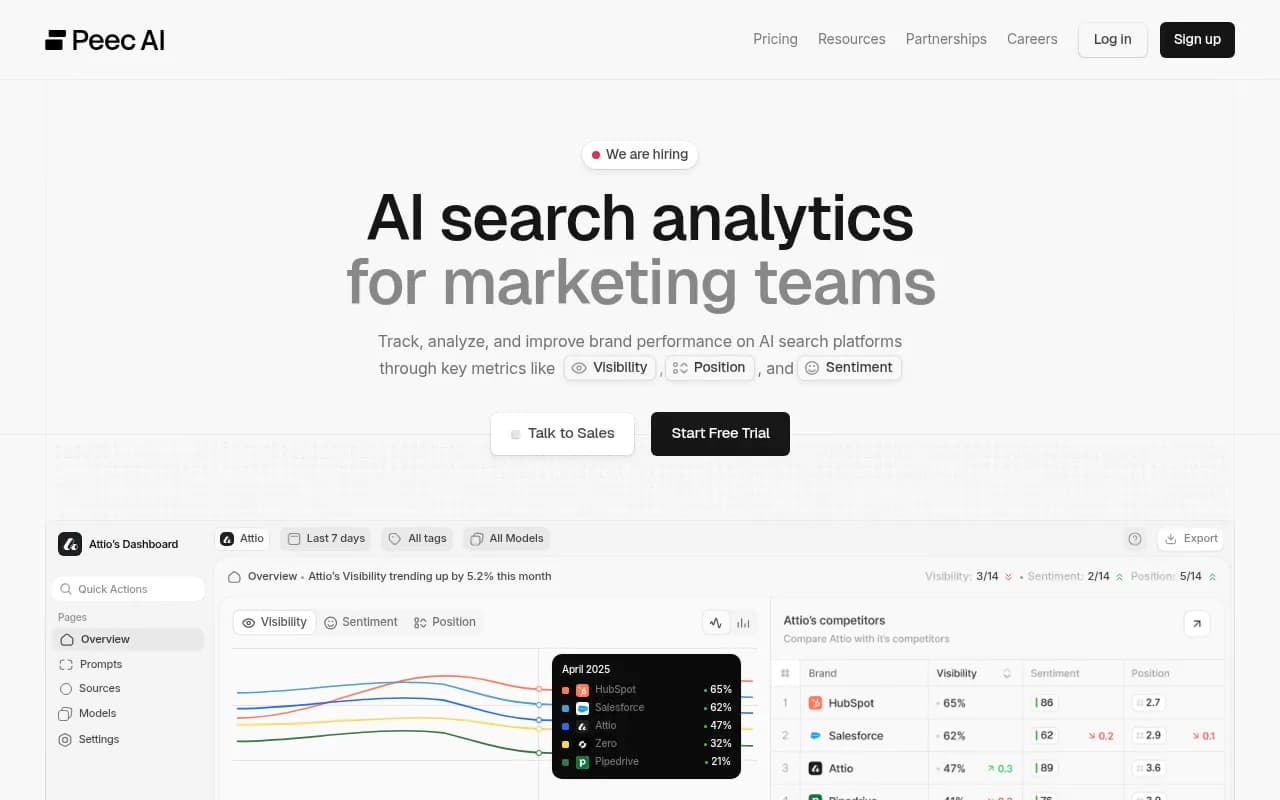
Peec.ai sits in a different category entirely. It's an AI visibility monitoring tool -- it tracks how your brand and competitors appear in responses from ChatGPT, Perplexity, Claude, Gemini, and other LLMs. It supports multiple languages, offers unlimited seats, and suggests prompts to track.
The limitation is that Peec.ai is primarily a monitoring dashboard. It shows you where you're visible and where you're not. What it doesn't do is help you fix the gaps. There's no content generation, no answer gap analysis that maps missing content to specific prompts, and no crawler log data to understand how AI agents are actually reading your site.
Promptwatch
Promptwatch occupies a different position. It monitors AI visibility across 10 LLMs (ChatGPT, Perplexity, Google AI Overviews, Google AI Mode, Claude, Gemini, Grok, DeepSeek, Copilot, and Mistral), but it doesn't stop there. The platform is built around a loop: find the gaps, create content to fill them, track the results.
The Answer Gap Analysis shows you exactly which prompts competitors are getting cited for that you're not -- and what content your site is missing. Content Agents then generate articles, listicles, comparisons, and briefs grounded in real prompt data, citation data, and competitor analysis. Page-level tracking shows which pages are being cited, by which models, and how often. AI Crawler Logs show you when ChatGPT or Perplexity actually crawled your pages and whether they encountered errors.

Feature comparison table
| Feature | Surfer SEO | Clearscope | Peec.ai | Promptwatch |
|---|---|---|---|---|
| Google content optimization | Yes (core feature) | Yes (core feature) | No | Partial (via content agents) |
| AI search monitoring (ChatGPT, Perplexity, etc.) | No | No | Yes | Yes (10 LLMs) |
| Answer gap / citation gap analysis | No | No | Basic | Yes (detailed) |
| AI content generation | Yes (basic) | No | No | Yes (prompt-grounded) |
| AI crawler logs | No | No | No | Yes |
| Prompt volume and difficulty scoring | No | No | No | Yes |
| Reddit / YouTube citation tracking | No | No | No | Yes |
| ChatGPT Shopping tracking | No | No | No | Yes |
| Page-level AI citation tracking | No | No | No | Yes |
| Traffic attribution from AI search | No | No | No | Yes |
| Multi-language support | Yes | Yes | Yes | Yes |
| Pricing (entry) | ~$89/mo | ~$170/mo | Custom | $99/mo |
The core problem: Google optimization ≠ AI visibility
Here's what makes this comparison tricky. Surfer SEO and Clearscope are genuinely good at what they do. If you're writing a blog post and want it to rank on Google, either tool will help you produce better content than you'd write without them. That's real value.
But the assumption baked into both tools -- that optimizing for Google's ranking signals will also get you cited by ChatGPT -- is increasingly shaky.
AI models don't rank content the way Google does. They don't care about keyword density or heading structure in the same way. They care about whether your content directly and clearly answers the question being asked. They care about whether your domain is cited by other sources they trust. They care about the freshness, specificity, and authority of the information. A page that scores 85 in Surfer's Content Editor might never appear in a Perplexity response if it doesn't address the specific angle that users are prompting about.
This is the gap that monitoring tools like Peec.ai surface -- and that Promptwatch is built to close.
Who should use what
If you're focused purely on Google rankings
Surfer SEO and Clearscope are both solid choices. Surfer has a more comprehensive feature set (SERP analysis, internal linking, topical maps) while Clearscope has a cleaner editor experience that writers tend to prefer. Neither will help you with AI search, but if that's not on your roadmap yet, they do their core job well.
If you want to monitor AI visibility without a big budget
Peec.ai is worth looking at for basic monitoring. It covers multiple LLMs, supports unlimited seats, and gives you a starting point for understanding where your brand appears in AI responses. The gap is that you'll need to figure out the content strategy yourself -- the tool won't tell you what to write or generate it for you.
If you want to rank in AI search and actually do something about it
Promptwatch is the platform to use. The combination of prompt intelligence, answer gap analysis, AI content agents, and crawler logs means you're not just watching a dashboard -- you're running an optimization cycle. The Content Agents generate articles grounded in real prompt data and citation analysis, which is meaningfully different from generic AI writing tools. And the page-level tracking closes the loop by showing you whether the content you published is actually getting cited.
For teams that care about both Google and AI search, the practical approach is to use Promptwatch for AI visibility and content strategy, then use that content in a workflow that also covers traditional on-page SEO. Promptwatch's content briefs include enough structural guidance that the output can be optimized for both channels.
The monitoring-only trap
One thing worth naming directly: there's a whole category of AI visibility tools that are essentially dashboards. They show you a score, they show you where competitors are visible, and then they leave you to figure out what to do next. Peec.ai falls into this category, as do several other tools in the market.
This isn't useless -- knowing you have a problem is better than not knowing. But in 2026, with AI search eating into traditional search traffic at a measurable rate, "we know we're invisible in ChatGPT" without a clear path to fixing it isn't a strategy.
The tools that are actually moving the needle for brands are the ones that connect visibility data to content action. That's a short list.
Pricing reality check
| Platform | Entry price | What you get |
|---|---|---|
| Surfer SEO | ~$89/mo | Content editor, SERP analysis, basic AI writing |
| Clearscope | ~$170/mo | Content optimization, semantic scoring |
| Peec.ai | Custom (contact) | AI monitoring, multi-language, unlimited seats |
| Promptwatch Essential | $99/mo | 1 site, 50 prompts, 5 articles/mo |
| Promptwatch Professional | $249/mo | 2 sites, 150 prompts, 15 articles, crawler logs |
| Promptwatch Business | $579/mo | 5 sites, 350 prompts, 30 articles |
Promptwatch's entry price is competitive with Surfer SEO and significantly cheaper than Clearscope, especially when you factor in that it covers a use case neither of those tools touches. The Professional plan adds AI crawler logs and state/city tracking, which is where the data gets genuinely granular.
A note on content quality for AI citations
One thing that comes up when teams start optimizing for AI visibility: the content that gets cited by LLMs tends to be different in character from content that ranks well on Google.
Google rewards comprehensive, well-structured content that covers a topic broadly. AI models often cite content that is specific, direct, and clearly answers a narrow question. A 3,000-word guide might rank well on Google but only get cited for the two paragraphs that directly address the query an LLM is processing.
This is why Promptwatch's approach of grounding content generation in real prompt data matters. If you know the exact prompts users are asking ChatGPT, you can write content that answers those prompts precisely -- rather than writing broad content and hoping the right paragraphs surface. Surfer and Clearscope don't have access to that data because they're not monitoring AI search behavior.
Bottom line
The honest answer to "which platform produces content that ranks in both Google and ChatGPT" is that no single tool is perfect for both channels simultaneously. But Promptwatch comes closest, because it's built around the AI search side (which is the harder problem to solve) and its content output is structured enough to be useful for traditional SEO as well.
Surfer SEO and Clearscope are worth keeping in a content workflow if Google rankings are a priority -- they're mature tools with strong track records. But treating them as your AI visibility strategy is a mistake. They weren't built for that, and the gap between what they track and what actually drives AI citations is real.
Peec.ai is a reasonable starting point for AI monitoring if budget is tight, but the lack of content action features means you'll hit a ceiling quickly.
For teams that want to take AI search seriously in 2026, the combination of Promptwatch for AI visibility and content strategy, plus Surfer or Clearscope for traditional on-page optimization, covers both channels. Or if you want to consolidate, Promptwatch's content agents are good enough that many teams find they can drop one of the traditional tools entirely.