Key takeaways
- Real estate searches are local, comparative, and trust-driven, which is exactly the kind of query AI engines like to answer directly. Being cited matters more than ranking number seven.
- Promptwatch Data (Sep 28 to Oct 4, 2026) shows product and landing pages earn 39% of ChatGPT citations. For property brands, that means listing, neighborhood, and agent pages need to be complete and factual.
- ChatGPT has nearly stopped citing social platforms (0.46% of citations), while Google AI Overviews gets 12.2% from them. Your YouTube and Facebook presence matters for Google, much less for ChatGPT.
- Local data hygiene (listings, reviews, Google Business Profile, consistent NAP details) is the base layer. Content and entity clarity come on top.
- Track a set of real prompts per market, then fix gaps. A monitoring-only tool tells you that you are invisible. Pick one that also helps you do something about it.
Why real estate is an AI search problem now
Think about how people research a move. They ask "best neighborhoods in Austin for young families," "top real estate agents near me," or "is this suburb good for rental yield?" Those are research-heavy, comparative, location-specific questions. AI systems answer them with a summary and a short list of names.
The numbers floating around the industry are large, and I would treat them with caution. FlyDragon, an AI visibility vendor, claims in its own 2026 report that 91% of US agents are effectively invisible in AI search and that the share of buyers using AI as their primary agent-research tool jumped from 17% to 67% in 18 months. Rankfender claims 76% of homebuyers start with AI. InboundREM's Robert Newman says roughly half of real estate keywords trigger AI Overviews. All of these come from vendors selling something, and none of them has been independently verified. The direction is believable. The exact percentages are marketing.
What is not in doubt: AI summaries cut clicks. Linvelo calls it the zero-click crisis for property developers, and Birdeye makes a similar argument about impressions falling while calls and direction requests hold steady. If your reporting only counts organic sessions, you will under-read your own visibility.
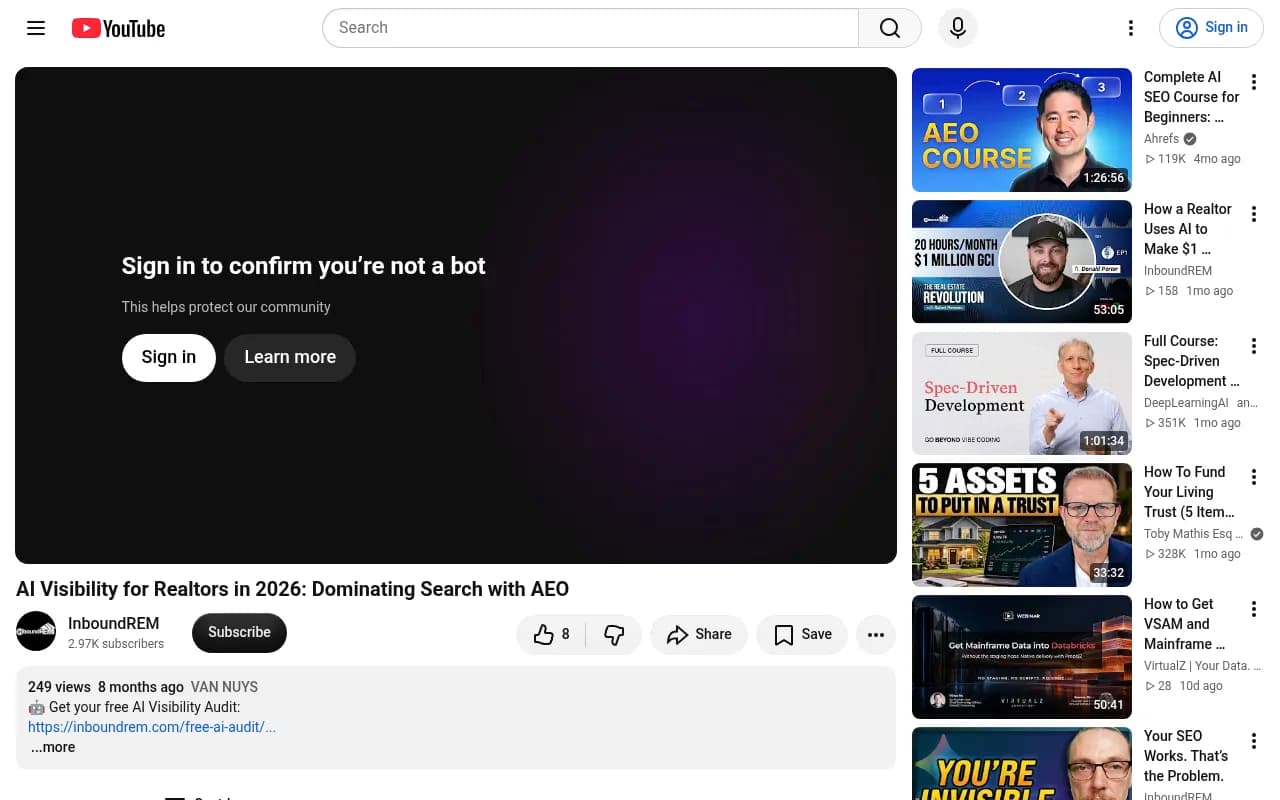
The InboundREM video above is a useful, if vendor-flavored, walkthrough of the agent angle. Their "elite ranking" point is worth noting: AI lists of top agents are short, so the gap between being on one and being off it is huge.
What AI actually cites for real estate-style prompts
No Promptwatch report covers real estate specifically. The closest first-party data is the general content-type breakdown, and it maps onto property surprisingly well.
According to Promptwatch's ChatGPT citation share by content type (Sep 28 to Oct 4, 2026), product pages get 22.4% of classified citations and landing pages 16.8%. Listicles get 13.6%, how-tos 8.7%, and reviews 1.7%. For commercial prompts like "best X for...", product pages, landing pages, listicles, and comparisons together make up almost 70% of citations. For branded prompts, reviews rise to 5.6%, more than three times their overall share.
My translation to real estate (this is inference, not Promptwatch's wording):
- Listing, community, and agent profile pages play the role of product and landing pages.
- "Best real estate agents in [city]" roundups are the listicles that decide who gets named on commercial prompts.
- Reviews matter most when someone asks about you by name. A buyer typing "is [agent name] any good?" will pull review sites and your own site.
Two more data points shape the local playbook:
- Almost half of ChatGPT responses cite 10 or more unique domains, per Promptwatch's unique domains report. You are competing for one slot among many, so being named on several third-party pages beats having one great page.
- In August 2026, sites with domain rank 46 to 75 earned almost half of ChatGPT citations, while DR 91 to 100 fell to about 3%, according to Promptwatch's domain rank report. Mid-authority local sites are not shut out. That is good news for a regional brokerage.
In adjacent verticals, travel and automotive citations are dominated by aggregators and marketplaces (Skyscanner, Tripadvisor, Autotrader, Cars.com). Real estate portals probably behave similarly, but there is no report to prove it, so test it with your own prompts rather than assuming.
Local tactics that move the needle
1. Fix your entity positioning first
AI systems need to know what you are. Stridec's example is a good one: "We sell properties" is weak, while "Luxury waterfront property specialists in Dubai Marina" or "High-yield rental property consultants in Manchester" is classifiable. Say who you serve, where, and what you specialize in, on your homepage, About page, agent bios, and every profile you control. Keep it identical everywhere.
2. Build neighborhood and market content that answers real questions
Write pages for the sub-questions buyers ask, not one giant city page. Neighborhood guides, price trend breakdowns, rental yield analysis, school district explainers, and comparisons like "Brickell vs Edgewater for first-time buyers" all fit. Include real numbers from your own transactions, because proprietary data is hard for a generic page to replace.
Promptwatch's query fanout data suggests ChatGPT's searches are short. Average query length fell from about 117 characters in December to roughly 53 from April. So write headings like short queries: "Best realtors in Austin TX" or "Condos for sale in Brickell Miami." Put the place and category first.
3. Treat transactions and reviews as evidence
Claims are cheap. Sold history, review volume, and recent ratings are the signals AI can weigh. Publish your closed sales as structured, crawlable pages (with permission and within your MLS rules), and keep collecting reviews on Google and on the sites that list local agents. Birdeye makes the point that AI recommendations draw on reviews, listing accuracy, and sentiment together. Inconsistent data across platforms drags all three.
4. Get into the roundups and directories AI reads
Because listicles are a top citation type, find the "best agents" and "best brokerages in [city]" pages that already rank and get cited, then earn a place on them. Local press, chamber of commerce pages, community sponsorships, and industry awards all create third-party mentions. Sponsoring local events, as one GeoGenius list suggests, only helps if it produces a crawlable page that names you.
5. Match your social effort to the engine
The social picture is split. From Promptwatch's October 2026 social citations report (Sep 28 to Oct 4):
- ChatGPT: all seven tracked platforms together are 0.46% of citations. Reddit fell from 5.19% to 0.09%. LinkedIn is the top social source at 0.3%.
- Google AI Overviews: 12.2% from social. YouTube is 4.28%, Facebook 2.38%, Reddit 2.15%, Instagram 1.61%, LinkedIn 1.55%.
- Perplexity: 2.7%, with LinkedIn and Reddit tied at 0.86%.
The Reddit drop in ChatGPT is also documented in Promptwatch's Reddit citations report: reddit.com's share fell from about 4% to 0.5% on August 14, 2026. So advice from earlier in 2026 to "get active on Reddit" for ChatGPT is stale. For agents, YouTube neighborhood tours and complete, active Facebook and Instagram profiles feed Google's AI surfaces far more than ChatGPT.
6. Do not neglect the technical layer
AI crawlers need to reach your pages. Check robots.txt, make sure listing and community pages render without heavy client-side JavaScript, add LocalBusiness, RealEstateAgent, and FAQ schema where it is accurate, and keep an XML sitemap current. Be careful with scale: Birdeye reports that Google's spam policies now apply to AI Overviews, targeting thin, templated pages. Hundreds of near-identical "homes for sale in [suburb]" pages are a risk, not a strategy.
If you want to see which AI bots are actually visiting, Promptwatch's AI crawler traffic data gives you a benchmark, and your own logs tell you where you stand.
7. Keep content fresh where it matters
Not all content decays at the same rate. Promptwatch's content half-life report found that landing pages and docs stayed cited longest, while news lost half its pages within 36 days. Your evergreen agent and community pages are durable assets. Market-update posts are short-lived, so refresh them monthly rather than letting them age.
Tools for tracking and improving local AI visibility
There are two jobs here. One is measurement: what do ChatGPT, Gemini, Perplexity, and AI Overviews say when buyers ask about your market? The other is action: fixing the reasons you are missing. Plenty of tools do the first. Fewer do the second.
AI visibility platforms
Promptwatch tracks real user interfaces of ChatGPT, Google AI Overviews, AI Mode, Gemini, Perplexity, and Copilot, with country tracking on every paid plan and state and city tracking from the Business plan. That matters for real estate, where "best agent in Tampa" and "best agent in Tulsa" are different prompts with different winners. It also has IP-verified AI crawler logs, page-level citation tracking, and a content gap analysis, then an Action Board and Content Agent to act on what it finds. Pricing starts at $95/month for Essential (50 prompts); confirm on promptwatch.com/pricing.

For the tools below, I am relying on the catalog descriptions, not hands-on testing, so treat them as starting points for a trial.
Rankfender publishes a real estate landing page and lists plans from free to $499/month, tracking 7 LLMs. It also pitches AI-written listing descriptions and neighborhood guides. Be wary of any generator that mass-produces property copy, per the spam point above.
Profound is the enterprise option for tracking brand mentions across many engines. Rankfender's comparison lists Lite at $499/month, which is a lot for a single-agent shop but plausible for a large brokerage.

Otterly.AI and Peec AI are lighter, cheaper prompt trackers. They answer "was I mentioned?" without much on crawler access or content execution.


Semrush and Ahrefs Brand Radar suit teams already living in those suites, though their AI prompt sets tend to be less flexible.

Local listings, reputation, and presence
Birdeye ties reviews, listings accuracy, and sentiment to AI discoverability through its Search AI product, and publishes useful research on multi-location brands. Yext and SOCi cover listings and local social and reviews at scale. These are the tools for the data hygiene layer, especially for brokerages with many offices.
Technical and content support
Screaming Frog and Sitebulb help you audit whether listing and community pages are crawlable. Clearscope and Surfer SEO help tighten neighborhood content once you know which prompts you are missing.
Comparison table
| Tool | Main job | City or region prompts | Helps you fix gaps | Best for |
|---|---|---|---|---|
| Promptwatch | Tracking, crawler logs, content agent | Country on all plans, state/city on Business | Yes (Action Board, Content Agent) | Brokerages and agencies wanting end-to-end |
| Rankfender | Tracking plus listing copy | Unverified | Partly (content generation) | Agents on a budget |
| Profound | Enterprise tracking | Unverified | Limited | Large brokerages |
| Otterly.AI / Peec AI | Basic prompt tracking | Varies | No | Solo agents testing the water |
| Birdeye | Reviews, listings, sentiment | Location-based | Reputation side | Multi-office teams |
| Yext / SOCi | Listings and local presence | Location-based | Data consistency | Franchise and multi-location |
| Semrush / Ahrefs Brand Radar | SEO suite with AI tracking | Limited | Limited | Teams already using them |
For more options, the GEO software directory and AI rank tracking directory list far more trackers than this guide can cover.
A practical 30-day plan
Week 1: baseline
Build a list of 30 to 50 prompts per market. Mix commercial ("best real estate agents in [city]"), informational ("is [neighborhood] a good place to live?"), and branded ("[your name] reviews"). Run them across ChatGPT, Gemini, Perplexity, and Google. Record whether you are named, where, and which sources are cited. A free scan or a tool trial will do this faster than doing it by hand.
Week 2: fix the foundation
Audit your Google Business Profile, listing data, and review profiles for consistency. Confirm AI crawlers are not blocked. Rewrite your homepage and agent bios so the specialization and geography are unmistakable.
Week 3: close content gaps
For each prompt where a competitor wins, look at the pages cited. Is it a roundup you are not on? A neighborhood page you lack? Build or pitch accordingly. Use short-query headings and add a plain-language FAQ.
Week 4: measure and repeat
Re-run the prompts. Check whether new pages are crawled and cited. Track calls, form fills, and direction requests alongside sessions, since impressions undercount AI-driven demand. Repeat monthly, because AI answers shift constantly.
Should you hire help?
If you are a brokerage without a marketing team, a specialist can save months. Several vendors sell real estate AI SEO packages, with FlyDragon listing a starting price around $799/month, though that comes from its own comparison page, so weigh it accordingly. Whoever you choose, ask how they measure AI visibility and whether they report on prompts you can verify yourself. Agencies such as 1001 SEO Media cover technical SEO, content, and GEO together, which suits teams that want one partner for both Google and AI search.
Mistakes to avoid
- Chasing vendor statistics. Plug in your own prompts and your own market.
- Mass-producing templated suburb pages. Google's spam policies now reach AI results.
- Spending on Reddit for ChatGPT visibility. The data says it stopped paying off in August.
- Reporting only on traffic. AI answers often resolve the question without a click, and the value shows up as calls and inquiries.
- Treating a single prompt result as truth. AI answers vary by run, so track trends over many prompts.
The bottom line
Local AI visibility for property brands comes down to being easy to identify, easy to verify, and mentioned by sources AI already trusts in your market. Start with clean local data and a sharp specialization, publish pages that answer short, specific questions, earn placement on the roundups AI cites, and track a fixed prompt set every month. Pick a tool that shows you why you are missing, not just that you are.