Key takeaways
- A refresh diff is a before-and-after view of a page, like a git diff, so you approve small edits instead of replacing a whole article.
- Start with pages AI already cites or should cite: landing pages, product pages, pricing pages, docs, comparisons and listicles.
- Promptwatch's half-life data shows news pages decay fastest, so they are the lowest-value pages for refresh work.
- Good diffs change facts, answer placement, headings, tables and internal links. They leave voice, URL and structure alone.
- Measure after publishing: did crawlers return, did AI cite the page, did traffic move.
Why a diff beats a rewrite
Most old pages are not bad. They have a URL with history, backlinks, impressions and often existing AI citations. A full rewrite throws that away and risks the exact thing that was working. As the Surfer guide to content refreshes puts it, a refresh is usually faster and cheaper than a new page precisely because the URL already has history.
A diff flips the workflow. Instead of a blank page, you get a list of specific changes: this price is wrong, this paragraph buries the answer, this section is missing. You read the changes, accept or reject each one, and publish. The review takes minutes, and you can see what you are about to change before it goes live.
The idea is not new. Editors have used tracked changes for decades. What is new is that AI search punishes stale facts more visibly. A model answering a pricing question will happily cite a page with last year's price, and your brand then repeats the wrong number in front of buyers.
Which pages deserve a refresh first
Not every old page is worth touching. The data on what ChatGPT keeps citing gives a sensible ordering.
Promptwatch Data tracked every page ChatGPT cited on July 6, 2026, and checked whether it was still cited over the next 90 days. Here is what survived:
| Content type | Still cited after 30 days | Still cited after 60 days | Refresh priority |
|---|---|---|---|
| Landing pages | 78% | 69% | High: long-term citation asset |
| Docs | 76% | 67% | High: keep public and accurate |
| Comparisons | 72% | 63% | High: lasting effort pays off |
| Listicles | n/a | 60% | Medium to high |
| Product pages, reviews, how-tos | n/a | about 55% | Medium: half-life is 74 to 77 days |
| News | about 50% gone by day 36 | 41% | Low: use for short bursts |
The practical read: pages that stay cited are the ones where stale facts hurt most, because they keep getting quoted. News pages decay no matter what you do, so polishing them is poor value.
Citation share points the same way. In the week of Sep 28 to Oct 4, 2026, product pages earned 22.4% of ChatGPT citations and landing pages 16.8%, followed by listicles at 13.6%. Those are the pages where a wrong spec or price costs you the most.
A quick triage list
Pull a spreadsheet and flag pages that match any of these:
- Commercial pages (pricing, product, landing) not edited in six months or more
- Pages ranking in positions 11 to 20, or with many impressions and few clicks
- Pages cited by AI engines with outdated claims
- Comparison and listicle pages where competitors or prices changed
- Docs pages that contradict your current product
A crawler like Screaming Frog or Sitebulb gets you the inventory with titles, word counts and last modified dates. Sitebulb's content refresh guide is a solid walkthrough of the audit step.
What a good refresh diff actually contains
A diff is only useful if the changes are worth approving. When I review one, I look for these categories, roughly in this order.
1. Facts that went stale
Prices, plan limits, feature names, version numbers, dates, statistics, screenshots and tool references. These are the changes AI models are most likely to repeat wrongly. Promptwatch's own recommendation from the half-life data is to keep prices, features and positioning accurate on landing, docs and pricing pages, and to keep specs, availability and prices current on product pages.
2. Answer placement
AI engines pull passages. If the direct answer to the page's main question sits in paragraph six, move it to the top. A diff shows this cleanly: one paragraph deleted, the same paragraph added under the first heading, usually with a sentence trimmed.
3. Missing sections and gaps
Compare the page against the prompts people actually ask. If buyers ask "how does this compare to X" and your page never says, the diff should add a short comparison table or an FAQ block. Promptwatch's advice from the content-type data is to add an FAQ that covers brand questions, and to make pricing, specs and who-it-is-for easy to compare.
4. Structure that machines can read
Clear H2 and H3 headings, short paragraphs, tables where data is comparative, and descriptive link text. None of this requires a rewrite. It is reformatting that a diff shows line by line.
5. Internal links
Point old pages at your newest, most authoritative pages. Favor pages with plenty of Search Console impressions but few clicks.
What a diff should leave alone
- The URL
- The core argument and voice
- Sections that still perform
- Original data, quotes and examples that nobody else has
If the diff rewrites 80% of the page, it is a rewrite in disguise. Reject it or narrow the scope.
A step by step workflow
Step 1: Pick 10 to 20 pages
Sort by commercial value and citation likelihood, not by age. Age alone is a bad signal. A three-year-old docs page can be perfectly fine while a two-month-old product page is already wrong.
Step 2: Check what AI says about the page today
Before editing, find out which prompts cite the page and what the answers claim. If an AI response quotes an old price, that tells you exactly which line the diff needs to change. Promptwatch has a Content Refresh feature that produces git-diff-style updates for existing pages, grounded in the prompts and citations it tracks, which is the workflow this guide describes.

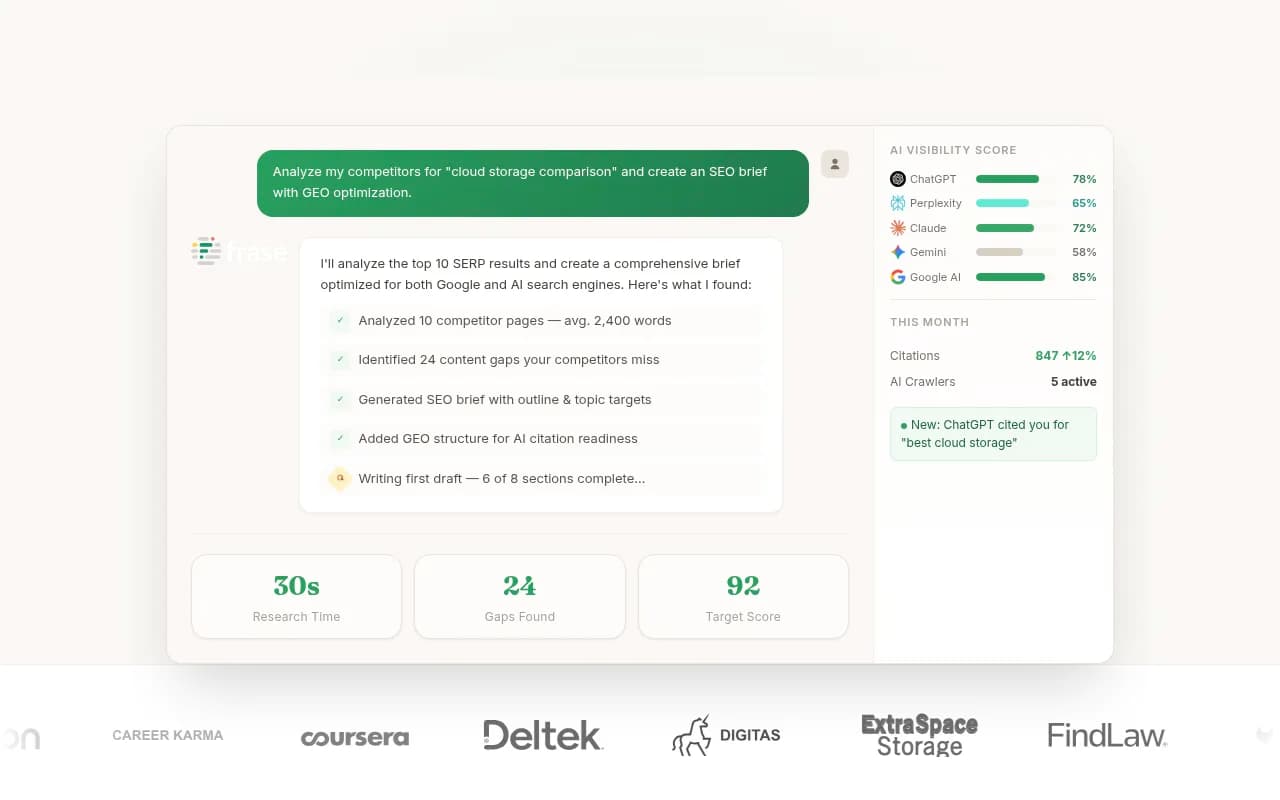
If you want to compare approaches, the GEO software directory at bestgeosoftware.com lists other platforms, and several of them (Surfer SEO, Frase, Clearscope) also offer on-page optimization scoring that can drive manual edits.

Step 3: Generate or write the diff
You can do this by hand: copy the live page into a document, make tracked changes, and review. Or let a tool propose the edits. Either way, set rules first:
- Do not change headings that already rank unless the intent shifted
- Keep word count within about 20% of the original unless a section is truly missing
- Every new claim needs a source or a first-party fact
- Update the visible last-modified date only when facts change
Step 4: Review the diff like an editor
Go hunk by hand. Ask three questions of each change. Is it true? Does it help someone answer a real question? Does it fit the page's voice? Decline anything that fails. A refresh that sounds like a different author reads as machine-written, and readers notice.
Step 5: Publish to the same URL
Keep the URL. Push the change as an update, not a new post. If your CMS supports it, publish as a draft first and compare the staged page.
Step 6: Check that machines noticed
Two checks matter. First, did AI crawlers come back and read the updated page? IP-verified crawler logs answer that, and tools like DarkVisitors or Promptwatch's AI crawler logs do. Second, did citations change? Page-level tracking shows whether the prompts that used to cite the old text now cite the new.

For traffic, look at AI-referred visits and conversions, plus Search Console clicks and impressions for the same URL. Give it a few weeks. Crawl and citation changes lag edits.
Refresh cadence by page type
You will see blog posts claiming quarterly refreshes outperform annual ones by 42%. I could not trace that figure to anything solid, so I would not build a schedule on it. Use the half-life data instead:
| Page type | Suggested review rhythm | What to check |
|---|---|---|
| Pricing and landing pages | Every month, and on any pricing change | Prices, plan limits, positioning |
| Product pages | Every 6 to 8 weeks | Specs, availability, prices |
| Docs | Every release | Accuracy, public crawlability |
| Comparisons and listicles | Quarterly | Competitor features, rankings, new entrants |
| How-tos and reviews | Every 2 to 3 months | Steps, screenshots, tool names |
| News | Do not refresh | Publish new pieces for bursts |
That is a judgment call built from decay rates, not a law. Adjust for how fast your market moves.
Common mistakes
Refreshing for the date, not the facts
Changing a year in the title and bumping the published date without touching the content is the oldest trick in SEO. It can backfire when AI models compare the claims to what they know. Update the date only when the substance changed.
Letting a tool rewrite your voice
AI edits tend to flatten the page into the same generic phrasing as everyone else's. Keep your examples, your opinions, your data. Those are the parts models cannot get elsewhere.
Ignoring crawl access
A perfect refresh does nothing if AI bots cannot read the page. Check robots.txt and your CDN rules. Promptwatch offers a free Agentic Readiness Check and a robots.txt generator for AI if you are unsure.
Refreshing everything at once
You lose the ability to tell what worked. Update in batches of 10 to 20, compare against untouched pages, then scale.
Forgetting related pages
If you change a price on the pricing page, five blog posts and a docs page probably repeat it. Search your own site for the old number before you call it done. A site audit that flags duplicate and conflicting content helps here.
Tools that help at each stage
| Stage | What you need | Options |
|---|---|---|
| Inventory and audit | Crawler with last-modified data | Screaming Frog, Sitebulb |
| Find decay and gaps | Search Console plus AI citation data | Promptwatch, Semrush |
| Write or approve edits | Diff view or on-page scoring | Promptwatch Content Refresh, Surfer SEO, Clearscope |
| Verify crawling and citations | Crawler logs, page tracking | Promptwatch, DarkVisitors |
For broader AI rank tracking options, the directory at ai-rank-tools.com is a handy shortlist.
A worked example
Say you run a SaaS company with a pricing page, a feature page and a "best tools for X" listicle. All three were last edited seven months ago.
The diff for the pricing page changes two prices and adds a short plan comparison table. Four lines changed. The feature page diff renames a feature that shipped under a new name, moves a summary sentence to the top, and adds three FAQ entries. The listicle diff swaps out one discontinued competitor, updates two feature claims, and adds your own product's entry with honest trade-offs.
Total editing time is under an hour per page, versus a day each for rewrites. The URLs, backlinks and most of the copy stay. Two weeks later you check crawler logs for visits to all three, then page tracking for citations, then AI-referred sessions. If the listicle started getting cited and the others did not, you learned something about where to spend your next batch.
What to do this week
- Export your commercial pages and sort by last edit date.
- Pick the ten whose facts are most likely stale.
- Review the AI answers that mention your brand and note wrong claims.
- Produce diffs, approve the small changes, and publish to the same URLs.
- Recheck crawlers and citations in two to four weeks.
If you want a quick starting point, the free AI visibility report shows how ChatGPT, Gemini and Perplexity currently describe your brand, which tells you where the stale claims are hiding.