Key takeaways
- AI citation tracking means monitoring which of your web pages get referenced in responses from ChatGPT, Perplexity, Claude, Gemini, and other AI search engines.
- Unlike traditional SEO rank tracking, AI citations are non-deterministic -- the same prompt can produce different sources each time, so you need repeated sampling at scale.
- The most important metrics to track are citation frequency, citation share vs. competitors, which pages get cited, and which AI models cite you.
- Dedicated GEO platforms like Promptwatch go beyond tracking to show you why you're not being cited and help you fix it with content gap analysis and AI-native content generation.
- Traffic attribution is the final step -- connecting AI citations to actual visits and revenue using crawler logs, GSC integration, or server-side analytics.
Why AI citation tracking matters in 2026
A year ago, most marketing teams were still treating AI search as a curiosity. Now it's a channel. ChatGPT has over 800 million weekly active users. Perplexity serves hundreds of millions of queries per month. Google's AI Overviews appear on a significant portion of all search results. People are asking AI engines which product to buy, which software to use, which brand to trust -- and those engines are citing sources when they answer.
If your pages aren't being cited, you're invisible to a growing slice of your potential audience. And unlike traditional search, where you can check your rankings in seconds, AI citations are harder to see. There's no position 1 or position 10. There's just "cited" or "not cited."
That's the problem this guide solves. Here's how to actually track which pages get cited, across which models, for which queries -- and what to do with that information.
How AI citations work (and why they're hard to track)
When a user asks ChatGPT or Perplexity a question, the model retrieves content from the web (or its training data), synthesizes an answer, and -- in many cases -- links to the sources it drew from. Those links are citations.
The tricky part: AI models don't cite sources the same way every time. Ask the same question twice and you might get different sources. This is called non-determinism, and it's the core reason why traditional rank tracking tools don't work for AI search.
To get reliable citation data, you need to:
- Run the same prompts repeatedly across multiple sessions
- Sample across different times of day and geographic locations
- Track results across multiple AI models, not just one
- Aggregate the data to find statistical patterns
That's a lot of infrastructure to build yourself. Most teams use a dedicated platform instead.
There's also a second layer of complexity: AI models don't always cite the same page for the same topic. One model might cite your homepage, another might cite a specific blog post, and a third might cite a competitor's comparison page. Page-level citation tracking -- not just domain-level -- is what tells you which content is actually doing the work.
What to track: the core citation metrics
Before picking a tool, it helps to know what you're actually trying to measure. Here are the metrics that matter.
Citation frequency
How often does your brand or domain appear in AI responses for a given set of prompts? This is the top-level number -- your overall visibility score. Track it over time to see if your visibility is growing or shrinking.
Citation share vs. competitors
What percentage of relevant AI responses cite you vs. your competitors? If you appear in 15% of responses and your main competitor appears in 40%, that gap is your opportunity.
Page-level citations
Which specific pages on your site are being cited? This is where things get interesting. You might find that one blog post from 2023 is responsible for 60% of your AI citations, while your product pages are invisible. That tells you exactly where to invest.
Model-by-model breakdown
ChatGPT, Perplexity, Claude, and Gemini don't cite the same sources. A page that ranks well in Perplexity might be ignored by Claude. Tracking by model helps you understand where your content strategy is working and where it isn't.
Prompt-level attribution
Which specific user queries are driving your citations? This connects AI visibility to actual search intent -- and helps you identify gaps where competitors are visible but you're not.
Methods for tracking AI citations
Manual spot-checking (not recommended at scale)
The simplest approach: open ChatGPT, Perplexity, or Claude, type in a prompt relevant to your business, and see if your site is cited. This works for a quick sanity check but falls apart fast. You can't sample at scale, you can't track over time, and you can't compare across models systematically.
Use manual checks to get a feel for the problem. Don't rely on them for decisions.
Building your own tracking system
Some teams build custom scrapers or use APIs to query AI models programmatically, parse the responses, and log citations to a database. This is technically feasible -- Perplexity and some other models have APIs that return source links -- but it's expensive to maintain, slow to scale, and doesn't give you competitor data.
If you have engineering resources and very specific needs, this can work. For most marketing teams, it's not worth the overhead.
Using a dedicated AI citation tracking platform
This is the practical choice for most brands. Dedicated GEO (Generative Engine Optimization) platforms handle the sampling infrastructure, give you dashboards, track competitors, and increasingly help you act on what you find.
The market has grown quickly. Here's a comparison of the main options:
| Tool | Page-level tracking | Competitor tracking | Content gap analysis | AI content generation | Crawler logs | Pricing starts at |
|---|---|---|---|---|---|---|
| Promptwatch | Yes | Yes | Yes | Yes | Yes | $99/mo |
| Profound | Yes | Yes | Limited | No | No | Higher |
| Otterly.AI | Limited | Yes | No | No | No | Lower |
| Peec AI | Yes | Yes | No | No | No | Mid |
| AthenaHQ | Yes | Yes | No | No | No | Mid |
| LLMrefs | Yes | Limited | No | No | No | Low |
| Trakkr.ai | Yes | Yes | No | No | No | Low |
| Rankshift | Yes | Yes | No | No | No | Mid |
Most tools in this space are monitoring dashboards -- they show you where you stand but don't help you improve. The distinction matters when you're trying to actually move the needle.
Promptwatch is built around what it calls the "action loop": find gaps, create content, track results. It's the only platform in the 2026 comparison of 12 GEO tools rated as a leader across all categories.

Step-by-step: setting up AI citation tracking
Step 1: Define your prompt set
Start with the queries your customers actually use. Think about:
- Category-level questions ("best project management software for agencies")
- Comparison queries ("X vs Y")
- Problem-based queries ("how to reduce customer churn")
- Brand queries (your brand name, your competitors' brand names)
Aim for 30-100 prompts to start. You can always expand. The goal is to cover the queries where being cited matters most to your business.
Step 2: Set up your tracking tool
Connect your domain, enter your prompt set, and configure your competitors. Most platforms will start pulling data within 24-48 hours. Some, like Promptwatch, also let you configure personas (the type of user asking the question) and geographic targeting, which matters if your customers are in specific regions.
Step 3: Establish your baseline
Before you do anything to improve your visibility, document where you stand. Screenshot your citation share, note which pages are being cited (if any), and record which models are citing you. This baseline is what you'll measure all future improvements against.
Step 4: Set up AI crawler log monitoring
This is a step most teams skip, and it's a mistake. AI crawlers -- the bots that ChatGPT, Claude, and Perplexity use to read your website -- leave traces in your server logs. Monitoring these logs tells you:
- Which pages AI engines are reading
- How often they return
- Whether they're hitting errors (404s, slow load times, blocked by robots.txt)
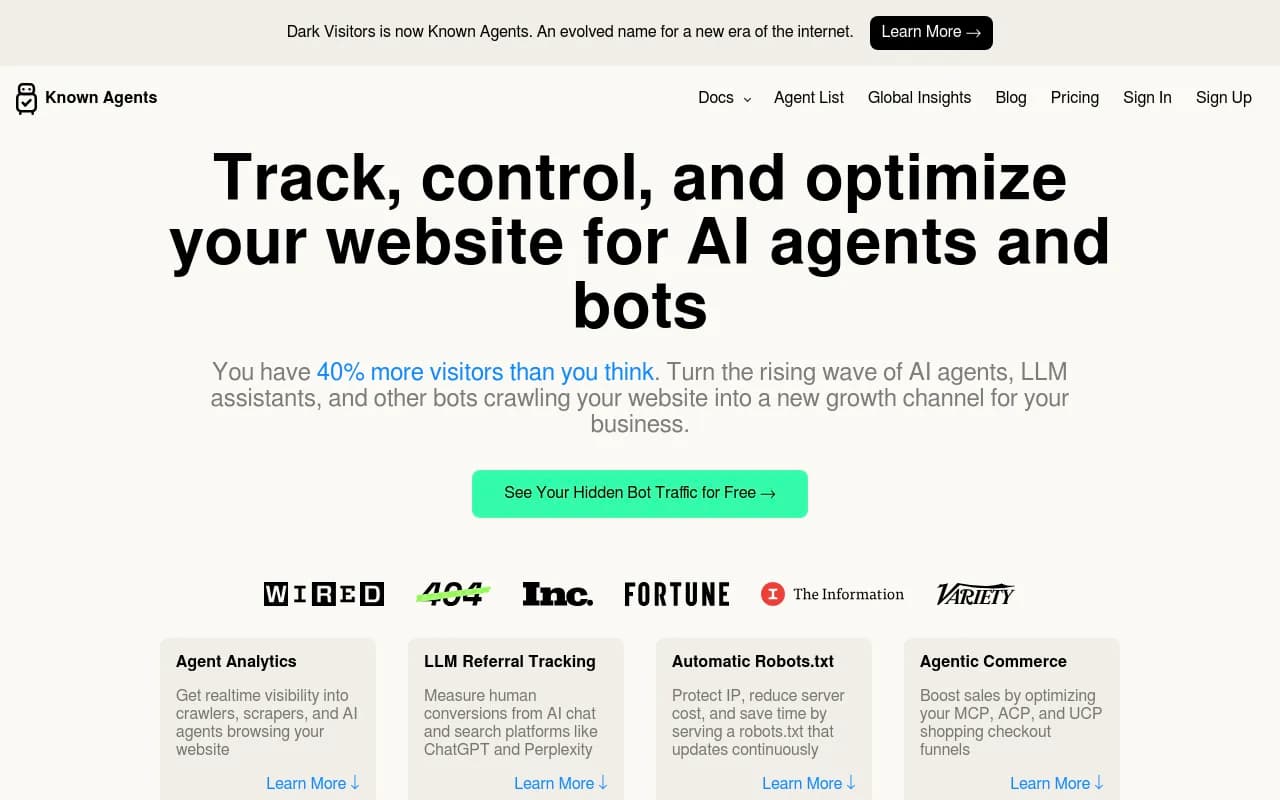
If an AI crawler can't read your page, it can't cite it. Crawler log monitoring closes that gap. Promptwatch includes this in its Professional plan. DarkVisitors is another tool specifically focused on tracking AI agents visiting your site.
Step 5: Track at the page level
Domain-level visibility tells you if you're in the game. Page-level visibility tells you what's working. Once your tracking is running, look for patterns:
- Which content types get cited most (guides, comparisons, product pages)?
- Which topics are you cited for vs. not cited for?
- Are there pages that rank well in Google but never get cited in AI?
That last question is particularly important. A page can have strong traditional SEO signals and still be invisible to AI models if it doesn't answer questions directly, lacks clear structure, or doesn't have the depth AI engines look for.
Step 6: Identify your citation gaps
Citation gap analysis compares your visibility against competitors prompt by prompt. For each query where a competitor is cited but you're not, you have a gap. These gaps are your content roadmap.
Some platforms surface these gaps automatically. Promptwatch's Answer Gap Analysis shows the specific prompts where competitors are visible and you're not, along with data on prompt volume and difficulty -- so you can prioritize the gaps worth closing first.
Step 7: Connect citations to traffic and revenue
Citation tracking is only half the picture. You also need to know whether those citations are driving actual visits. This is harder than it sounds because AI search traffic doesn't always show up cleanly in Google Analytics.
Three approaches work:
- Google Search Console integration: GSC now shows some AI Overview traffic separately. It's incomplete but useful.
- Server log analysis: Raw server logs capture every visit, including those from AI-referred traffic that GA misses.
- UTM parameters on cited pages: If you know which pages are being cited, you can add tracking parameters and watch for traffic patterns.
Platforms like Promptwatch offer traffic attribution built in, connecting the citation data to actual visit data via a code snippet, GSC integration, or log analysis.
What good citation data looks like in practice
Here's a concrete example of how this plays out. Say you run a B2B SaaS company selling HR software. You set up tracking for 50 prompts around HR software, onboarding tools, and employee management.
After two weeks of data, you find:
- Your domain appears in 12% of relevant AI responses overall
- Your main competitor appears in 34%
- The pages being cited on your site are mostly your homepage and one comparison blog post from 2022
- Your product feature pages are never cited
- Claude barely cites you at all; Perplexity cites you more often
- There are 18 prompts where competitors are cited but you're not, mostly around topics like "HR software for remote teams" and "employee onboarding automation"
That's actionable. You know you need content on remote HR and onboarding automation. You know your product pages need restructuring to be more citation-friendly. You know Claude specifically is a gap to close.
Without citation tracking, you'd have none of this. You'd be guessing.
Tools worth knowing about
Beyond the full-platform options, a few specialized tools are worth mentioning for specific use cases.
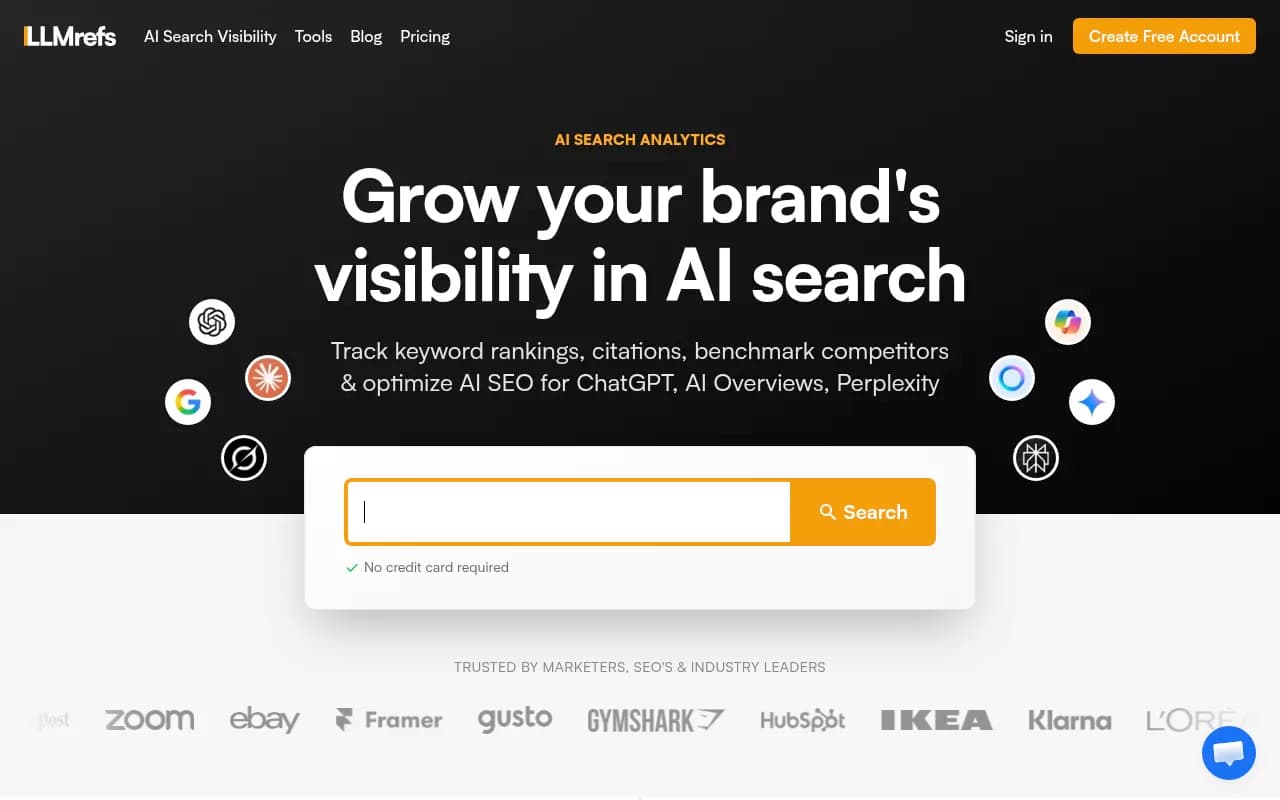
For teams that want lightweight tracking without a big platform commitment:
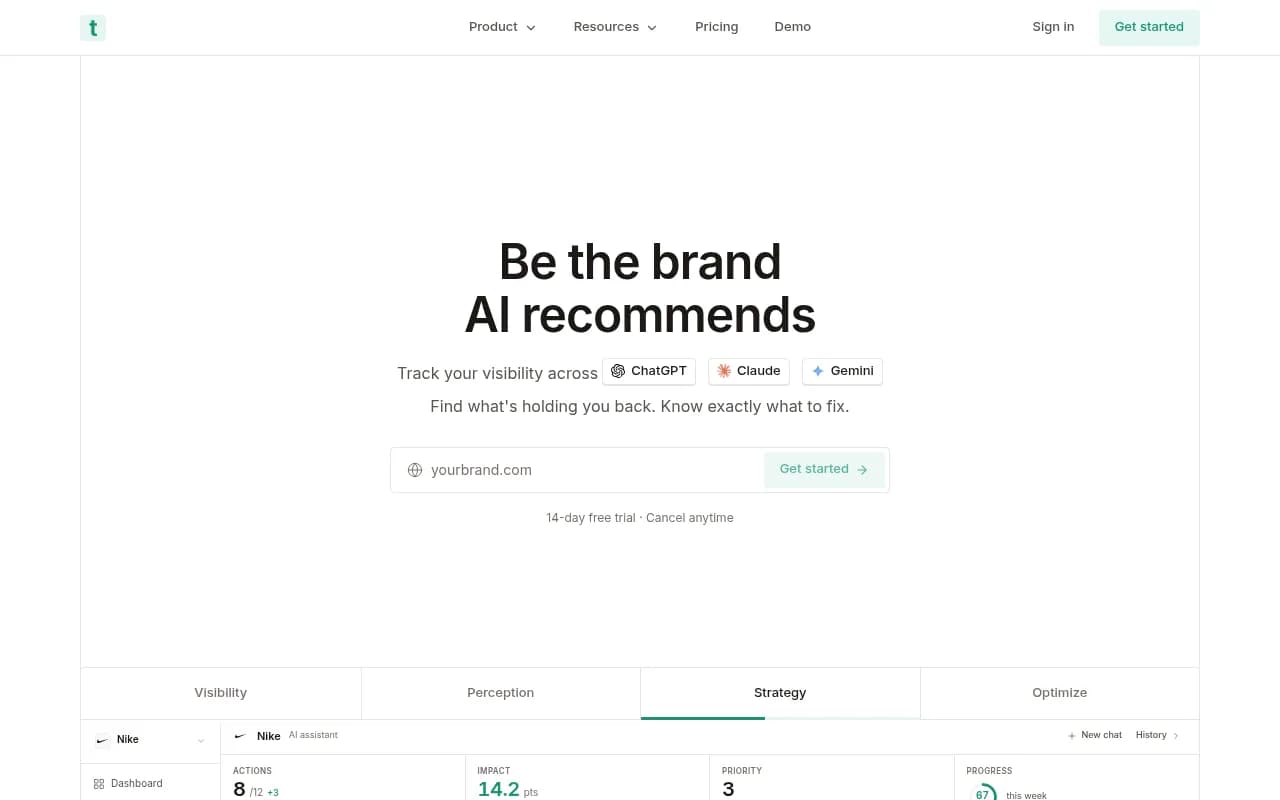

For teams that want deeper competitive intelligence alongside citation tracking:


For teams focused specifically on tracking AI crawler activity on their site:
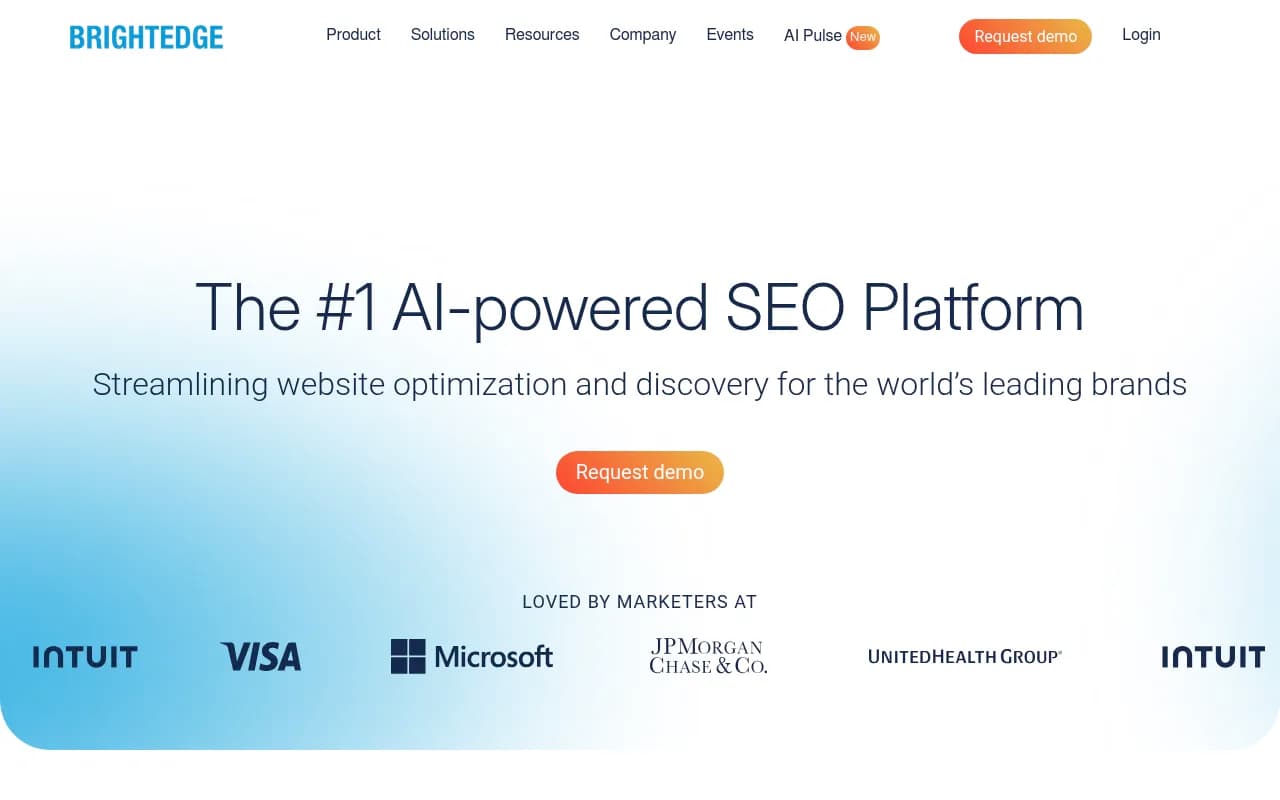
For enterprise teams that need citation tracking as part of a broader SEO stack:
Common mistakes in AI citation tracking
Tracking too few prompts
Fifty prompts sounds like a lot until you realize your customers might use hundreds of different phrasings to ask about your category. Start broader than you think you need to.
Only tracking your own brand
Brand query tracking tells you if people searching for you by name find you. It doesn't tell you if you're visible to people who don't know you yet -- which is where most of the opportunity is. Category and problem-based prompts matter more.
Ignoring model differences
ChatGPT and Perplexity have very different citation behaviors. A strategy that works for one won't necessarily work for the other. Track both and treat them as separate channels.
Treating citation tracking as a one-time audit
AI models update their retrieval behavior, new content gets published by competitors, and your own site changes. Citation visibility shifts constantly. This needs to be an ongoing monitoring practice, not a quarterly report.
Stopping at monitoring
The most common mistake: setting up a tracking dashboard, watching the numbers, and not doing anything about them. Citation tracking is only valuable if it drives action -- new content, page restructuring, technical fixes for crawler access. The data is the starting point, not the destination.
Making your pages more citation-worthy
Tracking tells you where you stand. Improving your citations requires a different set of actions. A few principles that consistently help:
- Answer questions directly and early. AI models favor content that gets to the point. If your page buries the answer in paragraph seven, it's less likely to be cited.
- Use clear structure. Headers, lists, and tables make it easier for AI engines to extract specific information.
- Cover topics with depth. Thin content rarely gets cited. Pages that comprehensively cover a topic from multiple angles perform better.
- Build topical authority. A site with 20 well-written pages on a specific topic will outperform a site with one page on that topic and 200 pages on unrelated subjects.
- Fix crawler access issues. Check your robots.txt, page speed, and server errors. If AI crawlers can't read your pages, nothing else matters.
The bottom line
AI citation tracking in 2026 is not optional for brands that care about search visibility. The channel is too large and growing too fast to ignore. But tracking alone isn't enough -- the teams winning in AI search are the ones who use citation data to drive content decisions, fix technical gaps, and close the distance between where they are and where their competitors are.
Start with a clear prompt set, pick a tool that gives you page-level data, set up crawler log monitoring, and build a process for acting on what you find. The brands that do this consistently will compound their AI visibility over time. The ones that don't will keep wondering why their traffic is flat while the category leader keeps getting cited.