Key takeaways
- Brand-level citation tracking is nearly useless for content decisions. You need to know which URL is being cited, not just whether your domain appeared.
- The overlap between top-10 organic rankings and AI Overview citations has dropped to somewhere between 17% and 38% in 2026, meaning your rank tracker is missing most of the story.
- Page-level monitoring requires a specific setup: the right prompts, the right tools, and a way to close the loop from citation to traffic.
- Most monitoring tools stop at showing you the data. A smaller number help you act on it.
- This playbook walks through the full setup, from choosing your target post to measuring the revenue impact.
There's a question most content teams can't answer right now: "Is our best blog post being cited by ChatGPT?"
Not "is our domain visible in AI search." Not "did we appear in a Perplexity response somewhere." The specific question: is this URL, the one we spent three weeks writing and optimizing, showing up when someone asks an AI model a question it was built to answer?
Most teams don't know. Their tools aren't built to tell them.
That's the gap this playbook closes.
Why page-level tracking is different from brand tracking
Brand-level AI monitoring tells you your company was mentioned. That's useful for PR and share-of-voice reporting, but it doesn't help you make content decisions.
Page-level tracking tells you something much more useful: which specific URL is being pulled into AI responses, for which prompts, on which platforms, and how often. That's the data you need to know whether a piece of content is working in AI search, or whether a competitor's page is eating your lunch.
The distinction matters more than it used to. Research from early 2026 shows the overlap between top-10 organic results and Google AI Overview citations has dropped from 76% in mid-2025 to somewhere between 17% and 38% today. That means a page can rank #1 in traditional search and still not appear in the AI response that most users actually see. Your rank tracker won't catch that.
The implication: if you're not tracking citations at the page level, you're flying blind on whether your content is actually reaching AI-driven audiences.
Step 1: Pick the right post to monitor
Not every post is worth setting up page-level tracking for. Start with posts that meet at least two of these criteria:
- The post targets a question someone would realistically ask an AI model (comparison queries, "best X for Y" queries, how-to questions, definitions)
- The post already gets meaningful organic traffic, meaning AI models have likely crawled it
- The post is in a category where you have known competitors who might be outranking you in AI responses
- The post has commercial intent behind it, so citation visibility connects to revenue
If you're not sure where to start, look at your top 10 posts by organic traffic and filter for the ones with question-based or comparison-based titles. Those are the most likely to appear in AI-generated answers.
Step 2: Build your prompt set
This is where most teams get it wrong. They run one or two prompts and assume the result is representative. It isn't.
AI models are probabilistic. The same prompt can return different results minutes apart. A single test tells you almost nothing. What you need is a prompt set: a collection of 5 to 15 queries that a real user might ask when looking for the information your post covers.
For a post titled "Best project management tools for remote teams," your prompt set might look like:
- "What are the best project management tools for remote teams?"
- "Which project management software works best for distributed teams?"
- "Compare Asana vs Monday.com for remote work"
- "What do experts recommend for managing remote projects?"
- "Best tools for remote team collaboration and task tracking"
Each of these is a slightly different angle on the same topic. AI models may cite your page for some and not others. The variation tells you which angles your content is strongest on and where gaps exist.
Keep a spreadsheet with each prompt, the platform you tested it on, whether your URL appeared, and which URL appeared if yours didn't. That's your baseline.
Step 3: Choose your monitoring tools
Manual testing works for a one-time audit, but it doesn't scale. For ongoing page-level monitoring, you need tools that can run prompts automatically, record which URLs appear in citations, and alert you when something changes.
Here's how the main options stack up for page-level tracking specifically:
| Tool | Page-level citation tracking | Platforms covered | Content gap analysis | Starting price |
|---|---|---|---|---|
| Promptwatch | Yes | 10+ (ChatGPT, Claude, Perplexity, Gemini, Grok, DeepSeek, etc.) | Yes (Answer Gap Analysis) | $99/mo |
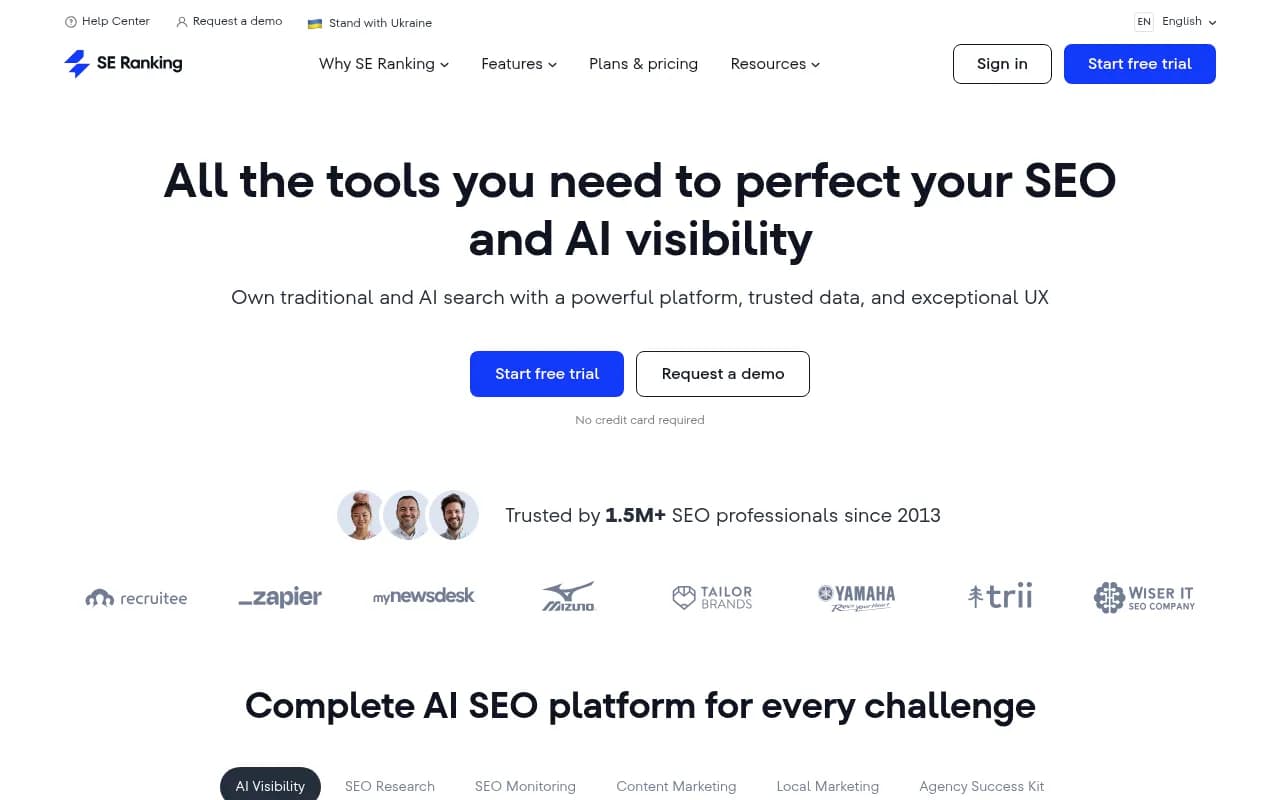
| SE Ranking | Yes (AI module) | AIO, Gemini, ChatGPT, Perplexity | Limited | $129/mo + AI module |
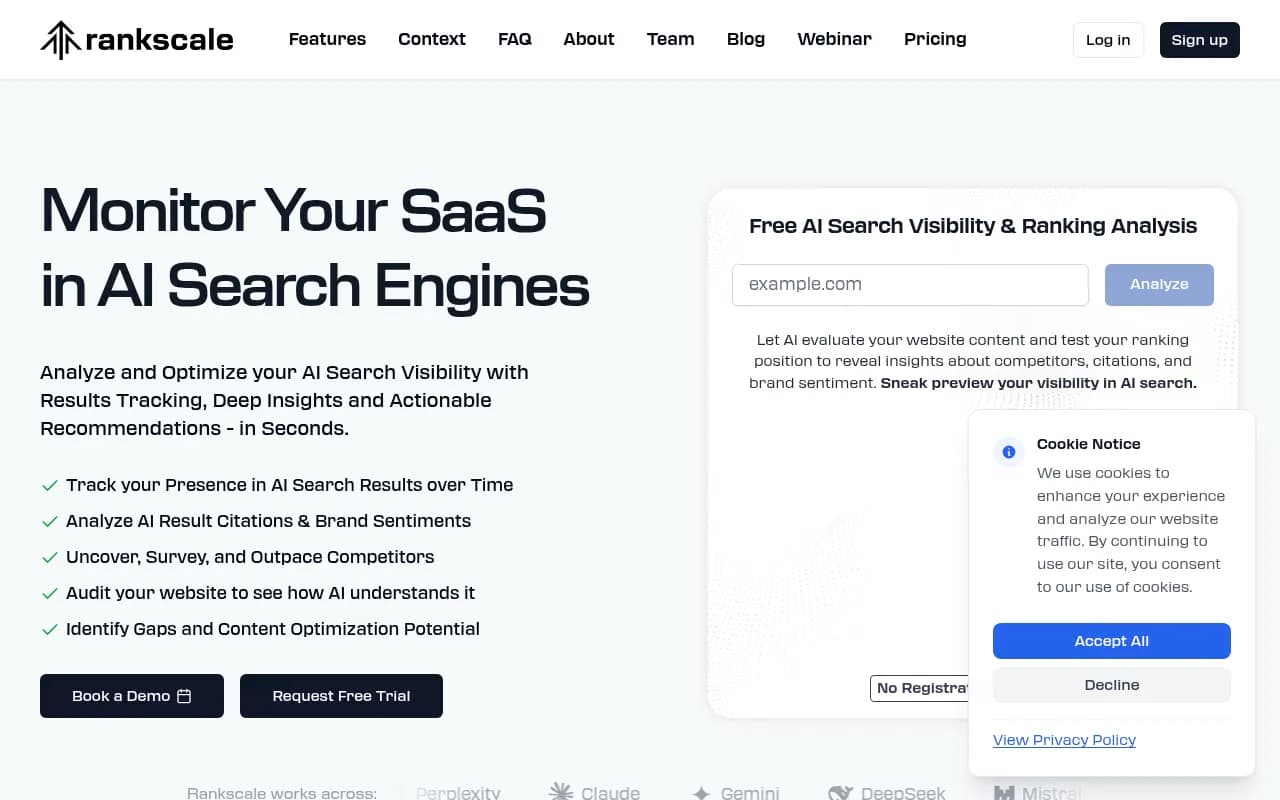
| Rankscale | Yes (evidence trails) | AIO, ChatGPT, Claude, Perplexity | No | From €20/mo |
| Otterly.AI | Limited (sentiment + trend) | AIO, ChatGPT, Perplexity, Gemini | No | $29/mo |
| Profound | Yes (deep) | 10+ LLMs | Limited | $2,000+/mo |
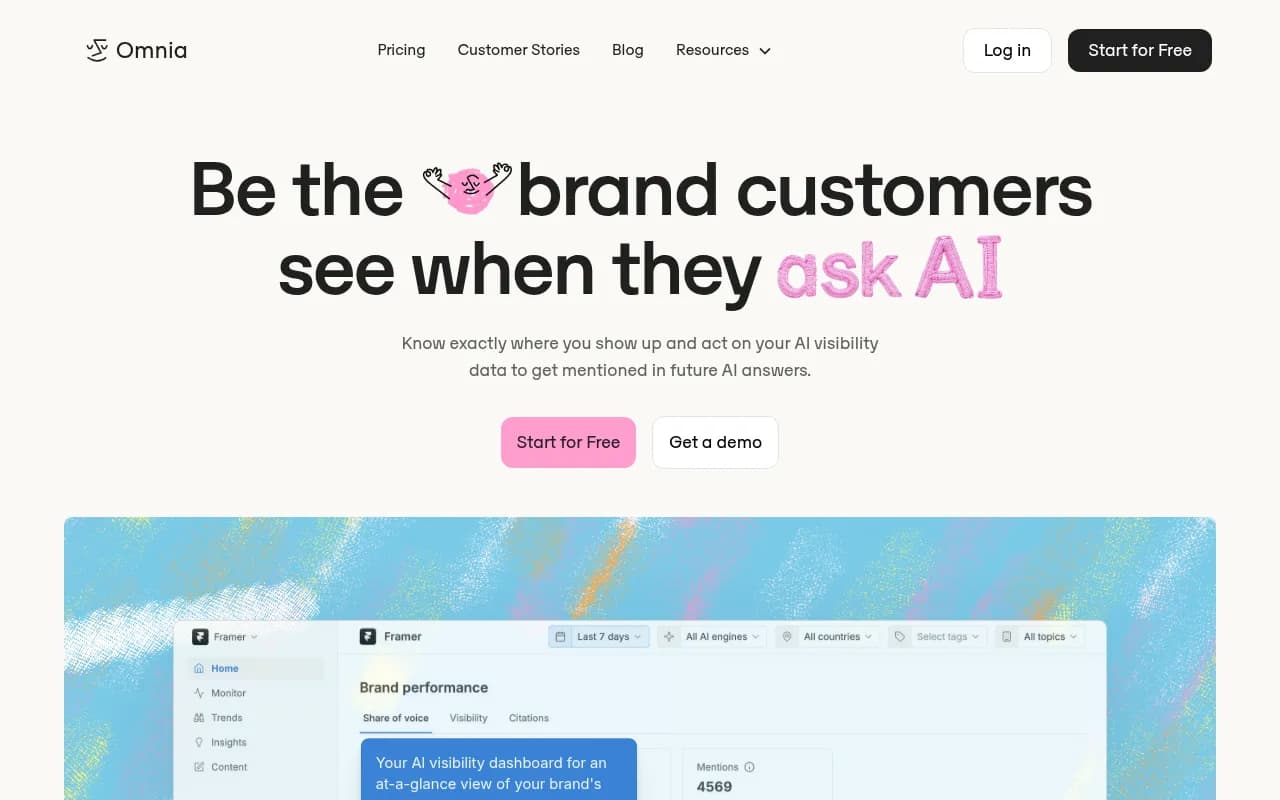
| Omnia | Yes | AIO, AI Mode, ChatGPT, Perplexity | Yes (brief generation) | €79/mo |
For most content teams, the meaningful split is between tools that show you which URL got cited and tools that only show you brand-level visibility. Otterly.AI is a solid entry point for brand monitoring but won't tell you much at the page level. Profound is thorough but priced for enterprise. The middle ground is where most teams will land.
Promptwatch sits in a different category from most of these because it doesn't just show you which pages are being cited. It shows you which prompts your competitors are visible for that you're not, then helps you create content to close those gaps. For page-level work specifically, the page-level tracking feature shows exactly which of your URLs are being cited, how often, and by which models.

For teams that want something simpler to start:

Step 4: Set up your monitoring baseline
Once you've chosen a tool, the setup for a single post looks like this:
- Add your target URL explicitly to the tracking configuration (don't just monitor your domain)
- Enter your prompt set from Step 2
- Set the monitoring frequency. Weekly is the minimum. Daily is better for competitive categories.
- Add your top 3 to 5 competitor URLs for the same topic so you can see who's getting cited when you're not
- Enable alerts for citation changes if your tool supports it
Some tools let you specify personas or locations, which matters if your post targets a specific audience or geography. A post about "best accounting software for UK freelancers" should be tested with a UK-based persona, not a default US one.
Step 5: Interpret what you're seeing
After your first week of data, you'll have a clearer picture. Here's how to read it:
You're being cited consistently: Your page is doing its job in AI search. Focus on maintaining it and expanding to adjacent prompts.
You're being cited sometimes but not consistently: This is the non-determinism problem. AI models don't return the same result every time, so some variation is normal. If your citation rate is below 30% across runs of the same prompt, your page is borderline. It's being considered but not reliably chosen. That usually means the content is relevant but not authoritative enough on the specific question.
A competitor URL is being cited instead of yours: This is the most actionable finding. Look at what that page does differently. Is it more specific? Does it have more data? Does it directly answer the question in the first paragraph? Does it have structured data your page lacks?
Nobody is being cited from your domain or your competitors: The AI is synthesizing from multiple sources without attributing. This happens more with general knowledge questions. It's less useful to optimize for these.
Step 6: Diagnose why you're not being cited
If a competitor is consistently getting cited over your page, the gap usually comes down to a few things:
Answer directness. AI models strongly favor pages that answer the question in the first 100 to 200 words. If your post buries the answer in paragraph six, a competitor who leads with it will win.
Specificity. "Project management tools are useful for remote teams" loses to "Remote teams using async workflows get the most value from tools with built-in time zone displays and async comment threads." Specific claims are more citable.
Structured data and formatting. FAQ schema, how-to schema, and well-structured headings help AI models parse your content. A wall of text is harder to extract from than a post with clear H2s, numbered lists, and a summary section.
Freshness. AI models weight recent content for fast-moving topics. A post from 2023 about AI tools will often lose to one updated in 2026, even if the older post has more backlinks.
Citation authority. Pages that are themselves cited by other authoritative sources carry more weight. This is where traditional SEO and AI search overlap.
Tools like Promptwatch's Answer Gap Analysis can surface which specific topics and angles your page is missing compared to what AI models are citing. It's a faster way to diagnose the problem than manually comparing pages.
Step 7: Connect citations to traffic
Citation data is only half the story. The other half is whether those citations are actually sending people to your page.
This is harder to measure than it sounds because most AI models don't pass referrer data the way traditional links do. Traffic from Perplexity might show up in GA4 as direct or as a referral from perplexity.ai. Traffic from ChatGPT's browsing mode may appear differently from traffic generated when someone reads a ChatGPT response and then manually searches for your URL.
A few approaches that work:
UTM-tagged landing pages. If you're running experiments where you update a page and want to see if citation rates improve, create a version of the URL with a UTM parameter and track it separately. This only works for some platforms.
Referral traffic segmentation. In GA4, create a segment for known AI referrers: perplexity.ai, chat.openai.com, claude.ai, gemini.google.com. Monitor this segment weekly alongside your citation tracking data. When citation rates go up, referral traffic from those sources should follow.
Server log analysis. AI crawlers hit your pages before they cite them. Tools like Promptwatch's AI crawler logs show you which AI bots are crawling which pages, how often, and whether they're encountering errors. If Perplexity's crawler is hitting your page regularly but you're not getting cited, the issue is likely content quality, not discoverability.
Search Console correlation. For Google AI Overviews specifically, Google Search Console now shows some AIO impression data. Cross-reference this with your citation tracking tool to validate what you're seeing.

Step 8: Build a weekly review rhythm
Page-level citation tracking is only useful if you act on it. Here's a simple weekly review structure:
- Check citation rates for your target post across each platform
- Note any changes from the previous week (up or down)
- Check which competitor URLs are appearing when yours isn't
- Flag any prompts where your citation rate dropped below 25%
- Identify one specific change to make to the post based on what you're seeing
The change doesn't have to be a full rewrite. Often it's adding a direct answer to a specific question in the first paragraph, updating a statistic that's gone stale, or adding a structured FAQ section that addresses the exact phrasing of prompts where you're losing.
Track the date of each change in a simple log. When citation rates shift, you'll want to know what you changed and when.
The non-determinism problem (and how to handle it)
One thing nobody talks about enough: AI search is not deterministic. The same prompt, same model, same time of day can return different results. This isn't a bug. It's how language models work.
What this means for your tracking:
- Never make decisions based on a single run of a prompt. Run each prompt at least five times and look at the citation rate across those runs.
- Week-over-week changes of less than 10 percentage points are probably noise, not signal.
- Larger, sustained shifts (your citation rate going from 60% to 20% over two weeks) are real and worth investigating.
- Different models behave differently. A page that ChatGPT loves might be ignored by Perplexity. Track each platform separately.
Most good monitoring tools handle this by running prompts multiple times and averaging the results. If your tool only runs each prompt once, treat the data with appropriate skepticism.
Scaling from one post to many
Once you've got the workflow running for a single post, scaling it is mostly a matter of adding more URLs and more prompts to your monitoring setup. A few things to keep in mind as you scale:
The posts most worth monitoring are the ones with the highest commercial intent or the ones driving the most organic traffic. Start there before expanding to informational content.
Prompt volume matters. A post monitored with 3 prompts gives you a much noisier signal than one monitored with 15. As you add more posts, resist the temptation to cut prompts per post too aggressively.
Competitor tracking becomes more valuable at scale. When you're monitoring 20 posts, you'll start to see patterns in which competitor domains are consistently winning citations you should be getting. That's a content strategy signal, not just a page-level one.

Closing the loop
The goal of all this isn't a dashboard full of citation percentages. The goal is knowing which content is working in AI search, why it's working, and what to do when it stops.
Page-level citation tracking gives you that. Brand-level monitoring doesn't.
Set it up for your most important post this week. Run it for a month. You'll know more about how AI models treat your content than most content teams know about their entire site.