Key takeaways
- Listicles account for 63% of all LLM citations across 400 million analyzed citations, and 71-86% of those are numbered "Top-N" or "Best X for Y" formats -- this is where AI search visibility is being won or lost.
- Ranking in Google's top 10 is no longer enough: AI Overview citations from top-10 organic results dropped from 76% to 38% in eight months (Ahrefs, March 2026). You need to be citation-worthy, not just rankable.
- 44.2% of all AI citations are extracted from the first 30% of a page -- your opening section does most of the work.
- Off-site presence matters as much as your own content: only 23% of branded-query AI citations come from your own website. The other 77% comes from reviews, forums, and editorial coverage.
- The brands winning "Best X" queries in 2026 are doing three things: structuring content for extraction, building off-site citation signals, and tracking which prompts they're missing.
There's a specific kind of frustration that's become common in 2026: you check your Google rankings and you're sitting at position 2 or 3, but when someone asks ChatGPT "what's the best [tool/service/product] for [use case]," your brand doesn't appear. Meanwhile a competitor with half your domain authority keeps showing up.
This isn't random. It's structural. AI search engines don't just pull from the same ranking signals Google uses. They're looking for something different -- and "Best X" queries in particular follow patterns that you can actually reverse-engineer and optimize for.
This guide breaks down exactly how.
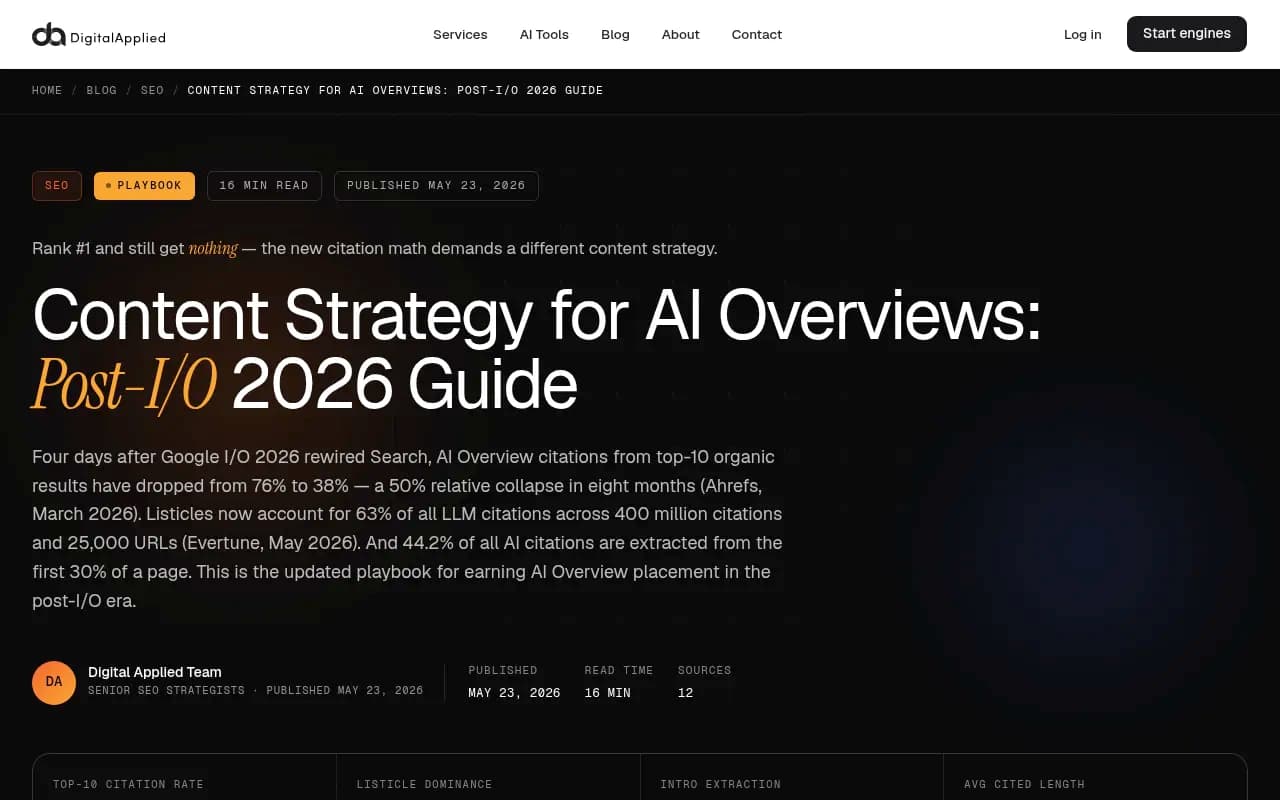
Research from Digital Applied's post-I/O 2026 guide: listicles now dominate AI Overview citations, with 44.2% of citations extracted from the first 30% of a page.
Why "Best X" queries are the highest-stakes format in AI search
When someone types "best project management software for remote teams" into ChatGPT or Perplexity, they're not browsing. They're about to make a decision. These are commercial-intent queries with real purchase intent behind them -- and according to research from Digital Applied, 40.86% of commercial queries now trigger AI Overviews.
The listicle format has become the dominant citation vehicle because it matches how AI models construct answers. When a model needs to answer "best X for Y," it's essentially building a list. It looks for sources that already have that list pre-built in a format it can extract from. Listicles now account for 63% of all LLM citations across 400 million citations analyzed by Evertune -- and of those, 71-86% are numbered Top-N formats.
So the question isn't whether to create listicle content. It's how to create listicle content that AI models actually extract from.
The extraction problem: what AI models actually pull from your pages
Here's the thing most SEO guides miss: AI models don't read your page the way a human does. They extract. They're looking for self-contained, answer-first sentences that make sense without surrounding context.
A Wix/Evertune study found that 44.2% of all AI citations come from the first 30% of a page. That's not a coincidence -- it's because most pages bury their actual answers in the middle after a long preamble. AI models are impatient in the same way readers are.
Structure your listicle for extraction, not for padding
The practical implication: your list items need to be self-contained units. Each entry in a "Best X" listicle should open with a direct claim that works as a standalone sentence.
Bad: "Next up on our list is Tool X, which was founded in 2019 and has grown significantly since then..."
Good: "Tool X is the best option for small teams that need [specific capability] without paying enterprise prices."
The second version can be lifted out of context and still answer the question. The first one can't.
Front-load the answer
Your intro paragraph should contain a direct answer to the query. If your article is "Best CRM for Startups," the first paragraph should name the top pick and give a one-sentence reason. Don't save the conclusion for the end -- AI models may never get there.
The average cited page length is 1,282 words (Ahrefs, 174K pages analyzed). That's not a coincidence either. It's long enough to be substantive but short enough that the key information appears early.
The content structure that gets extracted
Here's a concrete template for "Best X" listicles that consistently earn AI citations:
The opening block (most important section)
- One sentence stating what this list covers and who it's for
- One sentence naming the top overall pick with a reason
- One sentence on methodology or selection criteria
This block should appear before any H2 heading. It's the section most likely to be cited directly.
Each list entry
Every entry should follow this pattern:
- Tool/product name as the heading (H3 or H4)
- One-sentence verdict: what it's best for and why
- Two to three specific features or data points (not vague adjectives)
- One concrete limitation or caveat
- Who it's actually right for
The caveat matters more than most people think. AI models are trained to be helpful and balanced. A list that acknowledges tradeoffs reads as more trustworthy than one that's uniformly positive -- and trustworthiness is a signal that affects citation likelihood.
The comparison table
Include a comparison table. Every time. Not because it's good UX (though it is), but because tables are highly extractable. AI models can pull structured data from tables far more reliably than from prose.
| Tool | Best for | Price range | Key limitation |
|---|---|---|---|
| Tool A | Small teams | $29-99/mo | No API access |
| Tool B | Enterprise | $500+/mo | Steep learning curve |
| Tool C | Freelancers | Free-$19/mo | Limited integrations |
Even a simple table like this gives AI models structured data they can reference when constructing answers.
The off-site problem: 77% of citations aren't from your website
This is the part that surprises most people. According to research cited by Convert.com (sourcing Omniscient Digital), only 23% of branded-query AI citations come from your own website. The other 77% comes from external sources: review sites, Reddit threads, YouTube videos, comparison pages, and editorial coverage.
You can have the best-optimized listicle on your own domain and still lose "Best X" queries because you're not present in the sources AI models trust.
The sources AI models actually cite
Different AI engines pull from different source pools. Ahrefs found that only 7 of the top 50 cited domains appear across Google AI Overviews, ChatGPT, and Perplexity simultaneously. This means a single off-site strategy won't cover all three -- you need presence across multiple source types.
The sources that consistently drive AI citations:
- G2, Capterra, and Trustpilot reviews (especially for software)
- Reddit threads in relevant subreddits (r/entrepreneur, r/marketing, niche subreddits)
- YouTube comparison videos
- Independent editorial roundups and "best of" lists on authoritative domains
- Niche newsletters and industry publications
What to actually do about it
Getting onto third-party listicles is the most direct lever. Find every "Best X" article in your category that ranks in Google's top 20 and doesn't include you. Reach out to the authors. Offer a free trial, a data point they're missing, or a genuinely useful angle they haven't covered.
For Reddit, the approach is different. You can't spam subreddits with promotional content. What you can do is participate genuinely in communities where your product is relevant, answer questions thoroughly, and let your expertise create organic mentions. AI models read Reddit extensively -- a well-regarded thread where your product is recommended by real users is worth more than a dozen optimized blog posts.
Prompt coverage: the gap most brands don't know they have
Here's a practical exercise. Open ChatGPT, Claude, and Perplexity. Type in ten variations of "best [your category] for [different use cases]." Note which competitors appear in each response and which ones you're missing from.
That list of missing prompts is your content roadmap.
Most brands track their Google rankings obsessively but have no systematic view of which AI prompts they're visible for and which they're not. This is the gap that's costing them. A competitor might be invisible on Google for a query but consistently cited by AI models because they've published content that directly addresses that specific use case.
SparkToro's 2026 research found there's less than a 1-in-100 chance the same brand list appears twice across 100 ChatGPT runs for the same query. This means you need to appear frequently enough across enough sources that you're consistently included even with that variance. One citation on one page won't do it.
Platforms like Promptwatch are built specifically for this -- tracking which prompts your brand appears in across ChatGPT, Perplexity, Claude, Gemini, and other AI engines, and showing you the gaps where competitors are visible but you're not.

The freshness factor
AI models have a recency bias that's worth understanding. Content that's been recently updated or published tends to get cited more than older content, even if the older content is technically more comprehensive.
This doesn't mean you should publish thin content constantly. It means you should treat your "Best X" listicles as living documents. Update them when:
- A new competitor enters the market
- Pricing or features change significantly
- New research or data becomes available
- A tool you've recommended gets acquired or shuts down
A listicle with a "Last updated: May 2026" timestamp that reflects genuine updates will outperform a static page from 2024, even if the 2024 page was better written.
Eric Siu from Leveling Up makes this point directly: content freshness is one of the five things that actually matter for ranking in 2026, both for Google and AI search. The brands winning are treating content as infrastructure that needs maintenance, not as a one-time publication.
Semantic coverage: answer the sub-questions
When someone asks "best email marketing tool for e-commerce," they're implicitly asking several sub-questions:
- What makes an email tool good for e-commerce specifically?
- How does it integrate with Shopify/WooCommerce?
- What does it cost at different scales?
- How does it compare to the tools I've already heard of?
AI models often fan out a single query into multiple sub-queries before constructing an answer. If your listicle only answers the surface question and not the sub-questions, you'll get cited less often.
The practical fix: add a FAQ section at the bottom of every "Best X" listicle. Not a generic FAQ, but one that directly addresses the comparison questions and use-case questions that real buyers ask. Each FAQ answer should be two to four sentences, self-contained, and answer-first.
Technical signals that affect AI citation likelihood
A few technical factors that most guides skip:
Schema markup: Use FAQ schema and ItemList schema on your listicles. AI models that crawl the web (Perplexity's crawler, GPTBot, ClaudeBot) can parse structured data. ItemList schema explicitly tells them "this page is a list of things" -- which is exactly what they're looking for when answering "Best X" queries.
Page load speed: AI crawlers have limited patience. A page that loads slowly or has significant JavaScript rendering requirements may not be fully parsed. Keep your listicles as lightweight as possible.
Crawlability: Check your robots.txt. Some sites accidentally block AI crawlers (GPTBot, ClaudeBot, PerplexityBot) while trying to block other bots. If you want to be cited, you need to be crawlable. Tools like DarkVisitors can show you which AI crawlers are hitting your site and whether they're encountering errors.
Internal linking: Link to your listicles from your most authoritative pages. AI models that crawl your site use internal link signals to understand which pages are important. A listicle that's buried three clicks deep with no internal links pointing to it is less likely to be discovered and cited.
Tracking what's actually working
The measurement challenge with AI search is real. Traditional rank tracking doesn't capture AI visibility. You need to know:
- Which "Best X" prompts include your brand in responses
- How often you appear vs. competitors across different AI engines
- Which pages on your site are being cited
- Whether your visibility is improving after publishing new content
This is a genuinely different measurement problem from traditional SEO. A few tools worth knowing:


The table below shows how these tools compare for "Best X" prompt tracking specifically:
| Tool | Prompt tracking | Competitor comparison | Content gap analysis | AI crawler logs |
|---|---|---|---|---|
| Promptwatch | Yes (10 AI engines) | Yes, with heatmaps | Yes, with content generation | Yes |
| Profound | Yes | Yes | Limited | No |
| Rankscale | Yes | Yes | No | No |
| Otterly.AI | Yes | Basic | No | No |
If you're serious about winning "Best X" queries, you need visibility into which prompts you're appearing for and which you're not -- not just a general sense that AI search matters.
The content production reality
One honest note: doing this well requires more content than most teams expect. You're not just writing one "Best X" listicle. You're writing:
- "Best X overall"
- "Best X for [use case A]"
- "Best X for [use case B]"
- "Best X for [company size]"
- "Best X for [budget level]"
- "[Your product] vs. [Competitor]" comparison pages
Each of these is a separate prompt that AI models answer separately. Each one is an opportunity to appear -- or to be absent.
The brands that are winning AI search in 2026 are treating this as a systematic content program, not a one-off project. They're mapping the prompt landscape in their category, identifying gaps, and publishing content that directly addresses each gap.
Tools like Surfer SEO can help with content optimization, and Clearscope is useful for semantic coverage analysis.
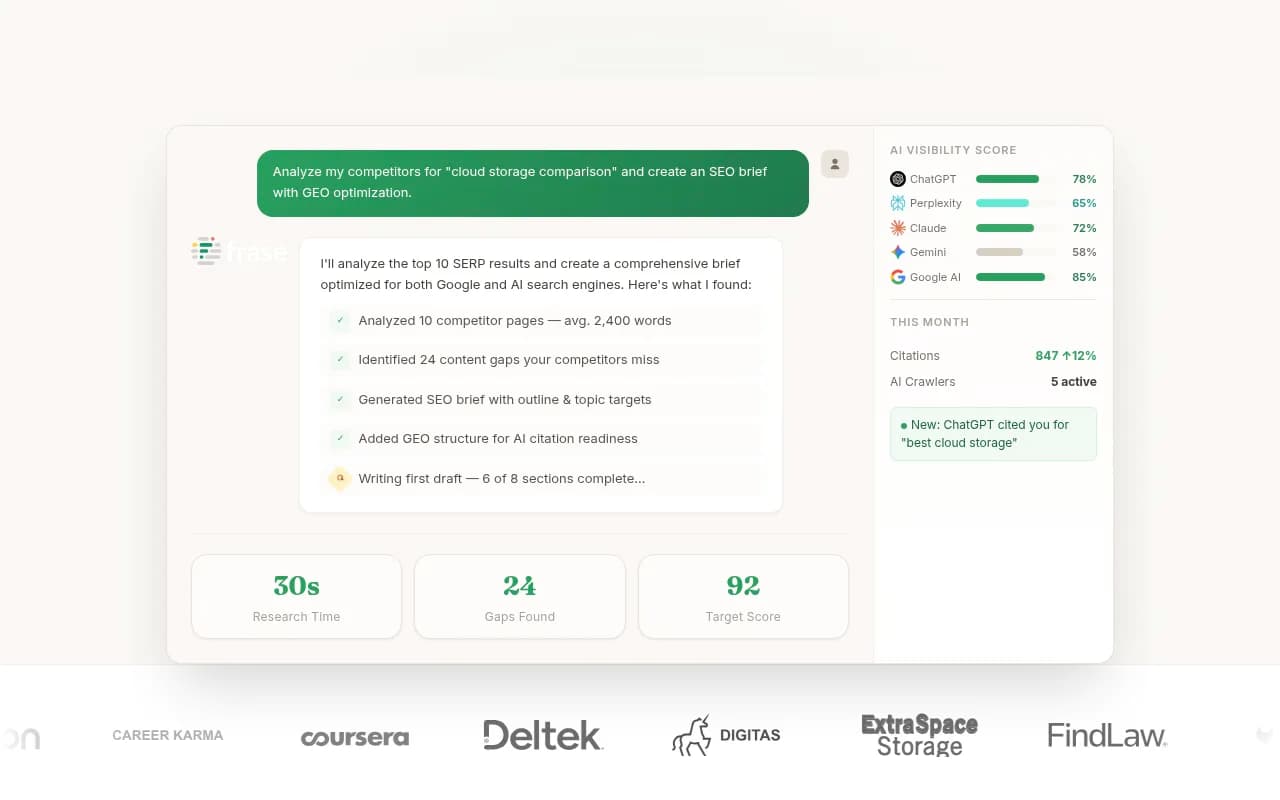
For content briefs grounded in actual AI search data rather than just traditional keyword research, Frase and MarketMuse both offer approaches worth considering.
Putting it together: the practical checklist
Before publishing any "Best X" listicle in 2026, run through this:
Structure
- Does the first paragraph contain a direct answer to the query?
- Is each list entry self-contained with a one-sentence verdict?
- Does each entry include a specific limitation or caveat?
- Is there a comparison table?
- Is there a FAQ section addressing sub-questions?
Technical
- Is ItemList schema implemented?
- Is FAQ schema implemented?
- Are AI crawlers (GPTBot, ClaudeBot, PerplexityBot) allowed in robots.txt?
- Is the page load time under 2 seconds?
Off-site
- Is your brand mentioned in third-party "Best X" lists for this category?
- Are there Reddit threads where your product is recommended?
- Is there YouTube coverage of your product in comparison videos?
Freshness
- Does the page have a visible "last updated" date?
- Is there a system to review and update this page quarterly?
Measurement
- Are you tracking which AI prompts in this category include your brand?
- Do you know which competitors appear for prompts you're missing?
The brands that check most of these boxes consistently are the ones showing up in AI "Best X" responses. It's not magic -- it's structured content that matches how AI models extract and synthesize information.
The shift from "ranking" to "being cited" is the core mental model change that 2026 requires. Ranking gets you on the page. Being citation-worthy gets you into the answer.