Key takeaways
- YouTube is the top social platform cited in Google AI Overviews, at 4.28% of citations in the week of Sep 28 to Oct 4, 2026, according to Promptwatch Data.
- Small channels win. In Promptwatch's February 2026 analysis, channels under 100K subscribers earned about 80% of YouTube citations, and nearly 80% of cited videos had under 100K views.
- Titles that phrase the exact question, a first-line answer in the description, accurate captions and chapters are the core levers.
- ChatGPT barely cites YouTube (0.05% in February 2026), so this is mainly a Google play.
- Measure it. Track which videos get cited and which prompts trigger them, rather than guessing from view counts.
Why video matters for AI Overviews
Google owns YouTube. That sounds like a trivial observation until you look at the citation data. In Promptwatch Data's social citation report covering Sep 28 to Oct 4, 2026, social platforms made up 12.2% of Google AI Overviews citations, roughly 26 times ChatGPT's share. YouTube led that group at 4.28%. Facebook had more than doubled to 2.38%, ahead of Reddit at 2.15%, with Instagram at 1.61% and LinkedIn at 1.55%.
That is a shift from earlier in the year. In the February 2026 YouTube report, YouTube sat at 2.25% of AI Overviews citations. It has nearly doubled in eight months. Meanwhile Perplexity's YouTube share fell from 2.67% to 0.79%, and ChatGPT's social citations collapsed to 0.46% across all seven platforms combined. Different engines, very different behavior.
So the practical read is simple. If your buyers search on Google, video is one of the more underused ways to get into the AI summary. If your buyers live in ChatGPT, video will not move the needle much.
What kinds of queries pull in video
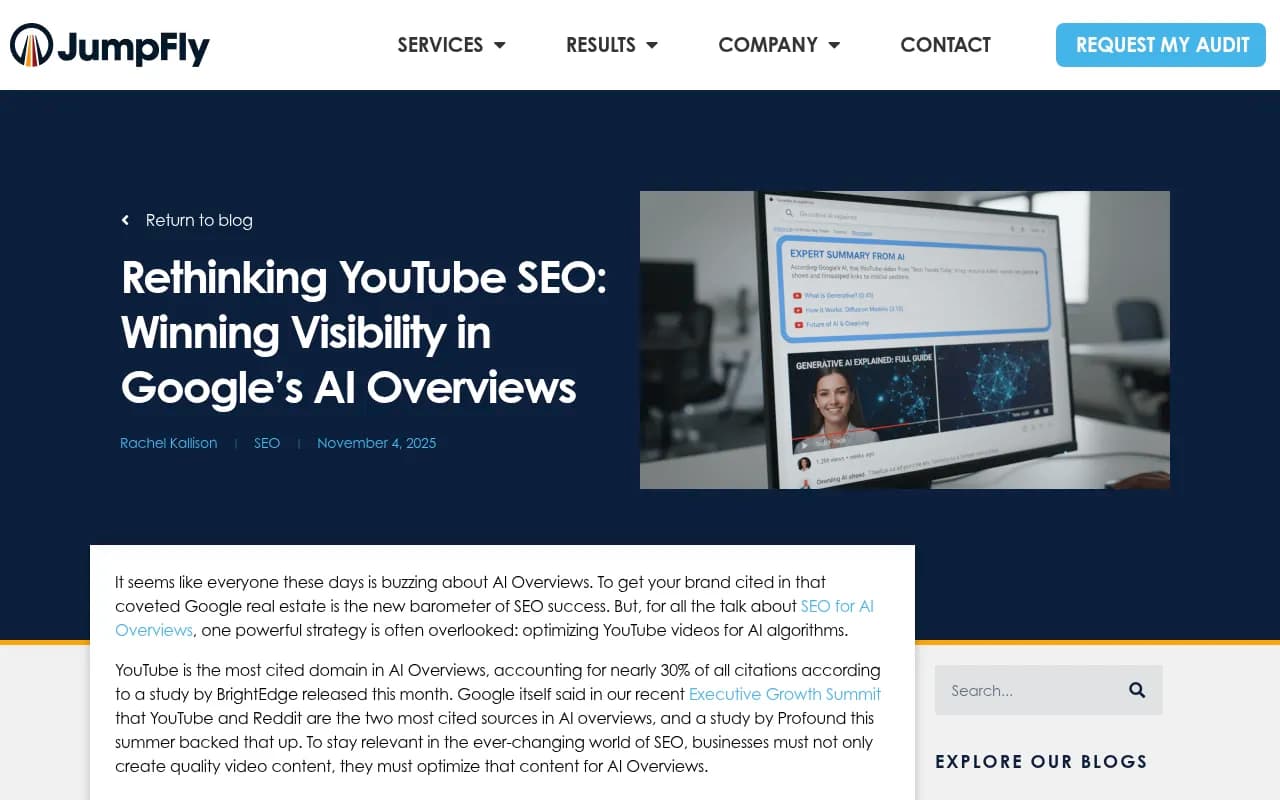
AI Overviews lean on YouTube when a visual answer is better than a paragraph. JumpFly's write-up of this topic lists how-tos, product reviews, tutorials, and anything in finance, software, health, sports or fitness as the usual suspects. Search Engine Land's Danny Goodwin, quoted in the same piece, says Google gives preference to YouTube for visual demonstrations, step-by-step tutorials and product comparisons.
That matches what I would expect. Nobody wants a 600-word text explanation of how to replace a bike chain. They want to watch someone do it.
What the citation data says about who gets cited
This is the part that should encourage smaller brands. The February 2026 Promptwatch analysis of cited YouTube videos found:
- Nearly 80% of citations went to videos with under 100K views. The 10K to 100K view bucket was the largest at 36%.
- Only about 7% of cited videos had passed 1M views.
- Likes barely matter: 43% of cited videos had fewer than 100 likes, and 78% had fewer than 1,000.
- Channels under 100K subscribers earned about 80% of citations. The 10K to 100K bucket was largest at 34%. Channels with 1M+ subscribers earned just 7%.
The takeaway: engagement and channel size are weak signals here. Relevance to the specific question is the strong one. A new channel's targeted explainer can be cited from day one, before it has built any audience. I find that more interesting than most SEO advice, because it means you do not need to out-muscle a big creator. You need to answer the question more directly than they do.
One caveat. These figures are from February 2026 and the platform mix has moved since. Treat the distribution patterns as directional, and re-check as new reports come out.
How to optimize a single video for AI Overviews
Think of each video as a source document an AI system has to quickly parse, locate an answer in, and trust. Everything below serves that.
Put the exact question in the title
Promptwatch's recommendation is to phrase the title as the question people ask. "How to descale a Breville espresso machine" beats "Maintenance tips (Part 3)". JumpFly's guidance is similar: titles should be clear, informative and descriptive. Clever and vague loses.
Find the phrasing by looking at the actual prompts and queries in your space. Autocomplete, People Also Ask and the questions your sales team hears all work. Tools like Promptwatch can also show prompt volumes and the query fan-outs AI runs for a topic, which helps you pick which questions are worth a video.

Answer in the first lines of the description
Front-load the description. The first sentence or two should state the answer in plain language, the way you would want it quoted. JumpFly advises putting key details first so AI can scrape the essentials easily, and Promptwatch's report says the same. Links, sponsors and social handles go below that.
A weak first line: "Welcome back to the channel! In today's video..."
A strong first line: "To reset a Nest thermostat, hold the ring down for 10 seconds until the screen turns off, then release and wait for the restart."
Add chapters and timestamps
Chapters let a system find the relevant segment instead of treating a 20-minute video as one blob. Both JumpFly and Promptwatch recommend them. Name chapters like questions or tasks ("Replace the filter", "Why the light blinks red") rather than "Part 2".
Fix your captions
Auto-generated captions are the transcript AI is most likely to read. JumpFly claims they are only 60 to 70% accurate, though that figure comes from a vendor blog and I would treat it as anecdotal. The principle holds regardless: product names, technical terms and numbers are exactly where auto-captions go wrong, and those are the words you want matched. Upload a clean SRT file or at minimum review the auto-captions and correct them.
Speak answers that stand alone
This one is easy to miss. If the transcript is what gets read, then a sentence like "so as I mentioned earlier, you just do that" is useless out of context. Say the full thing: "To export a report in Looker Studio, click Share, then Download report." Standalone spoken sentences become quotable passages.
Consider schema on your own site
If you embed videos on your website, JumpFly recommends VideoObject schema, timestamp (clip) markup and organization markup so AI systems understand the video content. I did not research Google's official documentation on video structured data for this guide, so check Google's current Search Central docs before implementing. Embedding the video on a page with a written summary and transcript also gives the same answer a second chance to be cited, as text.
How to optimize the channel
Single videos get the attention, but the channel is the context around them.
- Build playlists around core topics. JumpFly points out that playlists signal topical authority and work like content clusters, helping AI find answers for sub-topics within a broader theme.
- Keep channel metadata clearly topical. Your about page, channel description, video titles and playlist names should all point the same direction. A channel that covers payroll software and also random travel vlogs sends a muddy signal.
- Stay consistent in how you name things. If you call a feature "Smart Sync" in one title and "auto-sync" in another, you split your own signals.
Reworking your back catalog
Before filming anything new, look at what you already have. Promptwatch's report recommends updating titles and descriptions for back-catalog videos with 1K to 100K views, since that is the range where most cited videos sit. A video that already has a modest audience and a decent answer in it may just need a better title, a stronger first description line, chapters and fixed captions.
A simple triage:
- Export your video list with views and publish dates.
- Filter to videos between 1K and 100K views that answer a specific question.
- Rewrite titles as the question, rewrite descriptions to lead with the answer, add chapters, fix captions.
- Re-check after a few weeks to see whether those videos appear as cited sources.
This is cheaper than producing new content and probably faster.
A quick checklist by element
| Element | What to do | Why it helps |
|---|---|---|
| Title | Use the exact question or task | Matches the query and is easy to retrieve |
| Description | Answer in the first one or two sentences | Gives AI a quotable summary |
| Captions | Upload corrected SRT or fix auto-captions | The transcript is likely what gets read |
| Chapters | Name them as tasks or questions | Lets systems locate the relevant segment |
| Spoken script | Write standalone answer sentences | Makes passages quotable out of context |
| Playlists | Group by core topic | Signals topical depth |
| Channel metadata | Keep about page and titles on-topic | Clarifies what the channel is an authority on |
| On-site embed | Add summary, transcript and VideoObject schema | Gives a text version of the answer a second shot |
Does a Short work?
JumpFly tested a YouTube Short with naturally spoken phrases, a descriptive title and keyword-rich captions, and reported it appeared in an AI Overview and also ranked as the top traditional result. It is a single test from October 2025, so I would call it encouraging rather than proof. Still, it fits the broader pattern: a tight, well-labeled answer beats a long, popular one.
Don't ignore the rest of your SEO
Video is one source among many. Written guidance on AI Overviews from Americaneagle and others keeps returning to the same basics: concise answers, structured formatting like bullets and FAQs, and keeping content fresh. Those apply to the page that hosts or accompanies your video too.
If you want to go deeper on the written side, a few established tools help with on-page optimization, such as Surfer SEO and Clearscope.
Measuring whether it works
Views will not tell you whether a video is showing up in AI answers. A video can be cited a lot and have modest views, which is exactly the pattern the data shows. You need to check the answers themselves.
What to track:
- Which of your videos are cited in AI Overviews, and for which prompts
- Whether competitors' videos are cited instead, and what their titles and descriptions look like
- Whether visibility moves after you update titles, descriptions and chapters
- Downstream traffic from AI surfaces to your site
Several tools in this space can monitor AI Overviews. Promptwatch tracks YouTube, Reddit and LinkedIn citations as dedicated reports and monitors the actual Google AI Overviews interface by country, which is useful because API outputs and what users see can differ. Others to look at include:
| Tool | Angle | Best for |
|---|---|---|
| Promptwatch | Citation tracking incl. YouTube, content gap analysis, crawler logs, content generation | Teams that want to act on the data, not only monitor |
| Thruuu | AI Overview monitoring for content teams | Content teams watching specific queries |
| Knowatoa | AI Overviews and AI Mode brand monitoring | Focused Google AI surface tracking |
| Finseo | AI Mode and AI Overviews visibility | Google-specific tracking |
| Semrush | Broad SEO suite with AI tracking | Teams already in Semrush |
For a wider view of the category, the GEO software directory at bestgeosoftware.com lists many more options.
Which prompts to make videos for
Pick questions, not keywords. Good candidates:
- How-to and troubleshooting questions where seeing the steps beats reading them
- Product comparisons and "X vs Y" walkthroughs
- Tutorials for your own software or service
- Topics in finance, software, health, sports or fitness, where JumpFly says AI Overview YouTube results show up often
Then check what AI Overviews currently cite for those prompts. If a video is already cited, study its title, description and structure. If only text pages are cited, you may have a gap a video can fill.
What not to do
- Do not chase subscriber counts or likes. The data shows they are weak predictors of citation.
- Do not write clickbait titles. Specific beats curious.
- Do not bury the answer behind a long intro in either the script or the description.
- Do not assume the same video wins everywhere. ChatGPT cited YouTube for just 0.05% of its citations in February 2026, and its social citations overall were 0.46% in October. Perplexity's YouTube share dropped to 0.79%.
- Do not expect the numbers to hold still. The platform mix changed a lot between February and October 2026.
A simple 30-day plan
Week one: pick 10 questions your customers ask and check what AI Overviews cite for each. Week two: update titles, descriptions, chapters and captions on the five best-fitting existing videos. Week three: record two or three tight explainers that answer one question each, in under ten minutes, with the answer stated early. Week four: build or fix playlists, check channel metadata, and review which videos now show up as cited.
One more point. Promptwatch's advice is that if your buyers search on Google, YouTube comes first, then keep public Facebook and Instagram profiles complete and active, given their growing share in AI Overviews. That is a reasonable order of operations.
For more AI search research behind these numbers, the Promptwatch Data hub publishes regularly updated reports on citations across ChatGPT, Perplexity and Google AI Overviews.