Key takeaways
- A traditional keyword gap analysis won't cut it for AI search. You need to find the prompts and questions AI models are answering without citing you.
- The modern content gap has four dimensions: semantic gaps, intent gaps, format gaps, and value gaps (unique data or perspectives AI can't generate itself).
- The process runs in five stages: define your scope, audit what you already have, map competitor visibility in AI, identify specific gaps, then create and track content.
- Tools like Promptwatch can automate much of this -- showing you exactly which prompts competitors appear in that you don't, then helping you generate content to close those gaps.
- Measuring success means tracking AI citation rates, not just organic traffic. These are different metrics.
If you've been doing content gap analysis the traditional way -- pulling keyword data, comparing rankings, filling in missing topics -- you've probably noticed something: it doesn't translate cleanly to AI search.
ChatGPT doesn't rank pages. Perplexity doesn't care about your domain authority. Google AI Overviews pull from sources that often aren't the top organic results. The whole framework shifts when AI is the one synthesizing answers and deciding who gets cited.
This guide walks through how to actually do a content gap analysis for AI search in 2026. Some of it overlaps with traditional SEO. A lot of it doesn't.
What's different about AI search content gaps
In traditional search, a content gap is simple: your competitor ranks for a keyword you don't. Fix it by writing a page that targets that keyword.
In AI search, the gap is more subtle. AI models don't just look for pages that match a query -- they look for pages that answer a query with enough depth, specificity, and trustworthiness to be worth citing. You can have a page that ranks #1 in Google and still be completely invisible in ChatGPT's answer to the same question.
The gaps that matter in AI search fall into four categories:
- Semantic gaps: Topics or subtopics your site doesn't cover at all, which means AI has nothing to pull from when those questions come up.
- Intent gaps: You have content on a topic, but it's written for the wrong use case. A buyer asking "best project management software for remote teams" needs a different answer than someone asking "what is project management software."
- Format gaps: AI models prefer structured, citable content. If your knowledge lives in dense paragraphs with no clear structure, it's harder for AI to extract and cite.
- Value gaps: This is the hardest one. AI can synthesize generic information from thousands of sources. If your content doesn't add something unique -- original data, a specific methodology, a concrete case study -- there's no reason for AI to cite you over anyone else.
The Yotpo team describes this last category as "Information Gain": the unique expertise or data that AI models rely on because they can't generate it from consensus alone. It's a useful framing.
Step 1: Define your scope
Before pulling any data, get specific about what you're analyzing. Trying to close every gap at once leads to a spreadsheet nobody uses.
Pick one of these starting points:
- A specific product or service category
- A stage of the customer journey (awareness, consideration, decision)
- A competitor you're losing to in AI results
- A set of high-value prompts you know your customers are typing
For most teams, starting with a competitor is the fastest path to useful insights. If you know Brand X keeps showing up when customers ask questions you should be answering, that's your scope.
Also decide which AI models matter most for your audience. If you're B2B, Perplexity and ChatGPT are probably your priority. If you're e-commerce, Google AI Overviews and ChatGPT Shopping matter more. You don't need to analyze all ten models at once.
Step 2: Audit your existing content
You need a baseline before you can identify gaps. This means knowing what you already have and how it's performing in AI search -- not just in Google.
Map your current content
Export your site's pages (a tool like Screaming Frog works for this) and categorize them by topic cluster. You want to see:
- Which topics you have substantial coverage on
- Which topics have thin or outdated content
- Which pages are already getting cited in AI responses
That last point is the one most teams skip. Traditional content audits look at organic traffic and rankings. For AI search, you need to know which pages AI crawlers are actually reading and citing.
Check AI crawler activity
If you have access to server logs or a crawler analytics tool, look for visits from known AI bots: GPTBot (OpenAI), ClaudeBot (Anthropic), PerplexityBot, Google-Extended. These tell you which pages AI models are actively reading.
Pages that get crawled frequently but never cited are a signal that the content isn't citable enough -- it's being read but not trusted. That's a format or value gap, not a coverage gap.
Promptwatch has a crawler log feature that surfaces exactly this: which pages AI agents are hitting, how often, and whether those crawls are converting into citations.

Step 3: Map competitor visibility in AI
This is the core of the gap analysis. You need to know where competitors are getting cited in AI responses that you're not.
Manual spot-checking
The low-tech version: open ChatGPT, Perplexity, and Google, and start typing prompts your customers would ask. Look at who gets cited. Note which competitors appear consistently.
This works for getting a feel for the landscape, but it doesn't scale. You can't manually check hundreds of prompts across multiple AI models.
Systematic prompt testing
Build a list of 30-50 prompts relevant to your category. These should be:
- Questions your customers actually ask (pull from sales calls, support tickets, Reddit, Google's "People also ask")
- Comparison queries ("X vs Y", "best X for Y")
- How-to and explainer prompts
- Category-level prompts ("best [product type]", "top [service type] tools")
Run each prompt across your priority AI models and record who gets cited. A spreadsheet works. You're looking for patterns: which competitors show up repeatedly, which topics they own, and which prompts return zero results for your brand.
Using AI visibility tools
Doing this manually for 50 prompts across 5 models is about 250 manual queries. Doable once, but not sustainable.
Tools built for this can track prompt responses at scale, flag when competitors appear and you don't, and surface the specific gaps automatically.



The key difference between tools here is whether they stop at showing you the data or help you act on it. Most monitoring tools will tell you "competitor X appears for this prompt and you don't." That's useful. But you still have to figure out why and what to do about it.
Step 4: Identify and categorize the gaps
Now you have data. The next step is turning it into a prioritized list of gaps worth closing.
The gap audit matrix
For each prompt where a competitor appears and you don't, ask:
- Do I have any content on this topic? (If no: coverage gap)
- If yes, is my content actually answering this specific question? (If no: intent gap)
- Is my content structured in a way AI can parse and cite? (If no: format gap)
- Does my content say anything a competitor's content doesn't? (If no: value gap)
This categorization matters because the fix is different for each type. A coverage gap means writing new content. An intent gap means rewriting existing content. A format gap means restructuring. A value gap means adding original research, data, or expertise.
Prioritization
Not all gaps are worth closing. Prioritize based on:
- Prompt volume: How often are people actually asking this? High-volume prompts are worth more.
- Competitor strength: Is the competitor currently citing a weak source you could displace, or a deeply authoritative one?
- Business value: Does this prompt map to a stage of the funnel that matters? A prompt that leads to purchase decisions is worth more than one that leads to general awareness.
- Your ability to add unique value: If you have original data, case studies, or expertise on this topic, you have a real shot at being cited. If you don't, you're competing on generic content.
Step 5: Create content to close the gaps
This is where most guides stop at "write better content." That's not wrong, but it's not specific enough.
What AI-citable content actually looks like
AI models tend to cite content that:
- Directly answers a specific question in the first few sentences
- Uses clear headings that match the structure of the question
- Includes specific facts, numbers, or examples (not just general claims)
- Has a clear author or organizational source
- Is structured so that a paragraph or section can be extracted and cited without losing meaning
That last point is worth sitting with. AI doesn't cite entire articles -- it pulls specific passages. If your article is written as one continuous argument that only makes sense as a whole, it's harder to cite than an article structured as discrete, self-contained answers.
Content formats that work
For AI search, these formats tend to perform well:
- Direct answer articles: "What is X" and "How does X work" with clear, structured answers
- Comparison pages: "X vs Y" with explicit pros, cons, and use-case recommendations
- Listicles with depth: Not just a list, but each item explained with enough specificity to be citable
- Original research or data: Survey results, proprietary data, case studies -- anything AI can't synthesize from other sources
- FAQ pages: Structured Q&A maps directly to how AI models process queries
Using content gap data to brief writers
The best content briefs for AI search come from actual prompt data. Instead of briefing a writer on "write about project management software," you brief them on "answer these 12 specific questions that AI models are being asked about project management software, where we currently have no cited presence."
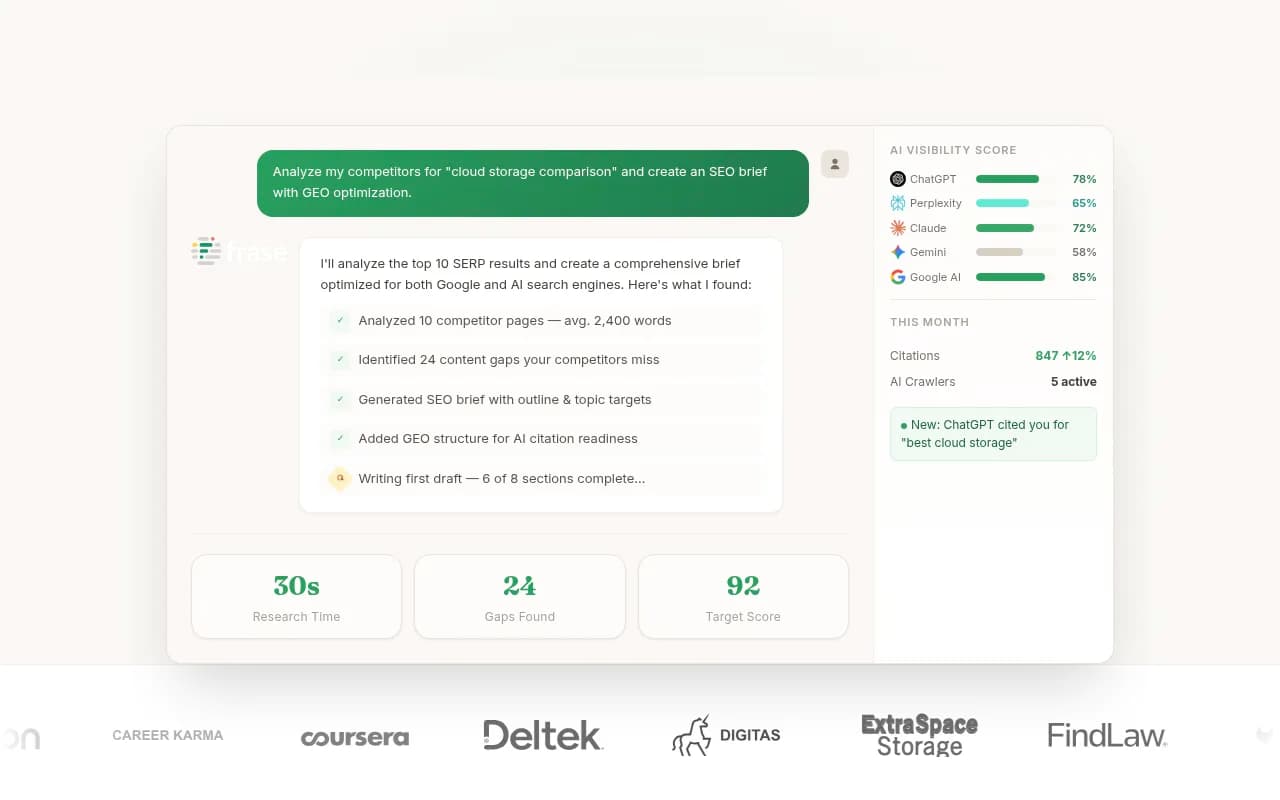
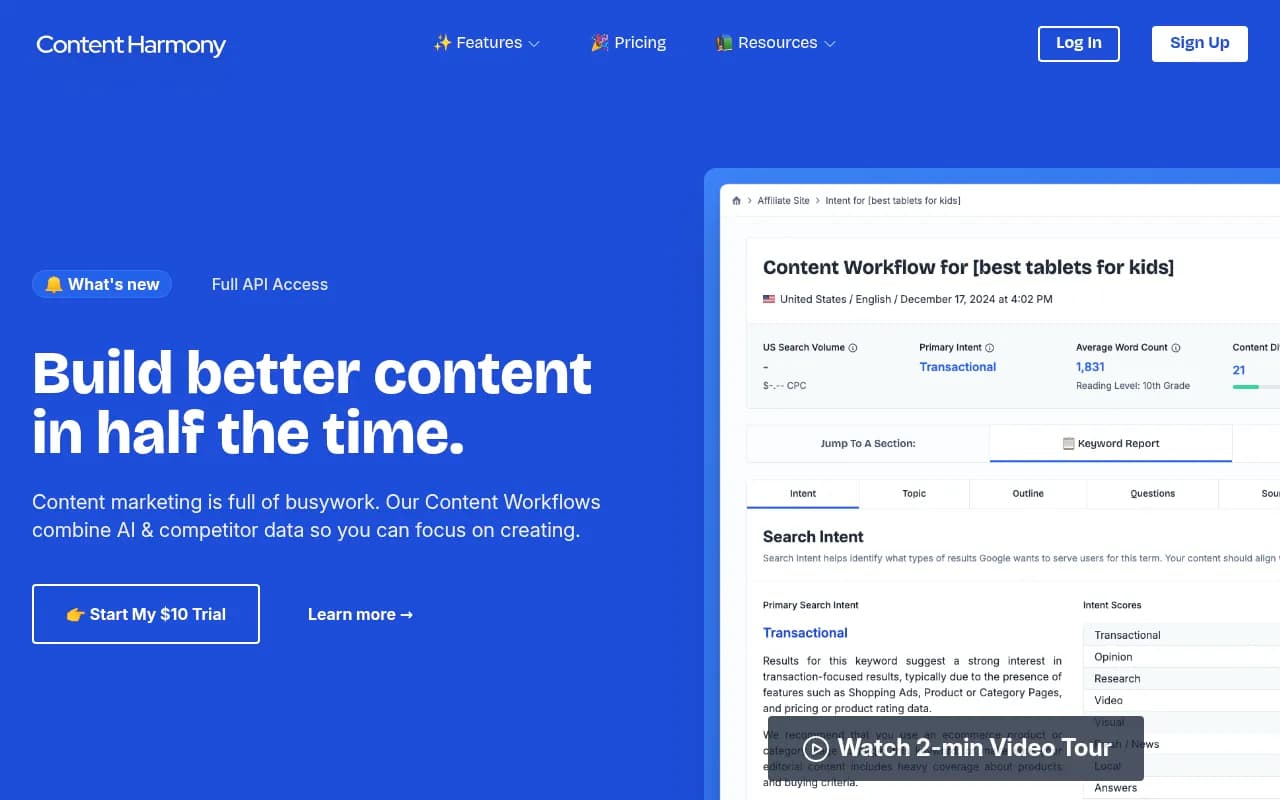
Tools like Frase and Content Harmony are built for this kind of brief generation. Surfer SEO helps with on-page optimization once the content is written.
If you're using Promptwatch, its Content Agents generate briefs and articles directly from gap data -- the prompts you're missing, the competitors who are winning them, and the specific angles that are getting cited.
Step 6: Track whether it's working
Publishing content and hoping for the best is not a strategy. You need to close the loop.
What to track
For each piece of content you create to close a gap:
- Is it getting crawled by AI bots? (Check crawler logs or your AI visibility tool)
- Is it appearing in AI responses for the target prompts?
- How long did it take from publish to first citation?
- Which AI models are citing it?
- Is the citation driving traffic back to your site?
This last metric is worth flagging. AI citations don't always drive clicks -- sometimes your brand just gets mentioned in a response without a link. That's still valuable for brand awareness, but it's different from traffic-driving visibility. Track both.
Setting realistic timelines
AI models don't update in real time. There's typically a lag between when you publish content, when AI crawlers index it, and when it starts appearing in responses. Based on data from Promptwatch's crawler analytics, this lag can range from a few days to several weeks depending on the model and your site's crawl frequency.
Don't judge new content after one week. Give it 4-8 weeks before drawing conclusions.
The comparison table
Here's how the main tools for AI content gap analysis compare on the capabilities that matter most for this workflow:
| Tool | Prompt tracking | Competitor gap analysis | Content generation | Crawler logs | Best for |
|---|---|---|---|---|---|
| Promptwatch | Yes (10 models) | Yes, automated | Yes (Content Agents) | Yes | Full gap-to-content workflow |
| Profound | Yes | Yes | No | No | Monitoring + gap identification |
| AthenaHQ | Yes | Yes | No | No | Monitoring-focused teams |
| Otterly.AI | Basic | Basic | No | No | Budget monitoring |
| Semrush | Limited | Keyword-based | Partial | No | Traditional SEO teams adding AI |
| Frase | No | No | Yes | No | Content brief generation |
| Surfer SEO | No | No | Yes | No | On-page optimization |
The pattern is clear: most tools handle one part of the workflow. Promptwatch is the only one that covers the full loop from gap identification through content creation to citation tracking.
Common mistakes to avoid
Treating AI search like traditional SEO. Keyword density, backlink counts, and domain authority matter less here. What matters is whether your content directly and specifically answers the question being asked.
Ignoring the value gap. If you only close coverage gaps -- writing content on topics you were missing -- you'll end up with generic content that competes with thousands of other generic pages. AI models have no reason to cite you over anyone else. Add something original.
Analyzing only one AI model. ChatGPT and Google AI Overviews pull from different sources and behave differently. A gap analysis that only looks at one model will miss significant opportunities.
Not checking format. You can have great content that AI simply can't parse. Run your pages through an AI model and ask it to summarize them. If the summary is vague or misses the point, your structure needs work.
Skipping the tracking step. Gap analysis without measurement is just content planning. You need to know whether your changes are actually moving your citation rates.
Putting it together
The full workflow looks like this:
- Pick a scope (competitor, topic cluster, or customer journey stage)
- Audit your existing content for AI crawl and citation data
- Run target prompts across priority AI models, recording who gets cited
- Categorize each gap (coverage, intent, format, or value)
- Prioritize by prompt volume, business value, and your ability to add unique insight
- Create content structured for AI citation, not just organic ranking
- Track crawl-to-citation timelines and adjust
The biggest shift from traditional gap analysis is the last step. In traditional SEO, you publish and check rankings. In AI search, you publish, watch for crawls, watch for citations, and then iterate on the content itself when citations don't materialize.
It's a tighter feedback loop -- and it rewards teams who treat content as something to optimize continuously, not just publish once.