Key takeaways
- AI visibility tools vary widely in what they actually do -- some only monitor, others help you act on the data
- Promptwatch is the only platform in this comparison that covers the full loop: tracking, content gap analysis, AI content generation, and crawler logs
- LLM Pulse and Peec AI are solid monitoring-focused options with transparent pricing starting under €100/month
- Omnia is strong for share-of-voice analytics and competitive benchmarking
- Rankshift is a lightweight option worth considering for smaller teams or agencies just getting started
- If you're serious about improving your AI search visibility (not just watching it), you need a platform that goes beyond dashboards
The AI search visibility category has exploded. Two years ago, tracking how your brand appeared in ChatGPT or Perplexity was a niche experiment. Now it's a line item in marketing budgets at companies of every size. The problem? The tools have multiplied faster than the clarity around what they actually do.
This comparison focuses on five platforms that come up repeatedly in 2026 discussions: Omnia, Promptwatch, Peec AI, Rankshift, and LLM Pulse. They're not all the same. Some are monitoring dashboards. Some are optimization platforms. One is genuinely trying to close the loop between data and action. Understanding the difference matters a lot before you commit to one.
What these tools actually do (and don't do)
Before diving into the comparison, it's worth being clear about the category itself. An AI visibility tool tracks how your brand appears in AI-generated responses -- when someone asks ChatGPT "what's the best CRM for startups?" or Perplexity "which accounting software should I use?", does your brand get mentioned? Cited? Recommended?
Traditional SEO tools are blind to this. Google Analytics doesn't capture it. So a new category emerged to fill the gap.
But "AI visibility tool" now covers a wide spectrum:
- Pure monitoring: You see your mention rate, share of voice, sentiment. That's it.
- Monitoring plus content briefs: You see the gaps and get suggestions for what to write.
- Full optimization platforms: You see the gaps, generate content designed to fill them, track crawler behavior, and connect visibility to revenue.
Most tools in this comparison sit somewhere in the first two buckets. That's not a criticism -- monitoring is genuinely useful. But if you're expecting a tool to help you actually improve your AI visibility, you need to know which category you're buying into.
The five tools at a glance
Omnia
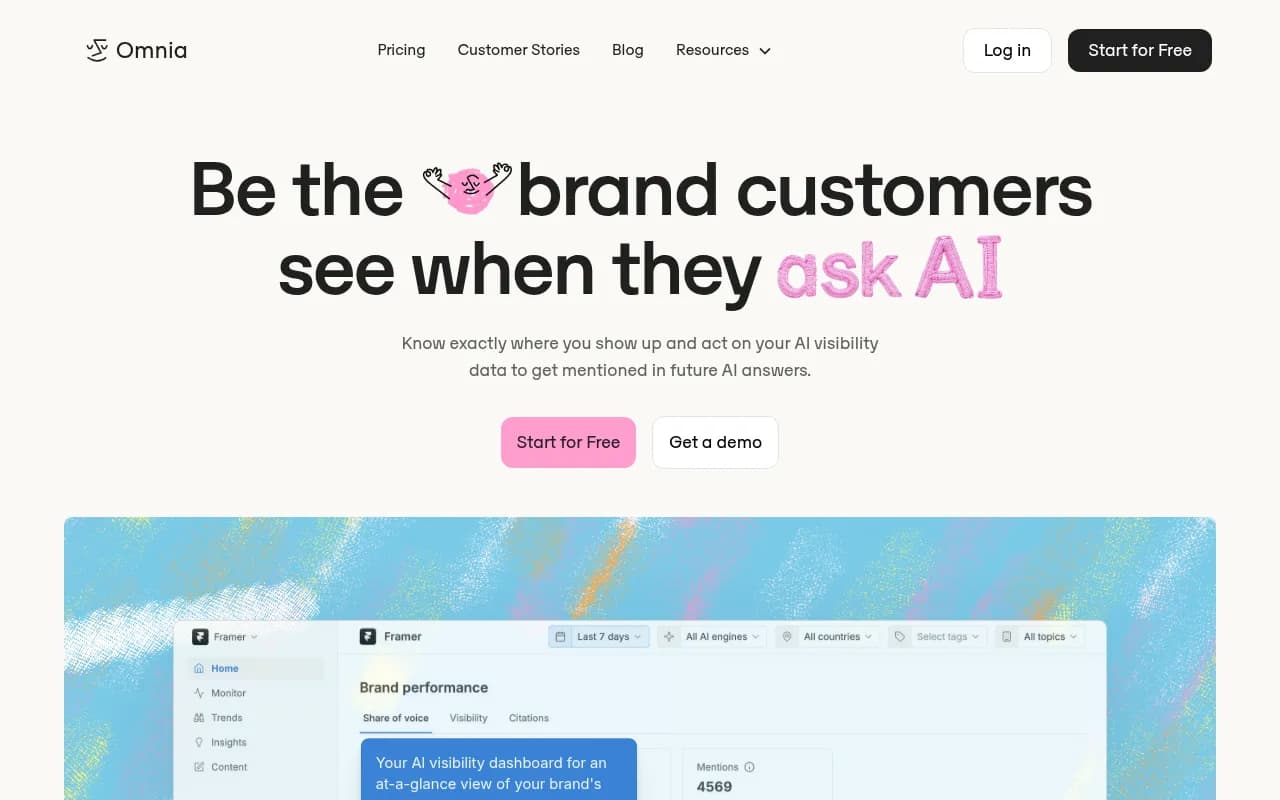
Omnia (useomnia.com) positions itself as an AI-powered visibility and share-of-voice analytics platform. Its blog has published some of the more thorough roundups of AI search monitoring tools in 2026, which suggests the team is thinking seriously about the category.
The platform focuses on competitive benchmarking -- showing you how your brand stacks up against competitors across AI models. Share-of-voice metrics, mention frequency, and sentiment tracking are the core outputs. It's a solid choice if competitive intelligence is your primary use case.
What Omnia doesn't do: there's no content generation, no crawler log analysis, and no direct path from "here's your gap" to "here's the content that fills it."
Peec AI
Peec AI is one of the more flexible options in this comparison. It supports up to 10 AI models and lets you customize which models you track, which is genuinely useful if your audience skews toward specific platforms. The entry price is around €85/month, which is reasonable for what you get.
Multiple independent reviews in 2026 have placed Peec AI in the top tier for monitoring-focused tools. The multi-language support is a real differentiator for European brands or anyone targeting non-English markets.
The limitation is the same as most monitoring tools: Peec AI shows you data but doesn't help you act on it. There's no content generation, no crawler logs, no traffic attribution.

Rankshift
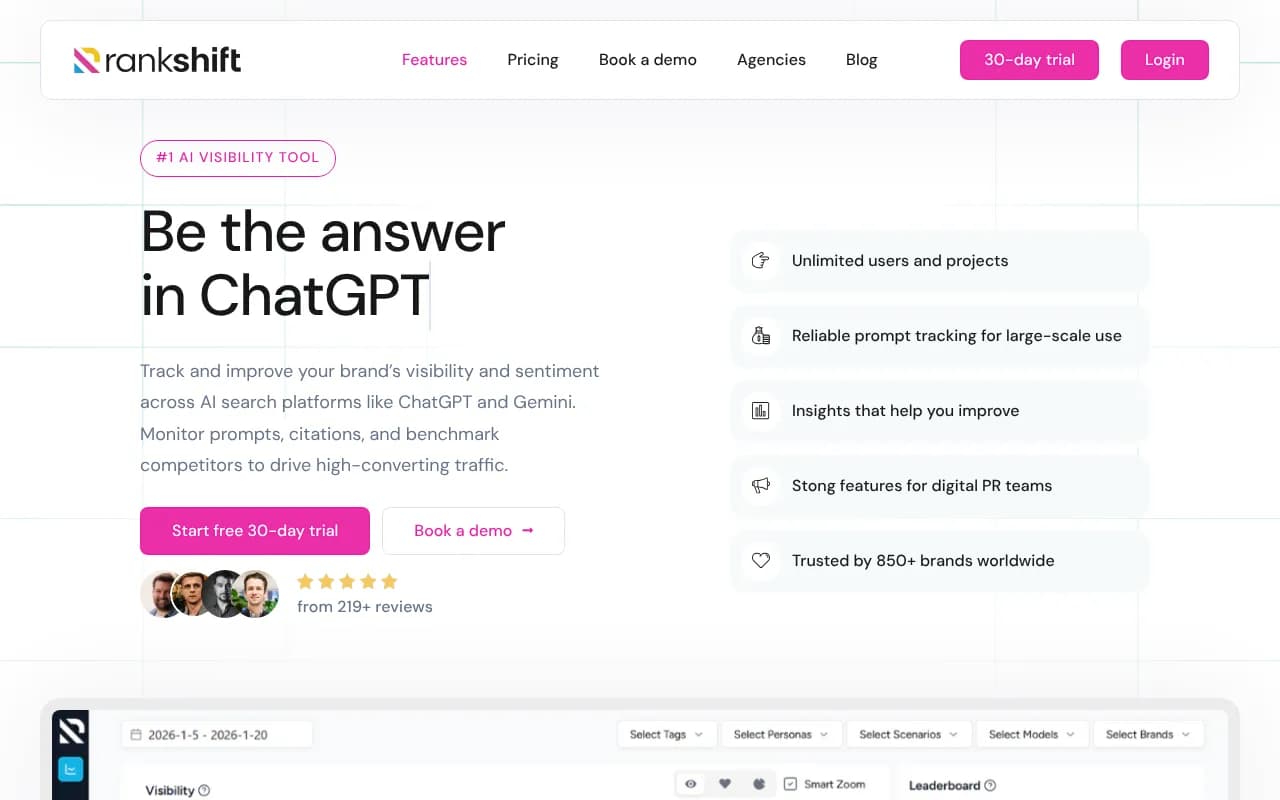
Rankshift is a lighter-weight option aimed at GEO and AI visibility tracking. It's worth considering for smaller teams or agencies that want a straightforward dashboard without the complexity (or price) of enterprise platforms.
The feature set is more limited than the other tools here -- it's primarily a tracking tool, not an optimization platform. But for teams that just need to answer "are we showing up in AI search results?", Rankshift gets the job done without overcomplicating things.
LLM Pulse
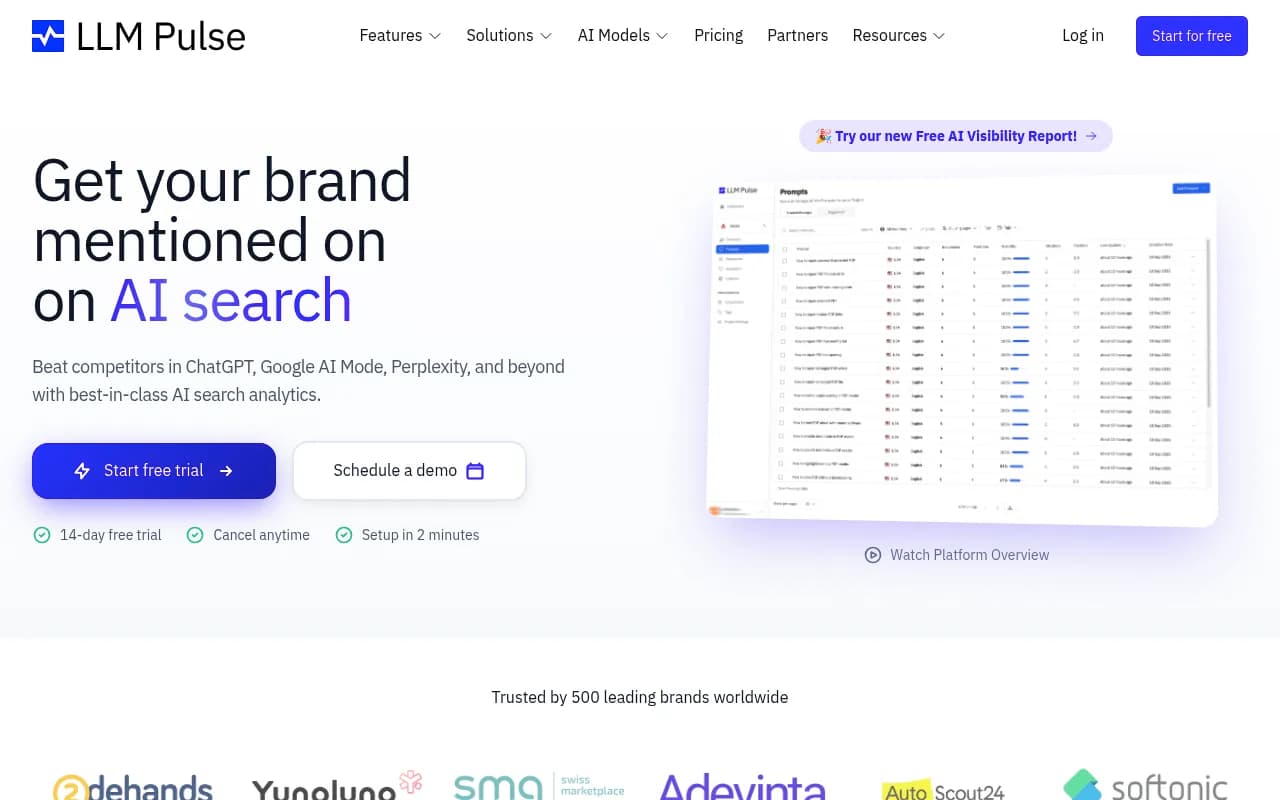
LLM Pulse has been getting strong reviews in 2026, with at least one independent roundup placing it as the top overall AI visibility tool. The pitch is solid: 5+ AI model coverage, real-time sentiment analysis, share-of-voice tracking, and transparent pricing starting at €49/month with a 14-day free trial.
That price point is genuinely competitive. If you're a smaller brand or early in your AI visibility journey, LLM Pulse is one of the more accessible entry points in the category.
Like the others, though, it's primarily a monitoring tool. The data is good. The path from data to improved visibility is still largely up to you.
Promptwatch
Promptwatch is the outlier in this comparison -- and I mean that in a specific, meaningful way. Every other tool here is essentially a monitoring dashboard. Promptwatch is built around what happens after you see the data.
The core difference is the action loop: find gaps, create content, track results. Answer Gap Analysis shows you exactly which prompts competitors are visible for that you're not. Content Agents then generate articles, listicles, and comparisons grounded in real prompt data and citation analysis. And page-level tracking shows you when that new content starts getting cited, by which models, and how often.
It also has capabilities that none of the other tools in this comparison offer: AI crawler logs (real-time logs of ChatGPT, Claude, Perplexity, and others hitting your website), ChatGPT Shopping tracking, Reddit and YouTube insights, and traffic attribution that connects AI visibility to actual revenue.
Used by 1,480+ brands and agencies including Booking.com and Center Parcs, it's the most complete platform in this comparison -- and priced accordingly, starting at $99/month.

Side-by-side feature comparison
| Feature | Omnia | Peec AI | Rankshift | LLM Pulse | Promptwatch |
|---|---|---|---|---|---|
| AI models tracked | Multiple | Up to 10 | Multiple | 5+ | 10 |
| Brand mention tracking | Yes | Yes | Yes | Yes | Yes |
| Share of voice | Yes | Yes | Limited | Yes | Yes |
| Sentiment analysis | Yes | Yes | Basic | Yes | Yes |
| Competitor benchmarking | Yes | Yes | Yes | Yes | Yes |
| Content gap analysis | No | No | No | No | Yes |
| AI content generation | No | No | No | No | Yes |
| AI crawler logs | No | No | No | No | Yes |
| Traffic attribution | No | No | No | No | Yes |
| Reddit/YouTube insights | No | No | No | No | Yes |
| ChatGPT Shopping tracking | No | No | No | No | Yes |
| Multi-language support | Limited | Yes | Limited | Yes | Yes |
| Starting price | Custom | ~€85/mo | Custom | €49/mo | $99/mo |
| Free trial | Unknown | Yes | Unknown | Yes (14 days) | Yes |
Pricing breakdown
Pricing in this category is not always transparent, which is frustrating. Here's what's publicly available:
- LLM Pulse: €49/month entry, with a 14-day free trial. The most accessible starting point.
- Peec AI: ~€85/month. Reasonable for the model coverage you get.
- Promptwatch: $99/month (Essential, 1 site, 50 prompts), $249/month (Professional, 2 sites, 150 prompts, crawler logs), $579/month (Business, 5 sites, 350 prompts). Annual billing discounts available.
- Omnia: Custom pricing -- you'll need to talk to their team.
- Rankshift: Pricing not publicly listed; contact required.
The lack of public pricing from Omnia and Rankshift is worth noting. It's not necessarily a red flag, but it does make comparison shopping harder.
Who should use which tool
This is where the rubber meets the road. The right tool depends entirely on what you're trying to accomplish.
If you're just getting started and want to understand your current AI visibility without a big investment, LLM Pulse is the most accessible entry point. The €49/month price and free trial make it easy to validate whether AI visibility tracking is worth your time before committing to a bigger platform.
If you need flexible model coverage and multi-language support, Peec AI is worth a serious look. The ability to customize which AI models you track is genuinely useful, and the pricing is reasonable.
If competitive share-of-voice analysis is your primary goal, Omnia's focus on benchmarking makes it a natural fit. It's built for teams that want to understand where they stand relative to competitors across AI search results.
If you're a smaller team or agency that wants simple tracking without complexity, Rankshift is worth evaluating. It won't give you the depth of the other tools, but it's a lower-friction starting point.
If you want to actually improve your AI visibility -- not just measure it -- Promptwatch is the only platform in this comparison that gives you the full toolkit. The content gap analysis, AI content generation, and crawler logs mean you're not just watching your visibility score; you're actively working to change it. For marketing teams that need to show results, not just reports, that distinction matters.
The monitoring-only problem
Here's something worth saying plainly: most AI visibility tools in 2026 are still monitoring-only products. They show you a dashboard. They tell you your mention rate went up or down. They compare you to competitors. And then they stop.
That's useful information. But it's not a strategy. Knowing you're invisible in AI search results doesn't tell you what to write, which prompts to target, or whether your new content is actually being crawled and cited by AI models.
The gap between "we know we have a problem" and "we fixed the problem" is where most teams get stuck. Monitoring tools get you to the first step. Optimization platforms like Promptwatch are designed to get you to the second.
This isn't a knock on monitoring tools -- they serve a real purpose, especially for teams that are still making the case internally for AI search investment. But if you're already past the "should we care about this?" stage and into the "how do we improve this?" stage, the tool you need looks very different.
A note on model coverage
One thing that varies significantly across these tools is which AI models they track. This matters more than it might seem. ChatGPT, Perplexity, Google AI Overviews, Claude, Gemini, and Grok all have different user bases, different citation behaviors, and different ways of surfacing brand recommendations.
A tool that only tracks three or four models might be missing the platforms where your specific audience is most active. If your customers skew toward enterprise buyers, they might be using Copilot or Claude more than Perplexity. If they're researchers, Perplexity might dominate.
Promptwatch tracks 10 models (ChatGPT, Perplexity, Google AI Overviews, Google AI Mode, Claude, Gemini, Meta/Llama, DeepSeek, Grok, Mistral, Copilot). Peec AI also supports up to 10. LLM Pulse covers 5+. Omnia and Rankshift don't publish specific model counts.
Before committing to any platform, ask specifically which models are tracked and whether new models are added automatically as the landscape evolves.
Final verdict
There's no single "best" tool here -- it genuinely depends on your situation. But there are some clear patterns:
For pure monitoring on a budget, LLM Pulse is hard to beat at €49/month. For flexible model selection and multi-language needs, Peec AI earns its place. For competitive benchmarking, Omnia is worth a conversation.
But if your goal is to actually move the needle on AI search visibility -- to go from invisible to cited -- Promptwatch is the only platform in this comparison built for that outcome. The monitoring is there, but so is everything you need to act on it: content gap analysis, AI-generated content, crawler logs, and traffic attribution. That's a meaningfully different product from a dashboard that tells you where you're losing.
The AI search landscape is still early enough that the teams who build systematic optimization workflows now will have a significant head start. The question is whether you want a tool that shows you the problem or one that helps you solve it.