Key takeaways
- Crawler log analysis is the single biggest differentiator between AI visibility platforms in 2026 -- most tools skip it entirely
- Promptwatch is the only platform in this comparison that combines real-time AI crawler logs with content generation and revenue attribution in one place
- Omnia and Evertune are strong monitoring tools but stop short of helping you act on what you find
- ZipTie takes a browser-level tracking approach that improves accuracy but covers fewer AI models
- Scriptbee is not a recognized AI visibility platform -- if you've seen it mentioned, it's likely confused with another tool in this space
- For agencies managing multiple clients, the choice comes down to how much you need to do beyond monitoring
If you've been shopping for an AI visibility platform in 2026, you've probably noticed something frustrating: most comparison articles treat all these tools as roughly equivalent, just with different price tags. They're not. The gap between a tool that shows you a citation count and one that tells you why you're being cited -- and helps you get cited more -- is enormous.
This comparison focuses specifically on crawler log analysis, because that's where the real differentiation lives. Knowing your brand appeared in 40% of ChatGPT responses is useful. Knowing which pages ChatGPT actually crawled before generating those responses, how often it returns, and which pages it ignores entirely -- that's what lets you fix things.
Let's go platform by platform.
What "deep crawler log analysis" actually means
Before comparing tools, it's worth being precise about what we're evaluating. Crawler log analysis in the AI search context means tracking when AI agents (ChatGPT's GPTBot, Perplexity's PerplexityBot, Claude's ClaudeBot, etc.) visit your website. Specifically:
- Which pages they crawl and how often
- Which HTTP errors they encounter
- How long it takes from crawl to citation
- Which pages get crawled but never cited (and why)
- Whether new content gets discovered quickly or sits ignored
This is fundamentally different from prompt monitoring, which tracks what AI models say about your brand. Crawler logs explain the mechanism behind those answers. A platform with both gives you a complete picture. A platform with only one leaves you guessing.
The platforms
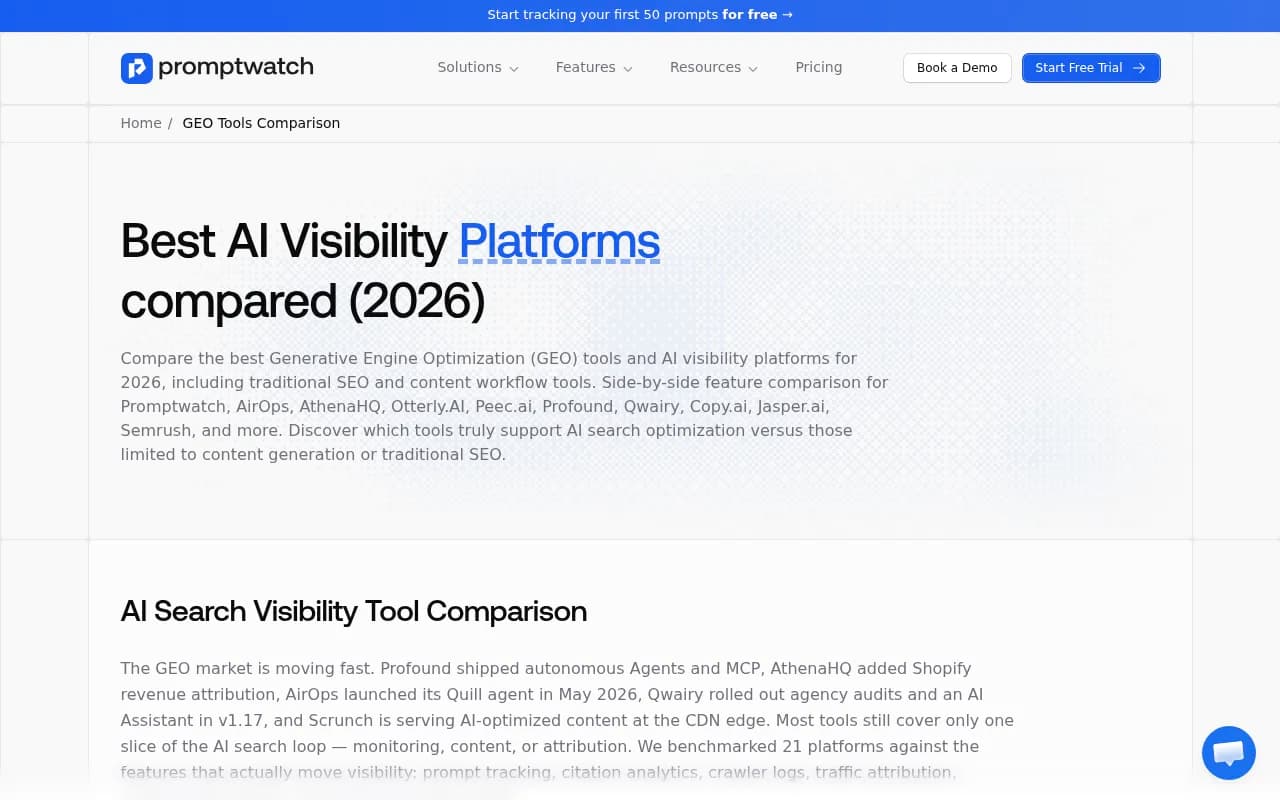
Promptwatch
Promptwatch is the most complete platform in this comparison. It monitors 10 AI models (ChatGPT, Perplexity, Claude, Gemini, Google AI Overviews, Google AI Mode, Grok, DeepSeek, Copilot, and Mistral) and pairs that monitoring with real-time AI crawler logs that show exactly which pages each AI agent visits, what errors they hit, and how quickly pages move from crawl to citation.
What separates Promptwatch from the others here isn't just the crawler logs -- it's what you can do with them. The platform's Answer Gap Analysis identifies specific prompts where competitors appear but you don't, then Content Agents generate articles and briefs designed to close those gaps. You're not just watching the problem; you're fixing it.
Other things worth noting: Promptwatch tracks Reddit discussions and YouTube content that influence AI recommendations, monitors ChatGPT Shopping carousels, and connects visibility data to actual revenue through traffic attribution. The page-level tracking shows which specific URLs are being cited and by which models, so you can prioritize optimization work precisely.
Pricing starts at $99/month for the Essential plan (1 site, 50 prompts, 5 articles). The Professional plan at $249/month adds crawler logs, city/state tracking, and 15 articles per month. Business is $579/month for 5 sites and 350 prompts.

Omnia
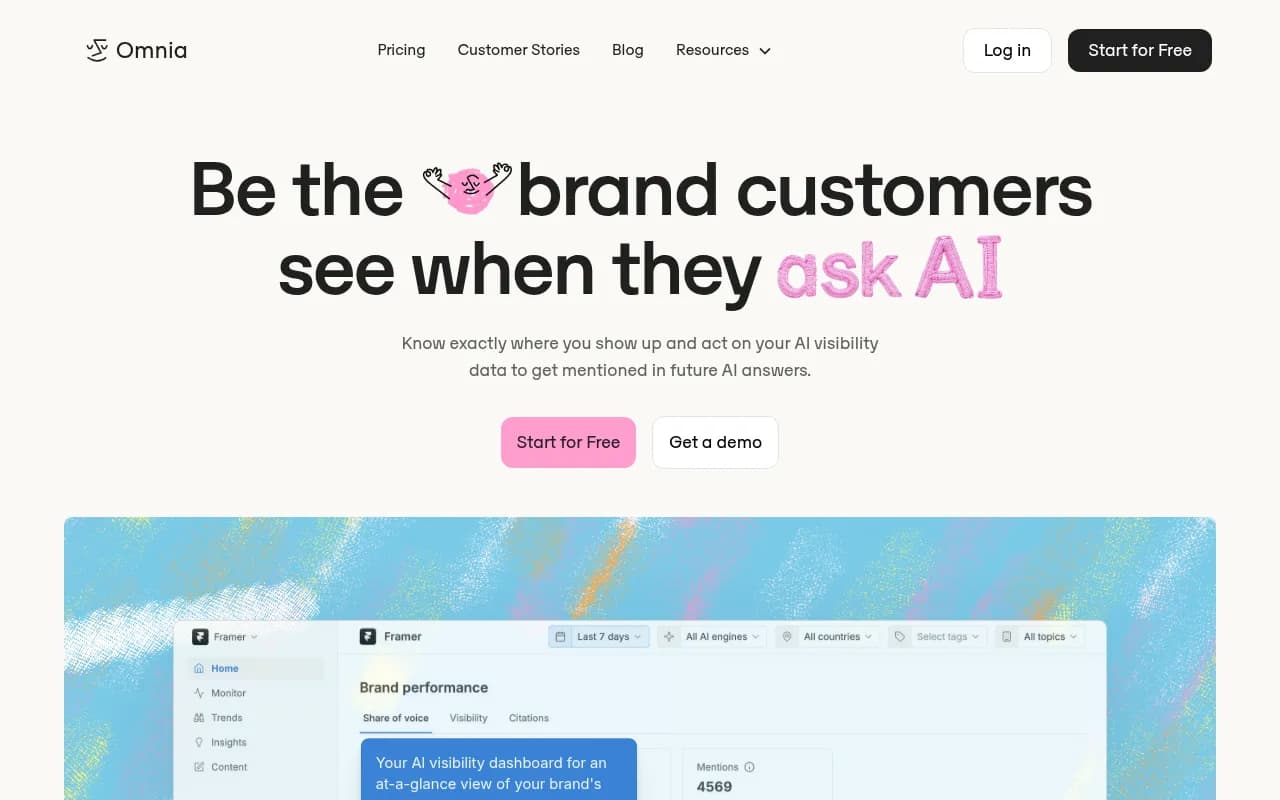
Omnia (useomnia.com) is a purpose-built AI visibility platform that covers four major AI models. Its core strength is share-of-voice analytics -- it's genuinely good at showing you how your brand's presence compares to competitors across AI responses over time.
What Omnia doesn't do is crawler log analysis. There's no mechanism for understanding which pages AI agents are actually visiting on your site, which means you can see that your visibility is declining but not diagnose why at the infrastructure level. It's a monitoring-first tool, and a solid one, but the gap between "we see a problem" and "here's how to fix it" is left to you.
Omnia also lacks content generation capabilities. If you want to act on the gaps it surfaces, you'll need a separate workflow.
ZipTie
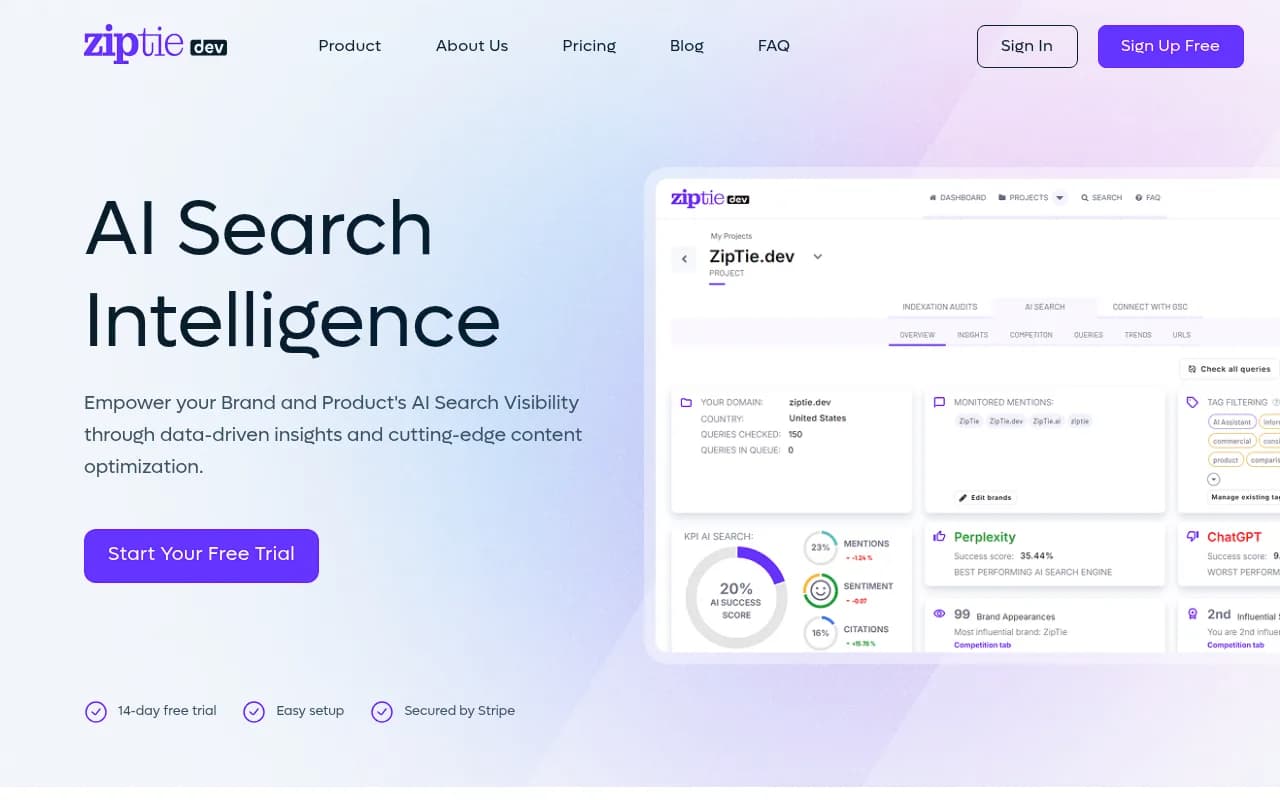
ZipTie takes an interesting technical approach: browser-level tracking rather than API-based monitoring. The argument, which has merit, is that user-facing AI responses can differ from what you'd see through an API, so tracking at the browser level gives you more accurate data about what real users actually see.
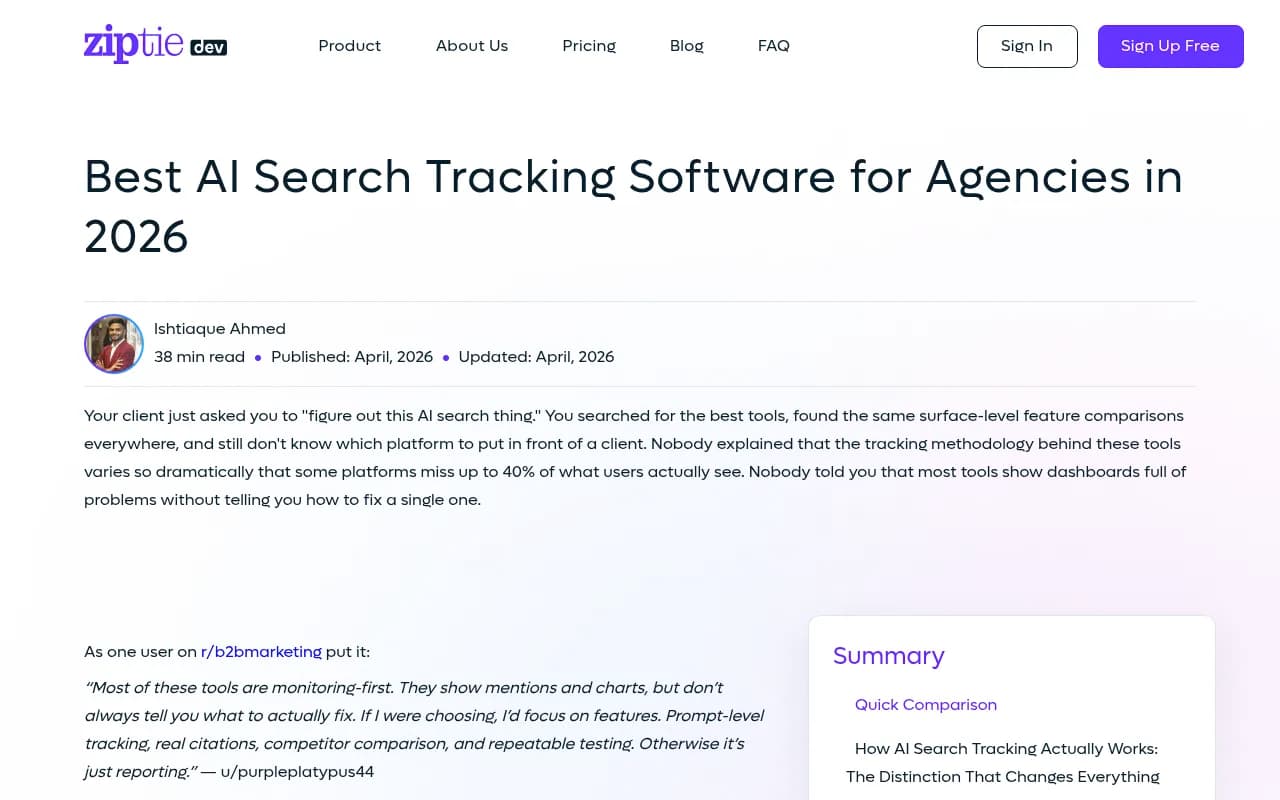
The trade-off is coverage. ZipTie currently covers three AI platforms, which is significantly fewer than the 10 that Promptwatch monitors. For agencies that care deeply about accuracy on a smaller set of models, this might be acceptable. For brands that need comprehensive coverage across ChatGPT, Perplexity, Gemini, Claude, and the rest, it's a real limitation.
ZipTie does include some content guidance features -- it's not purely a monitoring dashboard -- but it doesn't have the depth of crawler log analysis or content generation that the top-tier platforms offer.
Evertune
Evertune positions itself as an enterprise GEO platform, and its feature set reflects that. It covers multiple AI models, offers brand monitoring and competitive benchmarking, and has a reasonably strong analytics layer.
The platform is genuinely useful for large brands that need to understand their AI visibility at scale. Evertune's reporting is polished, and it handles the complexity of enterprise workflows reasonably well.
That said, crawler log analysis isn't a core feature. Like Omnia, Evertune is primarily a monitoring and analytics platform. It tells you what's happening with your brand in AI responses but doesn't give you the infrastructure-level view of how AI agents are interacting with your website. Content optimization and generation are also limited compared to what Promptwatch offers.
Scriptbee
Here's the honest answer: Scriptbee doesn't appear to be an established AI visibility platform in 2026. It's possible this is a very new entrant, a regional tool with limited public presence, or a name confusion with another platform. In researching this comparison across practitioner communities, third-party review sites, and platform databases, Scriptbee doesn't surface as a recognized player in the AI visibility or GEO space.
If you've seen Scriptbee recommended somewhere, it's worth verifying the source carefully. The AI visibility tool market has attracted a lot of new entrants in 2025-2026, and not all of them have the track record or feature depth to justify a serious evaluation. For now, it's not possible to make a fair comparison without verified feature data.
Feature comparison
| Feature | Promptwatch | Omnia | ZipTie | Evertune | Scriptbee |
|---|---|---|---|---|---|
| AI models covered | 10 | 4 | 3 | Multiple (unspecified) | Unknown |
| Real-time crawler logs | Yes | No | No | No | Unknown |
| Crawl-to-citation timeline | Yes | No | No | No | Unknown |
| Prompt monitoring | Yes | Yes | Yes | Yes | Unknown |
| Citation tracking | Yes | Yes | Yes | Yes | Unknown |
| Answer gap analysis | Yes | Limited | Limited | Limited | Unknown |
| Content generation | Yes (Content Agents) | No | Partial | No | Unknown |
| Reddit/YouTube tracking | Yes | No | No | No | Unknown |
| ChatGPT Shopping tracking | Yes | No | No | No | Unknown |
| Traffic attribution | Yes | No | No | No | Unknown |
| Competitor heatmaps | Yes | Yes | Limited | Yes | Unknown |
| Multi-language/region | Yes | Limited | No | Yes | Unknown |
| Agency white-label | Yes (custom) | No | Yes | Yes | Unknown |
| Starting price | $99/mo | Varies | Varies | Enterprise | Unknown |
Which platform fits which use case
If crawler logs are your primary need
Promptwatch is the only platform here that actually delivers deep crawler log analysis. The AI Crawler Logs feature shows real-time logs of GPTBot, ClaudeBot, PerplexityBot, and other AI crawlers hitting your website -- which pages they read, what errors they encounter, how often they return, and when pages move from crawl to citation. No other platform in this comparison comes close to that level of infrastructure visibility.
If you're an agency managing multiple clients
ZipTie was explicitly designed for agencies and has the workflow features to match -- white-labeling, multi-client management, and a focus on repeatable processes. The accuracy argument for browser-level tracking is real. The limitation is model coverage: if clients need visibility across 8-10 AI platforms, ZipTie's three-platform coverage will be a problem.
Promptwatch's Professional and Business plans also support multi-site management with agency-oriented features, and the breadth of model coverage (10 platforms) is a significant advantage for client reporting.
If you're an enterprise brand focused on share of voice
Evertune and Omnia both do competitive benchmarking well. If your primary use case is executive-level reporting on how your brand's AI presence compares to competitors over time, either platform handles that reasonably. Evertune's enterprise positioning means it's built for the complexity of large organizations.
The caveat: neither will tell you why your share of voice is changing at the technical level, and neither will help you create content to improve it.
If you want to close the loop from monitoring to optimization
This is where Promptwatch's design philosophy is most distinct. Most platforms in this space are built around the question "what is happening?" Promptwatch is built around "what is happening, why, and what do we do about it?" The Answer Gap Analysis, Content Agents, and crawler logs work together as a cycle: find gaps, generate content to fill them, track whether that content gets crawled and cited.
That full loop -- find gaps, create content, track results -- is genuinely rare. Most competitors stop at step one.
A note on the broader market
The AI visibility tool market has exploded in 2025-2026. There are now dozens of platforms claiming to track AI citations, and the quality varies enormously. A few things worth keeping in mind when evaluating any tool in this space:
Tracking methodology matters more than most vendors admit. API-based monitoring and browser-level tracking can produce meaningfully different results because AI models sometimes serve different responses in different contexts. Ask any vendor you're evaluating how they actually collect data.
Crawler logs are a rare feature. Most platforms don't have them because building the infrastructure to collect, parse, and surface AI crawler data is genuinely hard. If a vendor claims crawler log analysis, ask for a demo of the actual interface before committing.
Content generation quality varies wildly. Some platforms generate generic articles that won't get cited by AI models. The best ones (Promptwatch's Content Agents being the clearest example) generate content grounded in actual prompt data, citation patterns, and competitor analysis -- content that's designed to answer the specific questions AI models are already asking.
Bottom line
For most brands and agencies evaluating these five platforms in 2026, the honest recommendation is:
If deep crawler log analysis is a requirement, Promptwatch is the only platform here that delivers it. The combination of crawler logs, prompt monitoring across 10 models, content generation, and revenue attribution makes it the most complete platform in this comparison by a significant margin.
If you're an agency that prioritizes tracking accuracy over model breadth, ZipTie's browser-level approach is worth a serious look -- just go in knowing the coverage limitations.
If share-of-voice reporting for enterprise stakeholders is your primary need and you don't need to act on the data within the same platform, Omnia and Evertune are both solid choices.
Scriptbee doesn't have enough public presence to evaluate fairly. If you're considering it, do your due diligence before committing to a trial.
The broader point: AI visibility is no longer just about knowing your brand appears in AI responses. The brands gaining ground in 2026 are the ones that understand why they appear, which pages drive those appearances, and what content they need to create to appear more. That requires crawler logs. It requires content tools. And it requires a platform built around the full optimization loop, not just the monitoring dashboard.