Key takeaways
- Yext and Uberall are primarily local listing and reputation management platforms -- they weren't built for AI search visibility and show significant gaps in GEO capabilities
- Omnia focuses on AI visibility monitoring and share-of-voice analytics, but like most competitors, stops at tracking rather than helping you act on what you find
- Promptwatch is the only platform in this comparison that closes the full loop: find gaps, generate content engineered for AI citation, and track the results down to revenue
- For enterprise brands managing multiple locations, the most important question isn't "which tool shows me the most data" -- it's "which tool helps me actually improve my AI visibility"
- All four platforms have legitimate use cases, but they serve fundamentally different needs
Multi-location brands have a specific problem that most AI visibility tools weren't designed to solve. When someone asks ChatGPT "best hotel in Amsterdam" or Perplexity "top car dealerships near me," which locations get mentioned? Which competitors are dominating those responses? And if you're invisible, what do you actually do about it?
The four platforms in this comparison approach that problem from very different angles. Yext and Uberall come from the local listings world -- they built their businesses on making sure your NAP data (name, address, phone) was consistent across directories. Omnia was built specifically for AI visibility monitoring. Promptwatch was built as an end-to-end GEO platform that goes from tracking to content creation to revenue attribution.
This isn't a close race in every category. Let me walk through where each platform genuinely excels and where it falls short.
What "multi-location AI visibility" actually means
Before comparing tools, it's worth being precise about the problem. Multi-location brands face three distinct AI visibility challenges:
First, there's the brand-level question: does AI mention your brand at all when users ask relevant questions? Second, there's the location-level question: when AI recommends specific locations or stores, are yours included? Third, there's the content gap question: what information is AI pulling from competitors that it can't find on your site?
Most traditional local listing tools address none of these. They ensure your Google Business Profile is accurate, which matters for traditional local SEO, but AI models don't just pull from GBP. They synthesize information from your website, third-party reviews, Reddit discussions, news articles, and dozens of other sources.
The platforms that actually help with AI visibility need to track prompt responses across multiple AI models, identify what competitors are being cited for, and give you a path to close those gaps.
Platform-by-platform breakdown
Yext
Yext built its reputation on structured data syndication -- pushing your business information to hundreds of directories, maps, and search engines simultaneously. For a brand with 500 locations, that's genuinely valuable. Consistent NAP data across the web does influence how AI models perceive your brand's legitimacy and geographic presence.
But Yext's AI visibility story is largely a repackaging of existing capabilities. Their "AI search" features focus on structured data and knowledge graphs -- useful infrastructure, but not the same as tracking whether ChatGPT or Perplexity actually recommends your locations in conversational responses.
What Yext does well:
- Structured data management at scale across thousands of locations
- Review management and response workflows
- Pages product for location landing pages
- Analytics on traditional search and maps performance
What Yext doesn't do:
- Track brand mentions in ChatGPT, Claude, Perplexity, or Gemini responses
- Identify which prompts competitors are winning that you're not
- Generate content designed to be cited by AI models
- Show you AI crawler logs or which pages AI agents are actually reading
For a 500-location retail chain, Yext is probably already in your stack for listing management. It shouldn't be your AI visibility strategy.
Uberall
Uberall sits in a similar category to Yext -- local presence management with some reputation and analytics features layered on. Their "Near Me" brand experience platform is genuinely useful for ensuring location data consistency and managing customer reviews at scale.
Their recent pivot toward AI includes features like AI-generated review responses and some basic sentiment analysis. But like Yext, Uberall's core product wasn't designed for the GEO use case. They're not tracking how Gemini or Grok responds to "best [your category] in [city]" queries, and they're not helping you create content that changes those responses.
Where Uberall is strong:
- Local listing management across 200+ directories
- Review aggregation and response automation
- Location analytics and foot traffic insights
- Multi-language support for international brands
Where Uberall falls short for AI visibility:
- No prompt tracking across AI models
- No citation analysis showing which sources AI models reference
- No content gap analysis or content generation for GEO
- No AI crawler monitoring
The honest assessment: Uberall is a solid local presence tool. It's not an AI visibility platform, regardless of how their marketing describes it.
Omnia
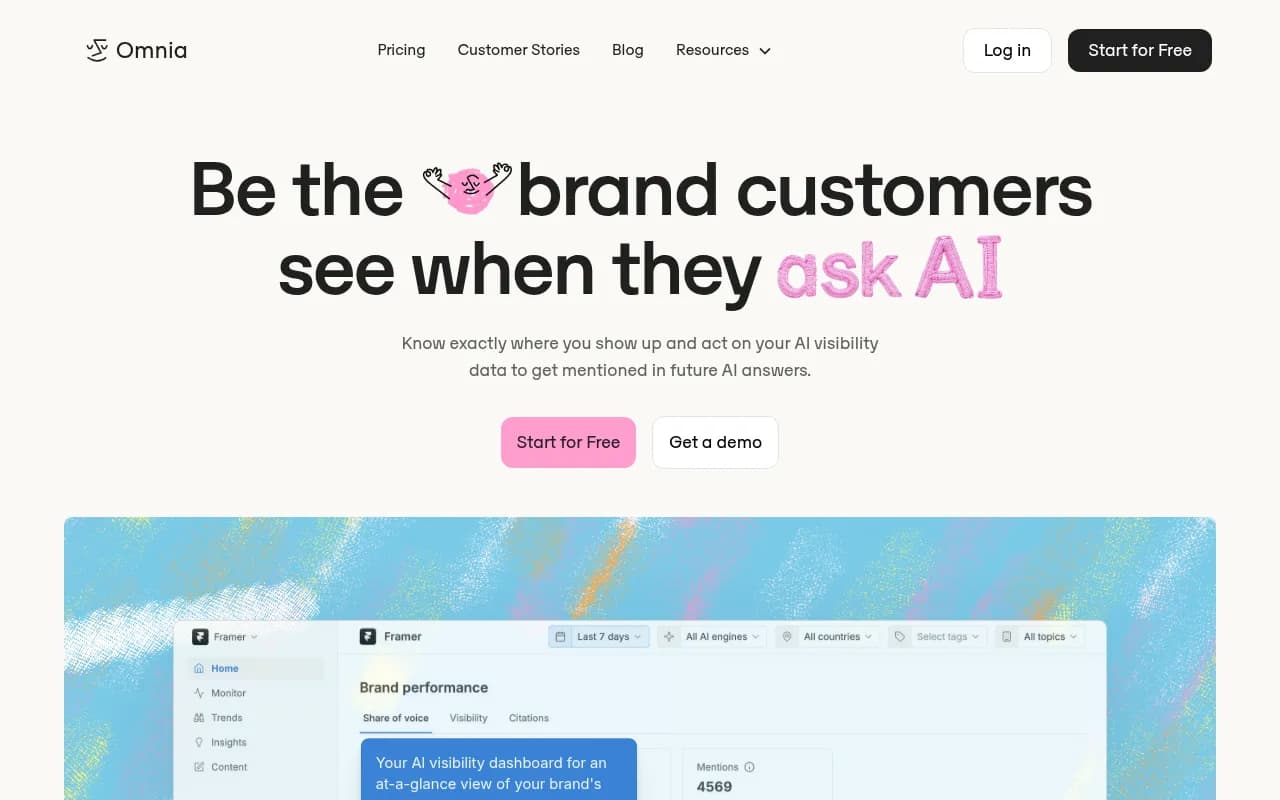
Omnia is a purpose-built AI visibility platform, which already puts it in a different category from Yext and Uberall. Their focus is on monitoring share of voice across AI models -- tracking how often your brand appears in AI-generated responses compared to competitors.

The platform covers prompt monitoring, brand mention tracking, and citation extraction. For a marketing team that wants to understand their current AI visibility position, Omnia gives you a reasonable starting point.
What Omnia does well:
- Share of voice tracking across multiple AI models
- Brand mention monitoring and sentiment analysis
- Citation extraction showing which sources AI models reference
- Competitive benchmarking against specific rivals
Where Omnia stops short:
- Monitoring-focused: it shows you the problem but doesn't help you fix it
- No content generation capabilities for closing identified gaps
- No AI crawler logs showing which pages AI agents are reading
- No traffic attribution connecting AI visibility to actual revenue
- No Reddit or YouTube insights (channels that heavily influence AI recommendations)
Omnia is a better choice than Yext or Uberall for AI visibility specifically. But it's still a monitoring tool. You'll need to take the data elsewhere to act on it.
Promptwatch
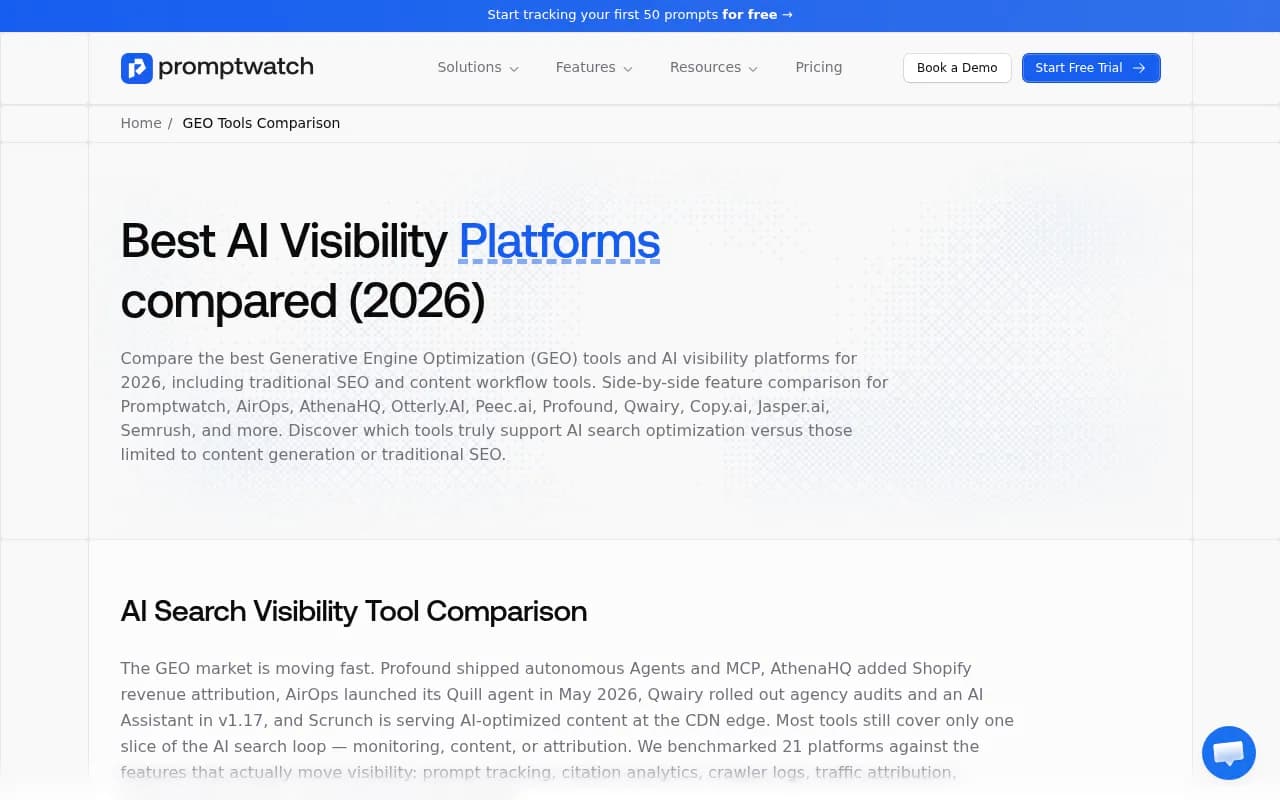
Promptwatch was designed around a different premise: monitoring alone doesn't move the needle. The platform tracks visibility across 10 AI models (ChatGPT, Perplexity, Claude, Gemini, Google AI Overviews, Google AI Mode, Grok, DeepSeek, Copilot, and Meta/Llama), but the tracking is the starting point, not the destination.

The core workflow is what separates it from every other tool in this comparison:
- Answer Gap Analysis identifies exactly which prompts your competitors appear in that you don't -- not just "you're invisible," but the specific questions and topics where you're losing
- Content Agents generate articles, comparisons, and briefs grounded in actual prompt data, citation patterns, and competitor analysis -- content built to be cited, not just to rank
- Page-level tracking shows which specific pages are getting cited, by which AI models, how often, and what that visibility is worth in actual traffic and revenue
For multi-location brands specifically, Promptwatch's city and state-level tracking (available on Professional and Business plans) lets you monitor AI visibility by geography -- so you can see that your Chicago locations are well-represented in AI responses but your Dallas locations are invisible, and then act on that.
The AI Crawler Logs feature is particularly useful for enterprise teams. You can see in real time which pages ChatGPT's crawler, Perplexity's bot, and other AI agents are actually reading, how often they return, and whether they're encountering errors. Most platforms don't offer this at all.
Other capabilities worth noting for enterprise brands:
- Reddit and YouTube insights surface discussions that influence AI recommendations -- a channel most competitors ignore
- ChatGPT Shopping tracking monitors when your brand appears in product recommendations and shopping carousels
- Offsite citation analysis tracks which third-party pages, listicles, and external mentions are driving your AI visibility
- Looker Studio integration and API access for custom reporting workflows
Pricing runs from $99/month (Essential, 1 site, 50 prompts) to $579/month (Business, 5 sites, 350 prompts, 30 AI-generated articles per month). Enterprise and agency pricing is available for larger deployments.
Feature comparison table
| Feature | Yext | Uberall | Omnia | Promptwatch |
|---|---|---|---|---|
| Local listing management | Excellent | Excellent | No | No |
| Review management | Yes | Yes | Limited | No |
| AI model prompt tracking | No | No | Yes | Yes (10 models) |
| Brand mention monitoring | Basic | Basic | Yes | Yes |
| Citation analysis | No | No | Yes | Yes |
| Answer gap analysis | No | No | No | Yes |
| AI content generation | No | No | No | Yes |
| AI crawler logs | No | No | No | Yes |
| Traffic attribution to AI | No | No | No | Yes |
| Reddit/YouTube insights | No | No | No | Yes |
| ChatGPT Shopping tracking | No | No | No | Yes |
| City/state-level tracking | Yes (listings) | Yes (listings) | Limited | Yes (AI responses) |
| Competitor heatmaps | No | No | Yes | Yes |
| Multi-language support | Yes | Yes | Limited | Yes |
| API access | Yes | Yes | Limited | Yes |
| Pricing (entry) | Custom | Custom | Contact | $99/month |
Which platform is right for your situation
The answer depends heavily on what problem you're actually trying to solve.
If your primary need is local listing consistency and review management at scale, Yext and Uberall are still the category leaders. They've spent years building publisher relationships and workflows for exactly that use case. Neither is going to help you improve your ChatGPT visibility, but they're not trying to.
If you want to understand your current AI visibility position -- share of voice, which competitors are winning, which AI models mention you -- Omnia gives you that picture. It's a reasonable starting point for teams that are just beginning to think about GEO.
If you need to actually move the needle on AI visibility -- not just measure it, but improve it -- Promptwatch is the only platform in this comparison that gives you the full stack. The combination of gap analysis, content generation grounded in real prompt data, and page-level tracking that connects back to revenue is what makes it an optimization platform rather than a monitoring dashboard.
For most enterprise brands, the realistic answer is a combination: keep Yext or Uberall for local listings (that problem isn't going away), and add Promptwatch for AI visibility strategy. Trying to use your local listings tool as your GEO platform is like using Google Analytics to run your paid search campaigns -- adjacent but not the right tool.
The multi-location wrinkle
One thing that deserves specific attention: multi-location brands have a content problem that single-location brands don't. If you have 200 locations, you probably have 200 location pages that are nearly identical. AI models notice this. They're much more likely to cite a page that has genuinely useful, location-specific content -- local context, specific services, real reviews -- than a templated page that differs only in city name and address.
This is where the content generation piece matters. Promptwatch's Content Agents can generate location-specific content grounded in what AI models are actually looking for in each market, rather than just spinning templates. That's a meaningful capability difference for brands managing content at scale.
Bottom line
Yext and Uberall are local presence tools that have added some AI language to their marketing. They're not AI visibility platforms in any meaningful sense.
Omnia is a legitimate AI visibility monitoring tool. It tells you where you stand.
Promptwatch tells you where you stand and helps you change it -- with content gap analysis that shows exactly what's missing, content generation that fills those gaps with material AI models actually want to cite, and attribution that shows whether it's working. For enterprise brands that want AI search to drive real business outcomes, that's the meaningful distinction.
The GEO market is moving fast. Brands that treat AI visibility as a monitoring exercise are going to watch competitors who treat it as an optimization discipline pull further ahead. The tools you choose now will determine which side of that gap you end up on.