Key takeaways
- Promptwatch is the only platform in this comparison that covers the full loop: monitoring, content generation, crawler logs, and traffic attribution in one place.
- Scrunch and Omnia are strong monitoring tools but stop short of helping you fix what they find.
- Search Party is more of an agency service than a self-serve platform, which suits some teams and frustrates others.
- For agencies managing multiple client brands across AI search engines, the gap between "tracking" and "optimizing" is where the real value difference shows up.
If you run SEO or digital marketing for multiple clients, you've probably already noticed that traditional rank tracking doesn't tell you much about what's happening in ChatGPT, Perplexity, or Google AI Overviews. A new category of tools has emerged to fill that gap, and in 2026 there are now enough options that picking the right one actually requires some thought.
This comparison focuses on four platforms that agencies frequently evaluate: Omnia, Promptwatch, Scrunch, and Search Party. They're not all competing on the same thing, which is part of what makes this confusing. Some are monitoring dashboards. Some generate content. One is closer to a managed service. Let's break down what each actually does, where each falls short, and which makes sense depending on what your agency needs.
 Promptwatch's 2026 platform comparison maps 21 GEO tools across functionality and value dimensions
What agencies actually need from an AI visibility platform
Before getting into the tools, it's worth being specific about what "AI visibility" work looks like for an agency in practice.
You're tracking multiple client brands across several AI engines. You need to know when a client gets cited, when a competitor gets cited instead, and why. You need to show clients something meaningful in a report. And ideally, you need to do something about the gaps you find, not just document them.
That last part is where most platforms fall down. Monitoring is the easy part. The hard part is turning a visibility gap into a content fix, then proving that the fix worked. Agencies that have figured this out are charging more and retaining clients longer. Agencies still stuck in "here's your visibility score" mode are losing ground.
With that in mind, here's how each platform stacks up.
Promptwatch
Promptwatch is the most complete platform in this comparison. It tracks brand visibility across 10 AI models (ChatGPT, Perplexity, Claude, Gemini, Google AI Overviews, Google AI Mode, Grok, DeepSeek, Copilot, and Meta AI), and it's one of very few tools that goes beyond monitoring to help you actually improve what you're tracking.

The feature that sets it apart for agencies is the action loop. Answer Gap Analysis shows you which prompts competitors rank for that your client doesn't. Content Agents then generate articles, listicles, and comparison pages built around those specific gaps, grounded in real prompt data and citation patterns. Then page-level tracking shows whether those new pages start getting cited, and AI visitor analytics ties that back to actual traffic and revenue.
That cycle -- find the gap, create the content, measure the result -- is what makes Promptwatch an optimization platform rather than just a tracker. Most competitors stop at step one.
A few other things worth noting for agencies specifically:
- AI Crawler Logs show which pages AI bots are reading, how often, and what errors they're hitting. This is genuinely useful for diagnosing why a client page isn't getting cited despite covering the right topic.
- Reddit and YouTube insights surface discussions that are actually influencing AI recommendations. This is a channel most platforms ignore entirely.
- ChatGPT Shopping tracking monitors when client brands appear in product carousels and shopping recommendations inside ChatGPT.
- Multi-language and multi-region support, with customizable personas, means you can track how AI answers differ by country and audience type.
Pricing runs from $99/month (Essential: 1 site, 50 prompts) to $579/month (Business: 5 sites, 350 prompts, 30 articles). Agency and enterprise pricing is available on request. There's a free trial.
The main limitation Omnia's blog (a competitor) points out is that prompt caps scale steeply in price as you grow. That's a fair observation. If you're managing 20 clients with 100 prompts each, you're in enterprise territory quickly. That said, the breadth of what you get per dollar is hard to match elsewhere.
Omnia
Omnia positions itself as a purpose-built AI visibility platform with a focus on URL-level citation intelligence and prompt-to-outcome mapping. It's a newer entrant that has built a clean product with some genuinely useful features.
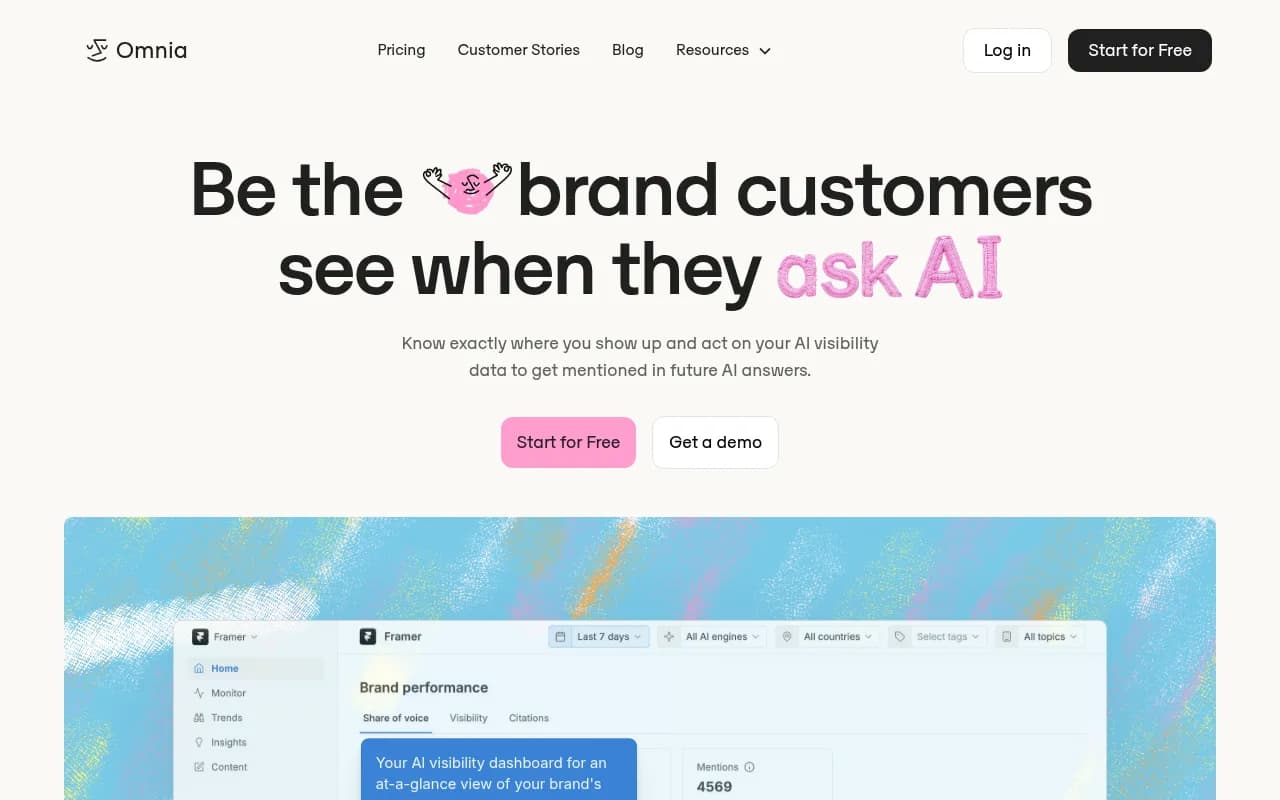
What Omnia does well: it tracks which specific URLs are being cited in AI responses, not just whether a brand appears. That granularity matters when you're trying to figure out which pages to optimize. It also offers geo-by-country tracking and some level of action guidance, though the depth of the content generation layer is thinner than Promptwatch's.
The honest read on Omnia is that it's a solid monitoring tool with better citation granularity than some competitors, but it's still primarily a tracking product. The "action layer" exists, but it tends to surface recommendations rather than generate the content itself. For agencies that have their own content teams and just need better data to direct them, that might be fine. For agencies that want to generate client content directly from the platform, it's a gap.
Omnia is worth evaluating if you're specifically prioritizing URL-level citation tracking and want a clean interface. It's less compelling if you need the full monitoring-to-content-to-attribution loop.
Scrunch
Scrunch is one of the more established names in AI visibility monitoring. It covers ChatGPT, Perplexity, Google AI Overviews, and Copilot, and it's been mentioned in several independent tool roundups as a reliable option for tracking brand mentions across AI engines.
The Core plan ($250/month) gives you four AI platforms, 125 prompts, and five site audits. That's a reasonable entry point for agencies with a handful of clients. The interface is clean and the data is solid.
Where Scrunch runs into limitations: it's fundamentally a monitoring dashboard. It shows you what's happening but doesn't help you change it. There's no content generation, no crawler logs, no traffic attribution. If a client's visibility drops, Scrunch can tell you it dropped. It can't tell you why the AI crawler stopped reading a particular page, and it can't generate the content fix.
For agencies that already have strong content workflows and just need a monitoring layer to feed them, Scrunch works. For agencies looking for a platform that does more of the heavy lifting, it's going to feel incomplete.
One thing Scrunch is exploring that's worth watching: serving AI-optimized content at the CDN edge. That's an interesting technical direction that could change the value proposition if it matures.
Search Party
Search Party is different from the other three in a meaningful way. It's less of a self-serve SaaS platform and more of an agency-oriented service that embeds AI automation into client workflows.
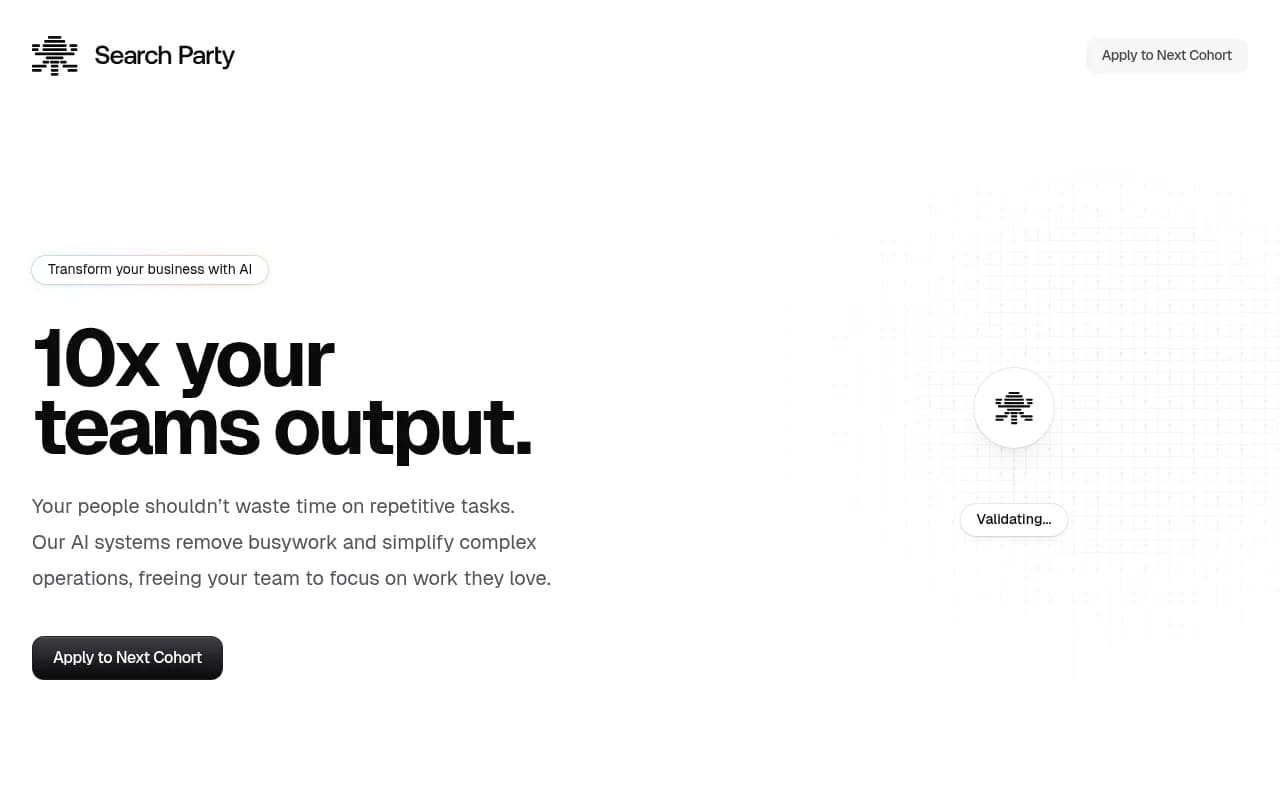
For some agencies, this is exactly what they want. Search Party handles a lot of the operational complexity that comes with AI visibility work, and it's built for teams that want a partner rather than a tool. The tradeoff is that you have less direct control over the data and less flexibility to build custom workflows.
From a feature standpoint, Search Party has limited prompt metrics compared to dedicated monitoring platforms, and there's no content gap analysis in the way Promptwatch or even Omnia approach it. It's not trying to be a full GEO platform -- it's trying to be a useful service layer for agencies that don't want to build this capability in-house.
If your agency is early in building an AI visibility practice and you want guardrails and support, Search Party is worth a conversation. If you're a more mature agency that wants data ownership, custom reporting, and the ability to generate client content directly from visibility insights, you'll probably outgrow it quickly.
Side-by-side comparison
| Feature | Promptwatch | Omnia | Scrunch | Search Party |
|---|---|---|---|---|
| AI models tracked | 10 (ChatGPT, Claude, Gemini, Perplexity, Grok, DeepSeek, Copilot, Meta AI, Google AIO, Google AI Mode) | Multiple (varies) | 4 (ChatGPT, Perplexity, Google AIO, Copilot) | Limited |
| Prompt tracking | Yes, with volume + difficulty scores | Yes | Yes (125 prompts on Core) | Limited |
| Citation analytics | Page-level + domain-level | URL-level focus | Domain-level | Basic |
| AI crawler logs | Yes | No | No | No |
| Content generation | Yes (Content Agents) | Partial (recommendations) | No | No |
| Answer gap analysis | Yes | Partial | No | No |
| Traffic attribution | Yes (AI visitor analytics) | No | No | No |
| Reddit/YouTube insights | Yes | No | No | No |
| ChatGPT Shopping tracking | Yes | No | No | No |
| Multi-language/region | Yes | Yes | Limited | Limited |
| Agency/white-label | Custom pricing | Available | Available | Core offering |
| Starting price | $99/mo | Contact | $250/mo | Contact |
| Free trial | Yes | Yes | No | No |
Which platform fits which agency type
The right answer depends on what your agency is actually trying to do.
If you want to run a full AI visibility practice -- tracking, diagnosing, creating content, and proving results -- Promptwatch is the only platform here that supports all of that without requiring you to stitch together multiple tools. The crawler logs alone are worth it for technical SEO-oriented agencies, because they answer questions that no other platform in this comparison can answer: why isn't this page being cited even though it covers the right topic?
If you have a strong in-house content team and just need better citation data to direct their work, Omnia's URL-level tracking is genuinely useful and worth evaluating alongside Promptwatch.
If you're running a simpler monitoring setup for clients who just want a visibility score and a trend line, Scrunch's Core plan is clean and functional. It's not going to help you grow the engagement, but it'll do the job.
If you're a smaller agency that wants a service partner rather than a platform to operate yourself, Search Party is worth a call. Just go in knowing that you're trading control for convenience.
The question most agencies aren't asking yet
Most of the conversation in this space is still about monitoring. Which tool shows me my brand mentions? Which AI engines am I appearing in? That's a fine starting point, but it's not where the value is.
The agencies building durable AI visibility practices in 2026 are asking a different question: what content do I need to create so that AI models cite my clients when users ask the questions that matter? That requires knowing which prompts exist, which ones competitors are winning, what the AI models actually want to see in a source, and whether the content you publish gets crawled and cited.
That's a harder problem than monitoring, and it's the problem that separates platforms that track from platforms that optimize. In this comparison, only one platform is genuinely built around that harder problem.
 Independent reviews of AI visibility tools in 2026 consistently highlight the gap between monitoring-only tools and platforms that help you act on what you find
The monitoring-only tools aren't going away, and they're not useless. But as clients get more sophisticated about AI search, they're going to start asking harder questions. The agencies with platforms that can answer those questions will be in a much better position than the ones showing a visibility score and calling it a month.