Key takeaways
- Semrush and Ahrefs are traditional SEO platforms that have added AI visibility features, but both use fixed prompt sets and lack traffic attribution from AI sources.
- Omnia focuses on AI brand monitoring across four major platforms (ChatGPT, Perplexity, Google AI Overviews, Google AI Mode) with clean dashboards but limited optimization depth.
- Promptwatch is the only platform in this comparison that closes the full loop: find gaps, generate content to fill them, and track whether that content gets cited.
- If your goal is passive brand monitoring, any of these tools will give you data. If your goal is actually improving AI visibility, the difference between them matters a lot.
The AI search visibility space has gotten crowded fast. Every major SEO tool now claims to track how your brand appears in ChatGPT, Perplexity, and Google AI Overviews. Meanwhile, newer purpose-built platforms are staking out territory with more focused feature sets.
Four names come up constantly in 2026: Omnia, Promptwatch, Semrush, and Ahrefs. They're not really competing on the same thing, though. Two are legacy SEO platforms that bolted on AI monitoring. One is a monitoring-first tool built for the AI era. And one is trying to be something different entirely: an optimization platform that doesn't just show you the problem but helps you fix it.
This guide breaks down each tool honestly, then gives you a framework for deciding which one actually fits your situation.
What "AI visibility" actually means in 2026
Before comparing tools, it's worth being precise about what we're measuring. AI visibility has a few distinct layers:
- Brand mentions: Does your brand name appear in AI-generated answers?
- Citation tracking: Is your website being cited as a source?
- Share of voice: How often do you appear vs. competitors for the same prompts?
- Content gap analysis: Which prompts are your competitors winning that you're not?
- Optimization: Can you actually do something about the gaps you find?
Most tools in 2026 handle the first three reasonably well. The last two are where they diverge sharply.
Omnia: clean monitoring, limited optimization depth
Omnia is a purpose-built AI visibility platform that covers four major AI search platforms: ChatGPT, Perplexity, Google AI Overviews, and Google AI Mode. For many brands, those four cover the vast majority of AI-driven traffic, so the coverage isn't a dealbreaker.
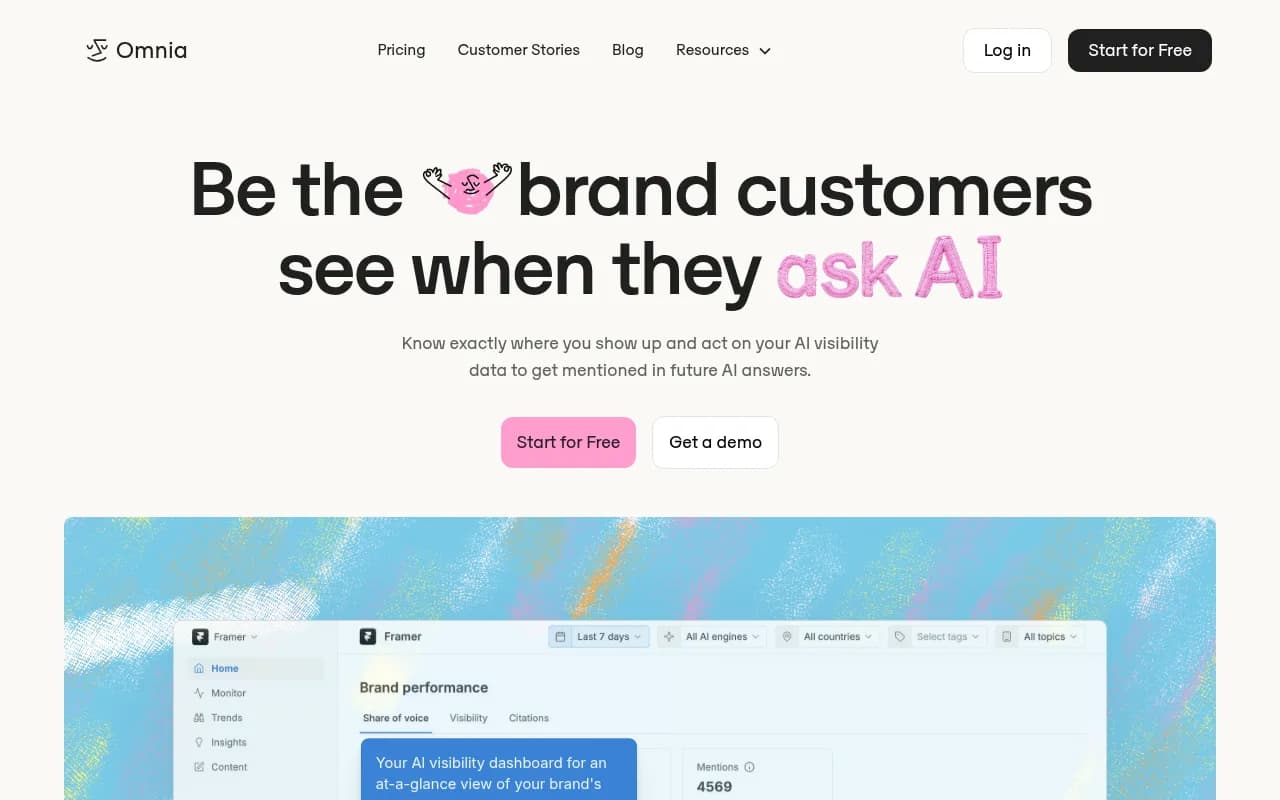
Where Omnia shines is in its interface. The dashboards are clean, onboarding is fast, and the share-of-voice reporting is genuinely useful for teams that need to show stakeholders a weekly visibility narrative. If you're a marketing manager who needs to report on "how we're doing in AI search" without getting deep into technical weeds, Omnia gets you there quickly.
The limitations show up when you want to move beyond observation. Omnia tells you where you're visible and where you're not. It doesn't tell you why you're losing specific prompts, and it doesn't generate content to close those gaps. The platform is monitoring-first, which is fine if that's all you need.
Pricing isn't publicly listed in a straightforward way, so you'll need to contact them for a quote depending on your prompt volume and team size.
Best for: Marketing teams that want clean, stakeholder-friendly AI visibility reporting without needing to act on the data immediately.
Semrush: the broadest platform, but AI visibility is an add-on
Semrush has been the dominant all-in-one SEO platform for years, and in 2026 it's made serious moves into AI visibility with its AI Visibility Toolkit (part of Semrush One). You get brand mention tracking across AI platforms, competitor benchmarking, and content suggestions tied to AI search data.
The appeal is obvious: if you're already paying for Semrush for keyword research, site audits, and backlink analysis, having AI visibility data in the same dashboard reduces tool sprawl. The data quality is solid, and the platform's scale means you're getting AI visibility alongside one of the deepest SEO datasets available.
But there are real limitations. Semrush uses fixed prompt sets, meaning you're tracking visibility for a predefined list of queries rather than the custom prompts that actually matter to your business. There's no AI traffic attribution -- you can't connect AI visibility to actual revenue or site visits. And the AI features feel like additions to an SEO platform rather than a native AI search product.
Predicta Digital's comparison of Semrush, Ahrefs, and SE Ranking found that Semrush wins on AI visibility feature depth among traditional SEO tools, but the cost at scale is significant, and the Adobe acquisition has introduced some uncertainty about the platform's direction.
Best for: Teams already embedded in the Semrush ecosystem that want to add AI visibility monitoring without switching platforms.
Ahrefs Brand Radar: the most limited of the four
Ahrefs added Brand Radar as its answer to the AI visibility question. It tracks brand mentions across AI platforms and gives you a high-level view of how often your brand appears in AI-generated answers.
The problem is that Brand Radar is the thinnest offering in this comparison. Like Semrush, it uses fixed prompts -- you're not defining the queries that matter to your business, you're accepting Ahrefs' predefined set. There's no AI traffic attribution. There's no content gap analysis. There's no way to generate content based on what you find.
Ahrefs' strength has always been its backlink database and keyword research tools. Brand Radar feels like a checkbox feature rather than a serious AI visibility product. If you're an Ahrefs user, it's worth glancing at, but it probably won't replace a dedicated AI visibility tool.
Best for: Existing Ahrefs users who want a basic sense of AI brand presence without investing in a separate platform.
Promptwatch: the only one that closes the loop
Promptwatch takes a different approach from all three tools above. It's not a monitoring dashboard with AI features bolted on, and it's not a lightweight brand tracker. It's built around what it calls the "action loop": find the gaps, create content to fill them, track the results.

The gap-finding piece works through Answer Gap Analysis, which shows you exactly which prompts your competitors are visible for that you're not. This is more useful than it sounds. Instead of a generic "your AI visibility score is 34%," you get a list of specific questions and topics where competitors are being cited and you're invisible. That's actionable.
The content creation piece is where Promptwatch separates itself most clearly from the other three tools. Content Agents generate articles, listicles, and comparisons grounded in real prompt data, citation data, and competitor analysis. This isn't generic AI writing -- it's content engineered around the specific gaps AI models are already exposing. Semrush has content suggestions, but they're not tied to the same depth of AI search data.
Then there's the tracking layer. Promptwatch monitors 10 AI models (ChatGPT, Perplexity, Google AI Overviews, Google AI Mode, Claude, Gemini, Meta/Llama, DeepSeek, Grok, Mistral, Copilot), tracks which pages are being cited and by which models, and connects visibility to actual traffic through website integrations. The AI Crawler Logs feature shows you in real time which AI crawlers are hitting your site, which pages they're reading, and when those pages move from crawl to citation.
A few other things worth noting: Promptwatch tracks Reddit and YouTube as citation sources (most competitors ignore this entirely), monitors ChatGPT Shopping recommendations, and supports multi-language and multi-region monitoring with customizable personas.
Pricing runs from $99/month (Essential: 1 site, 50 prompts, 5 articles) to $579/month (Business: 5 sites, 350 prompts, 30 articles), with agency and enterprise pricing available. There's a free trial.
Best for: Marketing and SEO teams that want to actually improve AI visibility, not just measure it.
Head-to-head comparison
| Feature | Omnia | Promptwatch | Semrush | Ahrefs Brand Radar |
|---|---|---|---|---|
| AI models covered | 4 | 10 | ~5 | ~4 |
| Custom prompt tracking | Yes | Yes | Fixed prompts | Fixed prompts |
| Content gap analysis | No | Yes | Limited | No |
| AI content generation | No | Yes | Basic suggestions | No |
| AI crawler logs | No | Yes | No | No |
| Reddit/YouTube tracking | No | Yes | No | No |
| ChatGPT Shopping tracking | No | Yes | No | No |
| AI traffic attribution | No | Yes | No | No |
| Multi-language/region | Limited | Yes | Yes | Limited |
| Pricing (entry) | Contact | $99/mo | ~$139/mo (Semrush One) | Included with Ahrefs |
| Free trial | Yes | Yes | Yes | Yes |
The table makes the trade-offs visible. Semrush and Ahrefs give you AI visibility as part of a broader SEO platform -- convenient if you're already paying for them, but thin on AI-specific depth. Omnia gives you a cleaner, more focused monitoring experience. Promptwatch is the only one that goes past monitoring into optimization.
Which tool is right for your situation?
The honest answer depends on what you're trying to do.
Choose Omnia if you need clean, fast AI visibility reporting for stakeholders and you're primarily interested in the four major AI platforms. It's a solid monitoring tool with a low learning curve.
Choose Semrush if you're already a Semrush customer and want AI visibility data without adding another tool to your stack. The AI features aren't best-in-class, but the convenience of having everything in one place is real.
Choose Ahrefs Brand Radar if you're an Ahrefs user who wants a basic pulse check on AI brand presence. Don't expect it to replace a dedicated AI visibility platform.
Choose Promptwatch if your goal is to actually move the needle on AI visibility, not just track it. The combination of gap analysis, content generation, and crawler logs means you're not just collecting data -- you're doing something with it.
The monitoring-only ceiling
One pattern that keeps showing up in the AI visibility space: teams buy a monitoring tool, spend a few weeks looking at dashboards, and then ask "okay, now what?" The data shows they're invisible for certain prompts. But the tool doesn't tell them why, and it doesn't help them fix it.
This is the ceiling that monitoring-only platforms hit. Omnia, Semrush's AI features, and Ahrefs Brand Radar all sit below that ceiling to varying degrees. They're useful for awareness, for reporting, for competitive benchmarking. But they leave the hard work -- figuring out what content to create, creating it, and verifying it worked -- entirely to you.
Promptwatch's design philosophy is different. The crawler logs tell you how AI engines are discovering your content. The gap analysis tells you what's missing. The content agents help you fill the gaps. And the page-level tracking closes the loop by showing whether the new content actually gets cited.
That's a meaningfully different product category, even if the marketing language around all four tools sounds similar.
A quick note on prompt coverage
One underappreciated difference between these tools: how they handle prompt selection. Semrush and Ahrefs use fixed prompt sets -- you're tracking visibility for queries they've predefined. This is fine for general benchmarking but misses the prompts that are actually relevant to your specific business, products, and customer personas.
Omnia and Promptwatch both support custom prompt tracking, which means you're measuring visibility for the questions your actual customers are asking. For most brands, this produces more actionable data. There's no point knowing you're visible for generic industry terms if the prompts driving your customers' decisions are more specific.
Promptwatch adds another layer here with Prompt Intelligence: volume estimates and difficulty scores for each prompt, plus query fan-outs that show how one prompt branches into sub-queries. This helps you prioritize which gaps to close first rather than treating all missing prompts as equally important.
Bottom line
In 2026, "AI visibility tracking" covers a wide range of actual capabilities. Semrush and Ahrefs are established SEO platforms that have added AI monitoring -- useful if you're already in their ecosystems, but not purpose-built for the AI search era. Omnia is a cleaner, more focused monitoring tool that does its job well without pretending to be something more.
Promptwatch is the only platform in this comparison built around the idea that tracking your AI visibility is only useful if you can improve it. The gap analysis, content generation, crawler logs, and traffic attribution work together in a way that none of the other three tools replicate.
If you're evaluating these tools, the right question isn't "which one has the best dashboard?" It's "which one will actually help me show up more in AI search results six months from now?" Those are different questions with different answers.