Key takeaways
- Omnia is a solid AI visibility tracker, but it lacks crawler log monitoring — meaning you can't see which AI bots are hitting your pages, how often, or what errors they're encountering
- Crawler log data is increasingly important in 2026: knowing that ChatGPT or Perplexity crawled your page is different from knowing whether they actually cited it
- Most Omnia alternatives are also monitoring-only tools — they show you data but don't help you act on it
- A small number of platforms (including Promptwatch) combine crawler log visibility with content gap analysis and AI content generation, closing the loop from diagnosis to fix
- If crawler logs are your primary need, prioritize tools with native server log integrations or Cloudflare/CDN connectors
Why crawler log monitoring matters now
There's a gap most AI visibility tools quietly ignore. They'll tell you whether ChatGPT mentioned your brand last Tuesday. What they won't tell you is whether ChatGPT's crawler even visited your site before generating that answer — and if it did, which pages it read, how long it spent, and whether it hit a 404 or a redirect chain that stopped it cold.
That distinction matters more than it used to. In 2026, AI search engines like Perplexity, ChatGPT, and Google AI Overviews are actively crawling the web to refresh their knowledge. If your content isn't being crawled, it isn't being cited. And if you can't see your crawler logs, you're flying blind.
Omnia is a capable tool for tracking share of voice and brand mentions across AI models. But crawler log monitoring isn't part of what it does. If that's a gap you need to fill — or if you're just looking for a stronger all-around alternative — here are nine options worth considering.
What to look for in an Omnia alternative
Before jumping into the list, it helps to be clear about what "crawler log monitoring" actually means in this context. There are a few different things tools might offer:
- Raw server log ingestion (you upload or pipe your logs, the tool parses AI bot activity)
- CDN/edge integrations (Cloudflare, Fastly, Vercel) that capture crawler requests without touching your server
- Tracking snippets that detect AI referrals client-side
- Agent analytics dashboards that show crawl frequency, errors, and the path from crawl to citation
Not every tool on this list does all of these. Some do one well. The table below gives you a quick comparison before we get into the detail.
| Tool | Crawler log monitoring | Content generation | Prompt tracking | Price from |
|---|---|---|---|---|
| Promptwatch | Yes (Cloudflare, Fastly, Vercel, server logs) | Yes (AI Content Agents) | Yes | $99/mo |
| Profound | Partial | No | Yes | Custom |
| Scrunch AI | Yes (bot diagnostics) | No | Yes | $250/mo |
| AthenaHQ | No | No | Yes | Custom |
| Otterly.AI | No | No | Yes | $Free tier |
| Peec AI | No | No | Yes | $Free tier |
| DarkVisitors | Yes (AI agent tracking) | No | No | Free/paid |
| Botify | Yes (enterprise crawler) | No | Partial | Enterprise |
| SE Visible | No | No | Yes | Low |
The 9 best Omnia alternatives in 2026
1. Promptwatch
Promptwatch is the most complete option on this list if crawler log monitoring is your actual priority. It's the only platform in this comparison that combines real AI crawler logs with prompt tracking, content gap analysis, and AI content generation in a single workflow.

The crawler log side works through integrations with Cloudflare, Fastly, Vercel, server logs, Google Search Console, or a lightweight tracking snippet. Once connected, you get real-time logs of which AI crawlers (ChatGPT, Claude, Perplexity, and others) are hitting your site, which pages they're reading, what errors they encounter, and how crawl frequency correlates with citation frequency. The "agent analytics" view shows the full timeline: when a page was crawled, when it moved to being cited, and how that maps to traffic.
That last part is what separates Promptwatch from most tools here. Seeing that GPTBot crawled your /pricing page is interesting. Knowing that it crawled it three times before citing it in a ChatGPT response, and that the citation drove 47 sessions, is actually useful.
Beyond crawler logs, Promptwatch runs prompt tracking across 10 AI models (ChatGPT, Perplexity, Claude, Gemini, Grok, DeepSeek, Copilot, Meta AI, Mistral, Google AI Overviews), surfaces answer gaps where competitors appear but you don't, and generates content briefs and articles grounded in real prompt data. It's the only platform in this space that's been independently rated as a "Leader" across all GEO categories in a 2026 comparison of 12 platforms.
Pricing starts at $99/month for the Essential plan (1 site, 50 prompts). Crawler logs and agent analytics are available from the Professional plan at $249/month.
2. Profound
Profound is one of the more established names in AI visibility tracking, with a strong feature set for enterprise teams. It tracks brand mentions and citations across major AI models, offers competitive share-of-voice analysis, and has decent prompt customization.

On the crawler log question: Profound has some visibility into how AI engines interact with your content, but it's not the same as raw crawler log ingestion. You won't get the granular "GPTBot hit this URL at 14:32 and got a 301" level of data. It's more of an inference layer — useful, but not the same thing.
Pricing is custom (enterprise-oriented), which makes it harder to recommend for teams that want to start small and scale.
3. Scrunch AI
Scrunch AI is worth a look specifically because of its bot crawling diagnostics. It's one of the few tools that explicitly positions itself around AI-readiness and real-time bot activity, which puts it closer to the crawler log use case than most alternatives.
The platform tracks which AI crawlers are visiting your site, flags pages that aren't being indexed by AI engines, and provides recommendations for improving crawlability. It's not as deep as a full server log integration, but it's more than the typical "we checked if you were mentioned" approach.
Pricing starts at $250/month for the Core plan.
4. AthenaHQ
AthenaHQ is a monitoring-focused platform that does prompt tracking and share-of-voice analysis well. It covers 8+ AI search engines and has solid competitive intelligence features.

What it doesn't have: crawler log monitoring, content generation, or traffic attribution. It's a strong monitoring tool, but if you need to understand what AI bots are doing on your site specifically, AthenaHQ won't give you that. It's better suited to teams whose primary question is "are we being mentioned?" rather than "why aren't we being crawled?"
5. Otterly.AI
Otterly.AI is one of the more accessible entry points into AI visibility tracking. It has a free tier, covers the major AI models, and gives you a clear picture of brand mentions and sentiment.

The tradeoff is depth. Otterly.AI is a monitoring dashboard — it shows you what's happening but doesn't explain why or help you fix it. No crawler logs, no content generation, no traffic attribution. For teams just getting started with AI visibility tracking, it's a reasonable first step. For teams that need crawler-level data, it's not the right tool.
6. Peec AI
Peec AI takes a similar position to Otterly.AI: solid multi-language prompt tracking, competitive mention monitoring, and a clean interface. It's particularly strong for teams operating across multiple markets, with support for region-specific prompts and localized AI responses.

Crawler log monitoring isn't part of the offering. Like most tools in this category, Peec AI focuses on what AI says about you rather than how AI discovers your content. That's a meaningful distinction if you're trying to diagnose crawlability issues.
7. DarkVisitors
DarkVisitors is the most specialized tool on this list, and arguably the most interesting for the specific crawler log use case. It's not an AI visibility platform in the traditional sense — it doesn't track brand mentions or share of voice. What it does is track AI agents, bots, and LLM crawlers visiting your website.
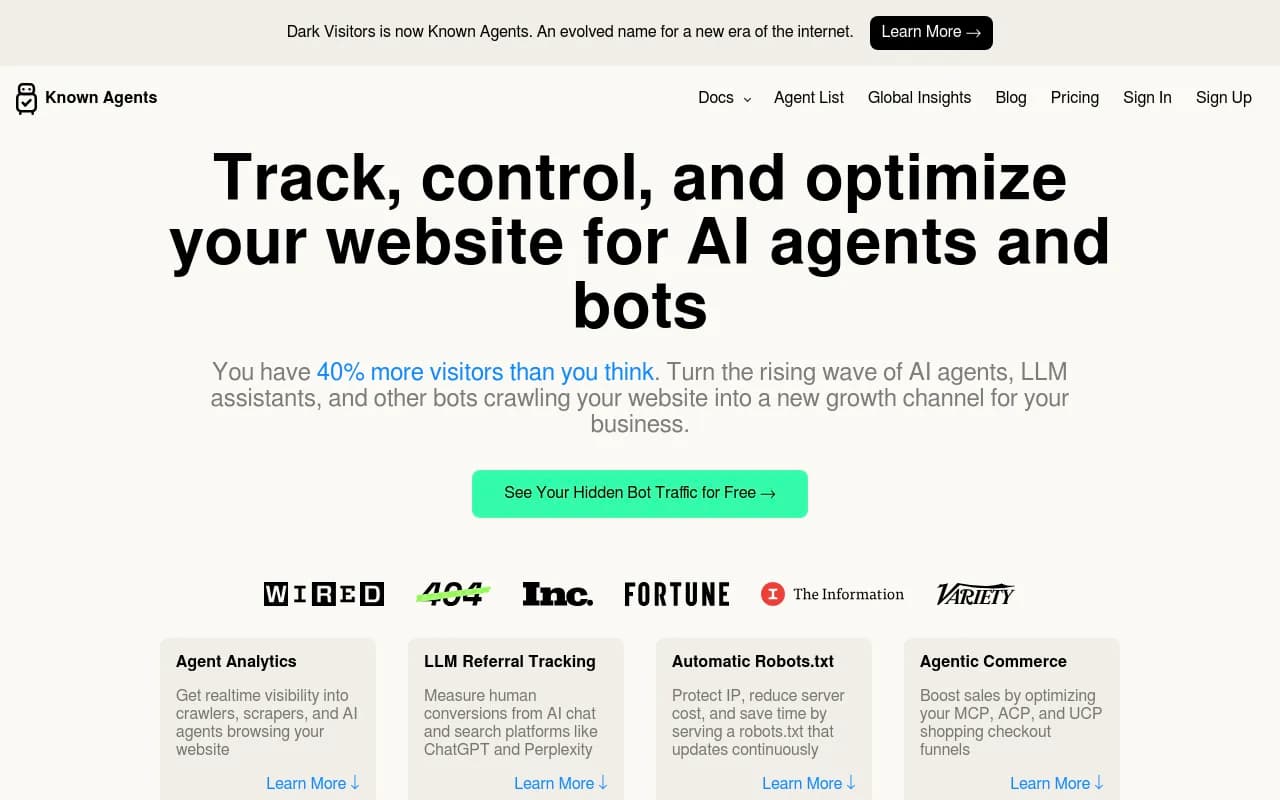
You get a database of known AI crawlers (GPTBot, ClaudeBot, PerplexityBot, and many others), tools to block or allow specific bots via your robots.txt, and visibility into which AI agents are hitting your site. If your primary question is "what AI bots are crawling my site and can I control them?" DarkVisitors is the most direct answer. It's not a replacement for a full AI visibility platform, but it pairs well with one.
8. Botify
Botify is an enterprise SEO and GEO platform with a genuinely powerful crawler. It's been around long enough to have deep technical SEO roots, and its AI-era additions include some GEO-specific features.
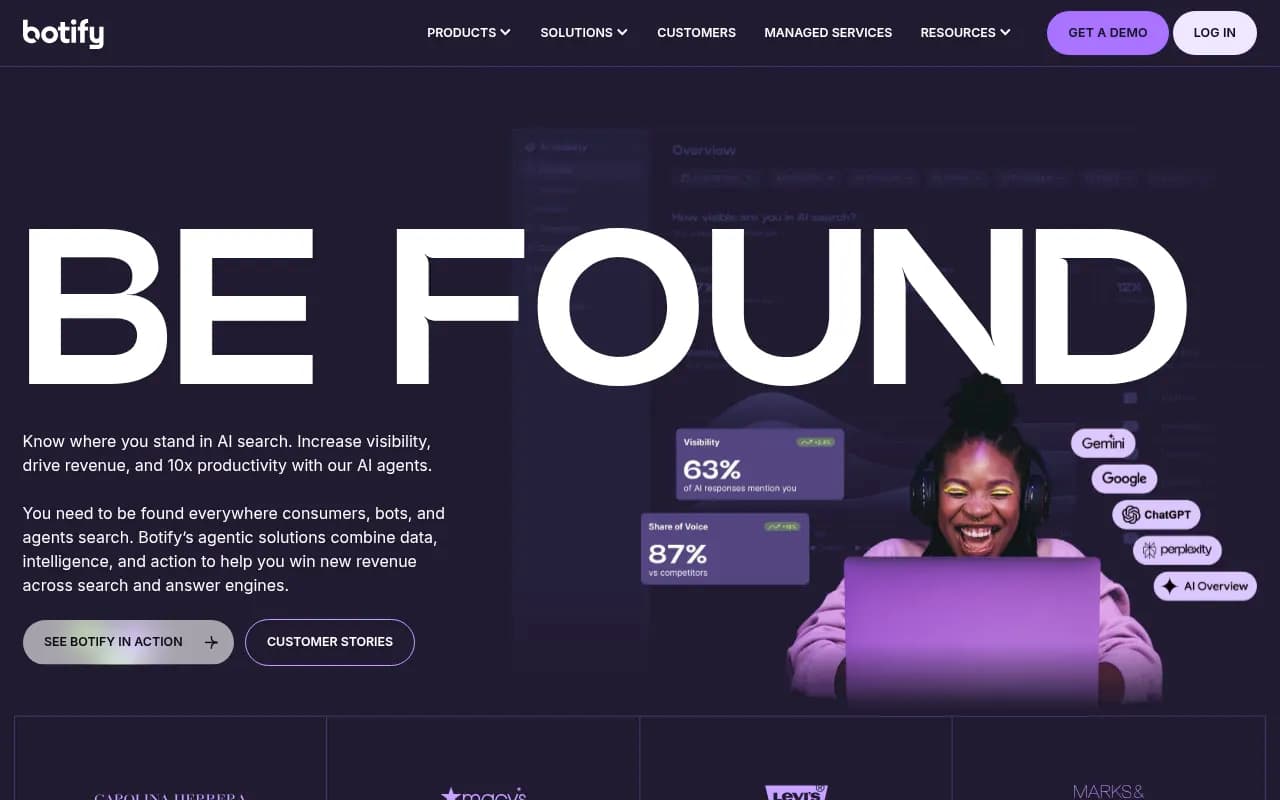
For crawler log monitoring, Botify is strong — it ingests server logs at scale, shows you how search engine bots (and increasingly AI crawlers) interact with your site, and surfaces crawl budget issues, error patterns, and indexation gaps. The limitation is that it's built primarily around traditional search crawlers (Googlebot, Bingbot) and is only partially adapted to the AI crawler landscape. It's also enterprise-priced, which puts it out of reach for most marketing teams.
9. SE Visible
SE Visible (from SE Ranking) is a user-friendly AI visibility tracker that covers prompt monitoring, brand mentions, and competitive analysis across the major AI models. It's one of the more affordable options in this space and has a clean, accessible interface.
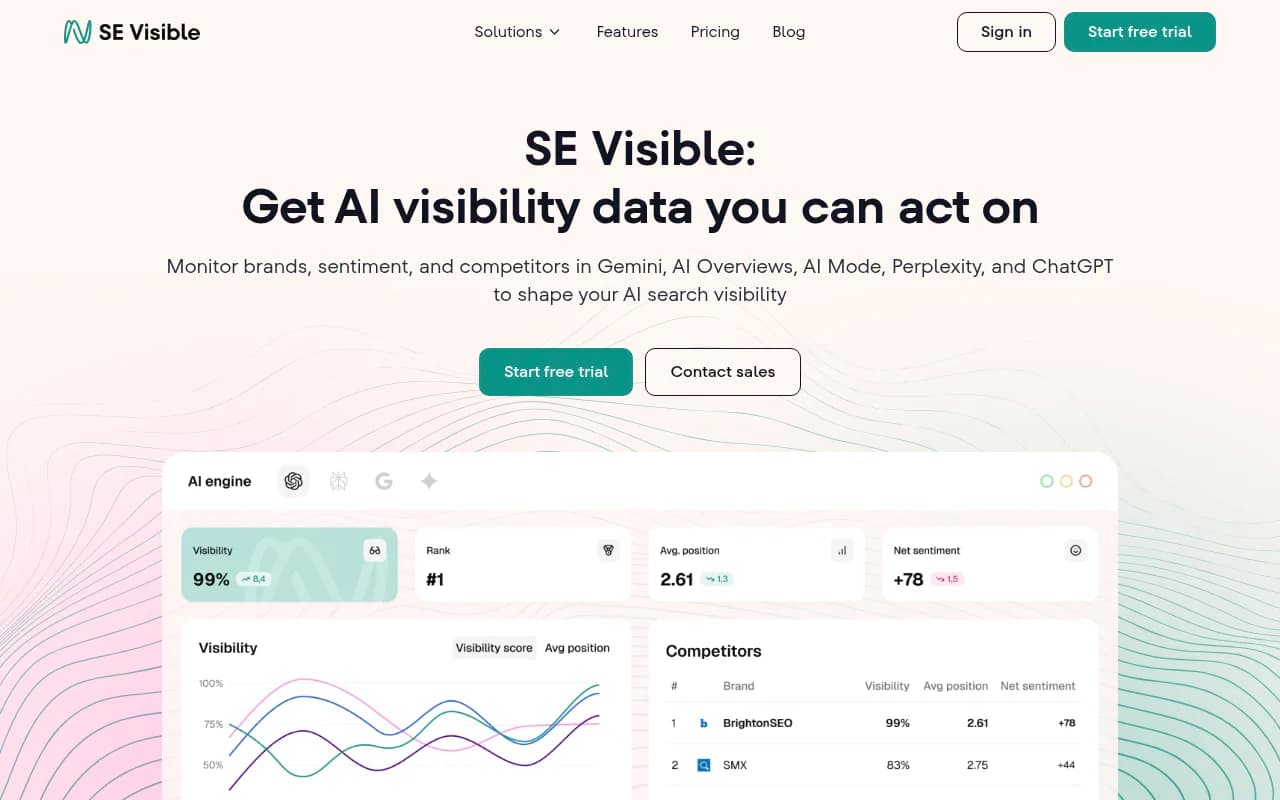
Crawler log monitoring isn't part of what SE Visible does. It's a solid choice for teams that want straightforward AI mention tracking without a steep learning curve or a steep price tag, but it won't answer questions about bot behavior on your site.
The crawler log gap: why most tools don't solve it
It's worth being direct about something: most AI visibility tools were built to answer one question — "is my brand appearing in AI responses?" That's a useful question, but it's downstream of a more fundamental one: "is my content being discovered and processed by AI engines in the first place?"
Crawler log monitoring answers that second question. And the reason most tools don't offer it is that it requires actual infrastructure integration — connecting to your CDN, ingesting your server logs, or deploying a tracking layer that can distinguish GPTBot from Googlebot from a regular user session. That's harder to build than a dashboard that queries AI APIs and counts brand mentions.
The tools that have done this work — Promptwatch, Scrunch AI, DarkVisitors, and to some extent Botify — are meaningfully different from the monitoring-only platforms. If you're seeing low citation rates despite publishing content that should be getting picked up, crawler log data is often where the diagnosis starts.
How to choose between these tools
The right choice depends on what question you're actually trying to answer:
"What are AI bots doing on my site right now?" Start with DarkVisitors for bot identification and control, then add Promptwatch for the full picture including citations and content gaps.
"Why isn't my content being cited despite being crawled?" Promptwatch's agent analytics show the full path from crawl to citation, which is where this diagnosis happens.
"We just want to track brand mentions and share of voice." Otterly.AI or SE Visible are the most accessible entry points. Peec AI is worth considering if you operate in multiple languages or regions.
"We need enterprise-grade crawler analysis." Botify handles large-scale server log ingestion better than anyone, but you'll need to pair it with a separate AI visibility tool.
"We want to find gaps and actually fix them, not just monitor." Promptwatch is the only platform here that closes the loop: crawler logs show you what's being missed, answer gap analysis shows you which prompts you're losing, and content agents generate the content to fill those gaps.
Final thought
Omnia does its core job well. But "monitoring what AI says about you" and "understanding how AI discovers your content" are two different problems, and in 2026 you increasingly need to solve both.
The tools on this list each address a piece of that. DarkVisitors is the most focused on raw bot visibility. Scrunch AI adds AI-readiness diagnostics. Promptwatch is the only one that connects crawler data to content strategy and actually helps you do something about what you find.
If you're evaluating alternatives because Omnia's monitoring is useful but you keep hitting a wall when you try to act on the data, that's the gap worth solving.