Key takeaways
- LLM model updates (GPT-4o, Claude 3.5, Gemini 2.0, etc.) can shift your AI search visibility dramatically without any warning -- traditional rank trackers won't catch this
- Most GEO platforms are monitoring dashboards that show you data after the fact; only a handful actively alert you to visibility drops tied to model changes
- The platforms that go beyond monitoring -- with content gap analysis, AI writing tools, and crawler logs -- give you a path to recover, not just a report of the damage
- Version-aware tracking matters most for brands in competitive categories where LLMs frequently update their "recommended" sources
- Pricing ranges from $29/mo for basic monitoring to $2,500+/mo for enterprise platforms, but the gap in capability between cheap and mid-tier tools is significant
Why LLM version updates are a visibility problem nobody talks about
Here's a scenario that's becoming increasingly common in 2026. Your brand has been consistently cited by ChatGPT for three months. Traffic from AI referrals is growing. Then, quietly, OpenAI ships GPT-4o with updated training data and revised citation preferences. Within two weeks, your share of voice drops 30%. Your traditional SEO metrics look fine. Your Google rankings haven't moved. But your AI visibility has cratered -- and you have no idea why.
This is the LLM version problem. Unlike Google algorithm updates, which come with at least some public communication, model updates from OpenAI, Anthropic, Google, and others happen on their own schedules, with minimal documentation about how they affect citation behavior. The models don't just get smarter -- they change which sources they trust, how they weight recency, and what content formats they prefer to cite.
For brands investing in Generative Engine Optimization, this creates a real operational challenge. You need to know:
- When a model update happened
- Whether your visibility changed around that time
- Which prompts were affected
- What content changes could help you recover
Most GEO platforms in 2026 can answer the first two questions, sometimes. Very few can help you with the last two.
What "tracking AI model versions" actually means in practice
Before comparing tools, it's worth being precise about what we mean. There are a few distinct capabilities that fall under this umbrella:
Historical visibility snapshots: Can the platform show you your citation rate over time, with enough granularity to spot a sudden drop? This is table stakes -- most tools do this.
Model-specific breakdowns: Does the platform separate your visibility by model (ChatGPT vs. Claude vs. Perplexity vs. Gemini)? A drop in one model but not others is a strong signal that a model-specific update happened.
Anomaly detection and alerts: Does the platform proactively notify you when your visibility drops significantly, rather than waiting for you to log in and notice?
Version change attribution: Can the platform correlate your visibility changes with known model update dates? This is rare and genuinely useful.
Recovery guidance: After detecting a drop, does the platform help you understand what content changes might restore your visibility?
The tools below vary considerably on these dimensions. I'll be direct about which ones actually deliver and which ones are mostly dashboards dressed up with GEO branding.
The platforms worth knowing about
Promptwatch: the closest thing to a full action loop
Promptwatch is the platform I'd point most brands toward first, specifically because it doesn't stop at detection. When your visibility drops after a model update, the question isn't just "what happened" -- it's "what do I do about it." Promptwatch's Answer Gap Analysis shows you exactly which prompts competitors are now winning that you're not, and the built-in AI writing agent generates content designed to close those gaps. That's a materially different workflow than logging into a dashboard, seeing a red number, and then figuring out next steps yourself.
The model-specific tracking is solid too. Promptwatch monitors 10 AI models separately -- ChatGPT, Claude, Perplexity, Gemini, Grok, DeepSeek, Meta AI, Copilot, Mistral, and Google AI Overviews -- so if a GPT-4o update tanks your visibility while your Perplexity numbers hold steady, you'll see that clearly rather than just watching an aggregate score move.
The AI Crawler Logs feature is particularly relevant here. When a model update happens, crawling behavior often changes before citation behavior does. Seeing which pages the ChatGPT crawler is suddenly ignoring (or newly interested in) gives you an early signal that something has shifted.

Profound: strong enterprise monitoring with model-level data
Profound has built a genuinely capable monitoring layer. It tracks visibility across major AI models with good historical data, and the enterprise tier includes automation features that can flag significant changes. The read/write AI model feature is interesting -- it can both analyze your current AI visibility and suggest content changes.
Where Profound falls short relative to Promptwatch is in the content generation and gap analysis depth. It's more of a monitoring and reporting tool than an optimization engine. For large brands that primarily need executive-level dashboards and solid data, it works well. For teams that need to act on what they find, the workflow requires more manual effort.

SE Visible: clean interface, good for agencies
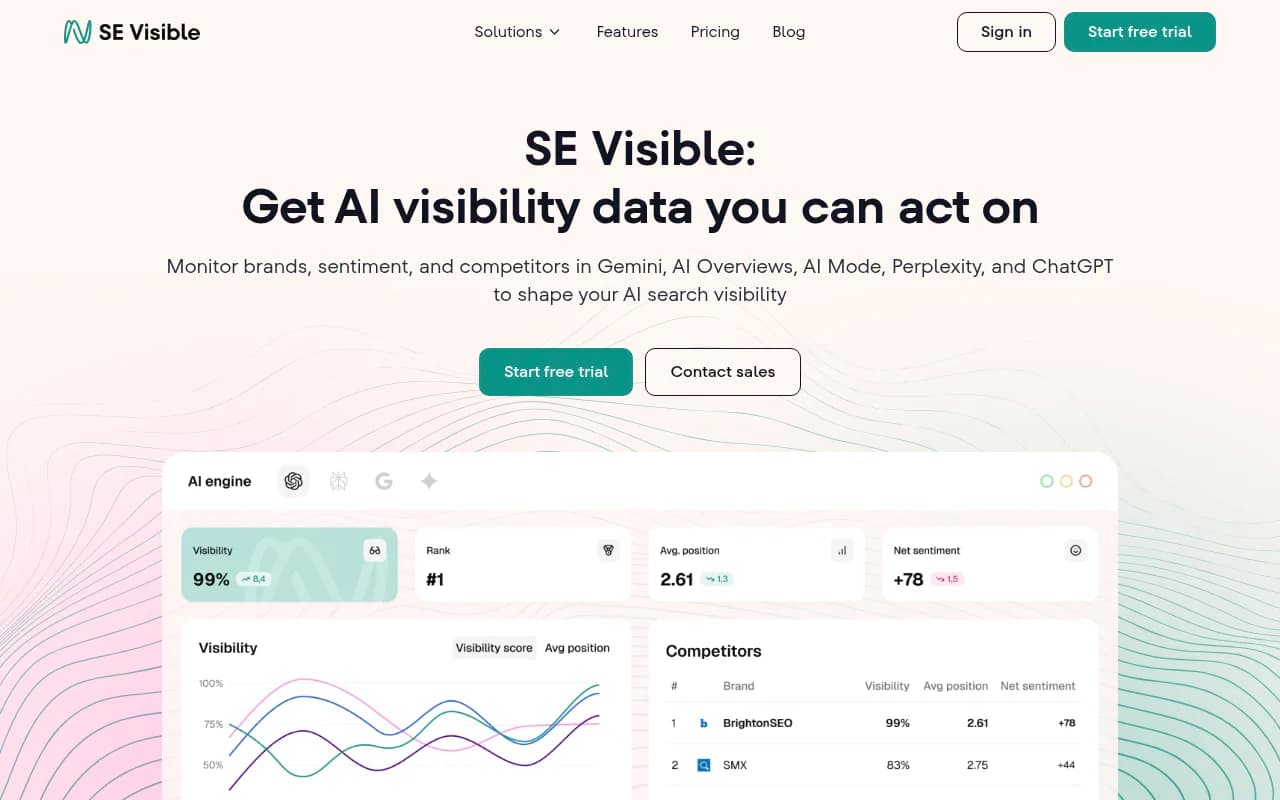
SE Visible (from SE Ranking) is one of the more polished tools in this space. The interface is genuinely clean, and it handles multi-client management well, which matters for agencies. AI Mode tracking is a core feature, and the tool does a reasonable job of showing brand appearance rates across AI responses.
What it doesn't do is alert you proactively to model-version-driven drops or help you create content to recover. It's a visibility tracker, not an optimization platform. Starting at $189/mo, it's priced reasonably for what it delivers.
Nightwatch: best value for the basics
Nightwatch is primarily a traditional rank tracker that has added an AI monitoring add-on. For teams that need both traditional SEO tracking and basic AI visibility in one tool, it's a cost-effective option. The geo-level data is genuinely good -- useful for brands that care about regional AI visibility differences.
The AI monitoring is more limited than dedicated GEO platforms. You won't get model-version attribution or anomaly alerts. But at $39/mo plus the AI add-on, it's a reasonable entry point for smaller teams.
Otterly.AI: affordable prompt-based tracking
Otterly.AI is one of the cheaper options in the market at $29/mo, and it delivers reasonable value at that price. Automated prompt testing and basic GEO audits are the core features. It's monitoring-only -- no content generation, no gap analysis, no crawler logs -- but if your primary need is tracking whether specific prompts return your brand, it works.
The lack of proactive alerting is a real limitation for the LLM version tracking use case. You'll need to check in regularly rather than being notified when something changes.

Peec AI: simple dashboard for B2B and SaaS
Peec AI has a clean, simple interface and handles competitor benchmarking reasonably well. For SaaS and B2B brands that want a quick read on how they compare to competitors across AI models, it's a decent choice. Multi-language support is a genuine differentiator for international brands.
Like Otterly.AI, it's a monitoring tool. The €89/mo price point is fair for what you get.

AthenaHQ: monitoring across 8+ models
AthenaHQ covers a solid range of AI models and has a reasonable interface for tracking brand visibility. It's positioned as a monitoring and tracking platform, which it does adequately. The gap relative to Promptwatch is the absence of content optimization tools -- you can see where you're invisible, but the platform doesn't help you fix it.

LLMrefs: keyword-centric approach
LLMrefs takes an interesting angle: it starts from keywords you already track and automatically generates conversational prompts around them, then monitors AI responses. This makes it easier to connect your existing SEO strategy to AI visibility tracking. The share-of-voice metrics are solid.
Rankshift: focused LLM tracking
Rankshift is a more focused tool that does LLM tracking without trying to be an all-in-one platform. If you want clean data on AI visibility without a lot of additional features, it's worth evaluating.
Scrunch AI: visibility monitoring for modern brands
Scrunch AI covers the monitoring basics and has a clean interface. It's been used by larger brands and handles multi-model tracking reasonably well.
Comparison: how these platforms handle LLM version changes
| Platform | Model-specific tracking | Proactive alerts | Version change attribution | Content gap analysis | AI content generation | Starting price |
|---|---|---|---|---|---|---|
| Promptwatch | 10 models | Yes | Yes (via crawler logs + visibility history) | Yes | Yes | $99/mo |
| Profound | Yes | Partial | Limited | Limited | Partial | $99/mo |
| SE Visible | Yes | No | No | No | No | $189/mo |
| AthenaHQ | 8+ models | No | No | No | No | Custom |
| Nightwatch | Basic | No | No | No | No | $39/mo + add-on |
| Otterly.AI | Yes | No | No | No | No | $29/mo |
| Peec AI | Yes | No | No | No | No | €89/mo |
| LLMrefs | Yes | No | No | No | No | Custom |
| Rankshift | Yes | Partial | No | No | No | Custom |
The table makes the gap pretty clear. Most platforms in this space are monitoring dashboards. They'll show you that your visibility dropped, but they won't tell you why (beyond the obvious) and they won't help you do anything about it.
What to actually look for when evaluating these tools
Model-level granularity matters more than aggregate scores
An aggregate "AI visibility score" that blends ChatGPT, Claude, and Perplexity into one number is almost useless for diagnosing model-version impacts. If GPT-4o updates its citation behavior and your Claude visibility is fine, an aggregate score will smooth over the signal. Look for platforms that show you per-model visibility clearly, with historical trends for each model separately.
Historical data depth determines how useful alerts are
Alerts are only actionable if you have enough historical context to distinguish a model-update-driven drop from normal variance. Platforms that have been collecting data for 12+ months have a real advantage here. Newer tools may lack the baseline needed to make their anomaly detection meaningful.
Crawler logs are an underrated early warning system
Most GEO platforms focus entirely on what AI models say in their responses. But what AI crawlers do on your website often changes before response behavior does. If the ChatGPT crawler suddenly stops visiting certain pages, that's a signal worth having before your citation rate drops. Promptwatch's crawler log feature is one of the few places you can get this data.
The "now what" question separates tools from platforms
After you detect a visibility drop, you need to create or update content. The platforms that can help you identify exactly which content gaps to fill -- and generate that content grounded in real citation data -- are worth significantly more than monitoring-only tools. The time saved on content strategy and production alone can justify the price difference.
How to set up a practical LLM version monitoring workflow
Even with the right tools, you need a process. Here's what works:
Weekly visibility checks by model: Don't just look at aggregate scores. Review your visibility for each AI model separately, and flag any model where your score has dropped more than 10% week-over-week.
Prompt-level tracking for your highest-value queries: Your top 20-30 prompts should be tracked individually. A drop in aggregate visibility might be driven by one or two high-volume prompts where a competitor has gained ground.
Correlate drops with known model updates: Keep a simple log of when major model updates ship (OpenAI, Anthropic, Google, and Perplexity all publish release notes). When you see a visibility drop, check whether a model update happened in the same window.
Run a gap analysis after any significant drop: If your visibility drops more than 15% in a two-week period, run a full competitor gap analysis to see which prompts you've lost ground on and what content your competitors have that you don't.
Check crawler logs for early signals: If you have access to AI crawler logs, review them weekly. Changes in crawl frequency or pages visited often precede changes in citation behavior by 2-4 weeks.
The broader context: why this matters more in 2026
The pace of model updates has accelerated. In 2024, major model updates happened a few times a year. In 2026, OpenAI, Anthropic, and Google are shipping meaningful updates on roughly a monthly cadence. Each update can shift citation preferences, change how models weight recency vs. authority, and alter which content formats get cited.
Brands that treat AI visibility as a "set it and forget it" channel are going to get hurt by this. The brands that build monitoring and response workflows -- the ones that can detect a drop within days and have content in production within a week -- are the ones that will maintain consistent AI search presence.
The tools exist to do this. The question is whether your team has the process to use them effectively.
Bottom line
If you're serious about tracking how LLM version updates affect your AI search visibility, you need a platform that does more than show you a dashboard. The monitoring-only tools (Otterly.AI, Peec.ai, most of the cheaper options) will tell you that something changed. They won't help you understand why or what to do about it.
Promptwatch is the most complete option for teams that need the full loop: detect the drop, identify the content gaps, create the content, track the recovery. For teams with more limited budgets or simpler needs, SE Visible and Nightwatch are reasonable starting points -- just go in knowing you'll need to do more of the diagnostic and recovery work manually.
The worst outcome is having no visibility into this at all. If you're still relying entirely on Google Search Console and traditional rank trackers, you're flying blind on a channel that's increasingly driving purchase decisions.