Key takeaways
- GEO platform pricing in 2026 ranges from around $20/month for basic trackers to $500+/month for platforms with content generation and deep analytics -- the gap in value is even wider than the gap in price.
- Most tools in this category are monitoring-only dashboards. They show you data but don't help you act on it, which matters a lot when you're comparing price-to-value.
- Pricing transparency varies wildly. Some tools publish clear tiers with specific prompt limits and feature breakdowns. Others hide everything behind "book a demo."
- The most important question isn't "what does it cost?" -- it's "what does it actually do for my visibility?" A $99/month tool that helps you create content that gets cited is worth more than a $300/month dashboard that just shows you a score.
- A handful of platforms -- including Promptwatch -- close the full loop from gap analysis to content creation to traffic attribution. Most don't.
The GEO tool market in 2026 is genuinely confusing. There are now well over 50 platforms claiming to help you "dominate AI search" or "optimize your brand for LLMs." Prices range from $20/month to enterprise contracts that require a call with a sales team. And almost none of them make it easy to compare what you're actually getting.
This guide cuts through that. We looked at how the major GEO platforms structure their pricing, what each tier actually includes, and -- more importantly -- whether the price reflects real value or just a monitoring dashboard with a premium label.
Why pricing transparency matters in this category
Most software categories have settled pricing norms. You expect a project management tool to show you a per-seat price. You expect an email platform to charge by subscriber count. GEO tools haven't settled yet.
Some platforms publish detailed pricing pages with specific limits (prompts per month, number of sites, articles generated). Others show vague tier names -- "Starter," "Growth," "Enterprise" -- without telling you what's included until you sign up or book a call. A few don't publish pricing at all.
This matters because the category is still new enough that buyers don't always know what questions to ask. If a tool says "$49/month," you need to know: 49 dollars for how many prompts? Which AI engines? Does it include content generation or just tracking? Can you monitor competitors? How many?
The tools that are upfront about these details tend to be the ones that are also more confident in their value proposition. Opacity is usually a sign that the price-to-value ratio doesn't hold up under scrutiny.
The pricing landscape: what you're actually paying for
Before diving into specific tools, it helps to understand what GEO platforms are actually selling. There are roughly three tiers of capability in this market:
Monitoring only. These tools track whether your brand appears in AI responses to a set of prompts. They show you a visibility score, maybe some competitor comparisons, and a history of how your mentions have changed. That's it. You get data. What you do with it is your problem.
Monitoring plus some analysis. A step up. These platforms add features like sentiment analysis, citation source tracking, or basic prompt suggestions. Still mostly passive -- they tell you what's happening but don't help you change it.
Full optimization loops. The smallest group. These platforms don't just show you where you're invisible -- they help you figure out why, generate content to fix it, and track whether the fix worked. This is where the real ROI lives, and it's also where the pricing jumps.
Most tools in the $20-$100/month range are in the first bucket. Most in the $200-$500/month range claim to be in the second or third, but many are still closer to the first. A few genuinely deliver on the third.
Tool-by-tool pricing breakdown
Budget tier ($20-$100/month)
Otterly.AI sits at the accessible end of the market. It's a monitoring tool -- clean, simple, and honest about what it is. Good for teams that just want to start tracking AI visibility without a big commitment.

Peec AI is another entry-level option, with multi-language tracking as a differentiator. The pricing is accessible, but like most tools in this range, it's monitoring-focused. You'll see your visibility scores but won't get much help improving them.

Rankscale starts at around $20/month, which makes it one of the cheapest options in the category. It covers citation source mapping and sentiment analysis. For solo marketers or small teams just getting started with GEO, it's a low-risk entry point.
Airefs is worth mentioning here as an affordable option for teams that want AI search visibility tracking without the enterprise price tag.
At this price point, the honest summary is: you're paying for awareness, not action. You'll know whether you're being cited. You won't know what to do about it.
Mid-tier ($100-$300/month)
This is where most of the serious GEO tools live -- and where pricing transparency varies the most.
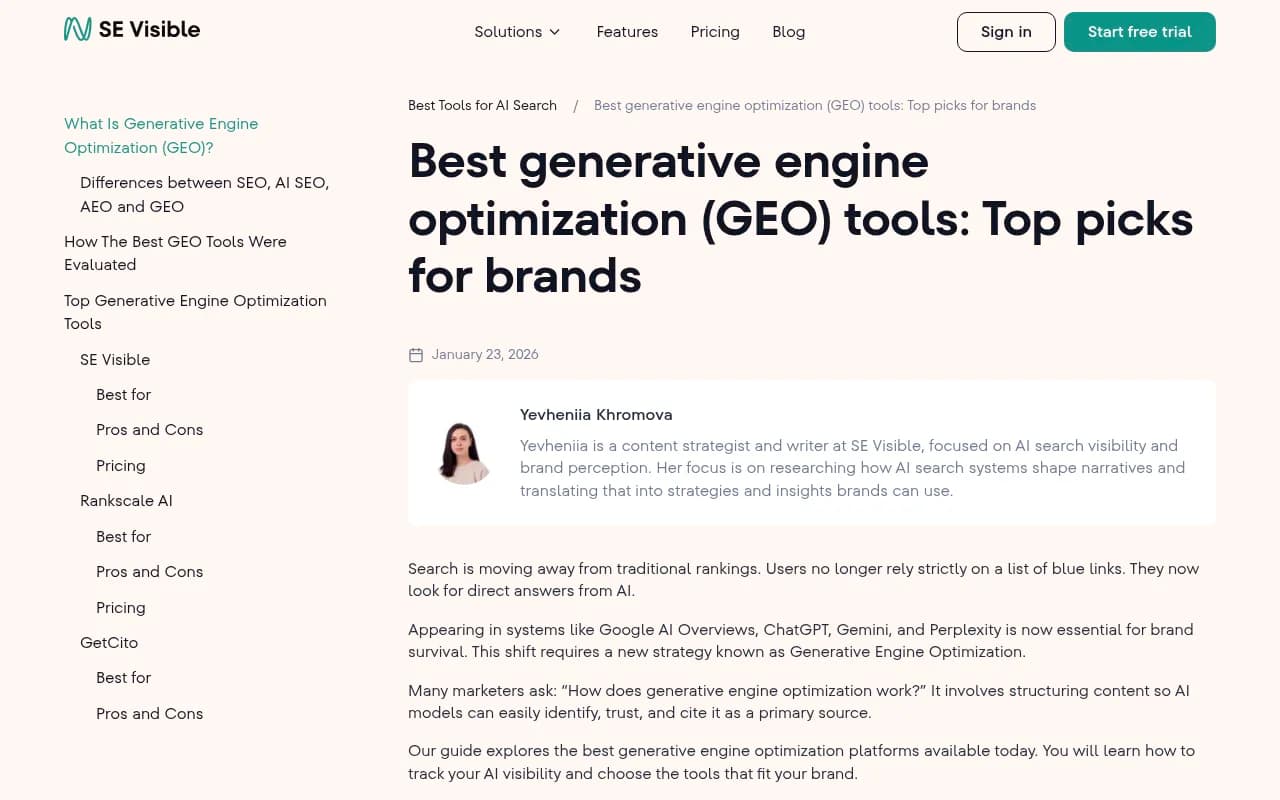
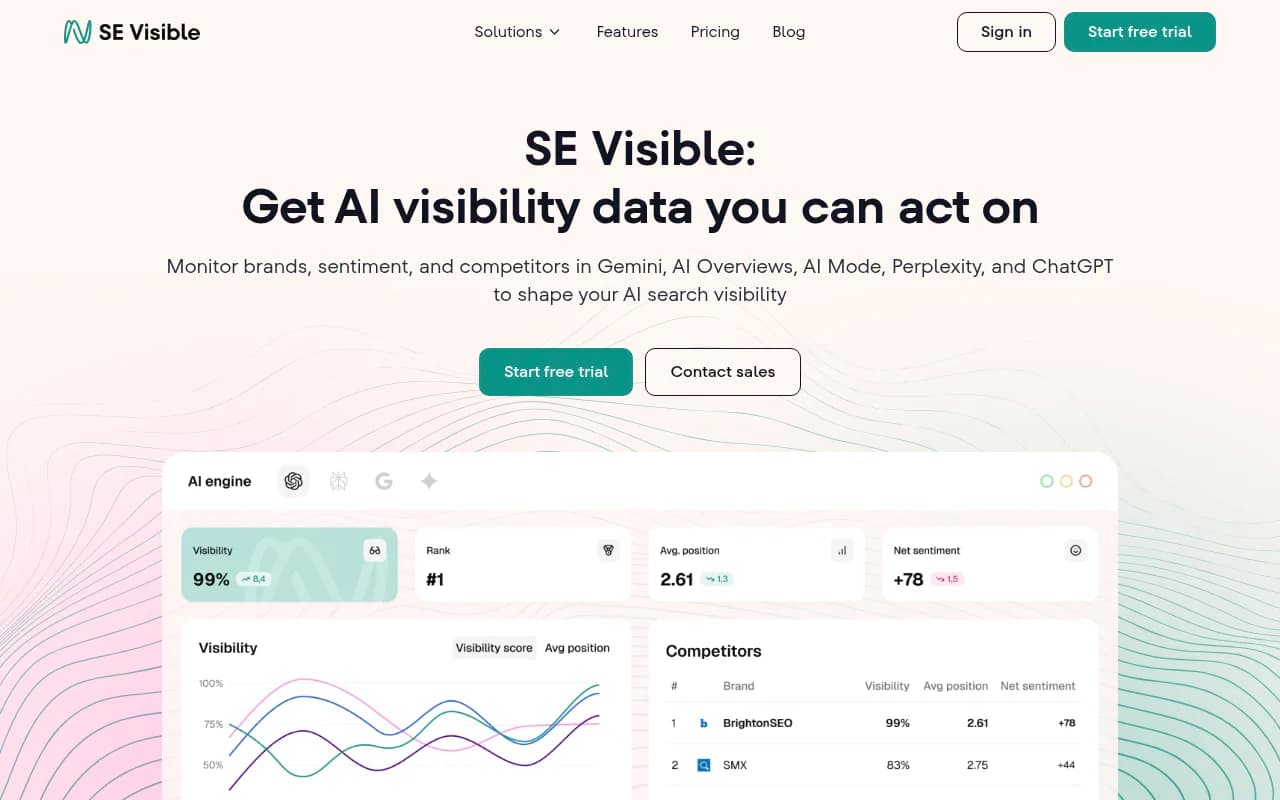
SE Visible (from SE Ranking) starts at $189/month and covers five AI platforms including Google AI Overviews, Gemini, ChatGPT, and Perplexity. It includes a visibility score, net sentiment score, competitor benchmarking, and prompt/topic insights. The pricing page is reasonably clear about what's included at each tier.
Promptwatch starts at $99/month for the Essential plan (1 site, 50 prompts, 5 articles per month) and $249/month for Professional (2 sites, 150 prompts, 15 articles, crawler logs, city/state tracking). The Business plan is $579/month for 5 sites and 350 prompts. These are specific, published numbers -- you know exactly what you're buying.
What makes Promptwatch different from most tools in this range isn't just the price. It's that the platform is built around an action loop rather than a monitoring dashboard. The Answer Gap Analysis shows you exactly which prompts competitors rank for that you don't. The built-in AI writing agent then generates content designed to get cited by ChatGPT, Claude, Perplexity, and other models -- grounded in real citation data from over 880 million citations analyzed. And the tracking layer closes the loop by showing you which pages are getting cited, how often, and by which models, with traffic attribution via GSC integration or server log analysis.
Most tools at this price point stop at step one. Promptwatch runs all three steps.

AthenaHQ sits at around $295/month and covers broad LLM coverage with prompt volume tracking and a GEO score. It's a solid monitoring and analysis tool, particularly for enterprise teams that want data depth. Pricing is published, though the feature breakdown at each tier requires some digging.

Profound has published pricing starting at $49/month for accessible automation, though their higher tiers scale up significantly. They cover tracking and some optimization features, and their pricing page is more transparent than many competitors.

Hall AI tracks how AI platforms cite and talk about your brand. Worth a look for teams focused specifically on citation monitoring.

Scrunch AI is positioned for modern brands that want AI search visibility monitoring. Pricing is less transparent than some competitors -- worth checking their current published rates directly.
Higher-tier and enterprise ($300+/month)
GetCito starts at $299/month and differentiates itself with open-source transparency and local/regional GEO tracking. For agencies and B2B brands that need to audit AI visibility across specific geographies, this is a genuine differentiator. The pricing is published and the feature breakdown is clear.
Goodie AI comes in at around $495/month on annual billing. It includes a semantic optimization hub, AEO writer, and AI attribution. This is one of the more complete platforms in the category, though the price puts it out of reach for smaller teams.
Evertune is positioned at the enterprise end of the market, targeting Fortune 500 brands. Pricing isn't published -- you'll need to contact them. For large organizations with complex multi-brand needs, it may be worth the conversation.
Semrush and Ahrefs Brand Radar are worth mentioning here because many teams already pay for them as SEO platforms. Both have added AI visibility features, but with limitations: Semrush uses fixed prompts, and Ahrefs Brand Radar has fixed prompts with no AI traffic attribution. If you're already paying for these tools, the AI visibility features are a bonus -- but they're not a substitute for a dedicated GEO platform.
Search Party is agency-oriented and has custom pricing. It's strong on automation but limited on prompt metrics and content gap analysis.
Comparison table: GEO platform pricing and transparency
| Tool | Starting price | Prompt limits published? | Content generation? | Crawler logs? | AI traffic attribution? | Pricing transparency |
|---|---|---|---|---|---|---|
| Otterly.AI | ~$49/mo | Yes | No | No | No | High |
| Peec AI | ~$49/mo | Partial | No | No | No | Medium |
| Rankscale | ~$20/mo | Partial | No | No | No | Medium |
| SE Visible | $189/mo | Yes | No | No | No | High |
| Promptwatch | $99/mo | Yes | Yes (built-in AI writer) | Yes | Yes | High |
| AthenaHQ | ~$295/mo | Partial | No | No | No | Medium |
| Profound | From $49/mo | Yes | Partial | No | Partial | High |
| GetCito | $299/mo | Yes | No | No | No | High |
| Goodie AI | ~$495/mo | Partial | Yes | No | Yes | Medium |
| Evertune | Custom | No | No | No | No | Low |
| Semrush | From $139/mo | No (fixed) | No | No | No | Medium |
| Ahrefs Brand Radar | Bundled | No (fixed) | No | No | No | Low |
| Search Party | Custom | No | No | No | No | Low |
What "transparent pricing" actually means in practice
A tool publishing a price doesn't automatically mean the pricing is transparent. Here's what to look for:
Prompt limits. How many prompts can you track per month? This is the core unit of value in GEO platforms. If a tool doesn't publish this number, you're flying blind on whether the plan will actually cover your needs.
Number of sites. Can you monitor one domain or multiple? Agencies especially need to know this upfront.
AI engine coverage. Which models does the tool actually query? There's a big difference between a tool that checks ChatGPT and Perplexity versus one that covers ChatGPT, Claude, Gemini, Perplexity, Grok, DeepSeek, Copilot, Meta AI, Mistral, and Google AI Overviews.
Content generation limits. If the tool includes AI content generation, how many articles per month? What's the quality like? Is it generic SEO filler or content engineered around real citation data?
What's gated behind "Enterprise." Many tools use "Enterprise" as a catch-all for features they don't want to price publicly. That's fine for genuinely complex enterprise needs, but if basic features like API access or multi-user support require a sales call, that's a red flag.
The features most tools don't mention in their pricing pages
A few capabilities are genuinely rare in this market and worth asking about specifically before you sign up:
AI crawler logs. Real-time logs showing when AI crawlers (ChatGPT, Claude, Perplexity) visit your site, which pages they read, and how often they return. This tells you whether AI engines can even discover your content -- a prerequisite for being cited. Most platforms don't offer this at all.
Reddit and YouTube tracking. AI models frequently cite Reddit threads and YouTube videos in their responses. A platform that ignores these channels is missing a significant part of the citation picture.
ChatGPT Shopping tracking. If you sell products, knowing when your brand appears in ChatGPT's shopping carousels is increasingly important. Very few platforms track this.
Query fan-outs. When someone asks an AI a question, the model often breaks it into sub-queries before generating a response. Understanding how prompts branch helps you prioritize which content to create. This is a niche but valuable feature.
Traffic attribution. The hardest problem in GEO: connecting AI visibility to actual website traffic and revenue. Tools that offer GSC integration, server log analysis, or a tracking code snippet to attribute AI-referred traffic are significantly more valuable than those that just show visibility scores.
How to decide what to pay for
The right GEO platform for your team depends on where you are in your AI visibility journey.
If you're just starting out and want to understand whether you have an AI visibility problem at all, a lower-cost monitoring tool is a reasonable starting point. Spend a month or two understanding your baseline before committing to a more expensive platform.
If you already know you have a visibility gap and want to do something about it, monitoring-only tools will frustrate you quickly. You need a platform that can help you identify which content to create and actually generate it -- or at minimum, give you specific enough guidance that your content team can act on it.
If you're an agency managing multiple clients, the per-site pricing structure matters a lot. Make sure you understand whether the plan you're considering supports the number of domains you need, and whether white-label reporting is included or an add-on.
And if you're evaluating platforms for a larger organization, don't just look at the feature list -- look at the data behind it. A platform that has processed over a billion citations has a fundamentally different quality of insight than one that launched six months ago with a few million data points.
A note on free trials
Most GEO platforms offer some form of free trial or free tier. Use them. The category is new enough that the difference between a tool that looks good in a demo and one that's actually useful in practice can be significant.
When you're in a trial, don't just poke around the dashboard. Run the specific prompts your customers are actually asking. Check whether your competitors are appearing in those responses. See whether the platform gives you any actionable guidance on what to do next -- or just shows you a number and leaves you to figure it out.
That last distinction is the most important one in this category. Data without direction is just noise.
Bottom line
GEO platform pricing in 2026 ranges from genuinely affordable to genuinely expensive, and the correlation between price and value isn't as strong as you'd hope. Some of the most transparent, useful platforms are in the mid-tier. Some of the most expensive tools are still primarily monitoring dashboards.
The questions worth asking before you commit to any platform: Does it tell me specifically what content I'm missing? Does it help me create that content, or just identify the gap? Can I see which of my pages are being cited and by which AI models? And can I connect any of this to actual traffic and revenue?
If the answer to most of those is yes, the price is probably worth it. If the answer is mostly "it shows you a visibility score," you might be paying for a dashboard when what you need is a strategy.