Key takeaways
- An entity is a uniquely identifiable thing (a company, product, person) that AI can tell apart from others and connect to facts. If your brand isn't a clear entity, it rarely makes it into answers.
- Consistency is the main lever. The same name, description, category and facts on your site, structured data, profiles and third-party pages give models a stable picture to repeat.
- Third-party corroboration carries more weight than your own claims. An Ahrefs study of roughly 75,000 brands, as summarized by Chatter Buzz Media, found web mentions correlated with AI Overview visibility at 0.66, versus 0.30 for referring domains.
- Your own domain matters more than before: Promptwatch Data shows ChatGPT began using site: queries at scale on August 8, 2026.
- Audit what AI says about you, fix the sources it learned from, then re-check on a schedule. Entities decay when details drift.
What entity signals are and why models care
A language model doesn't know your brand the way a customer does. It builds a picture from what it has read: your website, structured data, reviews, news, forum threads, directories. If those sources agree, the picture is sharp. If they disagree, the model averages them, or worse, merges you with someone else.
Lumar defines an entity as a clearly defined, uniquely identifiable thing that can be distinguished from others and connected to related information. Models and retrieval systems organize knowledge around entities and their relationships, not just keywords. Lumar's framing is useful here: entity work answers "who are you?", while brand authority work answers "should we trust you?" The first has to succeed before the second matters.
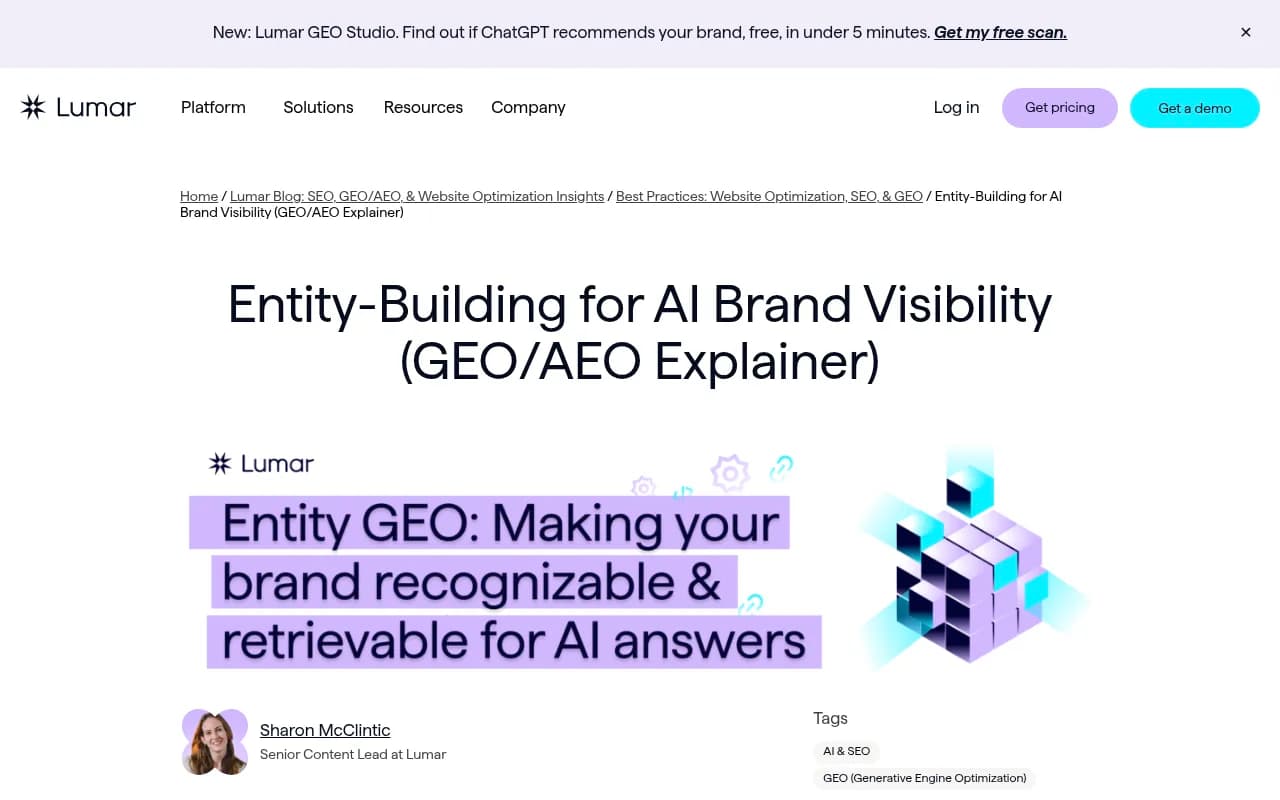
At the entity layer, a model is essentially checking three things:
- Does this brand exist as a distinct concept?
- Can it be disambiguated from similarly named things?
- Does it have stable, consistent facts attached?
That third point is where most brands leak. Not through a dramatic failure, but through small mismatches: "Acme Software" on the site, "Acme Inc." on LinkedIn, "Acme Analytics" in an old press release, a different founding year on Crunchbase.
How AI interprets a brand
Yoast's overview of AI brand perception lists the mechanisms involved. Knowledge graphs store entities and the relationships between them. Entity linking decides that "Apple's new iPhone" refers to the company, not the fruit. Relationship mapping connects a brand to competitors, products and audiences. Sentiment analysis reads tone across reviews, forums and media.
Yoast also makes a point I agree with: models often weigh what the world says about you more heavily than what you say about yourself. Their example is a software tool that fixed its early bugs but still gets labelled unreliable in AI summaries because old forum complaints remain in the record. That's not a content problem on your site. It's a corroboration problem elsewhere.
Where inconsistency creeps in
Before fixing anything, know the usual suspects.
- Name variants: legal name, trading name, product name and abbreviation used interchangeably.
- Descriptions: a tagline on the homepage, a different category on LinkedIn, a third version in directories.
- Facts that change: headquarters, founding year, pricing model, team size, leadership. Rebrands and office moves are the classic decay events.
- Name collisions: another company, person or product shares your name.
- Stale third-party data: old listings, outdated review profiles, archived press that never got corrected.
Chatter Buzz Media calls entity confusion one of the most common reasons a brand never earns a knowledge panel. I'd go further: it's also a plausible reason AI answers describe you vaguely or attribute your features to a competitor. I can't prove causation in a given case, but the pattern is easy to check.
Step 1: Audit how AI and search engines describe you now
Start with a baseline, because you can't measure drift without one.
- Ask each major assistant "What is [brand]?" and "Who is [brand] for?" Save the answers verbatim.
- Search your brand name alongside your category and city. Note whether anything else shares your name.
- Record what's wrong: wrong category, wrong competitors, outdated facts, missing products.
- Note which sources the answers cite. That tells you where the model learned the claim.
Doing this by hand works for one brand and a handful of prompts. It breaks down once you track multiple markets or competitors. Tools like Promptwatch can run these prompts across the real interfaces of ChatGPT, Gemini, Perplexity and AI Overviews, pull out the individual claims AI makes about you with Brand Narrative, and, on higher plans, use Fact Check to flag which of your pages state a claim you've marked inaccurate.

Step 2: Define canonical facts and an entity home
Pick one exact brand name and one authoritative page that states your core facts. Chatter Buzz Media's advice is to write these as factual statements, not marketing copy, because AI engines extract declarative sentences. I'd agree. "Acme is a project management tool for architecture firms, founded in 2016, headquartered in Denver" gets quoted. "Reimagine how teams build" doesn't.
A workable canonical fact sheet covers:
| Field | Example of what to fix |
|---|---|
| Legal and trading name | One primary form, with documented variants |
| One-sentence description | Category, audience, core offer |
| Founding year and location | Matches registry and profiles |
| Products and services | Exact names, no renamed duplicates |
| People | Founders and spokespeople with consistent titles |
| Official profile URLs | Used later in sameAs |
Store this somewhere your whole team uses, and treat it as the source of truth for every profile, press kit and boilerplate.
Step 3: Make your own site unambiguous
AN Digital's framing is that strength comes from consistency on the website, in structured data and in third-party sources. Your site is the part you fully control.
- Put the canonical description on the homepage and an about page, in plain language.
- Add Organization, Product and Person schema that matches those facts exactly, including a sameAs list pointing at your official profiles.
- Keep pricing, features and audience answers on product pages and docs, not hidden in PDFs or images.
- Add a plain-language FAQ about the brand.
The data backs the emphasis on owned pages. In Promptwatch Data's ChatGPT citation share by content type report (Sep 28 to Oct 4, 2026), product pages were 22.4% of classified citations and landing pages 16.8%. For branded prompts, those two types were almost half of citations (23.3% and 22.8%). When someone asks about you by name, the model leans on pages that describe what you sell.
There's also a retrieval angle. Promptwatch Data found that on August 8, 2026, ChatGPT Search started using the site: operator at scale, with site:-scoped fan-out queries jumping from 0.37% to 16.8% of all fanouts in a day (ChatGPT site: operator fanouts). Searches per response rose from about 1.08 to 1.83. So your domain can be queried directly. Crawlability, index coverage and clear about and category pages are now part of entity hygiene.
To verify that AI bots can actually read those pages, Promptwatch's AI crawler logs show IP-verified crawler visits and errors. If you only want a quick check of crawler access, the free Agentic Readiness Check covers it. For schema work specifically, InLinks focuses on entity-based internal linking and schema.
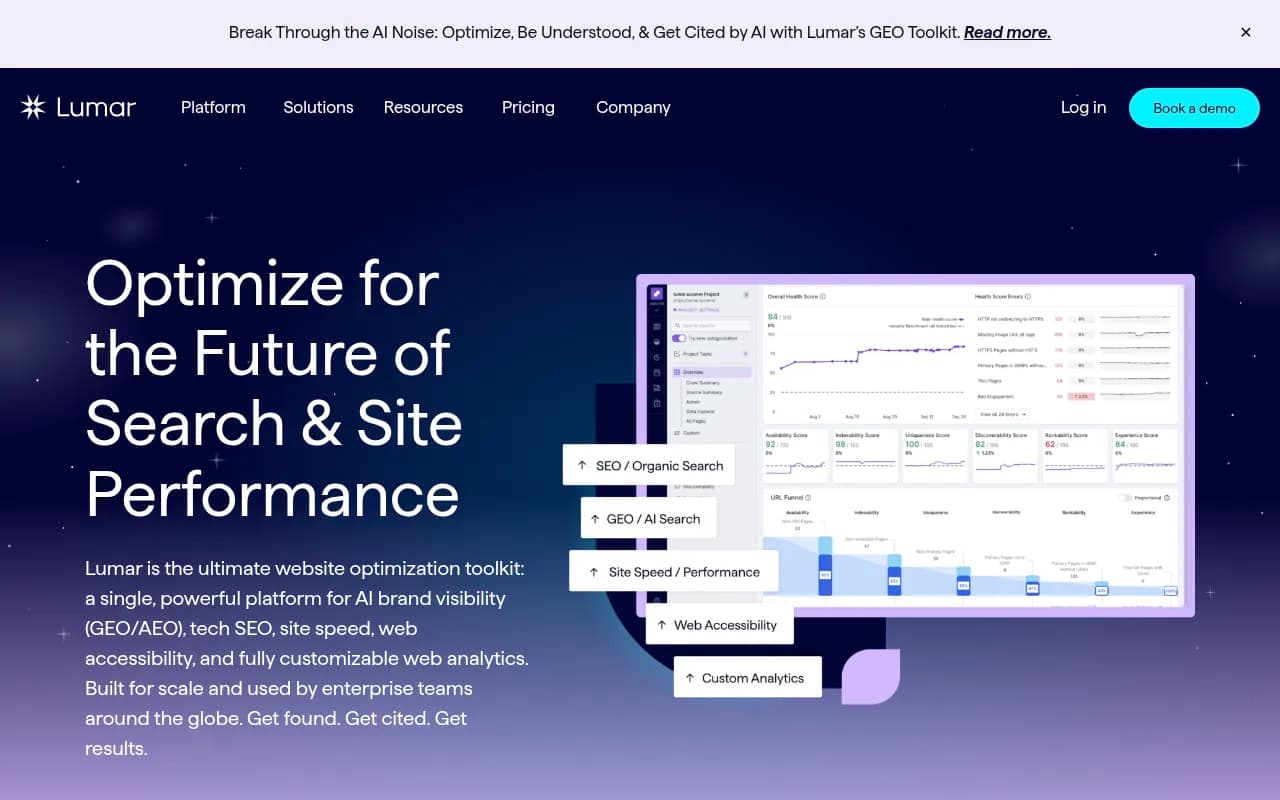
For crawling your own site and spotting broken or inconsistent markup at scale, a crawler such as Lumar, Screaming Frog or Sitebulb does the job.
Step 4: Build corroboration off your site
Google and AI systems trust what others say about you more than what you say. Chatter Buzz Media suggests starting with structured sources that engines read directly: Wikidata, Crunchbase, LinkedIn and Google Business Profile, each using your exact canonical facts. It singles out Wikidata as an important route for brands without a Wikipedia page. I haven't verified that independently, so treat it as a sensible default rather than a guarantee.
Then pursue mentions, not just links. The same source cites Search Atlas analysis attributing roughly 60% of new knowledge panels to brand mentions versus about 35% to backlinks. Earn them through digital PR, podcasts, guest contributions and industry roundups, and check that the description is accurate. Consistent phrasing reinforces your facts.
Which third-party sources matter most
Not every profile is equally useful for AI answers. Promptwatch Data's social media citations report (Oct 11 to Nov 9, 2026) puts social platforms at 13.16% of AI Overviews citations, 1.94% of Perplexity's and 0.64% of ChatGPT's. YouTube alone was 6.71% in AI Overviews. In ChatGPT, Reddit was 0.40% and LinkedIn 0.20%. Note the report's caveat: the October edition covered 7 days and this one covers 30.
My reading: for ChatGPT, keeping your LinkedIn page tidy is hygiene, not a growth lever. Brand-owned pages and third-party editorial and review pages carry more weight. For AI Overviews, video and social profiles are worth more attention.
For branded prompts, Promptwatch Data found reviews at 5.6% of citations, more than three times their overall share. So collecting reviews on sites people trust in your category is a direct entity-consistency task, not just reputation management. Local and multi-location brands also need listings kept in sync, which is what tools like Yext and BrightLocal are built for.
To find where your brand is named in third-party pages, Promptwatch's Offsite Mentions catches mentions without links, and general monitoring tools such as Brand24 or Mention cover the wider web.
Step 5: Fix the sources AI learned the wrong thing from
When the audit shows an inaccurate claim, trace it. The model usually isn't inventing it. It's repeating a page.
- Look at the citations behind the wrong answer.
- Decide who owns the page: you, a directory, a reviewer, a journalist.
- Correct what you own. Request corrections or update profiles for what you don't.
- Publish a clear, factual page of your own that states the right version, and link it internally from relevant pages.
Content age matters too. Promptwatch Data's content half-life report found that landing pages and docs stayed cited longest, while news lost half its pages within 36 days. A durable owned page beats chasing a news cycle for the fact you want repeated.
Step 6: Measure and re-check
Entities decay when details drift. Chatter Buzz Media recommends re-running brand searches monthly and checking that name, facts and sameAs profiles still agree. I'd add a prompt-level view on top.
Track these over time:
- Whether AI describes you with the right category and facts (accuracy of claims)
- Whether you appear at all for category prompts (coverage)
- Which of your pages get cited, and whether AI crawlers can reach them
- Branded search volume, which Chatter Buzz notes correlates with AI visibility in the Ahrefs data
- Sentiment and the specific claims repeated about you
Platform behavior also changes without warning. The August 8 site: shift happened overnight, which is a good argument for continuous audits instead of an annual project.
Tools for entity and perception work
There's no single entity tool. Different jobs need different products.
| Job | Tool types | Examples |
|---|---|---|
| Audit what AI says, extract claims, fix and verify | AI visibility platforms | Promptwatch, Profound, Peec AI, Otterly.AI |
| Schema and entity-based internal linking | Entity SEO tools | InLinks |
| Technical crawl and structured data checks | Crawlers | Lumar, Screaming Frog, Sitebulb |
| Listings consistency | Local data platforms | Yext, BrightLocal |
| Mentions and sentiment across the web | Brand monitoring | Brand24, Mention, Meltwater |
If you're comparing AI visibility trackers, Profound, Peec AI and Otterly.AI are common names. Many of these stop at reporting. Promptwatch's pitch is the full loop: monitor, trace the cited sources, act through the Action Board and Content Agent, then measure with crawler logs and visitor analytics. Pricing starts at $95 per month for Essential, and the 7-day free trial or the free AI visibility report is the low-effort way to see your baseline. Confirm current plans at promptwatch.com/pricing.



For a wider list, the GEO software directory at bestgeosoftware.com catalogues options by use case.
A practical 30-day plan
Week 1. Run the audit. Write the canonical fact sheet. List every profile, listing and directory that mentions you.
Week 2. Align your site: homepage, about page, product pages, FAQ. Add or correct Organization, Product and Person schema with sameAs.
Week 3. Fix off-site profiles: LinkedIn, Crunchbase, Wikidata, Google Business Profile, review sites, industry directories. Use the exact fact sheet wording.
Week 4. Start earning accurate mentions: a PR pitch, a podcast, a data point journalists can quote. Then re-run the audit and compare against week 1.
If you'd rather hand this to specialists, an agency that does technical SEO, digital PR and GEO together can run the loop for you. 1001 SEO Media, which publishes this site, offers exactly that, and it's a reasonable option if your team lacks the bandwidth.
Common mistakes
- Treating schema as a silver bullet. Markup that contradicts your visible page text adds confusion.
- Fixing the website and ignoring everyone else. Models weigh outside voices heavily.
- Marketing copy where facts should be. Vague slogans give a model nothing to extract.
- One-off audits. Rebrands, new products and platform changes all reopen the problem.
- Chasing social profiles for ChatGPT visibility. The citation data says they matter far less there than owned and editorial pages.
What I'd do first
If you only have an afternoon, ask three assistants what your brand is and who it's for, paste the answers next to your homepage description, and mark every mismatch. Those mismatches are your roadmap. Fix the ones on pages you control, then work outward to the sources the answers actually cite.