Key takeaways
- AI assistants now answer questions about rates, fees, coverage and eligibility. If the answer is wrong, regulators and customers will not care that a third party wrote it.
- You cannot edit an LLM, but you can control the sources it quotes. Product pages, landing pages and docs are where the fixes happen.
- Regulated teams need more than a score. They need evidence trails, IP-verified crawler logs, audit logs, and security certifications such as ISO/IEC 27001.
- Treat AI visibility as a joint project between marketing, compliance and legal. Marketing compliance tools and AI visibility tools solve different halves of the problem.
- Promptwatch has no banking or insurance dataset. The closest Promptwatch Data report covers healthcare, which I use below as a proxy and label as one.
Why this problem is different for banks and insurers
A retailer that gets misdescribed by ChatGPT loses a sale. A bank that gets misdescribed can have a compliance problem. If an assistant tells someone your savings account pays a rate it does not pay, or that a policy covers flood damage when it excludes it, the customer acts on that. Then they call you, or complain to a regulator.
The NAIC says it plainly on its artificial intelligence page: tools like Copilot, ChatGPT, Claude and Gemini can generate information that sounds accurate but is incorrect, so the output should be reviewed carefully, especially for important decisions. That warning is aimed at insurers using AI internally. It applies just as well to the public models that talk about you.
There are really two separate jobs here, and teams often mix them up:
- Governing the AI you deploy (chatbots, underwriting models, internal copilots).
- Monitoring the AI you do not control (ChatGPT, Gemini, Perplexity, AI Overviews describing your brand and products).
Most compliance content covers the first. This guide is about the second, with a nod to how the two connect.
The regulatory backdrop in 2026
I could not verify every date below against primary sources, so check each one with your own counsel. This is the picture from the sources I did read.
Banks and broker-dealers are not waiting for a new AI statute. A Gainam analysis of FINRA, SEC and OCC rules argues that existing rules already cover AI: FINRA's technology-neutral supervision and recordkeeping duties, the SEC's focus on AI-washing and Regulation S-P data handling, and the banking agencies' model risk management framework, described there as the successor to SR 11-7. In practice, that means you log, explain, validate and keep a human accountable.
Fin's guide to AI agent compliance in financial services lists the overlapping regimes: SR 11-7, GLBA, PCI DSS, NYDFS Part 500, DORA and GDPR. It also says high-risk AI systems in the financial sector must meet the EU AI Act's transparency, traceability and human oversight requirements by August 2, 2026. There have been proposals to delay parts of the Act, so confirm the current timeline.
The same Fin guide quotes the CFPB's warning that institutions risk legal violations, lost trust and consumer harm when deploying chatbots, and notes that wrong information about a fee, rate or account status can be a potential UDAAP issue. That is about your own chatbot. But think about the customer experience: they do not distinguish between your chatbot and ChatGPT. Both are "the AI said".
The FSB has also published sound practices for responsible AI adoption, noting that fragmented AI implementation across business units can undermine risk management at large institutions. The lesson for visibility work: if three teams each run their own AI monitoring with different tools and no shared owner, you will not have a coherent view.
How hallucinations about financial brands actually happen
I did not find a verified, public case of an AI misquoting a specific bank's rates or an insurer's coverage, so I will not invent one. The mechanism is easy to describe though, and you can test it on your own brand in ten minutes.
LLMs answer from two places. One is training data, which is frozen and may be a year or more stale. The other is live retrieval, where the assistant runs web searches (query fan-outs) and quotes pages. Wrong answers usually come from one of these:
- An old rate or fee table still indexed on a page you forgot about.
- A third-party comparison site or review page with outdated numbers.
- Your own page is blocked to AI crawlers or hard to parse, so the model leans on someone else's summary.
- Two similarly named products merged into one claim.
- A confident answer with no source at all, from training data.
The second and third causes are fixable. That is why visibility work in a regulated sector starts with sources, not prompts.
What the citation data says (and what it does not)
Here is the honest caveat first. Promptwatch Data has no banking or insurance report. The nearest thing is the healthcare citation report covering Sep 9 to Oct 8, 2026, which includes health insurance questions. Use it as a regulated-industry proxy, not as evidence about finance.
What it shows: NIH is the top source at 5.46% of healthcare citations, the FDA is second at 1.76%, and the NHS third at 1.1%. Government and public health sites together earn 7.06%. Reviews and directories earn only 0.46%. The pattern is that ChatGPT leans on primary, authoritative sources when the topic is high stakes. The mapping to banking is my inference: expect regulators and bodies like the NAIC, the CFPB and state insurance departments to carry similar weight, and keep your pages consistent with their guidance.
The more actionable report is which content types ChatGPT cites the most (Sep 28 to Oct 4, 2026):
| Content type | Share of ChatGPT citations |
|---|---|
| Product pages | 22.4% |
| Landing pages | 16.8% |
| Listicles | 13.6% |
| How-to guides | 8.7% |
| Documentation | 7.5% |
| General articles | 6.1% |
| Comparisons | 5.9% |
| News | 5.7% |
| FAQ pages | 3.3% |
| Reviews | 1.7% |
Product and landing pages are 39% of citations. For a bank or insurer, those are the pages with rates, fees, eligibility rules and disclosures. If those pages are incomplete, vague or out of date, ChatGPT will quote the gap. For branded prompts, Promptwatch's data shows product pages at 23.3% and landing pages at 22.8%, with reviews at 5.6%, more than three times their overall share. So review sites are one place wrong information about you can spread.
A few other numbers worth knowing, all from Promptwatch Data:
- Almost half of ChatGPT responses cite 10 or more unique domains (unique domains report, Sep 28 to Oct 4, 2026). Your page is one voice among many, so consistency across third-party sources matters.
- ChatGPT cited social platforms in just 0.46% of citations, versus 12.2% for Google AI Overviews (social citations report, Sep 28 to Oct 4, 2026). Different engines, different source mixes.
- News pages lose half their cited pages in about 36 days, while landing pages and docs last far longer (content half-life report). Evergreen, maintained pages are the durable asset.
A practical workflow for a regulated team
Step 1: build a prompt set with compliance in the room
Start with the questions customers actually ask: "best high-yield savings accounts", "is [your bank] safe", "does [your insurer] cover water damage", "[your brand] vs [competitor] mortgage rates". Split them into branded, competitor comparison and organic prompts. Compliance and legal should help decide which claims are sensitive (rates, guarantees, coverage, eligibility, fees) so the monitoring is aimed at the right things.
Track by country and language. A multinational bank has different rules, products and regulators in each market, and mixing them in one prompt set produces noise.
Step 2: record claims, not just mentions
A visibility score tells you whether you are mentioned. It does not tell you whether what was said is true. The useful capability for this sector is claim-level tracking: pulling out the individual statements AI makes about you ("no monthly fees", "slow claims process") and marking each accurate or inaccurate. Promptwatch calls this Brand Narrative and Fact Check; the latter reads the pages crawled from your site to find which one states the claim, so you know where the wrong idea is coming from. Fact Check is on Business and above.
Step 3: trace the sources
For every wrong or risky answer, find the cited URL. If it is your own page, fix the page. If it is a third-party article, you need outreach, a correction request, or a stronger authoritative page of your own. If there is no citation, you are looking at a training-data answer, and the lever is slower: consistent, crawlable, well-sourced content over time.
Crawler logs matter here more than most teams expect. If GPTBot or OAI-SearchBot cannot read your rate page because of a robots rule, a login wall or JavaScript rendering, the model will rely on someone else's version of your numbers. IP-verified logs also filter out spoofed bots.
Step 4: fix at the source, with review
Update the product or landing page so rates, fees, eligibility and disclosures are complete, dated and factual. Keep wording consistent with official regulator guidance. Then route every change through your normal approval flow. This is where the second tool category comes in.
Step 5: measure and keep an audit trail
Track whether the corrected page is crawled, whether it is cited, and whether the bad claim disappears. Keep records of what was found, what changed, who approved it and when. If a regulator ever asks how you handle AI misinformation about your products, this log is your answer.
Two tool categories you will need
The confusion in vendor demos comes from mixing these up.
| Need | What it does | Example tools |
|---|---|---|
| AI visibility and citation monitoring | Shows what AI engines say about you, which sources they cite, how you compare with competitors | Promptwatch, Profound, Scrunch, Brandlight |
| Marketing content compliance | Reviews and approves your own marketing content against FINRA, SEC, FTC and state insurance rules | Blee and similar content governance tools |
| AI governance and model risk | System of record for AI use cases and models you deploy | Dedicated governance platforms (see the JD Supra roundup) |
Blee, for example, positions itself around AI marketing compliance for financial services and insurance, reviewing content before it ships. I have not tested it and cannot compare it feature by feature. What I can say is that it addresses the pre-publication step, while visibility tools address what happens after the world's AI engines read your content.
If you are also deploying your own AI, a separate JD Supra roundup of AI governance tools for financial services covers software that acts as a system of record for models and use cases. That is a different budget line from visibility.
AI visibility platforms worth shortlisting
I do not have verified pricing or feature data for most of these, so treat the table as a starting shortlist for demos, not a ranking. Ask each vendor the questions in the next section.
Promptwatch is the one I would put first for a regulated team, mainly because it goes beyond monitoring. It tracks ChatGPT, Gemini, Claude, Perplexity, Google AI Overviews, AI Mode and Copilot through their real interfaces by country and language. It adds IP-verified AI crawler logs, Brand Narrative with Fact Check, an Action Board, and a Content Agent that publishes to WordPress, Webflow or Framer with a review inbox, so a human approves before anything goes live. It is ISO/IEC 27001 certified and GDPR compliant, with an audit log on Business and above, SSO on Enterprise, and role-based access. Customers include Rabobank, ABN AMRO, Achmea, Bitvavo and Moonfare, so it has seen European financial procurement. Business is $579/mo and Enterprise is custom; confirm current pricing at promptwatch.com/pricing. A free AI visibility report is a low-effort first look.

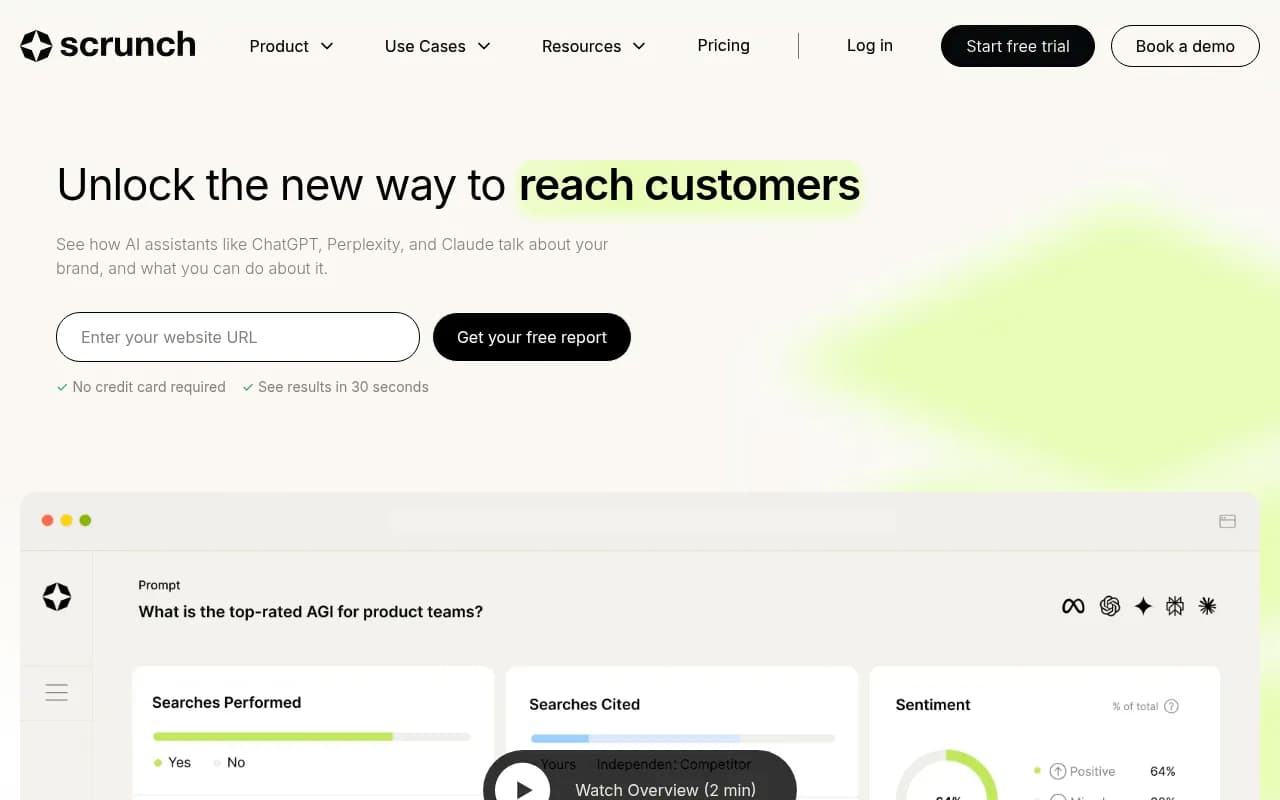
Profound and Scrunch are the other names that come up for enterprise buyers. Both have strong monitoring. In Promptwatch's comparisons they are positioned as higher priced with less agentic execution, so check that against your own needs (Promptwatch vs Profound, vs Scrunch).

Brandlight, Bluefish and Evertune target large brands, and BrightEdge and Botify come from the enterprise SEO side if you already run one of them.
If you want to browse more options, the GEO software directory at bestgeosoftware.com lists many of them side by side.
Questions to ask every vendor
Demos for banks and insurers should go past dashboards. These are the questions that separate tools:
| Question | Why it matters |
|---|---|
| Is data collected from the real UI or only APIs? | User-facing answers and citations can differ from API output |
| Can you mark a claim inaccurate and trace the page behind it? | Needed to fix hallucinations, not just see them |
| Are crawler logs IP-verified? | Spoofed bots make access data unreliable |
| What certifications and data residency do you have? | ISO/IEC 27001, GDPR, EU hosting speed up security review |
| Is there an audit log and role-based access? | Compliance wants to know who changed what |
| Does content go through human approval before publishing? | You do not want an agent publishing rates unreviewed |
| Can we track per country, state and city? | Regulation and products differ by market |
| What is the export and API story? | Feeds your risk and reporting systems |
The security-side checklist in the Fin guide (SOC 2 Type II, ISO 27001, ISO 27701 and so on) is a useful template even though it is written for customer service agents. Vendors that handle your brand data should meet a similar bar.
Governance: who owns this inside the bank
The FSB's warning about fragmentation is worth taking seriously. A workable setup:
- Marketing or SEO owns the monitoring and the content fixes.
- Compliance owns the list of sensitive claims and approves the content that changes.
- Legal decides when a wrong third-party claim warrants a formal correction request.
- Security reviews the vendor.
- One person owns the audit trail.
Put the weekly review on a calendar. Promptwatch's Action Board and weekly digest are built for this kind of rhythm, but any tool works if somebody actually looks at it.
What I would do first
Run ten branded and ten product prompts across ChatGPT, Gemini and Perplexity this week. Write down every factual claim about rates, fees and coverage, and mark each right or wrong. Check the cited pages for the wrong ones. That one exercise gives you a risk list, a business case for tooling, and a conversation starter with compliance.
If your internal team lacks time for the program, the agency 1001 SEO Media, which publishes this site, runs GEO programs on Promptwatch and works with a white-hat, no-long-term-contract model. Whichever route you take, keep human approval in the loop for anything that states a number.