Key takeaways
- Bluefish AI, Conductor, and BrightEdge all track AI search visibility in 2026, but they approach it from completely different angles: Bluefish is a cross-functional agentic marketing suite built for Fortune 500 brands, Conductor is a content-workflow-first SEO platform, and BrightEdge is a technical, data-heavy SEO command center.
- Pricing is opaque across the board. Conductor is the only one with a public pricing page; BrightEdge contracts typically run $36K–$120K+ per year, and Bluefish estimates land at $150K–$500K+ per year for enterprise deployments.
- Bluefish has almost no independent review footprint, while Conductor and BrightEdge both have extensive third-party validation (G2, Gartner Peer Insights, Forrester Wave). If you're evaluating Bluefish, plan on reference calls and a pilot instead of review-site research.
- All three measure AI visibility, but none of them generate the earned media that AI engines actually cite. Reddit, third-party editorial, and review sites drive most citations, according to Promptwatch's citation data.
- If you need a dedicated AI visibility platform with crawler logs, citation analytics, and automated content execution rather than an add-on to an SEO suite, a specialized tool like Promptwatch fills the gap all three leave open.
Enterprise marketing platforms are in a strange moment. Traditional search volume is shrinking (Gartner projected a 25% drop by 2026), AI answers are absorbing research queries, and every major platform has bolted on some version of "AI visibility tracking" to stay relevant. Three platforms sit at very different points on this spectrum: Bluefish AI, Conductor, and BrightEdge.
I've spent time digging into what each of these actually does, what they cost, and where they fall short. The short version: Bluefish is the most ambitious and least proven, Conductor is the most content-team-friendly, and BrightEdge is the deepest technical measurement stack. None of them will close your AI visibility gap on their own.
Quick comparison
| Bluefish AI | Conductor | BrightEdge | |
|---|---|---|---|
| Core identity | Agentic marketing platform for Fortune 500 | Enterprise SEO + content workflow platform | Enterprise SEO command center |
| AI visibility product | AI Monitoring, GEO Measurement, AI Accuracy | AI Search Performance, AgentStack | AI Hyper Cube, AI Catalyst, Agent Insights |
| Engines covered | ChatGPT, Gemini, Perplexity, Claude, AI Overviews, Amazon Rufus | ChatGPT, Perplexity, Gemini, AI Overviews, AI Mode, Copilot | ChatGPT, Gemini, Perplexity, AI Overviews |
| Unique capability | Hallucination reporting to AI providers; agentic commerce (Rufus) | Turnkey AEO agents, MCP server, native LLM apps | 10B+ term keyword database; deep entity/knowledge graph work |
| Pricing | Quote-only; est. $150K–$500K+/yr | Public tiers; contracts typically $30K–$150K+/yr | Quote-only; median ~$50K/yr, enterprise avg ~$119K/yr |
| Onboarding | 4–6 weeks | 2–3 weeks | 2–3 months |
| Review footprint | Essentially none | G2, Gartner, Forrester Wave Leader (Q3 2025) | G2 4.4/5, Gartner 4.5/5 |
| Best for | Fortune 500 brand/PR/commerce teams | Large content teams | Technical SEO teams at large enterprises |
Bluefish AI: the agentic marketing newcomer
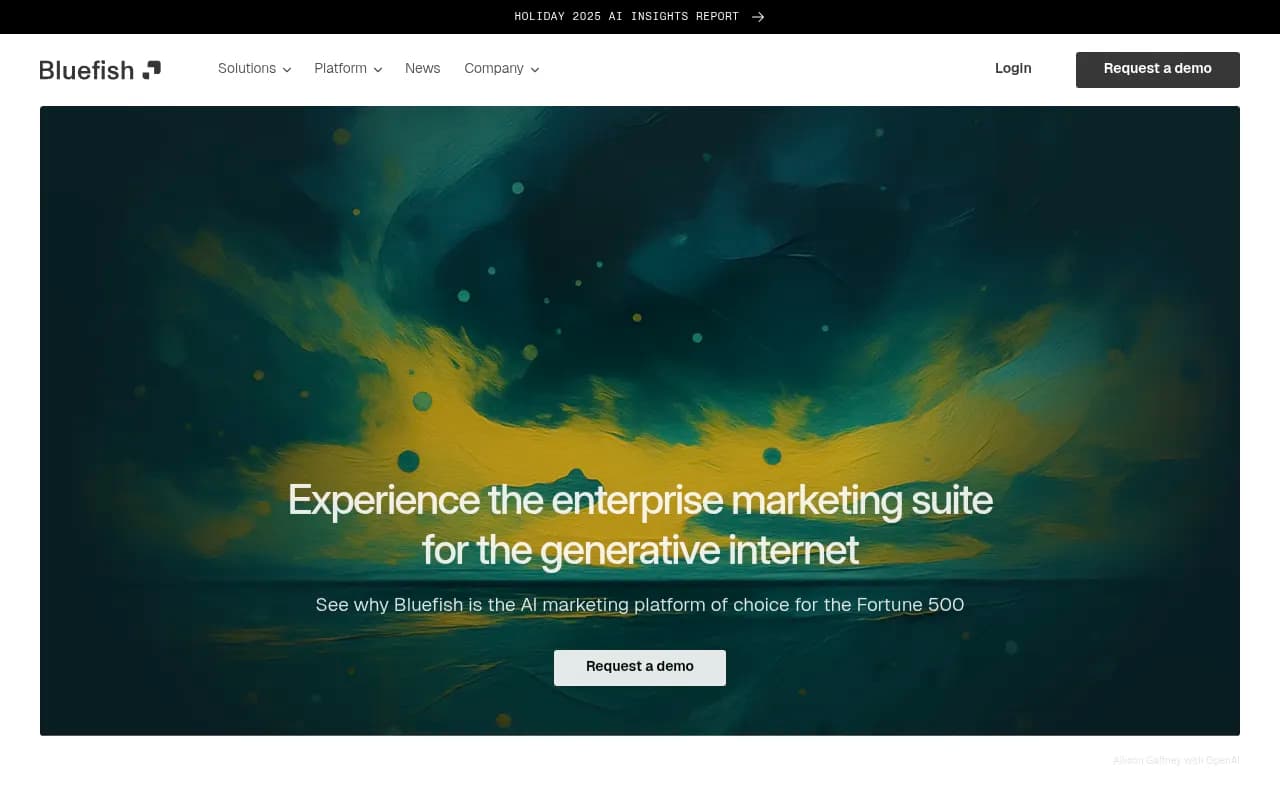
Bluefish calls itself "the AI marketing platform of choice for the Fortune 500," and unlike the other two, it was built for the AI era from day one rather than adding AI tracking onto an existing SEO product. Founded by Alex Sherman (PromoteIQ, acquired by Microsoft) and Andrei Dunca (LiveRail, acquired by Facebook), the company raised $68M across two years, including a $43M Series B in April 2026 co-led by Threshold Ventures and NEA, with Amex Ventures, TIAA Ventures, and Salesforce Ventures participating.
The customer list backs the positioning: Adidas, American Express, LVMH, Hearst, Ulta Beauty, and Tishman Speyer, with the company claiming engagement with roughly 10% of the Fortune 500.
What Bluefish actually does
The platform spans five modules: AI Monitoring (real-time brand visibility across AI-native experiences), GEO Optimization, GEO Measurement (campaign-level AI attribution via "Collections"), AI Commerce, and AI Accuracy. Two of these deserve attention because nobody else in this comparison does them:
AI Commerce tracks shopping performance in agentic environments, including Amazon Rufus, a surface neither Conductor nor BrightEdge touches. If you're a retail or CPG brand, that alone might justify a conversation.
AI Accuracy, launched May 2026, is the more interesting one. It ingests your first-party content as a verified source of truth, extracts factual claims from AI responses, severity-scores hallucinations and discrepancies, and reports inaccuracies back to the AI providers. It's essentially a factual-error correction loop with the engines themselves, which is a genuinely novel mechanism.
Bluefish's own research is worth reading too. Their "State of Enterprise Brands in AI" report (June 2026) measured 194 of the world's largest enterprises and found that brands with established topic authority get described better by AI even when they're not the most-mentioned brand, and that AI weighs sources differently by vertical. That second finding matters for budget allocation: the owned-vs-third-party mix that works in one vertical won't work in another.
Where Bluefish falls short
Two things give me pause.
First, the review footprint is nearly nonexistent. G2's "Bluefish" listing belongs to an unrelated open-source text editor. There's no meaningful TrustRadius or Gartner Peer Insights profile. Every performance claim comes from Bluefish's own funding announcements. For a platform asking $150K–$500K+ per year (per Meev's June 2026 estimate, citing OpenLens, plus $15K–$100K implementation), that's a lot of trust to extend on vendor-reported numbers.
Second, the org-chart assumption. Reviewers note that Bluefish assumes separate brand, PR, content, and product-marketing functions, which most companies below Fortune 500 scale simply don't have. There's also no GA4/conversion attribution layer, restricted API access on lower tiers, and reportedly thinner Claude-monitoring depth than other engines.
If you're a true enterprise with dedicated teams for each function and agentic commerce matters to you, Bluefish is a serious contender. If you're a mid-market company, the structure of the product will fight you.
Conductor: content teams first, AI second
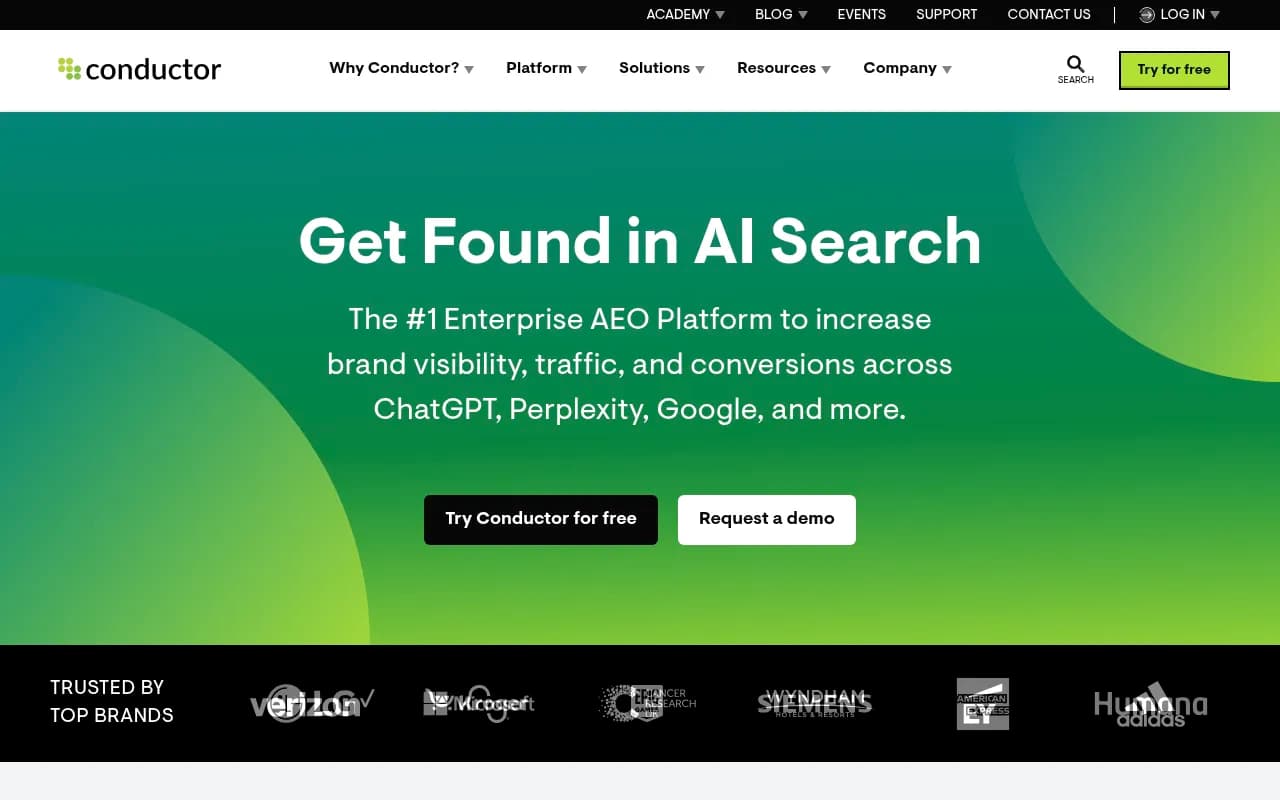
Conductor has been around since 2005 (with a detour through a WeWork acquisition and management buyback), and its 2026 repositioning is telling: it now calls itself an end-to-end enterprise AEO platform, not just an SEO tool. The Forrester Wave for SEO Solutions (Q3 2025) named Conductor a Leader, with the highest possible score in 16 of 23 criteria including AI-powered SEO and content optimization.
What Conductor actually does
The platform's strength has always been turning search data into content workflows. Its AI Search Performance layer measures brand mentions, citations, market share within AI-generated answers, and topic-association trends across ChatGPT, Perplexity, Gemini, Google AI Mode, and Microsoft Copilot.
The 2026 headline feature is AgentStack, launched in April 2026: native LLM apps for ChatGPT, Claude, and Microsoft Copilot, plus developer infrastructure including APIs and an MCP server. The pitch is that content teams go "from insight to published, optimized content in under three minutes with no prompt engineering or technical setup required." Conductor's own benchmarks report (analyzing 3.3 billion sessions across 13,000+ enterprise domains) found AI-referred sessions are about 1% of traffic but growing 527% year over year. That 1% number is honest and worth respecting; AI traffic is real but still small for most enterprises.
Conductor is also the only one of the three with a public pricing page: Essentials (2,500 AI Search Credits/yr, 1,000 pages, 500 keywords), Growth (2,500 credits, 25,000 pages, 5,000 keywords), and custom Enterprise. Actual contract values per Vendr typically run $30,000–$150,000+, with mid-market deployments landing $40,000–$70,000. Unlimited user licenses across plans make it easy to distribute insights across large cross-functional teams, and onboarding takes 2–3 weeks.
Where Conductor falls short
The AI tracking layer is newer and shallower than BrightEdge's. Conductor's prompts are synthetic and keyword-derived, with updates landing twice a week, which means you're monitoring a modeled version of what people might ask rather than actual prompt-level demand data. The data is also largely locked inside Conductor's reporting model; the API exists, but building custom pipelines on top of it requires engineering capacity most mid-market teams don't have.
And like BrightEdge, Conductor optimizes on-page structure and content extractability well, but it doesn't address the earned media signals that determine whether AI engines treat your brand as authoritative in the first place.
BrightEdge: the measurement heavyweight
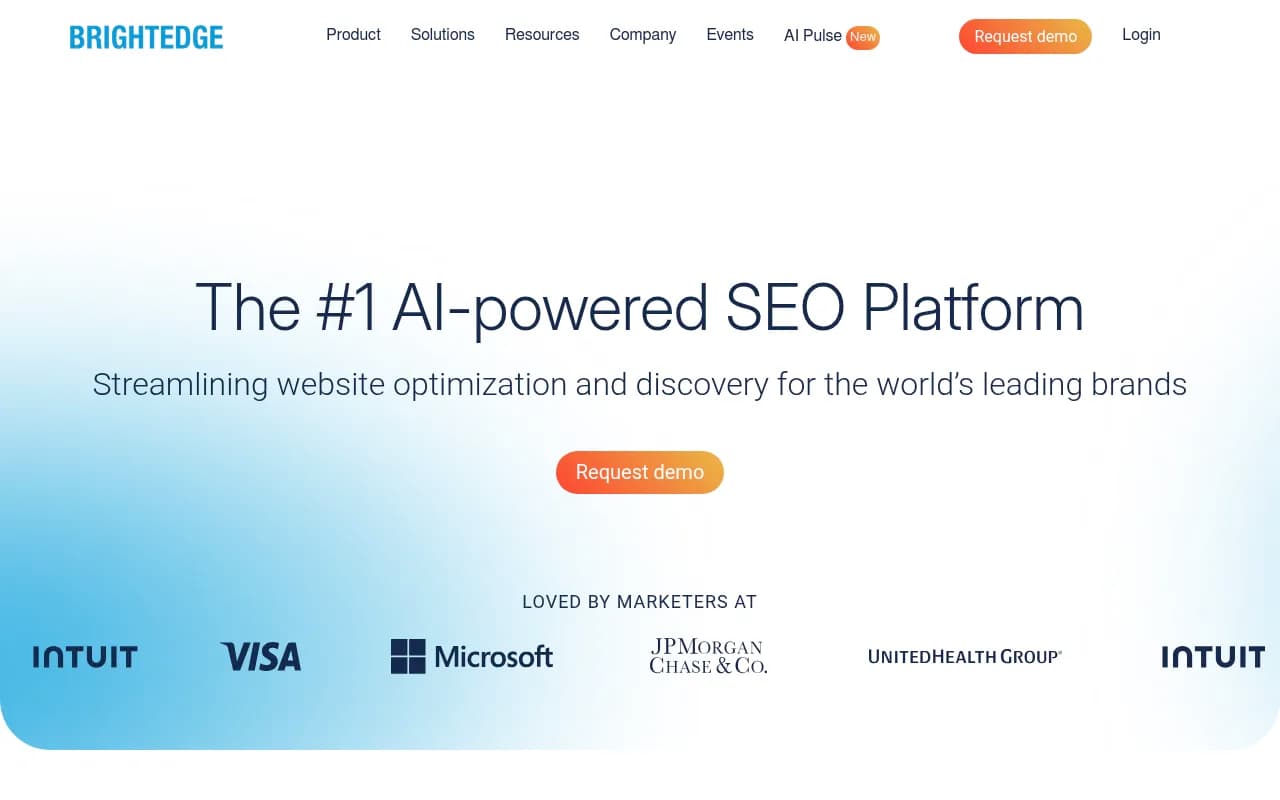
BrightEdge is the enterprise SEO incumbent, and its 2026 AI moves are the most measurement-heavy of the three. In November 2024 it added AI capabilities to Data Cube X for monitoring Google AI Overview presence at global scale. In March 2026 it launched AI Hyper Cube, tracking brand presence, sentiment, and share of voice across ChatGPT, Gemini, Perplexity, and Google AI Overviews. Paired with AI Agent Insights, which shows which AI systems crawl your site, what they read, and where they hit technical friction (blocked pages, broken paths, access barriers), BrightEdge now has arguably the most comprehensive measurement view of AI visibility among enterprise SEO platforms.
The underlying data is genuinely interesting. BrightEdge reports that 62% of brands lose visibility in AI environments compared to traditional search, and that AI agent requests have reached 88% of human organic search volume. That second number startled me when I first saw it; it suggests the crawler-vs-human traffic ratio on enterprise sites has already flipped toward agents.
What BrightEdge does best
Data Cube, the flagship keyword database, covers over 10 billion terms with real-time tracking across geographies, devices, and SERP features. Entity and knowledge-graph work is a real strength: structuring content so answer engines recognize the brand is something BrightEdge has done well for years, and it matters more in the AI era, not less. For technical SEO teams running analyst-led keyword intelligence and large-site monitoring across many regions, BrightEdge is the stronger command center.
Where BrightEdge falls short
Onboarding is slow: most organizations report 2–3 months to reach full operational capacity, versus Conductor's 2–3 weeks. Pricing is quote-only, with Vendr reporting a median contract of $50,000/year (range $42,492–$68,936) and Spendhound pegging the average enterprise price at $118,777/year. A Gartner reviewer note sums up the risk: "Expensive pricing models make BrightEdge potentially a huge cost for organisations who want to track a lot of keywords."
The AI tracking layer is also strongest on the Google ecosystem, with coverage of just three non-Google engines, and prompt suggestions derive from SEO data rather than real AI query demand. Conductor's competitive comparison (obviously biased, but the specifics are checkable) claims BrightEdge lacks SOC 2 Type II, ISO 27001, and ISO 42001 certifications that Conductor holds, and offers far less global data coverage. Verify those independently during procurement, but the security and compliance angle is worth raising.
The gap all three share
Here's the structural problem none of these platforms solves: they measure AI visibility, but they don't generate the earned media that AI engines actually cite.
This isn't a minor gap. Promptwatch's citation share data for June 2026 shows Reddit as the single most-cited domain in ChatGPT Search at 3.71% of all citations, more than 6x the runner-up (Wikipedia at 0.56%), and their social media citations research shows ChatGPT leaning heavily on Reddit while AI Overviews and Grok favor YouTube. Research from the University of Toronto (published 2025) found AI search exhibits a systematic bias toward earned media and third-party authoritative sources over brand-owned content, in contrast to Google's more balanced mix.
All three platforms can show you that you're invisible in AI answers. None of them will get you cited, because citation is driven by editorial authority, third-party coverage, review presence, and community discussion, not by on-page optimization alone.
There's also a slot-scarcity problem the platforms don't really surface. Promptwatch's average sources per response data shows ChatGPT cites roughly 5 sources per web-search response, while AI Overviews and Perplexity cite around 10. ChatGPT's citation inventory is scarcer and more contested than the Google surfaces, which should shape which engine you prioritize optimizing for, and in what order.
If your AI visibility program needs to go beyond monitoring into execution, closing gaps with content and technical fixes, a dedicated GEO platform is the more direct route. Promptwatch covers the measurement layer these enterprise suites provide (prompt tracking with volumes, citation trends, AI crawler logs, visitor analytics) and then actually closes the loop: content gap analysis, automated GEO-optimized content generation with CMS publishing, and a prioritized action list derived from your visibility and crawler data. It's used by 1,840+ brands and agencies and starts at $95/month, which makes it a realistic complement to an enterprise contract or a standalone option for teams that want execution, not just dashboards.

Which one should you actually pick
Choose Bluefish AI if
You're a genuine Fortune 500-scale brand with separate brand, PR, content, and commerce functions, agentic shopping surfaces (Amazon Rufus, Alexa) matter to your revenue, and hallucination reporting to AI providers is a capability you'd actually use. Budget $150K+ per year and plan a 4–6 week onboarding. Do reference calls; the public review data doesn't exist yet.
Choose Conductor if
Your bottleneck is turning search insight into shipped content fast. Content teams get briefs, workflows, executive-readable reporting, and now in-engine optimization via AgentStack. It's the fastest to onboard (2–3 weeks), the only one with public pricing tiers, and the strongest third-party validation. Expect $30K–$70K for mid-market, more for enterprise.
Choose BrightEdge if
You need the deepest measurement stack: 10B+ terms of keyword data, entity and knowledge-graph structuring, technical audits, and the most mature AI tracking layer among traditional SEO platforms. Accept the 2–3 month onboarding and enterprise pricing, and know you'll still need complementary tools for the action layer.
A realistic stack for most enterprise teams
Honestly, for most organizations the winning setup in 2026 is a primary platform plus a dedicated AI visibility tool. Use Conductor or BrightEdge for what they're great at (traditional SEO at scale, content workflows, technical monitoring), and run a specialized GEO platform alongside it for prompt-level demand data, crawler logs, citation analytics, and automated content execution. If you'd rather outsource the whole earned-media problem, 1001 SEO Media (the agency that publishes this site) runs GEO and digital PR programs specifically aimed at getting brands cited by AI engines, covering the exact gap these platforms leave open.
For a broader look at the specialized side of this market, the GEO software directory at bestgeosoftware.com covers dedicated platforms, and ai-rank-tools.com lists AI rank tracking tools if rank tracking is your primary need.
Frequently asked questions
Can Bluefish, Conductor, or BrightEdge track ChatGPT and Perplexity citations?
Yes, all three can. Bluefish monitors brand mentions across AI-native experiences with campaign-level attribution. Conductor's AI Search Performance tracks mentions, citations, and market share across ChatGPT, Perplexity, Gemini, AI Mode, and Copilot. BrightEdge's AI Hyper Cube covers ChatGPT, Gemini, Perplexity, and AI Overviews. The differences are in depth: prompt-level demand data, crawler analytics, and citation-source breakdowns vary significantly between them.
Which is cheapest?
Conductor, by a wide margin. It's the only one with published pricing tiers, and mid-market contracts typically land at $40K–$70K per year. BrightEdge's median contract runs around $50K/year but enterprise deployments average closer to $119K. Bluefish is the most expensive, with estimates starting around $150K per year plus implementation costs.
Is Bluefish AI legit?
It's real and well-funded ($68M raised, Fortune 500 customers including Adidas, Amex, and LVMH), but it's unproven by independent standards: no meaningful G2, TrustRadius, or Gartner Peer Insights presence, and all performance claims come from the company's own materials. Treat it as a promising early platform that requires a thorough pilot and reference calls before committing.
Do I need an enterprise platform at all for AI visibility?
Not necessarily. If AI search visibility is your primary concern rather than full-scale enterprise SEO, a dedicated GEO platform will get you prompt tracking, citation analytics, crawler logs, and content execution for a fraction of enterprise pricing. The enterprise platforms make sense when you need unified reporting, governance, and workflow across large teams, or when agentic commerce surfaces matter to your business.