Key takeaways
- Google AI Overviews now appear on a significant share of search queries, making traditional rank tracking insufficient for understanding real brand visibility.
- Most tools in this space only monitor — they show you where you're invisible but don't help you fix it.
- The best platforms track not just Google AI Overviews but also ChatGPT, Perplexity, Claude, and Gemini, since users are splitting their searches across all of them.
- Purpose-built GEO (Generative Engine Optimization) platforms outperform traditional SEO tools for this use case — Semrush and Ahrefs have AI features, but they're bolt-ons, not core products.
- If you want to close the loop from "I'm invisible" to "I'm getting cited," you need a platform with content gap analysis and optimization built in, not just a dashboard.
Why Google AI Overviews changed the tracking problem
When Google rolled out AI Overviews at scale, it broke a fundamental assumption in SEO: that ranking in position 1-3 meant you'd get the traffic. Now a user can search for "best project management software for remote teams," get a full AI-generated answer with three recommended tools, and never click anything. If your brand isn't named in that answer, you effectively don't exist for that query — regardless of where you rank organically.
The tracking problem is real. Traditional rank trackers tell you your position for a keyword. They don't tell you whether Google's AI mentioned your brand, which competitors it did mention, what sources it cited, or whether your content even appeared in the AI's context window. That's a completely different measurement challenge.
This guide ranks 10 platforms specifically on their ability to handle that challenge. The criteria: Google AI Overview tracking depth, multi-LLM coverage, whether they help you act on the data (not just view it), pricing, and practical usability.
The 10 best platforms for tracking brand visibility in Google AI Overviews
1. Promptwatch — best overall for brands that want to act, not just monitor
Promptwatch is the most complete platform in this category right now. It covers Google AI Overviews alongside nine other AI models (ChatGPT, Claude, Perplexity, Gemini, Grok, DeepSeek, Copilot, Meta AI, Mistral), and the key difference from most competitors is what happens after you see the data.
The Answer Gap Analysis feature shows you exactly which prompts your competitors are getting cited for that you're not. You see the specific topics and questions AI models want to answer but can't find on your site. From there, a built-in AI writing agent generates content grounded in real citation data — articles, listicles, comparisons — engineered to get cited rather than just ranked. Then page-level tracking shows whether the new content actually moved your visibility scores.
That loop — find gaps, create content, track results — is what separates Promptwatch from the monitoring-only tools that dominate this space. Other notable features: real-time AI crawler logs (so you can see when ChatGPT or Perplexity's bots visit your pages and what errors they hit), Reddit and YouTube citation tracking, ChatGPT Shopping monitoring, and prompt volume/difficulty scoring so you can prioritize winnable queries.
Pricing starts at $99/month for one site and 50 prompts. The Professional plan at $249/month adds crawler logs, city/state tracking, and 15 articles per month.

2. SE Visible — best for teams already using SE Ranking
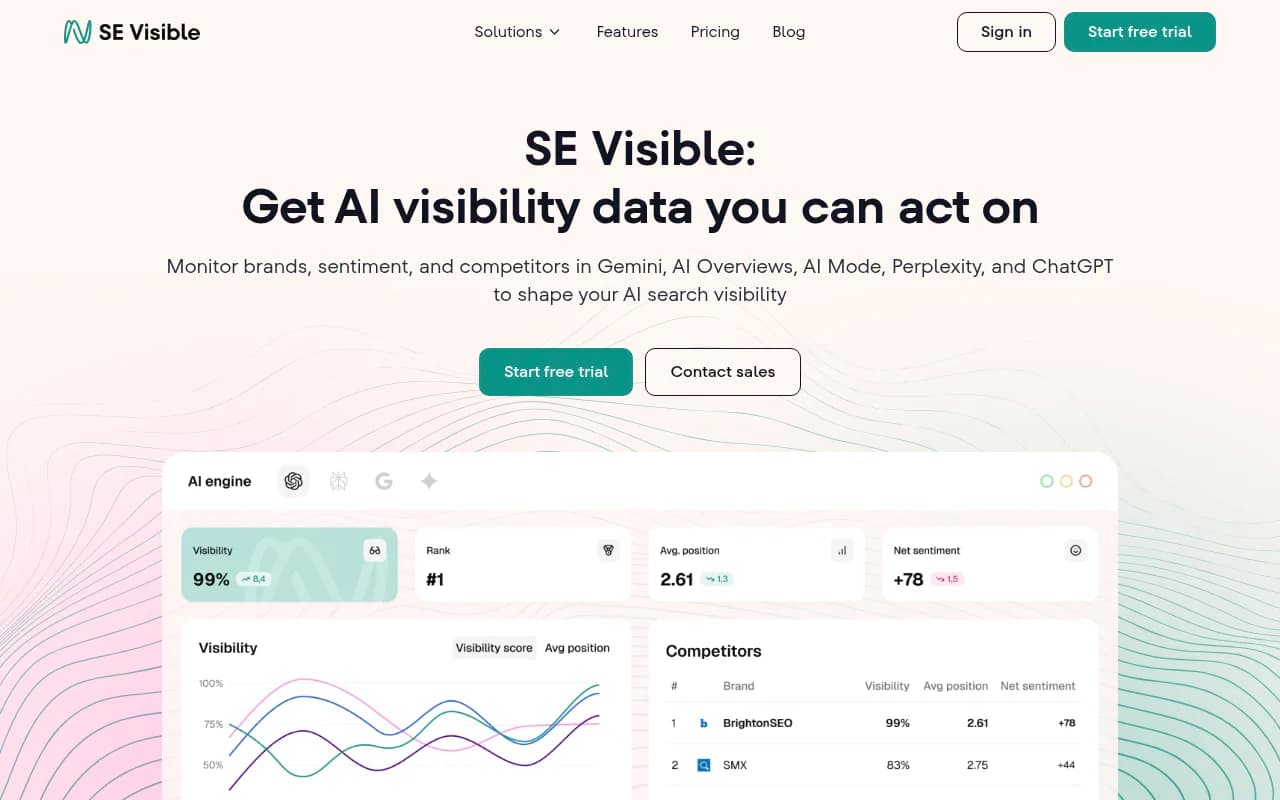
SE Visible is SE Ranking's dedicated AI visibility product, and it's one of the more polished monitoring tools in this space. It tracks brand mentions across Google AI Overviews, ChatGPT, Perplexity, and Gemini, with clean dashboards showing mention frequency, sentiment, and which competitors are appearing alongside you.
The integration with SE Ranking's broader SEO suite is the main appeal — if your team already lives in SE Ranking for keyword tracking and site audits, having AI visibility data in the same platform reduces context-switching. The AI visibility features are genuinely good, not just a checkbox addition.
Where it falls short: it's primarily a monitoring tool. There's no content gap analysis that shows you what to write, and no built-in content generation. You'll see the problem clearly; fixing it is on you.
3. Semrush — best for teams that want everything in one platform
Semrush added AI visibility tracking to its already-large toolkit, and for teams that use Semrush for everything else, it's a reasonable option. The AI Overview tracking shows when your brand or pages appear in Google's AI-generated answers, and the competitive data is solid.
The honest limitation: Semrush built its AI features on top of a traditional SEO platform, and it shows. The prompts used for tracking are fixed rather than customizable, there's no AI traffic attribution, and the depth of LLM coverage doesn't match purpose-built GEO platforms. It's good enough if you're already paying for Semrush and want a baseline view of AI visibility. It's not the right tool if AI search is a primary focus.
4. Ahrefs Brand Radar — best for backlink-heavy SEO teams
Ahrefs added Brand Radar specifically for AI search monitoring, and it does the core job: tracking when your brand appears in AI-generated answers across major models. The data quality is consistent with what you'd expect from Ahrefs — reliable, well-presented, and integrated with their existing keyword and backlink data.
Similar to Semrush, the AI features feel like an addition rather than a core product. Fixed prompts mean you can't customize tracking to your specific customer journey or industry vocabulary. There's no AI traffic attribution to connect visibility to actual revenue. For teams that are deep in the Ahrefs ecosystem and want a quick view of AI visibility without switching tools, it works. For teams where AI search is the primary concern, it's not deep enough.
5. AthenaHQ — best for structured competitive monitoring
AthenaHQ focuses specifically on AI search visibility across eight or more AI engines, with a clean interface that makes competitive benchmarking straightforward. You can see how your brand stacks up against specific competitors across different query types, which is useful for identifying where you're losing ground.
The platform is monitoring-focused, which means the data is good but the path from insight to action isn't built in. Teams that have strong content operations and just need reliable visibility data to inform their editorial calendar will find it useful. Teams that need the full loop — data, content creation, and results tracking — will need to supplement it.

6. Profound — best for mid-market brands with dedicated SEO teams
Profound has built a solid AI visibility product with good coverage across major LLMs including Google AI Overviews. The platform is particularly strong on share-of-voice metrics — understanding not just whether you appear but how often relative to competitors across a defined prompt set.
It's priced toward mid-market and enterprise, and the feature set reflects that positioning. The reporting is thorough, the competitive data is detailed, and the platform handles multi-brand and multi-region setups reasonably well. The gap, like most tools in this tier, is on the optimization side — Profound shows you where you stand but doesn't generate content to improve it.

7. Otterly.AI — best budget option for small teams
Otterly.AI is one of the more affordable options in this space, making it accessible for smaller brands and individual marketers who want to start tracking AI visibility without a significant budget commitment. It covers the major AI models and provides brand mention tracking with basic competitive comparison.
The trade-off for the lower price point is depth. Prompt volume data, crawler logs, content gap analysis, and traffic attribution are all absent. For a team just starting to understand their AI visibility and working with limited budget, Otterly.AI is a reasonable starting point. For a team that needs to drive measurable results from AI search, it's not enough on its own.

8. BrightEdge — best for enterprise SEO teams
BrightEdge has been an enterprise SEO platform for years, and its AI search tracking capabilities are built for large organizations with complex site structures and multiple stakeholders. The platform tracks AI Overview appearances alongside traditional ranking data, which gives enterprise teams a unified view of their search presence.
The enterprise positioning means the pricing and onboarding complexity are significant. It's not a tool you spin up in an afternoon. For large brands with dedicated SEO teams and existing BrightEdge contracts, the AI visibility features are a natural extension. For everyone else, the cost-to-value ratio is hard to justify when purpose-built GEO platforms exist at a fraction of the price.
9. Peec AI — best for multi-language tracking
Peec AI has carved out a useful niche with strong multi-language and multi-region support. If you're tracking AI visibility across markets where English isn't the primary language, Peec AI handles this more gracefully than most competitors. The core monitoring features cover major LLMs including Google AI Overviews, with brand mention tracking and basic competitive analysis.
The platform is monitoring-focused, and the depth of features outside language/region flexibility is more limited than the top-tier options. But for international brands or agencies managing clients across multiple markets, the multi-language capability is a genuine differentiator.

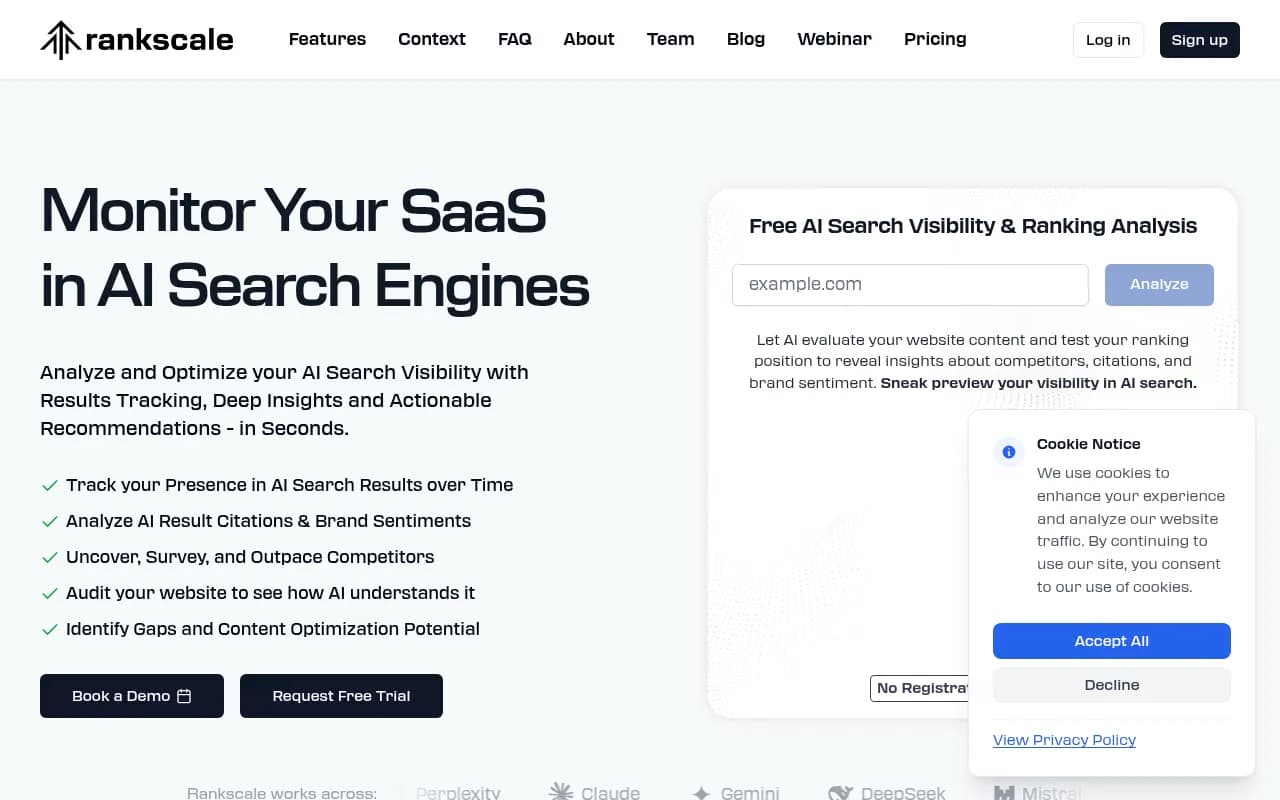
10. Rankscale — best for agencies tracking multiple clients
Rankscale is built with agency workflows in mind, making it easier to manage AI visibility tracking across multiple client accounts from a single interface. The platform covers the major AI models and provides the brand mention and competitive data agencies need for client reporting.
The multi-client management and white-label reporting options are the main reasons to choose Rankscale over alternatives. On pure feature depth, it doesn't match the top platforms, but for agencies that need to scale AI visibility reporting across dozens of clients without building custom tooling, it solves a real operational problem.
How these platforms compare
| Platform | Google AI Overviews | Multi-LLM coverage | Content gap analysis | Content generation | Crawler logs | Pricing from |
|---|---|---|---|---|---|---|
| Promptwatch | Yes | 10 models | Yes | Yes (built-in) | Yes | $99/mo |
| SE Visible | Yes | 4 models | No | No | No | ~$65/mo |
| Semrush | Yes | Limited | No | No | No | $140/mo |
| Ahrefs Brand Radar | Yes | Limited | No | No | No | $129/mo |
| AthenaHQ | Yes | 8+ models | No | No | No | Custom |
| Profound | Yes | Multiple | No | No | No | Custom |
| Otterly.AI | Yes | 4 models | No | No | No | ~$49/mo |
| BrightEdge | Yes | Multiple | Limited | No | No | Enterprise |
| Peec AI | Yes | Multiple | No | No | No | ~$79/mo |
| Rankscale | Yes | Multiple | No | No | No | Custom |
What to actually look for when choosing
Monitoring vs. optimization
This is the most important distinction in this category. Most platforms are monitoring tools. They run queries against AI models on a schedule, record whether your brand appeared, and show you a dashboard. That's useful for understanding where you stand, but it doesn't move the needle.
Optimization platforms go further. They analyze why competitors are appearing and you're not, identify the specific content gaps on your site, and help you create content that AI models will actually cite. If your goal is to improve your AI visibility (not just measure it), you need a platform that does both.
Prompt customization
Fixed prompts are a significant limitation. Your customers don't search using the same generic queries a tool vendor decided to track. The best platforms let you define the specific questions your target customers ask, then track your visibility for those exact prompts. This matters especially for Google AI Overviews, where the queries tend to be longer and more conversational.
Traffic attribution
Knowing you appeared in an AI Overview is one thing. Knowing that appearance drove 200 additional visitors to your pricing page is another. Traffic attribution — connecting AI visibility data to actual website traffic and conversions — is still relatively rare in this category, but it's what separates vanity metrics from business impact.
Crawler log access
AI crawlers behave differently from Googlebot. Understanding when ChatGPT's crawler visits your site, which pages it reads, and whether it encounters errors is genuinely useful for diagnosing why certain content isn't being cited. This feature is uncommon — most platforms don't offer it at all.
The practical starting point
If you're new to tracking AI visibility, start by defining 20-30 prompts that reflect how your actual customers search. These should be conversational, question-based queries in the language your customers use — not keyword-style terms.
Then run those prompts manually across Google AI Overviews, ChatGPT, and Perplexity. Note which competitors appear and which sources get cited. That manual exercise will tell you more in an hour than most dashboards will tell you in a week, and it'll help you evaluate which tracking platform actually covers the queries that matter to your business.
From there, the choice of platform depends on what you need to do with the data. If you need to report on visibility trends and competitive benchmarks, most monitoring tools will serve you. If you need to actually improve your visibility — and connect that improvement to revenue — you need a platform built around the full optimization loop.
Tools like Promptwatch are built specifically for that second use case: find the gaps, create content that fills them, and track whether it worked. That's a meaningfully different product from a dashboard that shows you a visibility score and leaves the rest to you.
The AI search landscape is moving fast. Google AI Overviews are expanding in scope and query coverage. ChatGPT's search features are getting more sophisticated. The brands that build systematic AI visibility practices now — with proper tracking, content strategy, and measurement — will have a real advantage over those that treat it as a future problem.