
Key takeaways
- Coding agent visibility is a different job from consumer AI search tracking. The question is whether an agent puts your product in the plan, installs it, and still uses it after implementation.
- Mentions and selections diverge sharply. In Armature's study, PayPal was mentioned 139 times and never selected, and LangChain was mentioned 194 times and selected 4 times.
- Promptwatch tracks Claude Code and Codex on every plan and pairs that with IP-verified crawler logs. Gauge and Lightsage cover OpenCode and add integration testing. Check each vendor's current coverage before you buy.
- Security and LLM observability tools (Akto, Langfuse, PostHog) show up in the same searches but measure something else: your own team's agent usage, not your product's discoverability.
- Cheapest first step: read your AI crawler logs for docs traffic from Claude and OpenAI bots, then fix robots.txt, JavaScript rendering and docs structure.
What coding agent visibility means
When a developer types "add transactional email to the signup flow" into Claude Code, a handful of things can happen. The agent might recommend a product. It might pick one and run npm install. It might decide to build the thing itself. Or it might choose you, then fumble the integration and quietly swap you out.
Every one of those outcomes is a visibility outcome. If an agent writes your package into a project, you become a dependency, and the first pick tends to stay. The tutorials, repos and forum threads that grow around that choice then feed the next round of agents.
That is why this category is different from tracking brand mentions in ChatGPT. A mention in a consumer answer is a nudge. A selection in a coding agent is an installed dependency.
The numbers that should worry you
Two third-party studies, both cited in Promptwatch's own coding-agent guide, show how lopsided the picture is. I have not verified them independently, so treat them as reported figures.
- Amplifying's "What Claude Code Actually Chooses" (Feb 2026) ran 2,430 open-ended prompts across 20 tool categories. In 12 of the 20 categories, the most common pick was a custom build, not a third-party product. GitHub Actions took 93.8% of CI/CD picks, Stripe 91.4% of payments, and Vercel 100% of JavaScript deployment.
- Armature's study (Sep 3, 2026) of Claude Code, Codex and Cursor found Claude Code built in-house in 19% of sessions, against 10% for Codex and Cursor. The three agents chose the same tool in only 42% of cases. Codex used web search in 94% of sessions.
Take the second finding seriously. Agreement across agents is under half, so you cannot measure "coding agent visibility" by checking one agent and calling it done.
Four questions to answer
Promptwatch frames coding-agent visibility around four questions, and they are a decent checklist for any tool you evaluate:
- Is your product in the plan?
- Is it the default pick?
- Does the agent build instead of buy?
- How does the agent describe you?
I would add a fifth that only some tools can answer: does the integration actually work once the agent writes the code? A product can win the recommendation and lose on implementation. Gauge's research makes this point directly, and it is right.
Three kinds of evidence
The tools below overlap, but they produce different kinds of proof. Gauge's own comparison puts it neatly: an observed page request establishes access, a recommendation establishes a stated preference, and a functional check establishes whether an integration works. Those are not interchangeable.
| Evidence type | What it tells you | How you collect it |
|---|---|---|
| Response monitoring | Whether agents mention, rank and describe you | Prompts run through each agent, scored for mentions, sentiment, competitors |
| Crawler and traffic logs | Whether agents can reach your docs and which pages they read | IP-verified logs from your CDN, host or plugin |
| Integration evaluations | Whether an agent can implement your product correctly | Recorded sessions, code diffs, pass/fail checks |
You want at least two of the three. Response monitoring alone tells you what agents say. Logs alone tell you what they fetched. Neither tells you whether the code compiled.
The tools compared
| Tool | Claude Code | Codex | OpenCode | Best for |
|---|---|---|---|---|
| Promptwatch | Yes, all plans | Yes, all plans | Not confirmed in its coding-agent guide, check before buying | Monitoring plus crawler logs, content fixes, AI traffic |
| Gauge | Yes | Yes | Yes (Pro plan, per Gauge) | Agent Preference and implementation testing for dev-tool companies |
| Lightsage | Yes | Yes | Not confirmed | Recommendation share plus recorded integration runs |
| Amplifying | Research-led | Research-led | Not confirmed | Competitive product-selection studies |
| Known Agents | Access-level | Access-level | Access-level | Seeing which agents hit your site and APIs |
| DarkVisitors | Access-level | Access-level | Access-level | Bot and agent traffic detection |
Coverage and pricing change often. Confirm each row on the vendor's own site. I did not find first-party pricing pages for Promptwatch, Gauge or Lightsage while researching this.
Promptwatch
Promptwatch is the option I would start with if your goal is to find and fix the gaps, not just score them. It tracks Claude Code and Codex alongside ChatGPT, Gemini and Perplexity, using the same visibility, mention, sentiment and competitor metrics. Most coding-agent prompts land in the Transactional intent bucket, the highest-intent stage, even when no brand is named. That matches how developers actually ask: "set up auth for this Next.js app," not "best auth vendor."
Where it pulls ahead of pure monitors is the other half of the loop. AI crawler logs are IP-verified against each operator's published ranges, so you can see whether ClaudeBot or OAI-SearchBot are actually reading your docs, which pages, and where they hit errors. Visitor analytics measure AI-referred traffic, and the Content Agent can write and publish the pages you are missing to WordPress, Webflow or Framer.
One caveat. On brand plans each project actively tracks four models at a time from the full list, while agency plans track all models at once. And its coding-agent guide does not list OpenCode as a tracked agent, though the product lists OpenCode among supported coding agents. Ask before you commit if OpenCode matters to you.

The 7-day free trial on monthly billing (Essential, Professional, Business) is enough to run a real prompt set. Current prices are at promptwatch.com/pricing. For a quick baseline, the free AI visibility report covers ChatGPT, Gemini and Perplexity, though not coding agents.
Gauge
Gauge is the most coding-agent-specific product here. It combines AEO, AI traffic analytics, Agent Preference (which products agents choose) and Agent Experience (whether agents successfully implement them). Per Gauge, its $499/month Pro plan includes Claude Code, Codex, OpenCode, Pi and Antigravity.
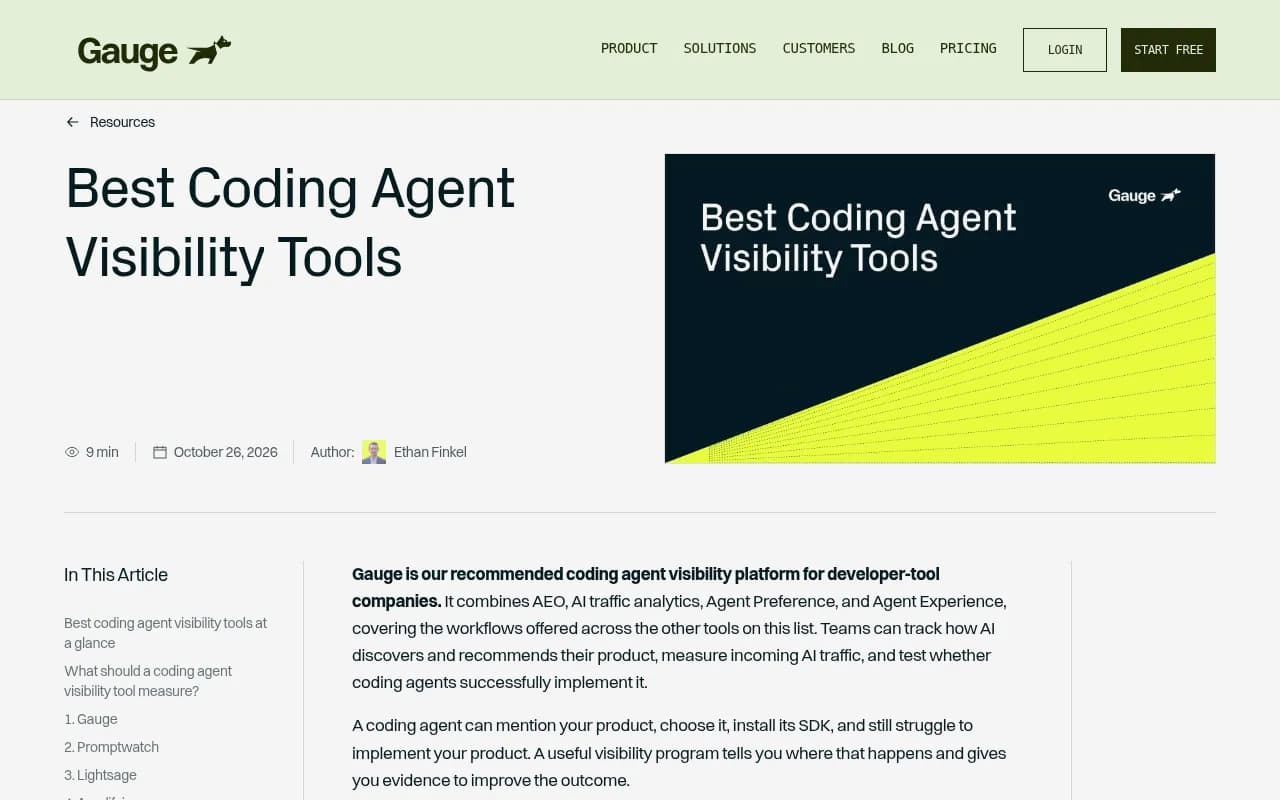
Two honest notes. Gauge publishes that comparison itself and ranks itself first, so weigh its framing accordingly. It also says Lightsage's pricing page shows Scale at $1,000/month for coding-agent access, which is a competitor's claim I could not check. The session traces and code-change evidence are the real draw for SDK and API companies.
Lightsage
Lightsage sits in the same camp as Gauge: recommendation share, recorded integration runs, and website requests in one place. I have little first-hand detail beyond Gauge's description, and no pricing I can vouch for. Put it on a shortlist if integration evaluations are your priority, and request a demo with your own product as the test case.
Amplifying and Known Agents
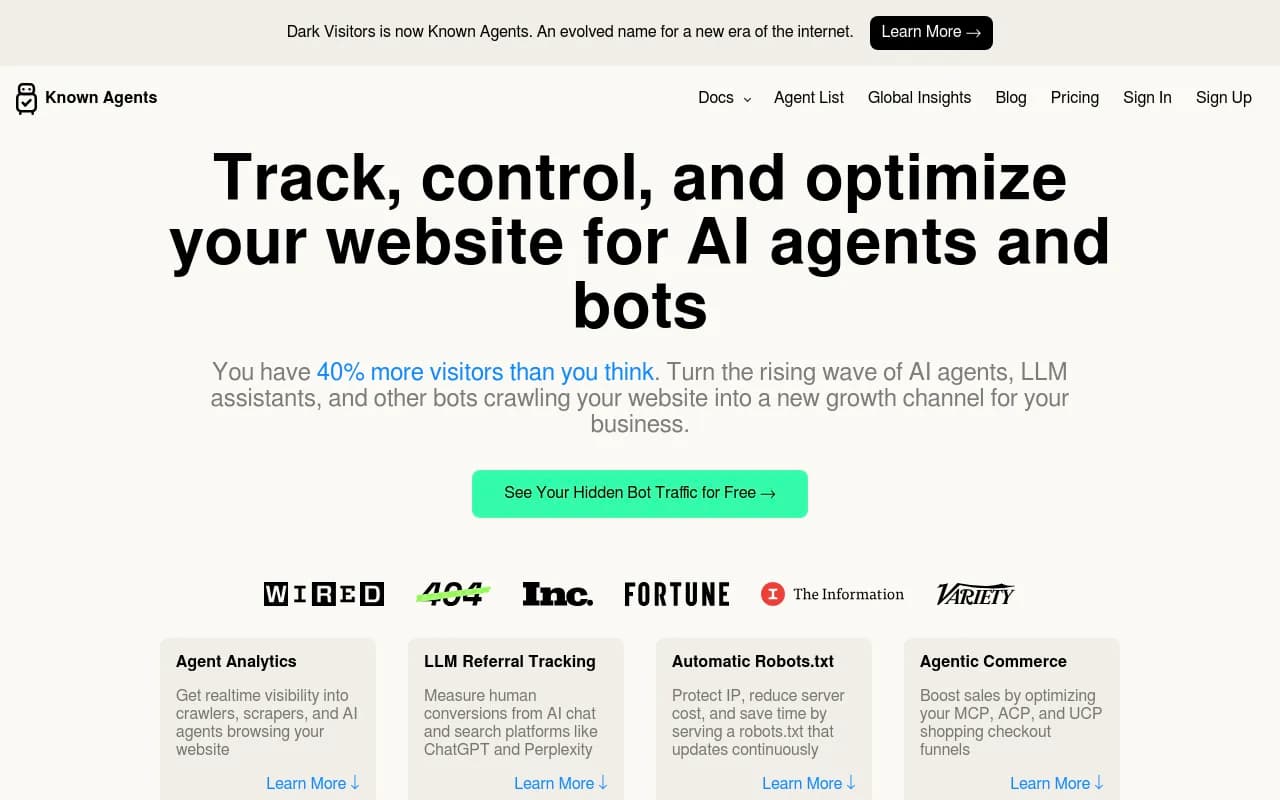
Amplifying is better thought of as research than a dashboard. Its Claude Code study is the clearest public look at how often agents build instead of buy. Known Agents, like DarkVisitors, focuses on seeing agents hit your site and APIs: incoming requests, agent identification and referral traffic. Useful, but it answers access, not preference.
What coding agents do differently from AI search
Promptwatch Data has one finding worth knowing before you build anything. In its Markdown in AI Search report (covering a 7-day window published Feb 19, 2026), HTML made up 99.94% of AI search citations and .md files 0.05%, roughly 2,000 to 1. So consumer AI search reads HTML.
Coding agents behave differently. Promptwatch saw a large increase in docs crawling from Claude's bot (which powers Claude Code) and OpenAI's bot (which powers Codex). The most-requested paths in the sample were /docs/.../*.md files, with the top path at 3,241 requests. Agents grab specific docs, READMEs and API references because markdown is cleaner and keeps the context window small.
The practical advice from that report is sensible:
- Do not build .md mirrors of marketing pages for AI search.
- Reserve .md endpoints for developer documentation.
- Fix client-side JavaScript rendering problems first.
OpenCode adds another wrinkle. It searches the web through Exa, an agent-native search engine, so being retrievable there matters for that agent specifically.
Read your own crawler logs first
Before paying for anything, look at what your server already knows. Promptwatch's AI Crawler Traffic data (IP-verified weekly requests, June 8 to Sept 6, 2026) showed OpenAI at 79.8% of verified AI crawler requests in Aug 31 to Sep 6, down from 94.8% in early June. Only requests from the operator's published IP ranges count, so spoofed user agents are excluded.
The useful trick: compare your own logs against that mix. If a provider is big in the report but near zero in your logs, you are probably blocked or unreachable for it. Check robots.txt, CDN and WAF rules for each provider. The robots.txt generator for AI and the AI crawler URL inspector are free ways to test access, and the AI bots directory lists user agents with guidance.
Do not confuse these with visibility tools
Search results for this topic are full of products that sound relevant and are not.
| Tool type | Examples | What it measures | Is it visibility? |
|---|---|---|---|
| Coding agent security | Akto Atlas, Zenity, Noma, Lasso | Risky prompts and tool calls from your developers' agents | No |
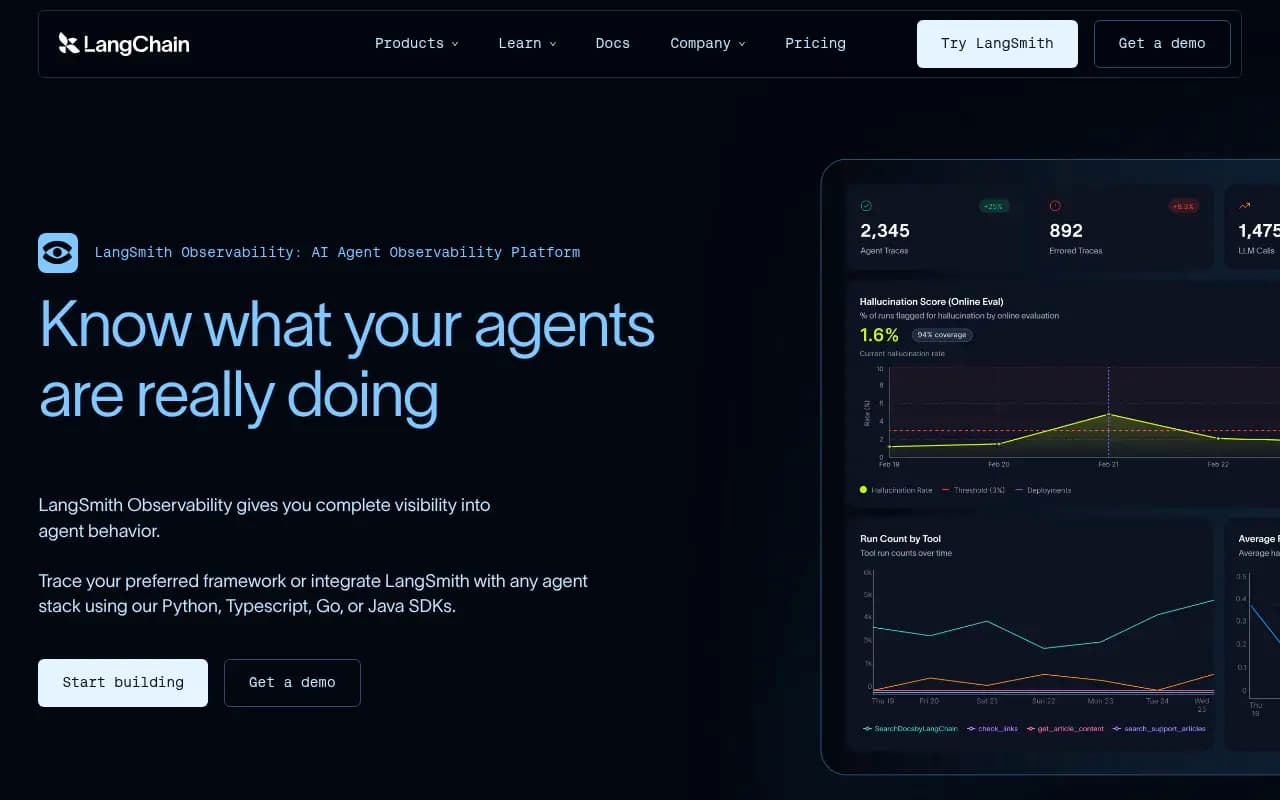
| LLM observability | Langfuse, PostHog, Helicone, LangSmith | Costs, errors and traces from your own agent usage | No |
| Coding agent visibility | Promptwatch, Gauge, Lightsage | How agents discover, pick and describe your product | Yes |
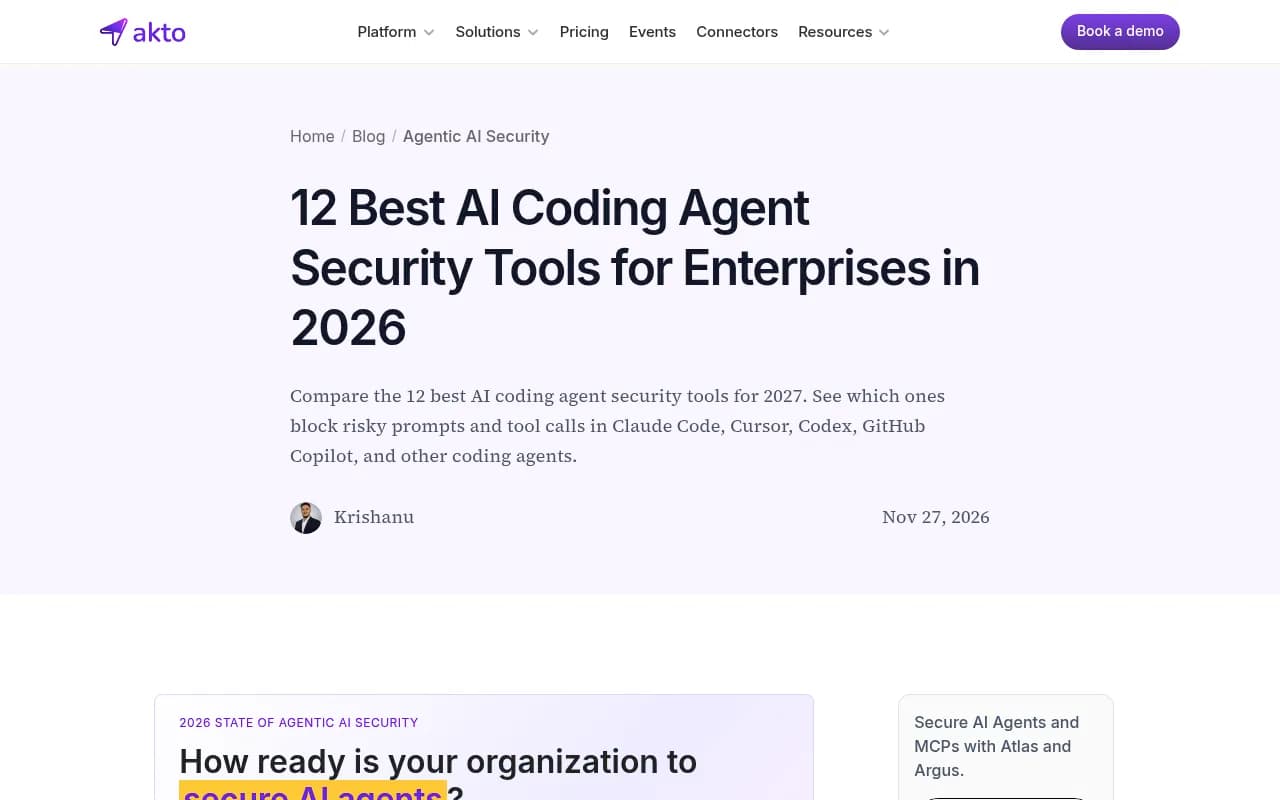
Akto's list of 12 coding agent security tools is a good read if you run Claude Code, Codex or OpenCode inside your company and worry about prompt injection. It does nothing for your product's discoverability.
Langfuse documents tracing for Claude Code and OpenCode, and PostHog's MCP server lets those agents query LLM costs from your editor. Both are about your own usage. Same story for Helicone and LangSmith.
A practical setup
Here is the workflow I would run for a developer-tool company.
- Build a prompt set of 30 to 50 real tasks. Write them the way developers do: "add rate limiting to this Express API," "set up background jobs." Include a few where you are a plausible fit and a few where you are not.
- Run them across Claude Code and Codex, and OpenCode if your tool covers it. Record whether you are in the plan, whether you are the default, and whether the agent builds its own.
- Split mentions from selections. If you are mentioned often and picked rarely, the problem is usually implementation friction or docs, not awareness.
- Check crawler logs. Confirm ClaudeBot and OAI-SearchBot reach your docs without errors, and look at which paths they request.
- Fix rendering and docs structure. Server-render your docs, add clean .md endpoints for documentation only, keep quickstarts short and copy-pasteable.
- Re-run monthly. First picks stick, so early movement matters more than late catch-up.
If you also want to know whether the same investment helps in consumer assistants, tools like Promptwatch track both sides in one place. The Agentic Readiness Check shows which agent standards your site supports, such as llms.txt and MCP server cards.
Choosing between them
- Mostly worried about whether agents can read your docs: start with crawler logs, then Promptwatch or DarkVisitors.
- A dev-tool company where implementation failure is the risk: Gauge or Lightsage, because they record integration runs.
- Need monitoring plus the means to fix content gaps and measure AI traffic: Promptwatch.
- Want market research on what agents pick in your category: Amplifying's published studies are free to read.
- Browsing the wider category: the GEO software directory at bestgeosoftware.com lists broader AI visibility platforms.
One last opinion. The category is young, the vendor claims are mostly self-published, and no one has a neutral benchmark. Run a two-week trial with your own prompts on two tools, compare what they find against your logs, and keep the one whose numbers you can reproduce.
FAQ
Does Promptwatch track OpenCode?
Promptwatch's coding-agent guide names Claude Code and Codex as tracked on every plan and does not list OpenCode. Confirm current support with the vendor before relying on it.
Is coding agent visibility the same as GEO?
It is a branch of it. The goal is similar (get recommended), but the evidence differs: agents install packages, read docs and write code, so selection and implementation matter more than a mention.
Do I need markdown versions of my pages?
Only for developer documentation. Promptwatch Data found .md files are 0.05% of AI search citations, but docs-focused paths dominate coding agent crawling.
Are security tools like Akto useful here?
Only if you want to govern your own developers' agent use. They do not tell you whether agents recommend your product.