Key takeaways
- Qwairy covers the basics of GEO strategy but lacks the multi-client workspace architecture and white-label reporting that agencies actually need at scale.
- The best alternatives in 2026 combine monitoring across 8-10 AI models with content optimization and client-ready reporting in one platform.
- Promptwatch is the only platform in this category rated as a "Leader" across all evaluation criteria -- and the only one that closes the loop from gap analysis to content creation to citation tracking.
- For agencies already deep in Semrush, the AI Toolkit is a convenient add-on. For agencies that want a dedicated GEO workflow, purpose-built tools like Profound and Peec AI are worth evaluating.
- Price range across the category runs from $29/month for basic monitoring to $579/month for full multi-site optimization suites.
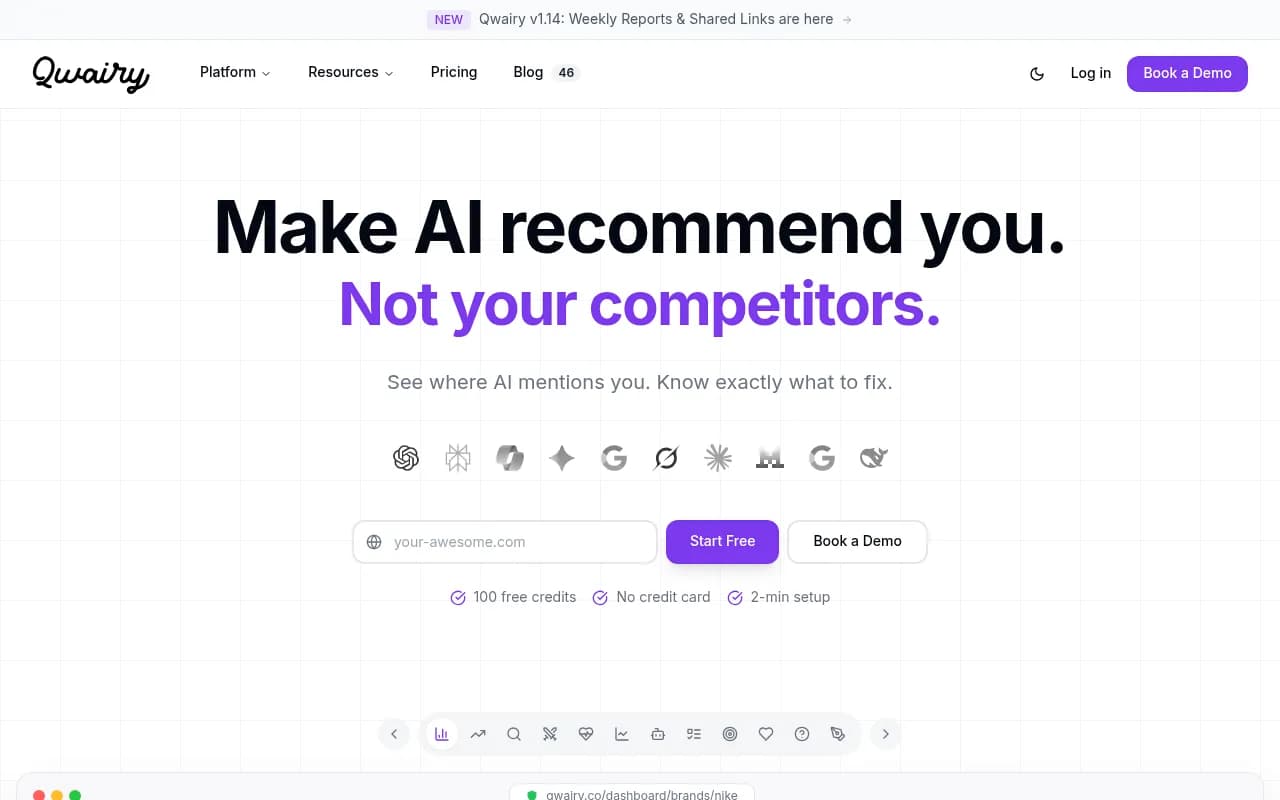
Qwairy has positioned itself as an all-in-one GEO strategy platform, and for a solo brand manager or small in-house team, it does a reasonable job. But agencies have a different problem. You're not managing one brand's AI visibility -- you're managing 15, 30, maybe 80. And the tools that work fine for one brand start to crack when you need separate client workspaces, white-label reports, per-client prompt libraries, and a way to show clients that your work is actually moving the needle.
This guide covers the best Qwairy alternatives for agencies in 2026, with a focus on what actually matters at scale: multi-client architecture, AI model coverage, content optimization capabilities, and reporting that doesn't require a manual export every time a client asks for an update.
What agencies actually need from an AI visibility tool
Before getting into specific tools, it's worth being clear about what "scales for agencies" actually means. These are the criteria that separate agency-grade tools from solo-brand tools.
Multi-client workspace management. Can you run all your clients from one login? Are workspaces cleanly separated so client A's data never bleeds into client B's reports? This sounds basic but a surprising number of tools in this category require separate accounts per client.
AI model coverage. The major surfaces to track are ChatGPT, Perplexity, Google AI Overviews, Google AI Mode, Claude, Gemini, Microsoft Copilot, Grok, DeepSeek, and Meta AI. Tools that only cover 3-4 models leave real blind spots -- especially as Perplexity and Google AI Mode are now driving meaningful referral traffic for many B2B and e-commerce clients.
Content optimization, not just monitoring. Knowing your client is invisible in ChatGPT is useful. Knowing exactly which prompts they're missing, why competitors are being cited instead, and having a brief ready to fix it -- that's what justifies your retainer. Most tools stop at the monitoring step.
Client reporting and white-label. Scheduled PDF exports, live dashboards, branded reports. Clients don't want to log into your tool; they want a clean summary of what's happening and what you're doing about it.
Competitive benchmarking. Share of voice comparisons, competitor citation analysis, and visibility heatmaps across models. This is the data that makes strategy conversations with clients actually productive.
The best Qwairy alternatives for agencies in 2026
Promptwatch -- best overall for agencies that want to act, not just monitor
Promptwatch is the most complete platform in this category. Where most tools show you a dashboard and leave you to figure out what to do next, Promptwatch is built around a specific workflow: find the gaps, create content to fill them, track the results.
For agencies, the Answer Gap Analysis is particularly useful. It shows exactly which prompts your clients' competitors are visible for that your clients aren't -- the specific topics and questions AI models want to answer but can't find on your client's site. That's not just a monitoring insight; it's a content brief waiting to happen.
The Content Agents then generate articles, listicles, and comparisons grounded in real prompt data, citation patterns, and competitor analysis. This isn't generic AI writing -- it's content built specifically to close the gaps the analysis identified. And the page-level tracking shows when AI crawlers pick up the new content and when it starts generating citations.
On the agency operations side: multi-site support, AI crawler logs that show which pages each model is reading and how often, ChatGPT Shopping tracking, Reddit and YouTube citation analysis, and coverage across 10 AI models. The Business plan at $579/month covers 5 sites with 350 prompts and 30 articles per month. Agency and enterprise pricing is available for larger portfolios.

Profound -- best for enterprise-grade prompt research
Profound has built a strong reputation for depth of prompt intelligence. The Agency mode includes brand configurations and pitch environments that make it practical to manage multiple clients, and the competitive benchmarking is solid.
Where Profound shines is in the research layer -- understanding how different prompts branch into sub-queries, which sources AI models are pulling from, and how brand positioning affects citation rates. It's a good fit for agencies working with larger enterprise clients who want rigorous data to back up strategy recommendations.
The starting price is $99/month, with enterprise tiers for broader model coverage. The main limitation compared to Promptwatch is that Profound is primarily a research and monitoring tool -- content generation and optimization are not core to the workflow.

Peec AI -- best for flexible model selection and multi-language work
Peec AI is worth a look if your agency works across multiple markets and languages. The platform lets you configure which AI models to track per client, which is useful when different clients have different geographic priorities -- a German B2B client cares about different AI surfaces than a US e-commerce brand.
Starting at €85/month, it's competitively priced for the feature set. The content optimization recommendations are present but not as deep as Promptwatch's Content Agents. For agencies that need solid monitoring with good language and region flexibility, it's a practical choice.

Otterly.AI -- best for agencies on a tight budget
Otterly.AI is the most affordable option in this category at $29/month for the entry tier. It covers 4 AI models at the base level and does the core monitoring job well enough for smaller agency clients or for agencies that are just starting to add AI visibility to their service offering.
The honest limitation: it's a monitoring tool. There's no content generation, no crawler logs, no answer gap analysis. If you're managing 5-10 smaller clients and need to show them basic AI visibility data without a large platform investment, Otterly.AI is a reasonable starting point. If you're trying to build a differentiated GEO service offering, you'll outgrow it quickly.

SE Visible -- best for multi-brand, multi-country monitoring
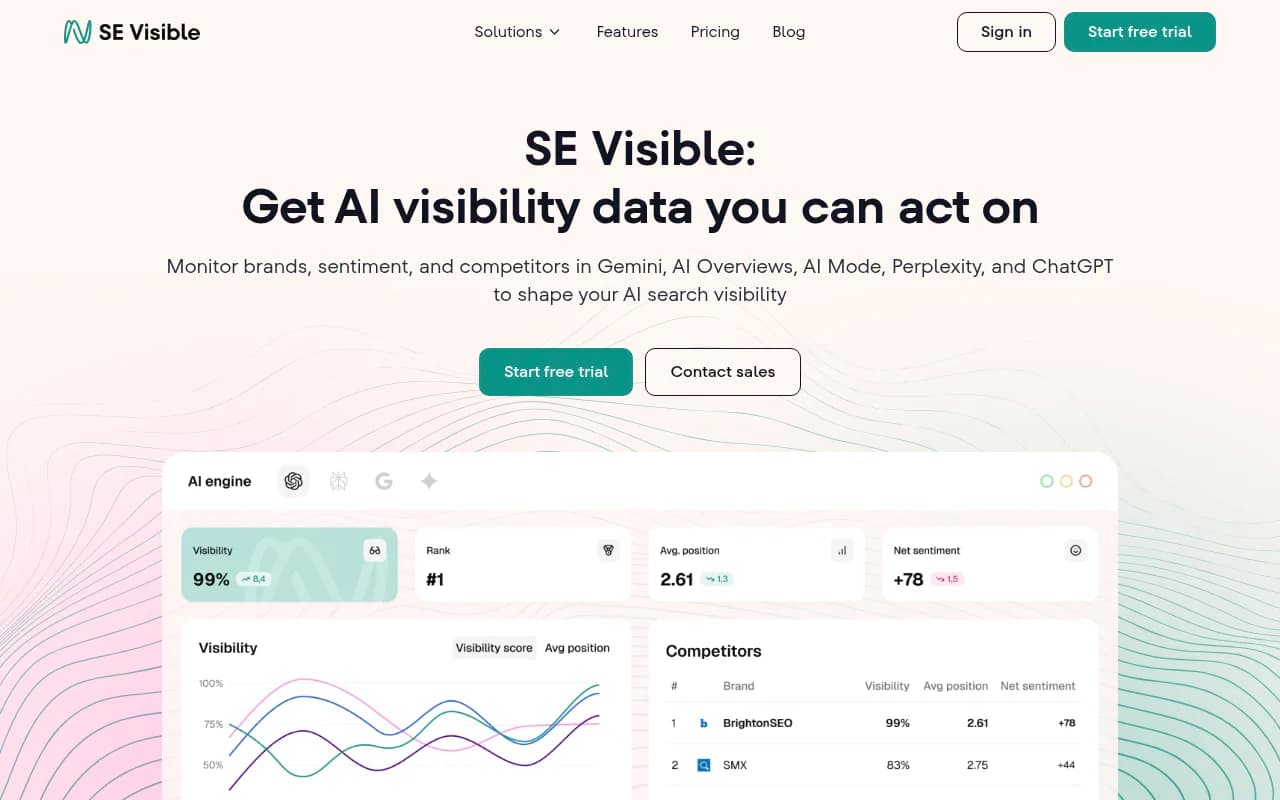
SE Visible (from SE Ranking) covers 5 AI models and is specifically designed for multi-brand and multi-country setups. At $99/month, it sits in a reasonable price range for agencies, and the integration with SE Ranking's broader SEO platform means you can connect AI visibility data to traditional SEO metrics in one place.
For agencies that are already SE Ranking users, this is the most natural upgrade path. For agencies evaluating from scratch, it's a solid monitoring option but doesn't offer the content optimization depth that justifies a GEO-specific retainer.
Semrush AI Toolkit -- best for agencies already embedded in Semrush
If your agency runs on Semrush, the AI Toolkit is the path of least resistance. It adds AI visibility tracking directly within the platform your team already uses, which reduces onboarding friction and keeps data in one place.
The limitation is that Semrush uses fixed prompts rather than letting you build custom prompt libraries for each client. That's a real constraint for agencies doing serious GEO work -- the prompts that matter for a cybersecurity client are completely different from the ones that matter for a travel brand. Ahrefs Brand Radar has the same issue, plus no AI traffic attribution.
For agencies that want AI visibility as a bolt-on to existing SEO reporting, the Semrush AI Toolkit is convenient. For agencies building a dedicated GEO practice, it's not deep enough.
Rankability -- built with agencies specifically in mind
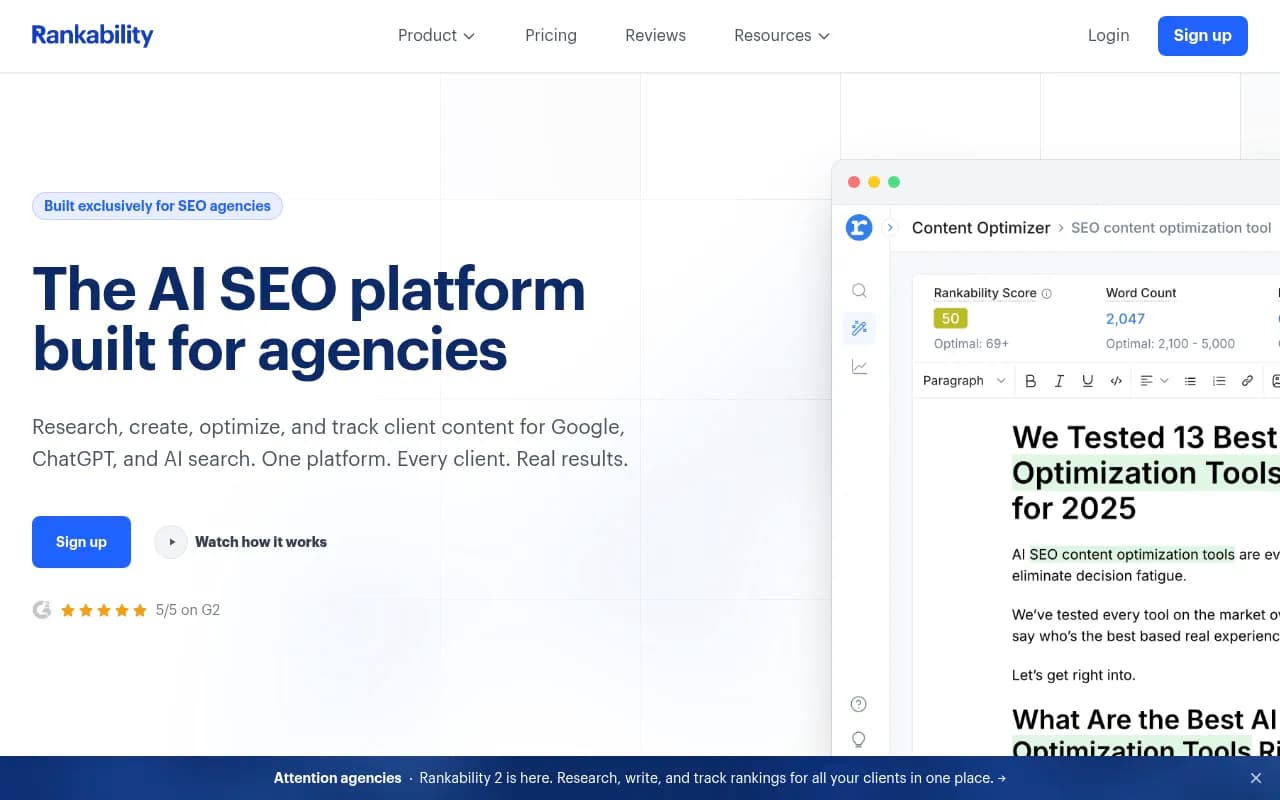
Rankability is one of the few platforms in this category that explicitly targets agencies rather than in-house teams. The analytics are designed around the kind of reporting agencies need to deliver to clients, and the multi-client management is cleaner than most.
Nightwatch -- best for combining traditional SEO and AI monitoring
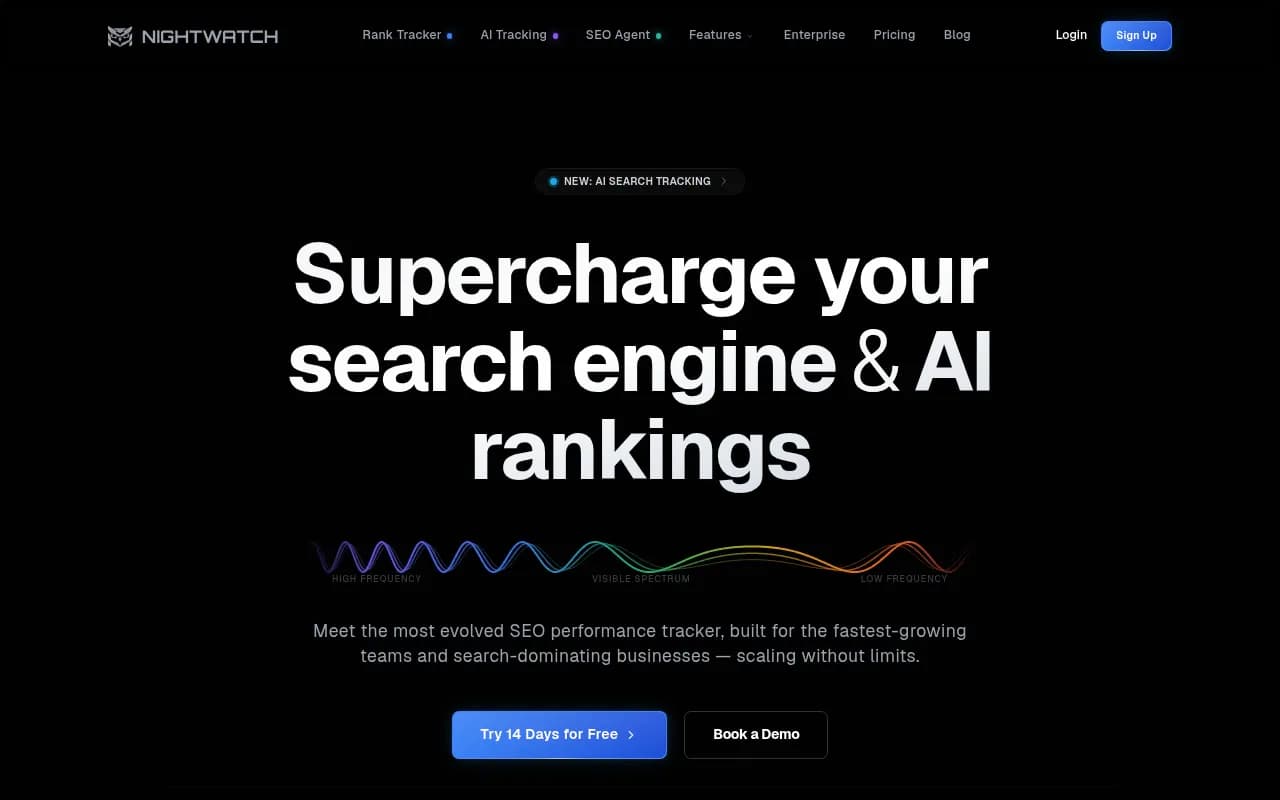
Nightwatch started as a rank tracker and added AI search monitoring as an add-on ($99/month on top of the base plan starting at $32/month). If your agency is still doing significant traditional SEO work alongside AI visibility, keeping both in one tool has operational advantages.
The AI model coverage is 4 models, which is on the lower end. But for agencies that want a single platform for rank tracking, site auditing, and AI monitoring without switching tools, Nightwatch is worth considering.
Side-by-side comparison
| Tool | AI models | Multi-client | Content generation | Starting price | Best for |
|---|---|---|---|---|---|
| Promptwatch | 10 | Yes | Yes (Content Agents) | $99/mo | Full GEO workflow, agencies |
| Profound | Up to 10 | Yes (Agency mode) | No | $99/mo | Enterprise prompt research |
| Peec AI | Up to 10 | Yes | Limited | €85/mo | Multi-language, flexible models |
| Otterly.AI | 4 (base) | Limited | No | $29/mo | Budget-conscious agencies |
| SE Visible | 5 | Yes | No | $99/mo | Multi-brand, multi-country |
| Semrush AI Toolkit | 5 | Yes | No | Bundled | Existing Semrush users |
| Rankability | Varies | Yes | Limited | Custom | Agency-focused reporting |
| Nightwatch | 4 | Yes | No | $32/mo + $99 add-on | SEO + AI combined |
What makes Qwairy fall short for agencies
Qwairy's core problem isn't the feature set -- it's the architecture. The platform was designed around a single brand's GEO strategy, and that shows when you try to scale it across a client portfolio.
The workspace management requires workarounds for multi-client setups. The reporting is functional but not white-label ready. And critically, there's no content generation layer -- so when you identify that a client is invisible for a high-value prompt, you're on your own to figure out what to do about it.
For a solo consultant managing one or two brands, those limitations are manageable. For an agency billing clients on a GEO retainer and needing to show measurable progress every month, they're real operational friction.
How to choose the right alternative
The right tool depends on where your agency is in building out its GEO practice.
If you're just starting to add AI visibility to your service offering and want to test the waters without a large investment, Otterly.AI or Nightwatch let you get started cheaply and see whether clients respond to the reporting.
If you're running a mid-size agency with 10-30 clients and want to build a proper GEO service line, Profound or Peec AI give you the monitoring depth to have serious strategy conversations with clients. You'll need to supplement with your own content production workflow.
If you want a complete GEO workflow -- gap analysis, content generation, citation tracking, crawler logs, and client reporting all in one place -- Promptwatch is the only platform that covers the full loop. The difference between showing a client a visibility score and showing them a visibility score that went up because of content you created and tracked is the difference between a monitoring report and a retained service.
Tools like Profound and Peec AI are good at step one. Promptwatch handles all three steps, which is what makes it the practical choice for agencies that want GEO to be a real revenue line rather than a dashboard add-on.
Final thought
The AI visibility tool category has matured quickly. In 2024, most platforms were glorified dashboards. In 2026, the gap between monitoring-only tools and full optimization platforms is significant -- and that gap is exactly where agency value lives.
Clients don't pay retainers for reports. They pay for results. The tools that help you get from "here's where you're invisible" to "here's the content we published and here's the citation data showing it's working" are the ones worth building a service offering around.